-
-
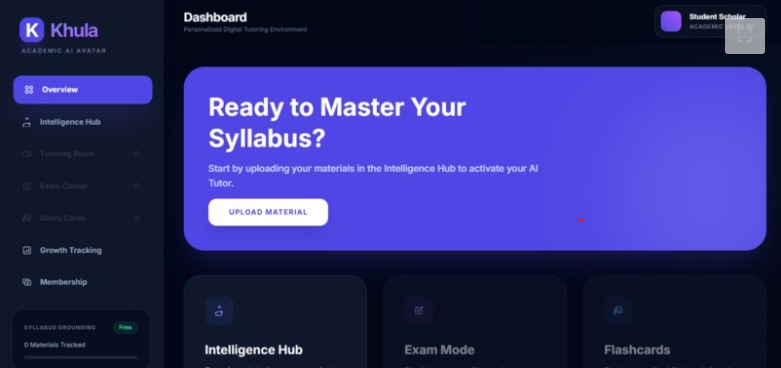
Khula
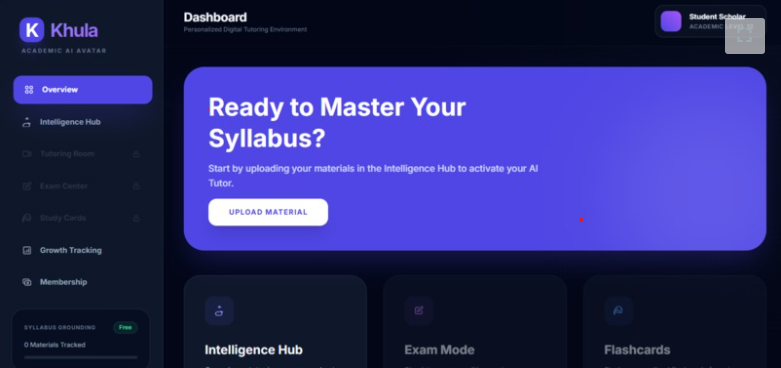
About Khula Tutor 🌍 Inspiration
Khula Tutor was born from a simple but urgent reality: millions of students do not have access to consistent, high-quality tutoring support. In many communities, especially across developing regions, students rely heavily on overcrowded classrooms, limited teacher availability, and outdated learning materials. I wanted to build something that could act as a 24/7 academic companion — not just another chatbot, but a tool that truly understands a student’s study material and adapts to their learning journey. The name Khula means “open” — representing open access to education, open opportunity, and open knowledge for students everywhere.
🧠 The Problem
Students often: Struggle to understand dense PDFs or textbooks. Study passively without feedback. Don’t know where their knowledge gaps are. Lack personalized revision tools. Cannot afford private tutoring. Traditional study methods are linear and static. But learning should be dynamic and adaptive.
🚀 The Solution Khula Tutor transforms any uploaded document into: Interactive AI Tutoring Sessions Students upload a PDF and engage in a conversational tutoring experience based entirely on their own study material. AI-Generated Exams & Knowledge Checks After tutoring, the system generates assessment questions derived from: The uploaded document The tutoring conversation Identified weak areas Automated Scoring & Feedback Students receive performance feedback to understand their level of mastery. Smart Flashcards for Reinforcement Flashcards are automatically generated to strengthen memory retention and close knowledge gaps. (In Progress) Progress Tracking & Analytics We aim to track subject mastery over time and share performance insights with schools or academic providers.
🏗️ How It Was Built Khula Tutor was developed using: AI language models for tutoring and content generation PDF parsing to extract structured learning content Session-based conversation storage Dynamic question generation logic Scoring and reinforcement mechanisms The system follows a learning loop: Upload → Tutor → Assess → Score → Reinforce
This mirrors effective educational psychology principles:
Learning Gain ∝ Practice + Feedback + Repetition
By combining tutoring + assessment + spaced reinforcement, Khula Tutor creates an adaptive study cycle rather than a static reading experience.
📚 What I Learned
Building Khula Tutor taught me: AI is most powerful when it augments human learning, not replaces it Context-aware tutoring dramatically improves comprehension Generating meaningful assessments is harder than generating explanations Personalization is the key to engagement I also learned that building educational technology requires more than coding — it requires empathy for students’ struggles and deep consideration of accessibility and affordability.
⚡ Challenges Faced
Context Management Handling long PDF documents and maintaining relevant conversation memory required careful token management and structured extraction. Meaningful Assessment Generation Ensuring exam questions are: Relevant Clear Aligned with the material Appropriate difficulty This required iterative prompt engineering and testing.
Scoring Logic Designing fair automated scoring that reflects understanding — not just keyword matching — was complex.
Scalability & Pricing
A major challenge is balancing:
Accessibility + Compute Cost + Scalability
Our goal is to develop pricing models that make Khula Tutor accessible to students globally, especially in underserved communities.
🌟 Vision
Khula Tutor is more than a tool — it is a step toward democratizing personalized education. The long-term vision is to: Track subject mastery over time Identify recurring learning gaps Provide performance dashboards for schools Support multiple languages Scale globally while remaining affordable Education should not depend on geography or income level.
With AI, we can open learning to everyone.

Log in or sign up for Devpost to join the conversation.