Project Overview
KHABAR is a decentralized, AI-driven emergency response orchestration platform designed for Pakistan. It connects citizens, emergency coordinators, public alerts, maps, resource management, and AI decision-making into one complete civic response workflow.
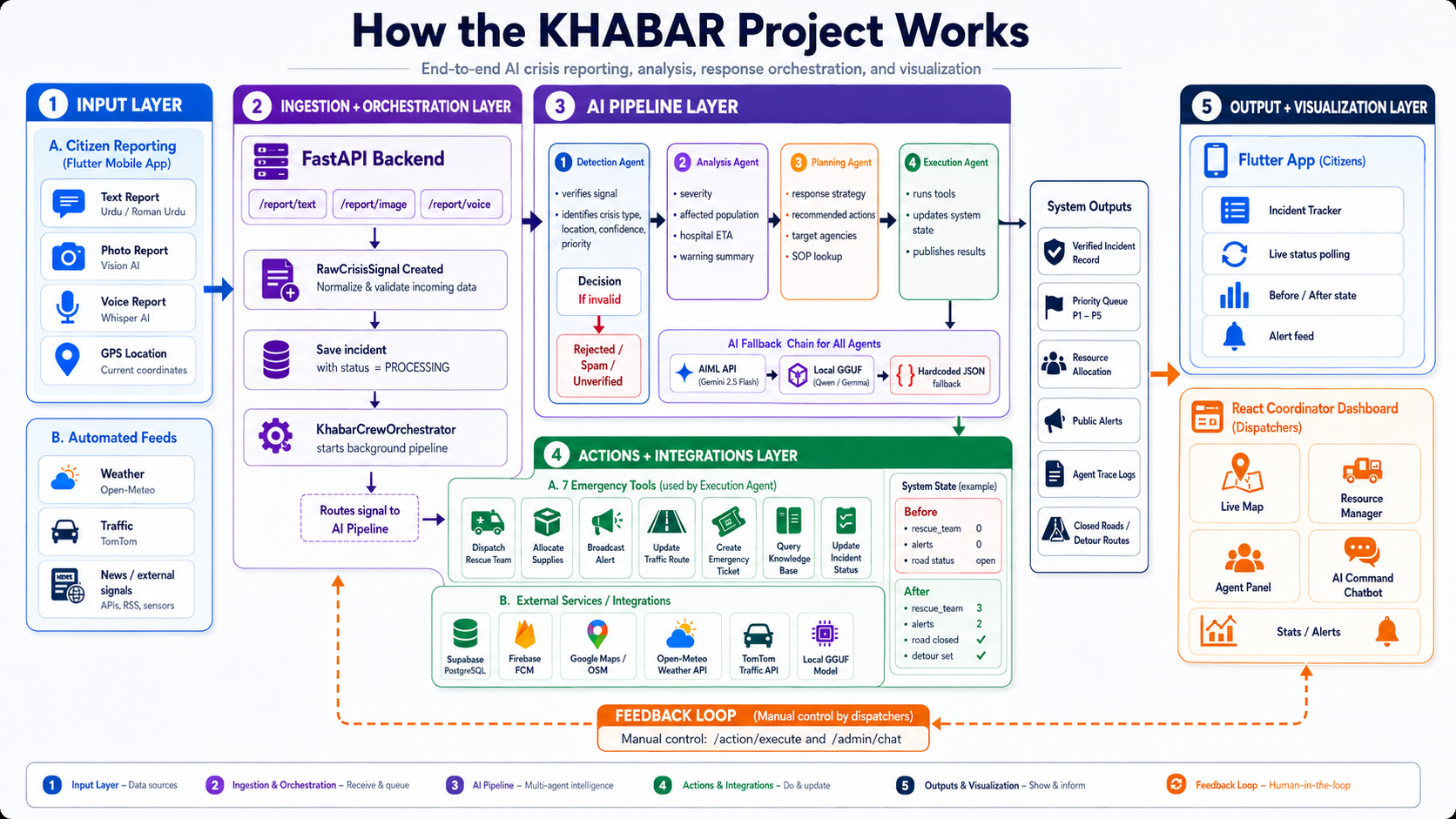
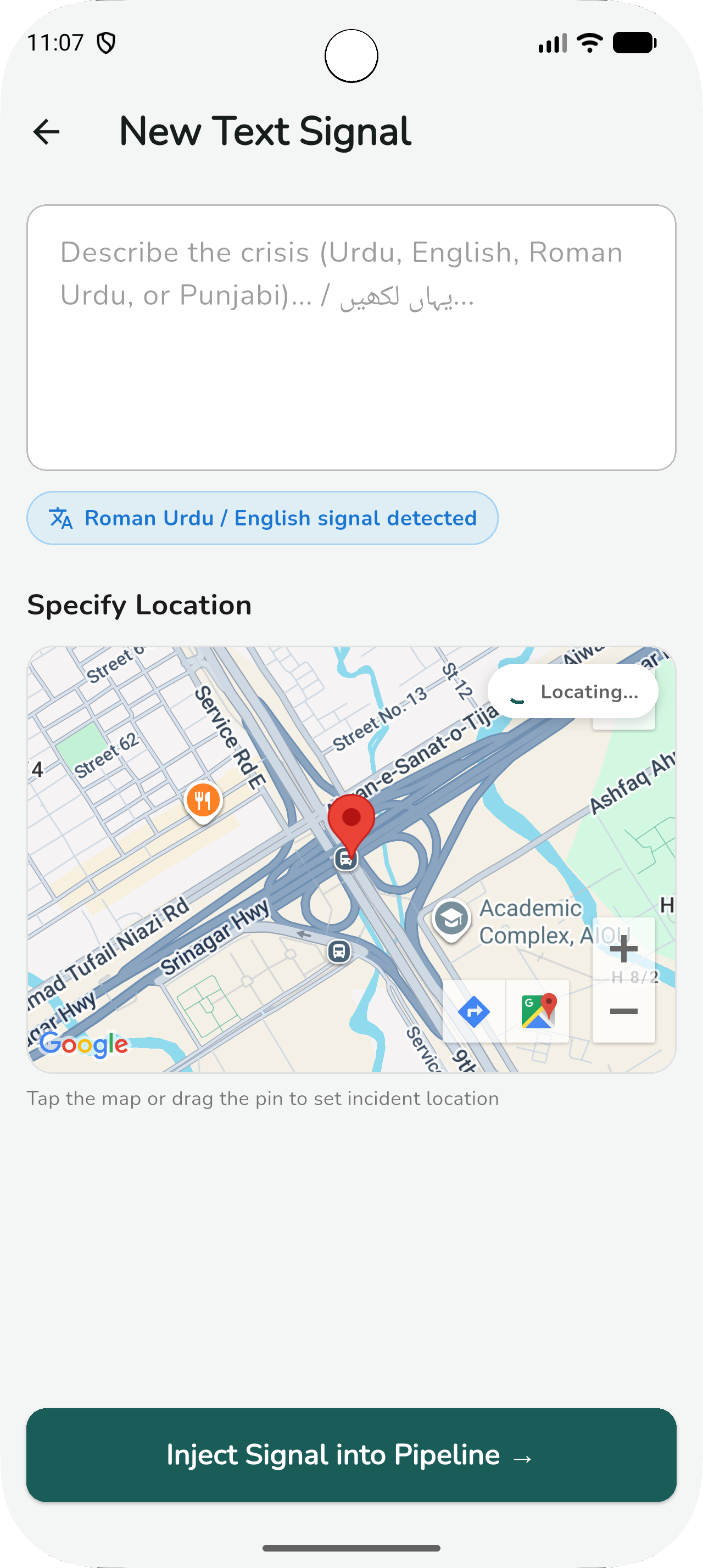
Citizens can report emergencies through a Flutter mobile app using text, photo, voice, and GPS. The backend receives the report, creates a structured crisis signal, and sends it through a 4-stage AI agent pipeline. The AI verifies the incident, analyzes its severity, plans the response, executes emergency tools, updates resources, sends alerts, and displays the outcome on a React-based admin dashboard.
The goal of KHABAR is not only to collect emergency reports, but to transform raw citizen signals into verified, prioritized, and actionable emergency response decisions.
Problem
In Pakistan, emergency response is often delayed because crisis information is scattered across multiple sources such as phone calls, social media posts, local reports, news updates, and informal communication channels.
During floods, fires, road accidents, traffic blockages, heatwaves, medical emergencies, or infrastructure failures, citizens may report the problem quickly, but authorities often struggle to:
- Verify whether the report is real.
- Identify the exact crisis type and location.
- Decide which incident is most urgent.
- Estimate the severity and possible impact.
- Allocate rescue teams, ambulances, fire trucks, or supplies.
- Inform citizens through timely public alerts.
- Coordinate multiple agencies from a single dashboard.
- Track what actions were taken and what changed after execution.
Because of this, emergency response can become slow, fragmented, and difficult to monitor.
KHABAR solves this problem by using AI to connect citizen reporting, incident verification, emergency planning, resource dispatch, alert generation, and coordinator visualization in one system.
Why This Problem Matters
Emergency response is a direct civic and public service issue. In cities like Islamabad and Rawalpindi, incidents such as urban flooding, road accidents, fires, heatwaves, and road blockages can quickly affect thousands of people.
A small delay can lead to:
- More people being trapped or affected.
- Delayed ambulances and rescue teams.
- Poor coordination between departments.
- Public panic due to lack of verified information.
- Duplicate or fake reports wasting resources.
- No clear audit trail of what decision was taken and why.
KHABAR matters because it gives citizens an easy way to report emergencies and gives coordinators an intelligent dashboard to verify, prioritize, and respond faster.
Solution
KHABAR provides an AI-powered emergency response workflow with two main user sides:
- Citizen side — Flutter mobile app for reporting and receiving alerts.
- Coordinator side — React admin dashboard for monitoring, decision-making, and action execution.
The system works like this:
Citizen Report / Automated Signal
        ↓
FastAPI Backend
        ↓
RawCrisisSignal Created
        ↓
4-Agent AI Pipeline
        ↓
Detection → Analysis → Planning → Execution
        ↓
Database + Alerts + Resources + Dashboard
        ↓
Citizens and Coordinators receive live updates
KHABAR turns unstructured emergency reports into structured civic intelligence.
How KHABAR Works
1. Citizen Reporting
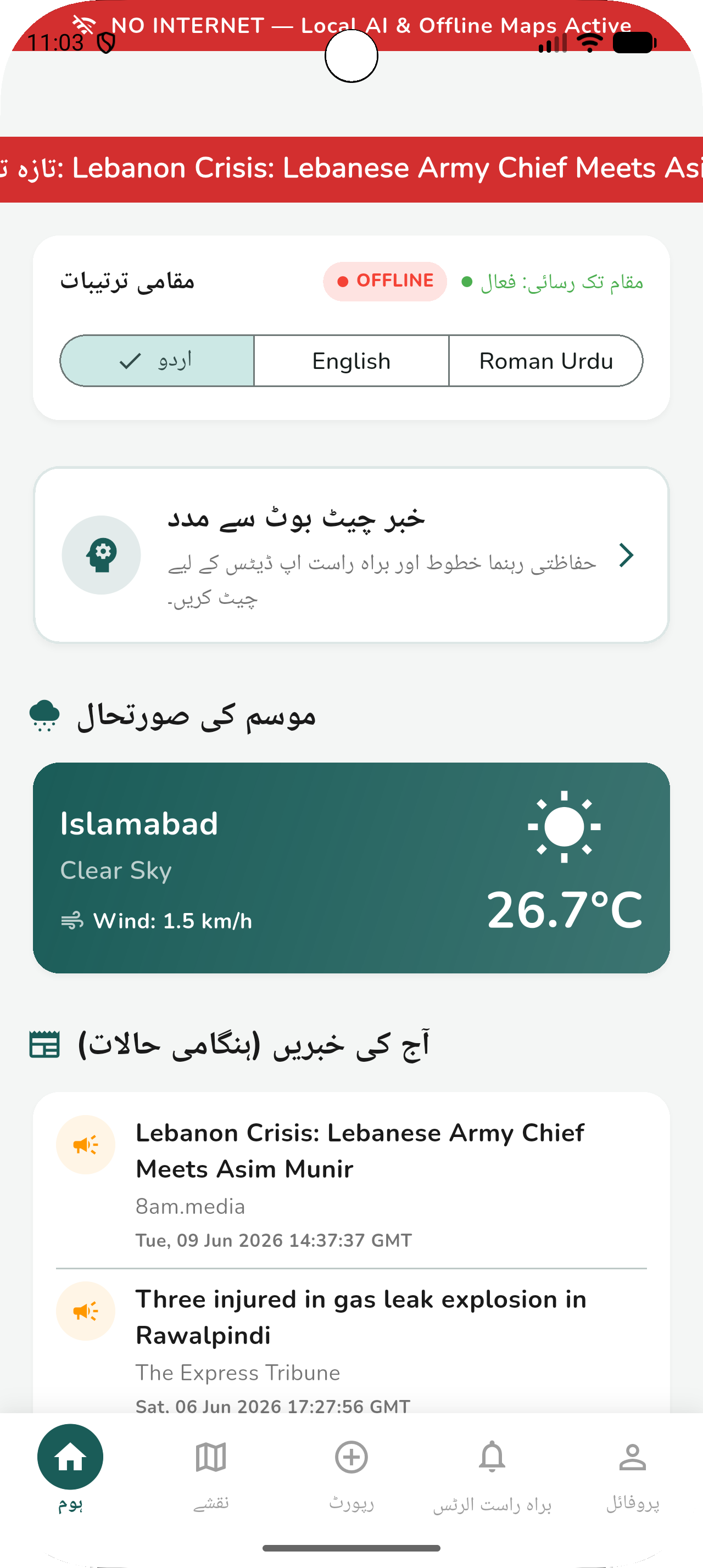
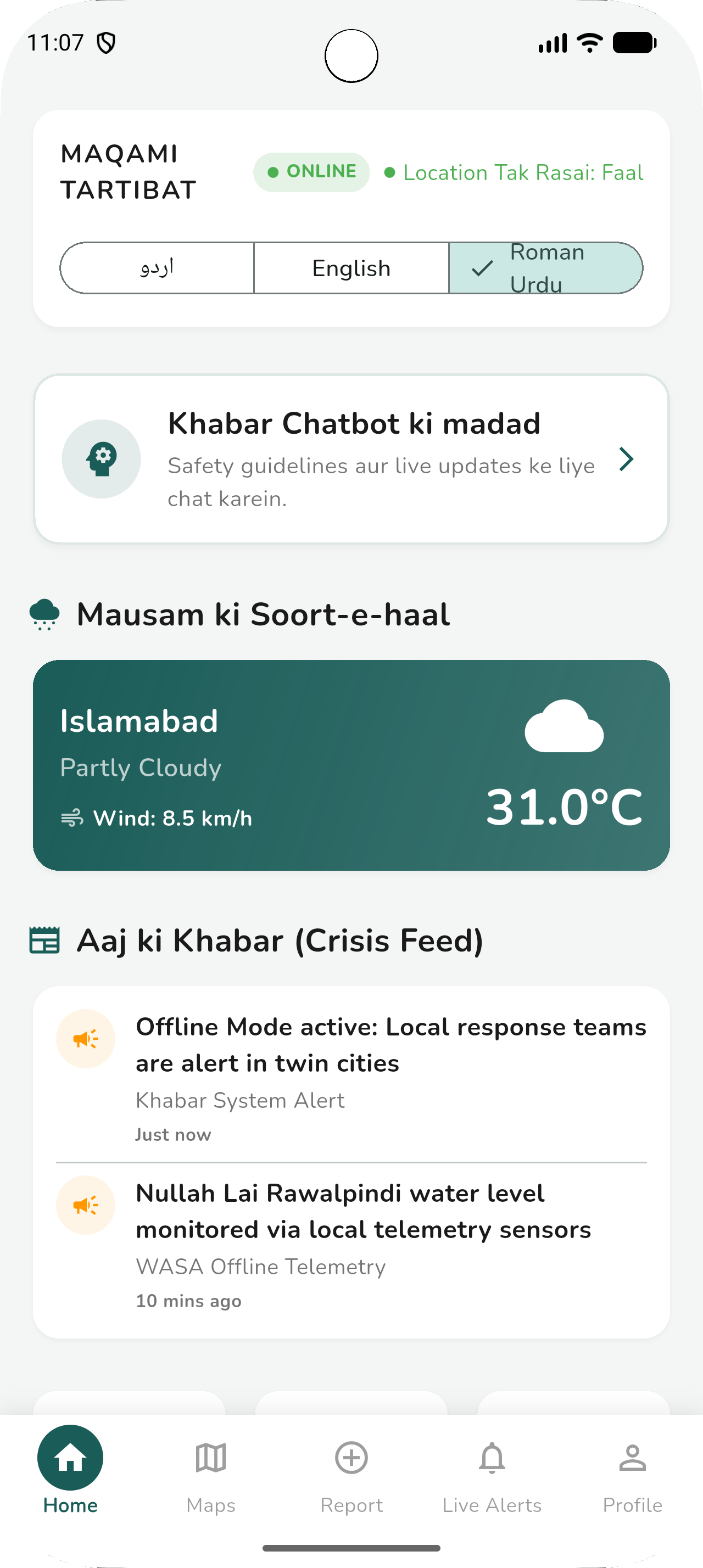
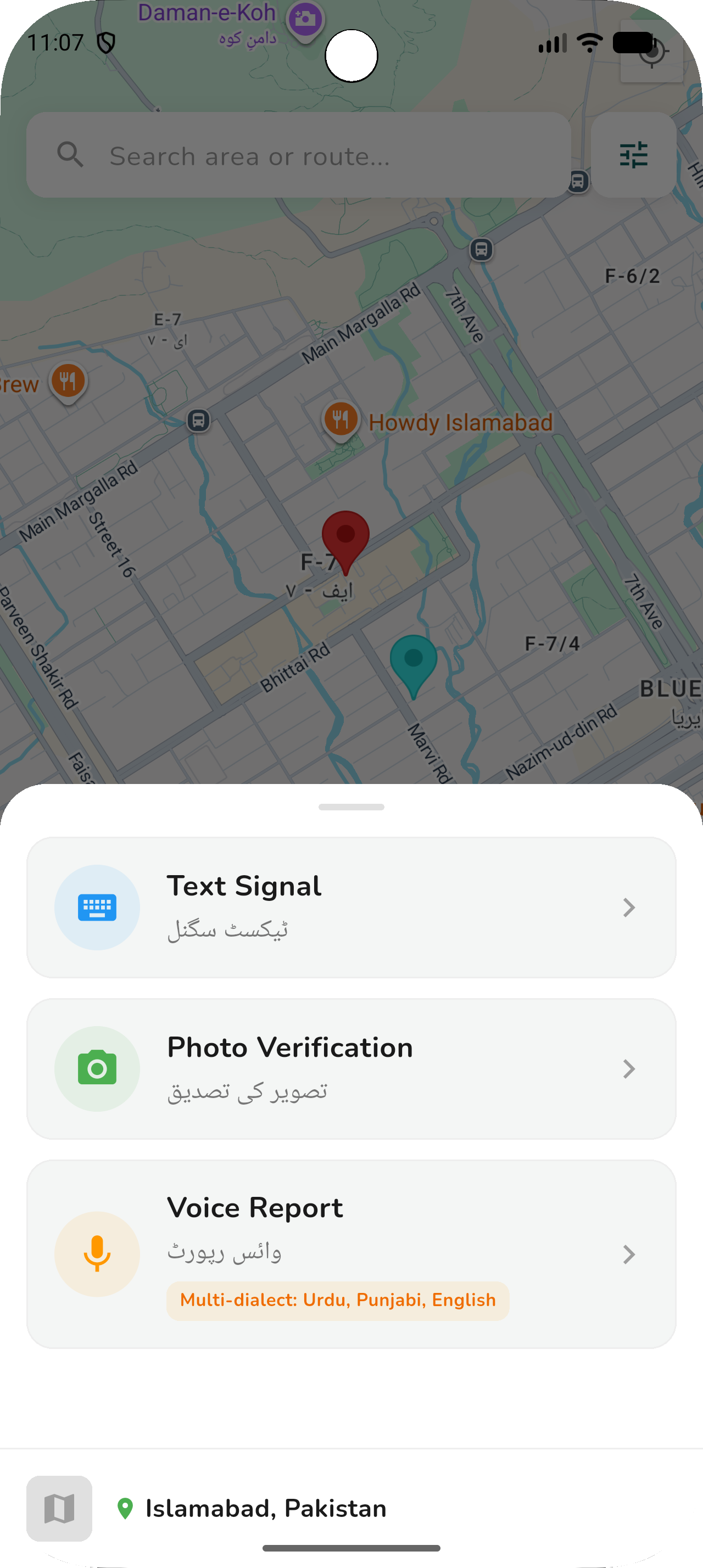
Citizens can submit emergency reports using the Flutter mobile app.
Supported input types include:
- Text report
- Photo report
- Voice report
- GPS location
The system supports local language reporting, including:
- English
- Urdu
- Roman Urdu
- Punjabi
Example citizen report:
Nullah Lai overflow ho rahi hai, Murree Road Rawalpindi band ho gayi!
This makes the system accessible for ordinary citizens because they do not need to write formal English. They can report in the language and style they naturally use.
2. Multi-Source Input
KHABAR accepts crisis signals from multiple sources.
Text Input
Text reports are submitted through:
POST /report/text
The text is passed directly to the Detection Agent with GPS metadata.
Image Input
Photo reports are submitted through:
POST /report/image
The image is analyzed by Vision AI. The system can detect visual evidence such as flooding, fire, road blockage, damaged vehicles, or infrastructure damage.
Voice Input
Voice reports are submitted through:
POST /report/voice
The voice note is transcribed using speech AI. The transcription is then converted into a crisis signal and passed into the same AI pipeline.
Automated Feeds
KHABAR can also monitor automated external sources such as:
- Open-Meteo weather data
- TomTom traffic data
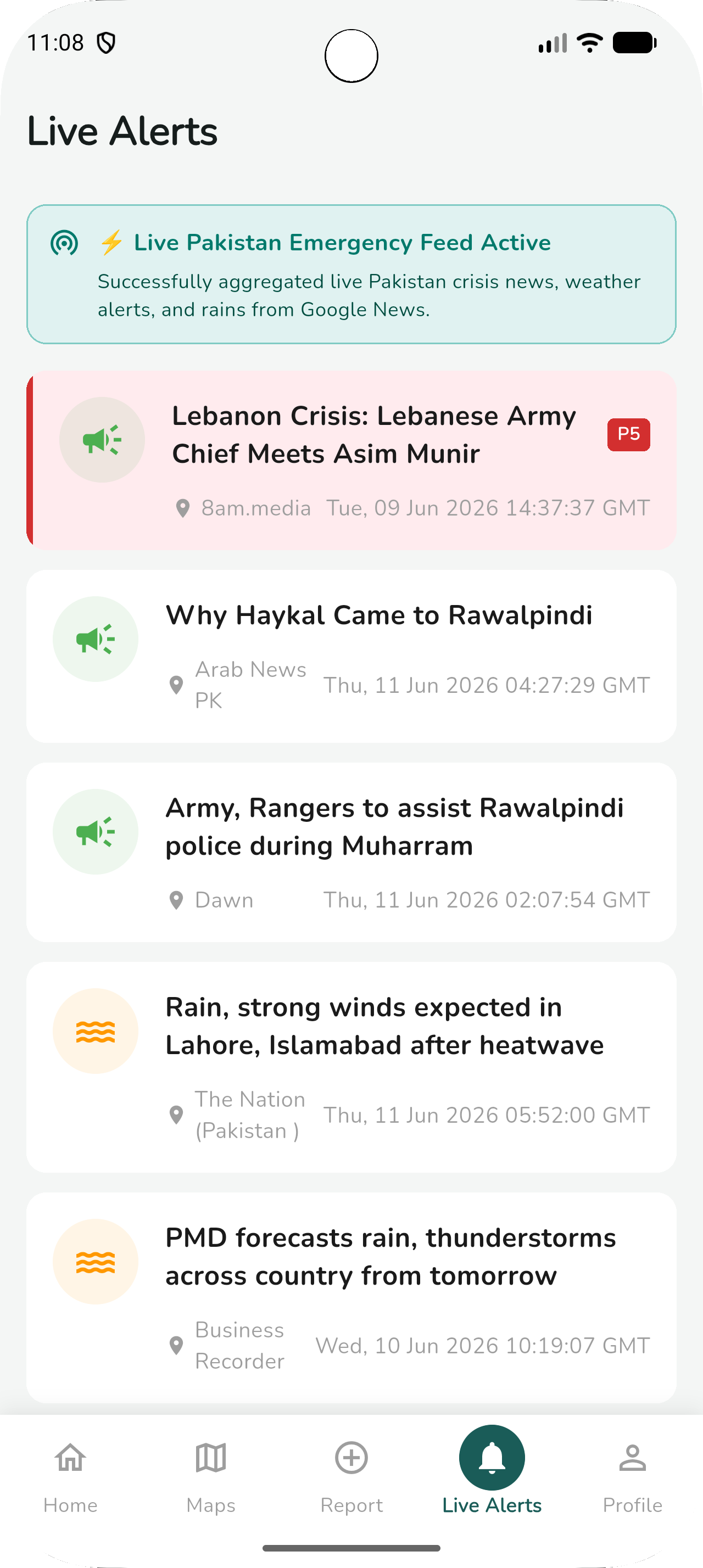
- Google News RSS
- External emergency signals
These automated signals can trigger proactive crisis detection when dangerous conditions are detected, such as heavy rainfall, heatwave conditions, or abnormal traffic slowdown.
Signal Lifecycle
When a report is submitted, KHABAR creates a structured signal called RawCrisisSignal.
A signal includes:
- Signal ID
- Source type
- Raw content
- Timestamp
- Latitude and longitude
- Vision result, if image was submitted
- Speech result, if voice was submitted
The incident is first saved with this status:
PROCESSING
Then the background AI pipeline starts.
Final status can become:
PIPELINE_COMPLETE
or:
REJECTED
depending on whether the report is verified and processed successfully.
AI Multi-Agent Pipeline
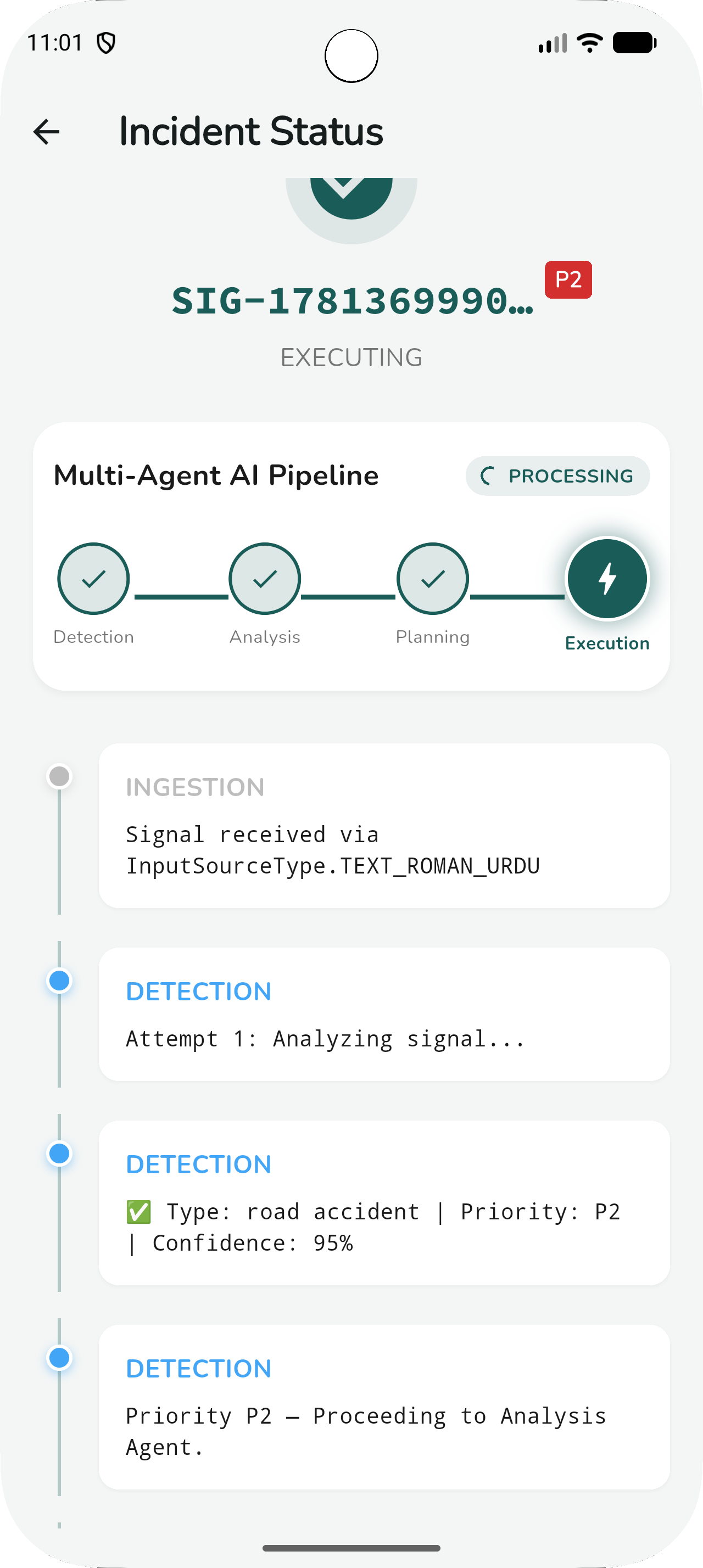
KHABAR uses a 4-stage sequential AI pipeline:
Detection Agent → Analysis Agent → Planning Agent → Execution Agent
Each agent performs a specific role and passes structured output to the next agent.
Stage 1: Detection Agent
The Detection Agent reads the raw citizen report or automated signal.
It performs:
- Crisis classification
- Location extraction
- Priority assignment
- Confidence scoring
- Spam or invalid report detection
- Verification against external data when available
It identifies crisis types such as:
- Urban flooding
- Fire
- Road accident
- Building collapse
- Heatwave
- Medical emergency
- Road blockage
- Infrastructure failure
It assigns priority from:
P1 = Critical
P2 = High
P3 = Medium
P4 = Low
P5 = Informational
If the signal is fake, irrelevant, or unverified, it can be rejected.
Stage 2: Analysis Agent
The Analysis Agent studies the real-world impact of the verified incident.
It estimates:
- Severity score
- Affected population
- Stranded vehicles
- Nearby hospitals
- Hospital ETA
- Critical infrastructure at risk
- Bilingual public warning summary
This stage helps coordinators understand how serious the incident is and what kind of emergency response may be required.
Stage 3: Planning Agent
The Planning Agent creates an ordered emergency response plan.
It recommends actions such as:
- Dispatch rescue teams
- Allocate supplies
- Broadcast public alerts
- Reroute traffic
- Create emergency tickets
- Update incident status
- Query emergency SOP knowledge base
The plan includes:
- Response strategy
- Required units
- Target agencies
- Priority of each action
- Recommended sequence
Example target agencies:
- Rescue 1122
- WASA
- Traffic Police
- NDMA
- Edhi Foundation
- Hospitals
- Fire services
Stage 4: Execution Agent
The Execution Agent executes the recommended plan using emergency response tools.
It can:
- Dispatch rescue teams
- Allocate supplies
- Send bilingual alerts
- Close roads
- Set detour routes
- Create emergency tickets
- Query SOP knowledge base
- Update incident status
Every execution produces a before/after state so coordinators can see exactly what changed.
Example:
Before:
rescue_team: 0
ambulance: 0
alerts_sent: 0
closed_roads: []

After:
rescue_team: 3
ambulance: 2
alerts_sent: 2
closed_roads: ["Murree Road"]
detour_routes: ["Via Expressway"]
This makes the system transparent and auditable.
Emergency Action Tools
KHABAR includes seven emergency tools used by the Execution Agent.
1. Dispatch Rescue Team
Deploys rescue teams or emergency units from the resource inventory.
2. Allocate Supplies
Reserves supplies such as medical kits, food packs, or equipment.
3. Broadcast Alert
Sends bilingual Urdu and English public alerts using Firebase Cloud Messaging.
4. Update Traffic Route
Marks roads as closed and sets alternate detour routes.
5. Create Emergency Ticket
Creates an inter-agency emergency support ticket.
6. Query Knowledge Base
Looks up relevant emergency SOPs and response protocols.
7. Update Incident Status
Updates the incident status, such as from PROCESSING to PIPELINE_COMPLETE.
Admin / Coordinator Dashboard
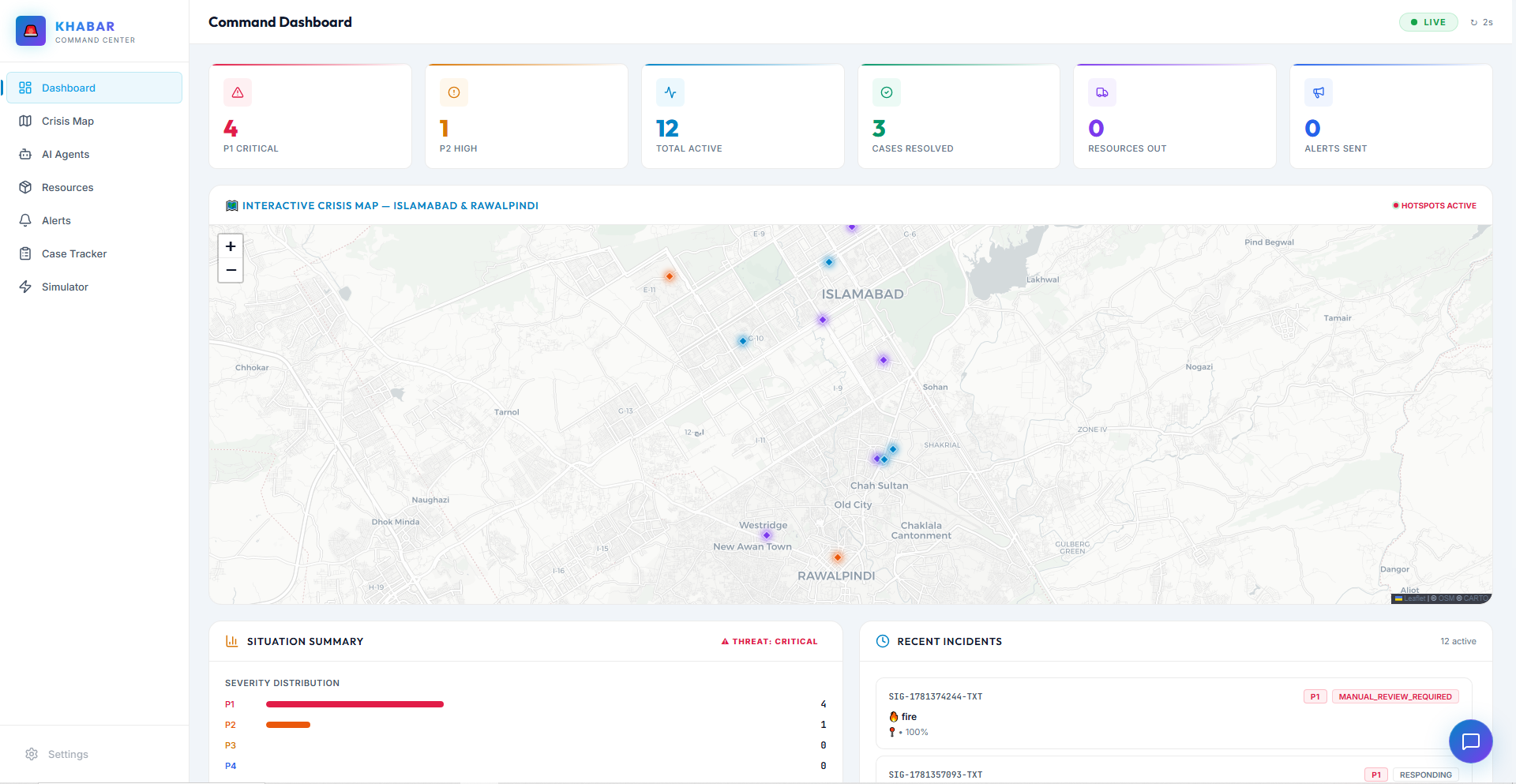
KHABAR includes a dedicated React-based Admin / Coordinator Dashboard for emergency dispatchers, civic authorities, and response teams.
While the Flutter app is for citizens, the admin dashboard is for coordinators who need to monitor, verify, manage, and respond to incidents.
The dashboard acts as a real-time civic emergency command center.
Purpose of the Admin Dashboard
The dashboard solves a major coordination problem. Emergency coordinators need one place where they can see:
- What incident was reported
- Where it happened
- How serious it is
- Which priority level it has
- What the AI agents decided
- Which resources are available
- Which resources have been dispatched
- What alerts were sent
- What roads are closed
- What actions still require manual control
KHABAR provides this through a single dashboard interface.
Dashboard Features
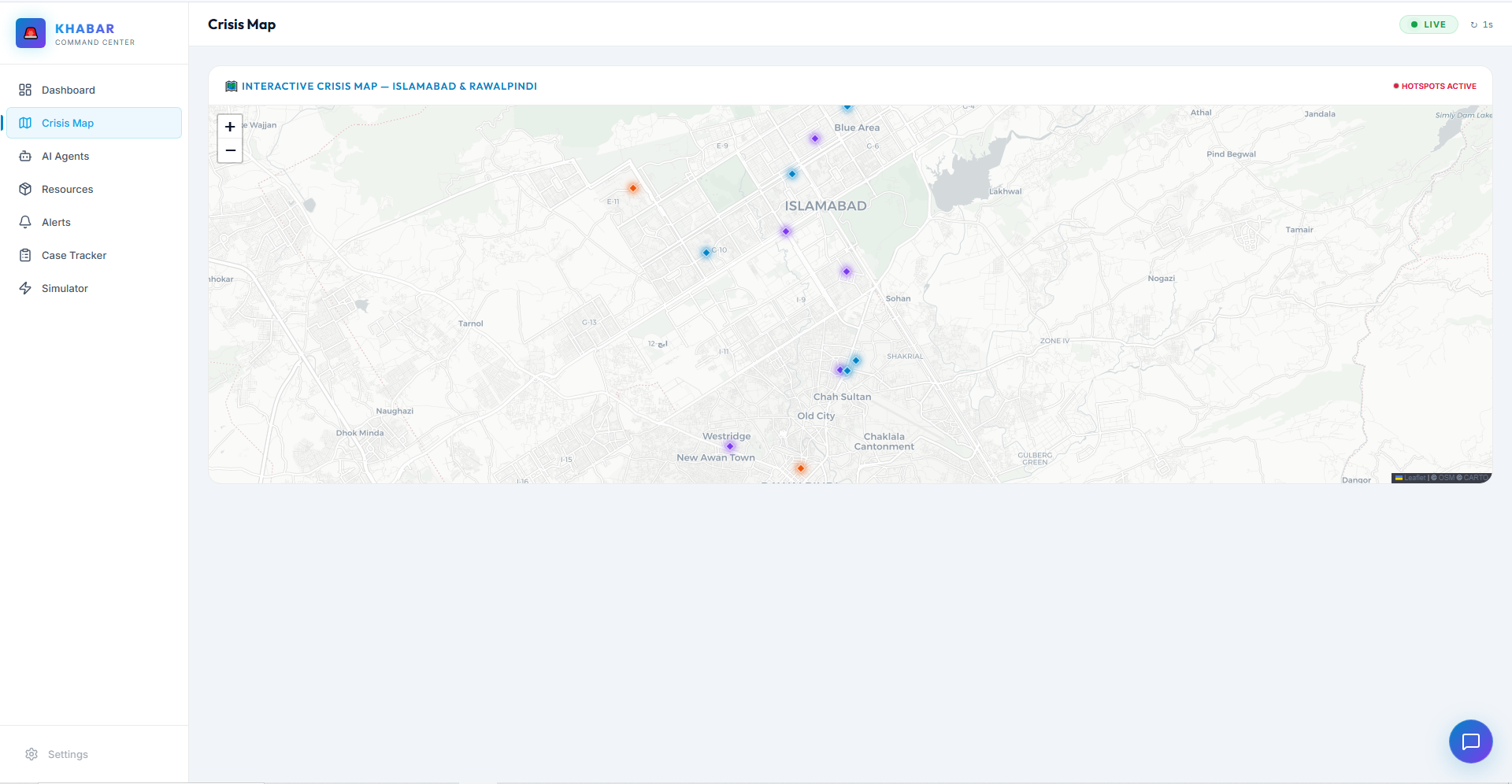
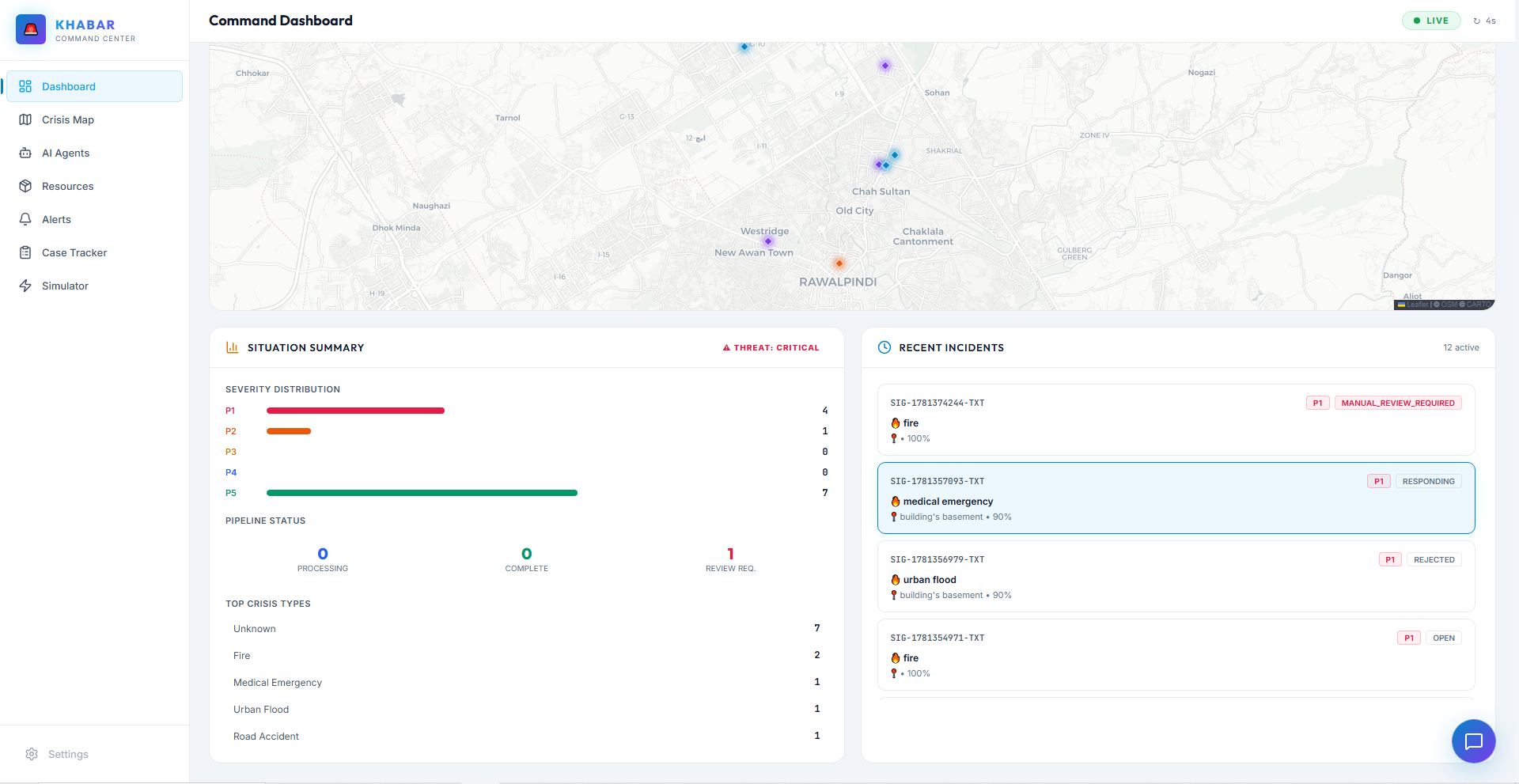
1. Live Map
The dashboard includes a live map that shows:
- Incident markers
- Resource markers
- Rescue team locations
- Priority-based incident colors
- Closed roads
- Detour routes
- Nearby emergency resources
This helps coordinators quickly understand where the crisis is happening and which resources are nearby.
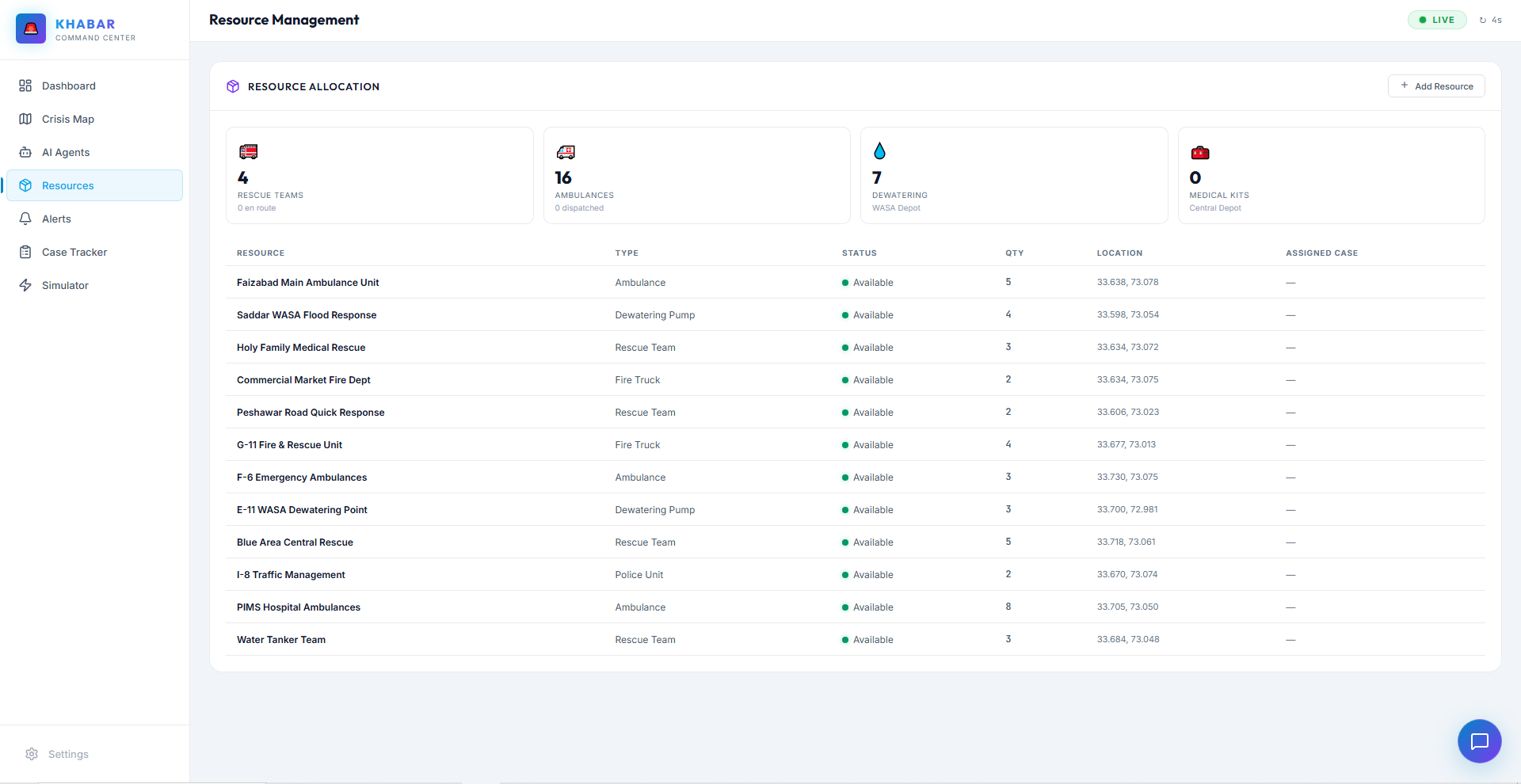
2. Resource Manager
The Resource Manager shows live emergency resource inventory.
It tracks:
- Ambulances
- Rescue teams
- Fire trucks
- Dewatering pumps
- Emergency supplies
- Resource status
- Available quantity
- Assigned incident ID
When a resource is dispatched, its status changes from available to deployed or en route. This prevents duplicate assignment and improves coordination.
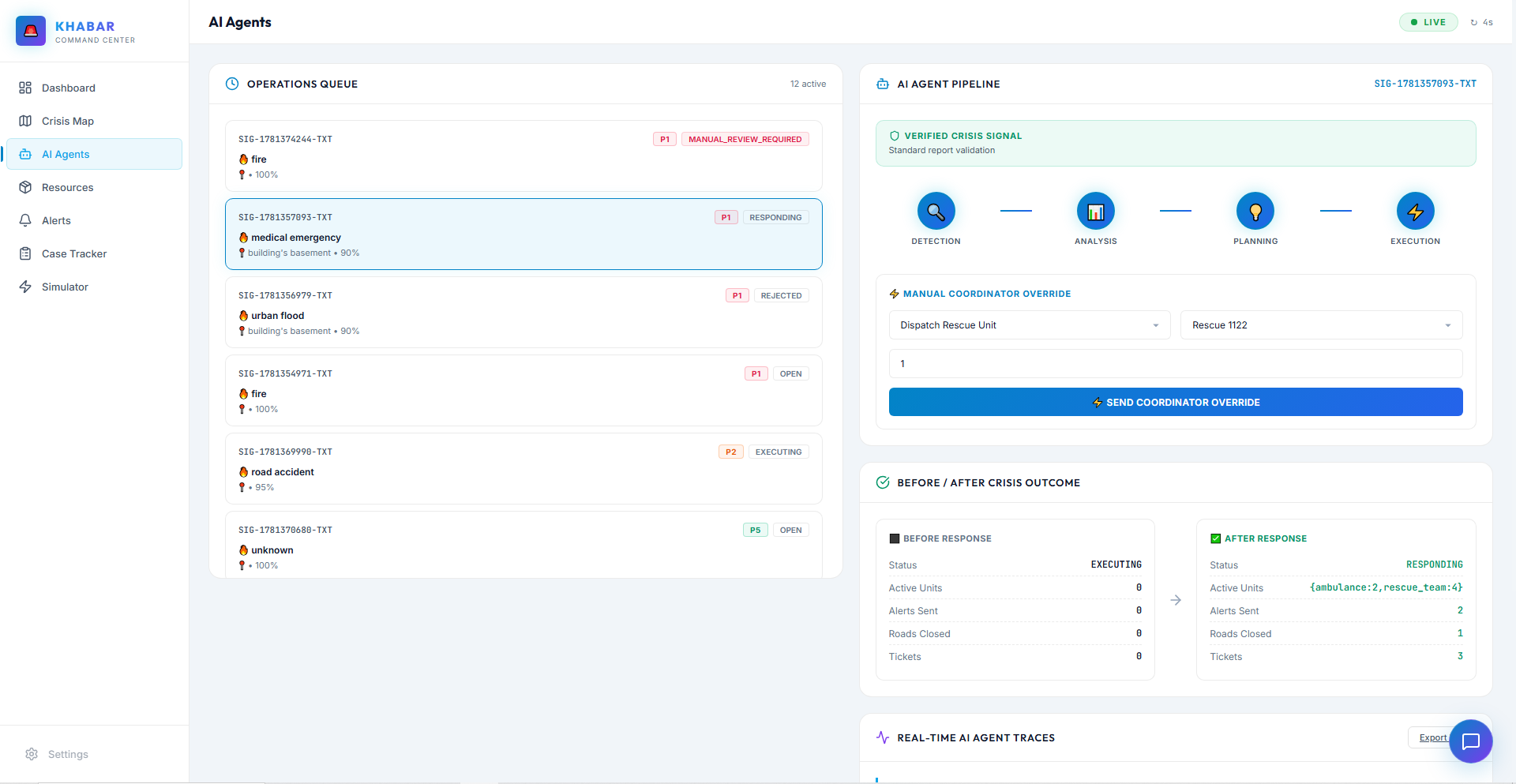
3. Agent Panel
The Agent Panel displays the output of each AI agent.
Coordinators can inspect:
- Detection Agent result
- Analysis Agent result
- Planning Agent result
- Execution Agent result
- AI reasoning trace
- Allocated resources
- Tool execution logs
- Before/after system state
This makes KHABAR explainable. The AI is not a black box because the coordinator can see why a priority was assigned and why an action was recommended.
4. AI Command Chatbot
The dashboard includes an AI Command Assistant for emergency coordinators.
Instead of manually filling forms, a dispatcher can type natural language commands such as:
Dispatch Rescue 1122 to SIG-123 immediately
or:
Send flood alert to sector G-10
or:
Mark SIG-123 as resolved
The chatbot reads current incidents and resources, understands the command, and executes backend actions through:
POST /admin/chat
Supported actions include:
- Dispatch resources
- Send public alerts
- Reroute traffic
- Create emergency ticket
- Update incident status
- Add resource
- Clear/reset incidents
This gives KHABAR a human-in-the-loop control system where AI assists the coordinator, but the coordinator remains in command.
5. Stats Grid
The Stats Grid shows quick KPI cards such as:
- Total incidents
- Active resources
- Alerts sent
- Pipeline success rate
This gives emergency managers a quick overview of the current situation.
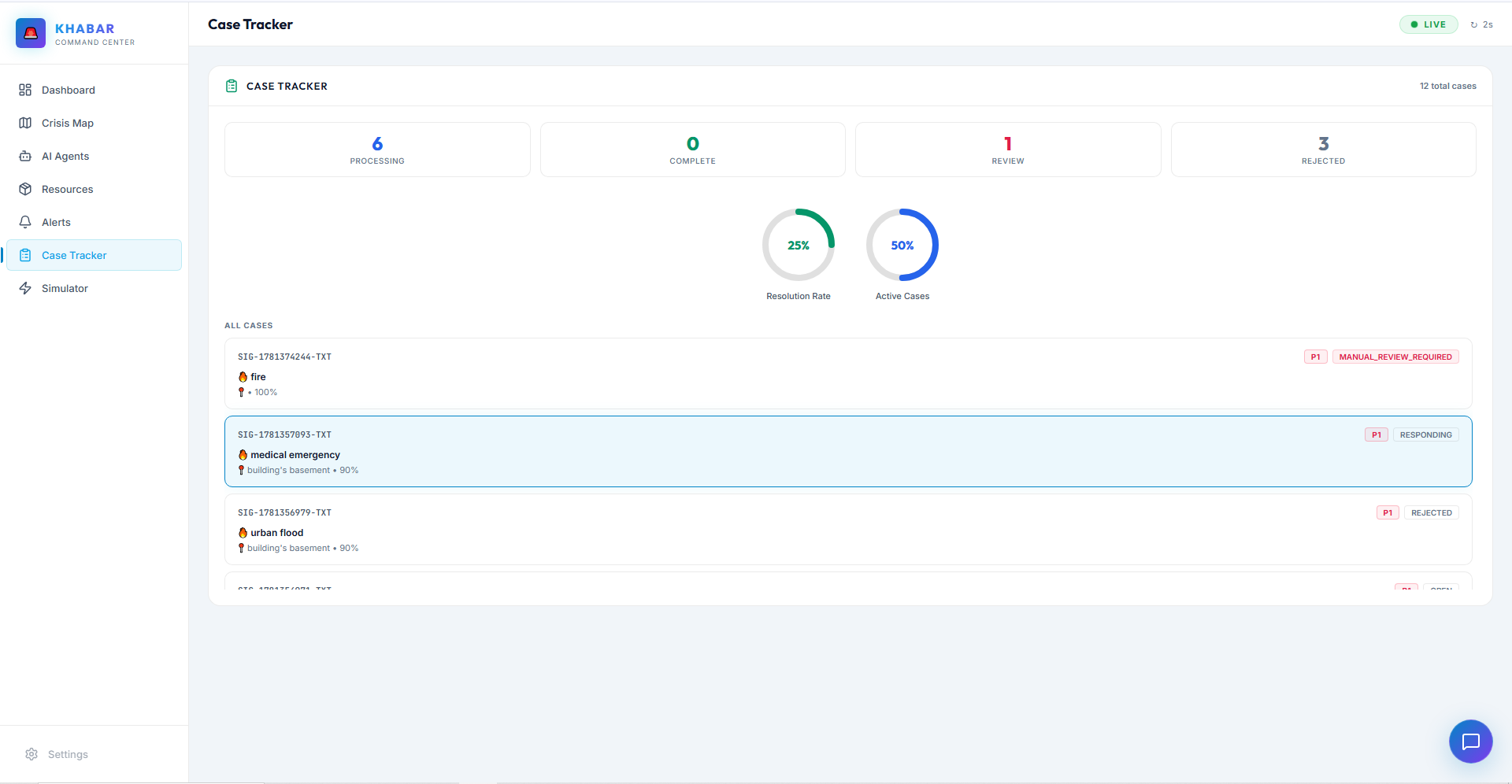
6. Case Tracker
The Case Tracker shows the distribution of incidents by priority.
It tracks:
- P1 critical incidents
- P2 high-priority incidents
- P3 medium incidents
- P4 low-priority incidents
- P5 informational incidents
This helps authorities focus on the most urgent cases first.
7. Alerts Panel
The Alerts Panel shows public warnings sent through the system.
It displays:
- Alert content
- Alert time
- Incident reference
- Urdu message
- English message
- Firebase notification history
This helps coordinators confirm that citizens were informed.
8. Situation Summary
The dashboard includes an AI-generated situation summary.
It summarizes the overall emergency landscape so coordinators can understand the situation quickly without reading every incident manually.
Manual Control and Human Oversight
KHABAR does not remove human decision-making. It supports human coordinators with AI assistance.
Coordinators can manually trigger actions using:
POST /action/execute
They can also use natural language through:
POST /admin/chat
This human-in-the-loop design is important because civic systems require safety, accountability, and human judgment.
The AI recommends and assists, but the coordinator can review, trigger, modify, or override actions.
Public Alert System
KHABAR sends real-time bilingual push notifications using Firebase Cloud Messaging.
Alerts are sent in:
- Urdu
- English
Alert types include:
- Flood alert
- Urban flooding alert
- Fire alert
- Road accident alert
- Building collapse alert
- Heatwave warning
- Medical emergency alert
- Road blockage alert
All Flutter app users can subscribe to the public alert topic:
khabar_public_alerts
If Firebase credentials are missing, the system falls back to simulated delivery logs so the pipeline does not crash.
Maps and Location Intelligence
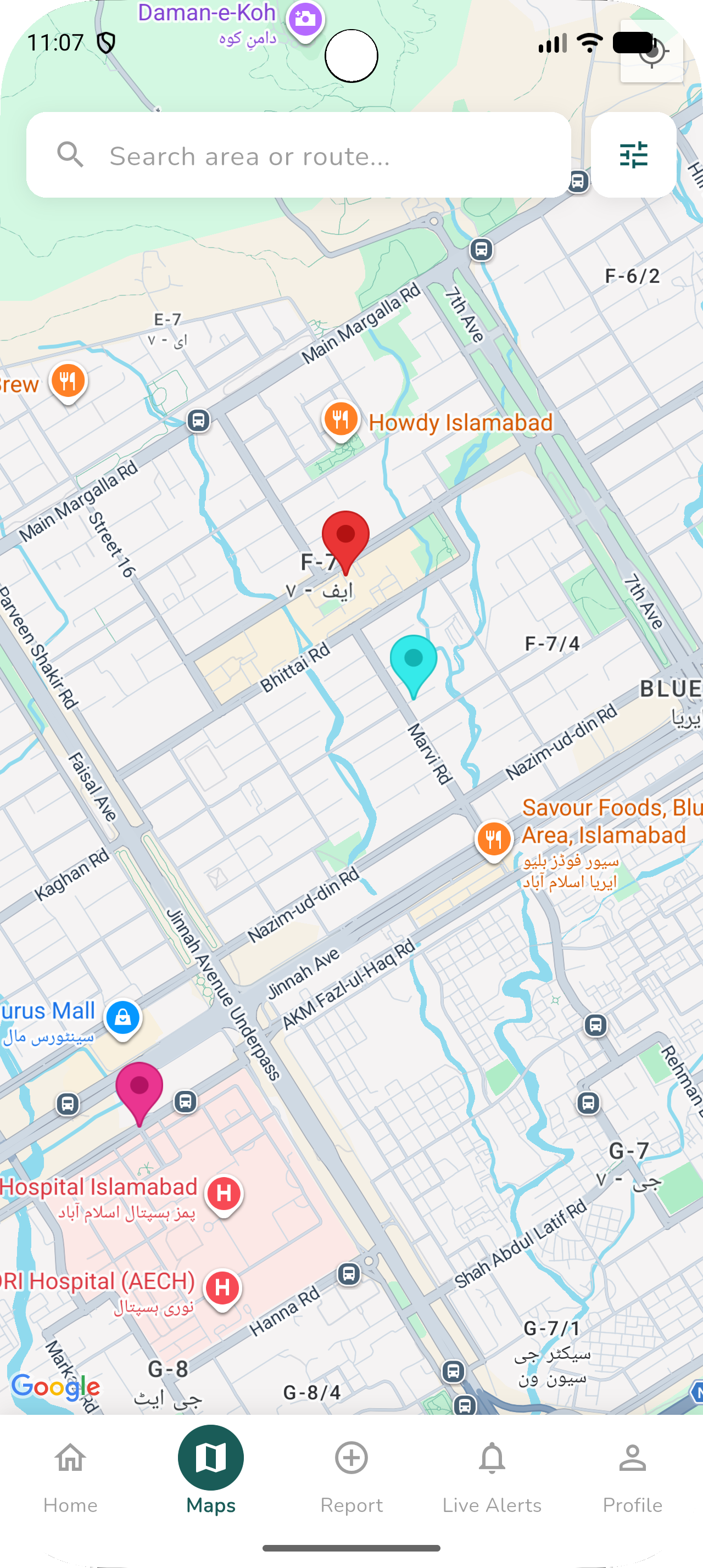
KHABAR uses map and geocoding services to improve location-based emergency response.
It supports:
- Text location to coordinates
- GPS coordinates
- Incident markers
- Resource markers
- Hospital lookup
- ETA calculation
- Closed road visualization
- Detour route visualization
The geocoding fallback chain is:
Google Maps API → Local Pakistan City Dictionary → OpenStreetMap Nominatim → Islamabad Default Location
This makes the system more reliable if one location service fails.
Database and Resource Tracking
KHABAR uses Supabase PostgreSQL to store:
- Incidents
- Resources
- Agent traces
- Before/after states
- Allocated units
- Alert records
The system also includes an in-memory fallback. If Supabase is unavailable, the backend can still continue using thread-safe local memory instead of crashing.
Resources include:
- Ambulances
- Rescue teams
- Fire trucks
- Dewatering pumps
- Medical supplies
- Emergency units
When a resource is dispatched, KHABAR updates its status and assigns it to a specific incident.
Offline and Resilience Features
Emergency systems must work even when internet access is unstable. KHABAR includes a local offline AI fallback.
The AI fallback chain is:
AIML API → Local GGUF Model → Hardcoded JSON Fallback
Local models include:
- Qwen GGUF
- Gemma GGUF
The local model can power offline citizen chat through:
POST /local-chat
If the local model is not available, the system uses keyword-based fallback responses.
This ensures the system can still provide emergency guidance even when cloud AI is unavailable.
API Endpoints
KHABAR includes API endpoints for reporting, monitoring, actions, resources, chat, and logs.
Important endpoints include:
GET /health
POST /report/text
POST /report/image
POST /report/voice
GET /incidents
GET /incident/{id}
GET /resources
POST /resources/add
POST /action/execute
GET /logs/{id}
GET /geocode
POST /chat
POST /local-chat
POST /admin/chat
GET /live-news
These endpoints connect the mobile app, backend, AI pipeline, dashboard, database, maps, alerts, and admin control system.
AI Component
KHABAR uses AI in several meaningful ways.
1. Multilingual Text Understanding
AI understands citizen reports written in English, Urdu, Roman Urdu, and Punjabi.
2. Vision AI
Photo reports are analyzed to detect crisis evidence such as flooding, fire, damaged vehicles, road blockage, or disaster scenes.
3. Speech AI
Voice reports are transcribed and converted into structured emergency signals.
4. Multi-Agent Reasoning
The 4-agent pipeline performs:
Detection → Analysis → Planning → Execution
This is the core intelligence of the system.
5. RAG-style SOP Lookup
The Planning Agent can query emergency response knowledge base content to recommend better actions.
6. AI Command Assistant
The admin dashboard includes a chatbot that allows coordinators to issue natural language commands.
7. Offline AI
Local GGUF models provide AI fallback when cloud AI is unavailable.
Why AI Is Appropriate
AI is appropriate because emergency reports are often:
- Unstructured
- Noisy
- Multilingual
- Time-sensitive
- Incomplete
- Location-dependent
- Difficult to verify manually at scale
AI helps KHABAR by:
- Understanding natural language reports.
- Extracting crisis type and location.
- Verifying report relevance.
- Assigning priority.
- Estimating severity.
- Generating response plans.
- Creating bilingual alerts.
- Assisting coordinators through chat commands.
- Reducing response delay.
Without AI, this system would only be a reporting form. With AI, it becomes an emergency response orchestration platform.
Who Will Benefit
Citizens
Citizens can report emergencies easily and receive real-time safety alerts.
Emergency Coordinators
Coordinators get a live dashboard to monitor incidents, resources, AI decisions, and response actions.
Rescue Agencies
Rescue teams receive structured incident details and priority-based dispatch information.
Government and Civic Organizations
Public-sector teams can improve transparency, accountability, and service delivery.
Vulnerable Communities
People in flood-prone, high-risk, or low-connectivity areas can receive faster warnings and support.
Civic and Social Impact
KHABAR can create strong civic impact by:
- Reducing emergency reporting delays.
- Improving incident verification.
- Supporting faster resource dispatch.
- Helping citizens receive timely alerts.
- Improving coordination between agencies.
- Increasing transparency in emergency response.
- Creating traceable AI decision logs.
- Supporting bilingual communication.
- Helping authorities prioritize critical cases.
- Making emergency response more data-driven.
In the long term, KHABAR can help cities become safer, more responsive, and more resilient.
Innovation
KHABAR is innovative because it does not stop at reporting.
It moves from:
Report → Verify → Analyze → Plan → Execute → Alert → Visualize
Most civic reporting apps only collect complaints or incidents. KHABAR goes further by using AI agents to convert reports into actions.
Its key innovation is the combination of:
- Citizen reporting
- Multi-source input
- Multi-agent AI reasoning
- Emergency tool execution
- Resource allocation
- Public alerts
- Admin command dashboard
- Agent trace transparency
- Offline AI fallback
This makes KHABAR a complete civic emergency intelligence system.
Technical Implementation
KHABAR is implemented using a modular architecture.
| Layer | Technology |
|---|---|
| Citizen App | Flutter / Dart |
| Admin Dashboard | React + Vite |
| Backend | Python FastAPI |
| AI Pipeline | Multi-agent LLM orchestration |
| Primary AI | AIML API with Gemini 2.5 Flash |
| Offline AI | Qwen / Gemma GGUF with llama-cpp-python |
| Database | Supabase PostgreSQL |
| Database Fallback | In-memory Python store |
| Notifications | Firebase Cloud Messaging |
| Maps | Google Maps + OpenStreetMap |
| Weather | Open-Meteo |
| Traffic | TomTom |
| News | Google News RSS |
| API Documentation | FastAPI Swagger |
Prototype Status
The current prototype includes:
- Flutter citizen reporting app.
- Text, image, and voice reporting.
- GPS-based incident reporting.
- FastAPI backend.
- 4-agent AI pipeline.
- React admin dashboard.
- Live map visualization.
- Resource manager.
- AI command chatbot.
- Firebase alert integration.
- Supabase incident and resource storage.
- Local offline AI fallback.
- Manual action execution.
- Agent trace logs.
- Before/after state comparison.
- External integrations for maps, weather, traffic, and news.
This demonstrates a complete end-to-end civic AI workflow.
Feasibility
KHABAR is feasible because it uses available technologies and modular services.
The prototype already demonstrates the core flow:
Citizen report → Backend API → AI pipeline → Execution tools → Database update → Alerts → Dashboard visualization
Each component can be improved independently:
- Mobile app can support more languages.
- Backend can scale on cloud.
- Database can connect to real agencies.
- AI pipeline can use stronger models.
- Dashboard can add more operational controls.
- Alerts can expand to SMS and WhatsApp.
Scalability
KHABAR can scale from a hackathon prototype to a city-level or national civic platform.
Future scaling options include:
- Add more cities across Pakistan.
- Integrate with Rescue 1122, NDMA, WASA, hospitals, and traffic police.
- Add SMS alerts for citizens without smartphones.
- Add WhatsApp reporting.
- Add more regional languages.
- Add predictive disaster risk analysis.
- Connect with IoT sensors, CCTV, or drone feeds.
- Add role-based access for agencies.
- Create open data dashboards for public transparency.
- Train models on local emergency datasets.
- Use historical incident data for heatmaps and risk prediction.
Because KHABAR is modular, it can support more agencies, more cities, and more emergency types over time.
User Experience
KHABAR is designed for two user groups.
Citizen Experience
Citizens can:
- Submit reports easily.
- Use text, image, or voice.
- Attach GPS location.
- Track incident status.
- Receive alerts.
- Use online or offline AI chat.
Coordinator Experience
Coordinators can:
- View live incidents.
- Inspect AI decisions.
- Manage resources.
- Dispatch teams.
- Send alerts.
- Track priority cases.
- Use AI command chatbot.
- Review trace logs.
This dual-interface design makes KHABAR useful for both public participation and official response coordination.
Demo Scenario
A possible demo scenario:
- A citizen reports urban flooding near Nullah Lai using Roman Urdu text and GPS.
- KHABAR creates a crisis signal and saves the incident as
PROCESSING. - Detection Agent verifies the report and classifies it as
URBAN_FLOODING. - Analysis Agent estimates high severity, affected population, and nearest hospital ETA.
- Planning Agent recommends dispatching Rescue 1122, sending a public alert, and closing a risky road.
- Execution Agent dispatches rescue teams, sends bilingual FCM alerts, creates a road closure, and updates the incident status.
- Citizens receive alerts.
- The admin dashboard shows the incident on a live map with resources, priority, trace logs, and before/after state.
- The coordinator uses the AI chatbot to manually send an additional alert or mark the incident resolved.
Future Roadmap
Future improvements include:
- Real-time agency integration.
- SMS and WhatsApp alert support.
- More accurate traffic and routing intelligence.
- Predictive crisis risk maps.
- Citizen trust scoring.
- Duplicate incident clustering.
- CCTV or drone image confirmation.
- More local languages.
- Role-based admin accounts.
- Public transparency portal.
- Historical analytics dashboard.
- Mobile app deployment for Android users.
Conclusion
KHABAR is an AI-powered civic innovation project designed to improve emergency response in Pakistan.
It allows citizens to report crises through accessible channels, uses AI to verify and prioritize incidents, creates response plans, executes emergency actions, sends bilingual alerts, and gives coordinators a live dashboard for transparent decision-making.
By combining citizen participation, artificial intelligence, emergency response tools, public alerts, maps, resource management, and human-in-the-loop coordination, KHABAR can help communities become safer, more informed, and more resilient.
Built With
- aiml-api
- crewai
- dart
- fastapi
- firebase-cloud-messaging
- flutter
- gemini-2.5-flash
- gemma-gguf
- google-maps
- google-news-rss
- javascript
- leaflet.js
- llama-cpp-python
- open-meteo-api
- openstreetmap/nominatim
- pydantic
- python
- qwen-gguf
- react
- rest-apis
- supabase-postgresql
- swagger/openapi
- tomtom-traffic-api
- uvicorn
- vite


Log in or sign up for Devpost to join the conversation.