Inspiration
Fast-food kitchen operations run on razor-thin timelines where sudden ingredient shortages lead to lost revenue and over-ordering leads to massive food waste. We wanted to move past simple chatbot interfaces and explore true "Agentic AI"—building an autonomous digital restaurant operations manager that shifts logistics from reactive human monitoring to proactive, intelligent automation.
What it does
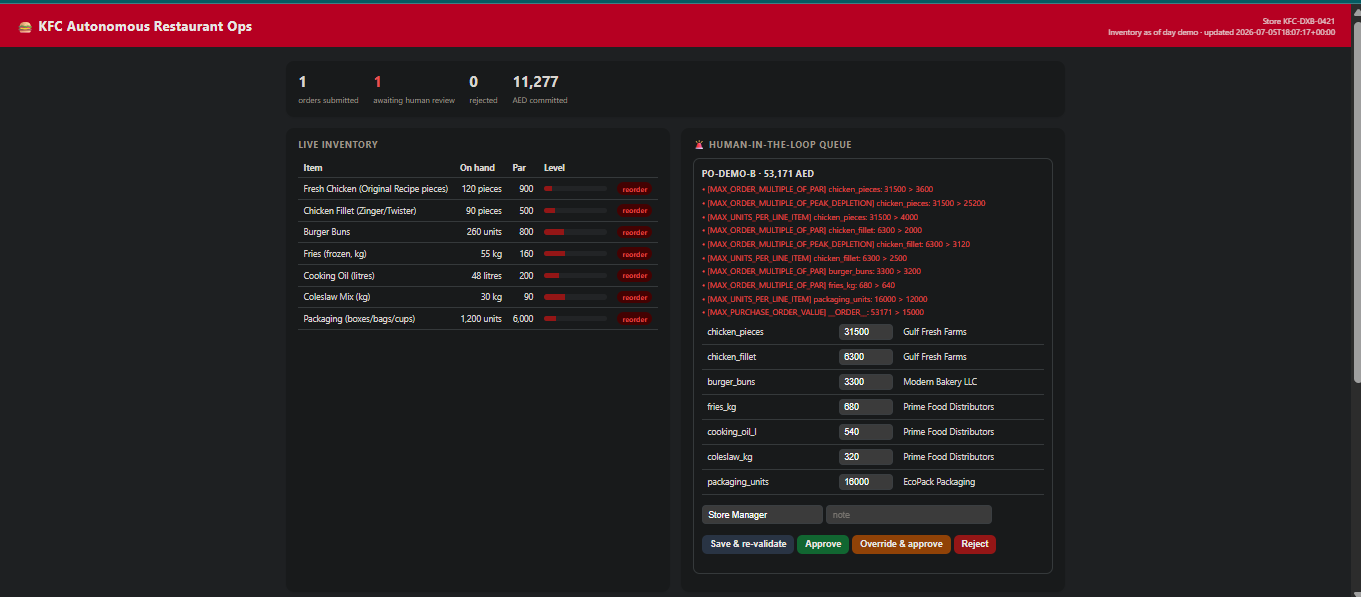
Our project is an autonomous multi-agent operational system engineered specifically for the KFC F&B track. Instead of acting as a standard Q&A chatbot, this system monitors simulated kitchen stock levels, analyzes local demand factors (like upcoming weekend weather changes or regional sports events), calculates real-time ingredient depletion, and autonomously drafts and validates supplier purchase orders without needing manual tracking from store managers.
How we built it
We engineered the agent's core cognitive loops using a modular backend tailored for intelligent tool use:
- Orchestration & State: Built using Python-based agent frameworks to coordinate cooperative agent personas (a Demand Forecasting Agent and a Supplier Purchasing Agent).
- Tool Integrations: Equipping the agents with specific execution tools to parse live inventory datasets, read local event calendars, and format structured JSON purchase schemas.
- Development Workflow: Rapidly scaffolded, iterated, and checked locally using Claude Code in our terminal to ensure the agent avoids infinite logical loops.
Challenges we faced / expect to face
The primary challenge in autonomous F&B logistics is preventing severe ordering anomalies (e.g., an agent accidentally buying 10,000 lbs of chicken due to an unexpected data typo). We addressed this by embedding strict, deterministic mathematical guardrails and an anomaly detection layer. If an agentic decision exceeds normal operating bounds, the system automatically triggers a hard pause and flags the order for a "Human-in-the-Loop" validation review.
What we learned
Building this project taught us that the true power of AI isn't in generating text, but in orchestrating structured actions. Designing clean, predictable tool interfaces for an AI to interact with is completely different from designing APIs for human developers, requiring a brand new way of thinking about software reliability.
Built With
- api
- claudecode

Log in or sign up for Devpost to join the conversation.