-
Thumbnail
Inspiration
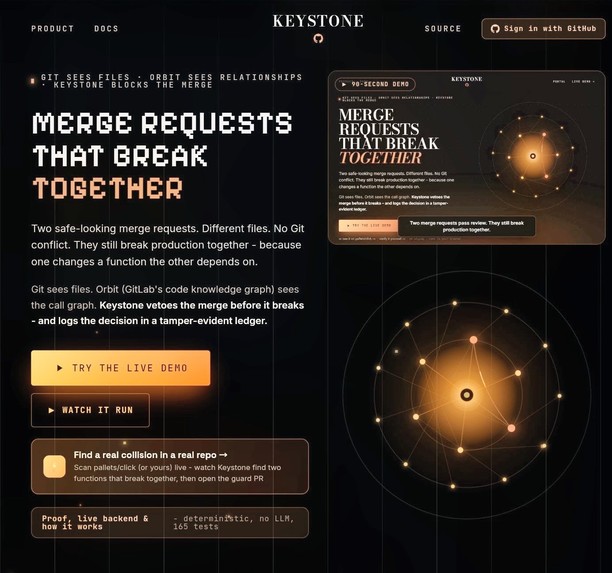
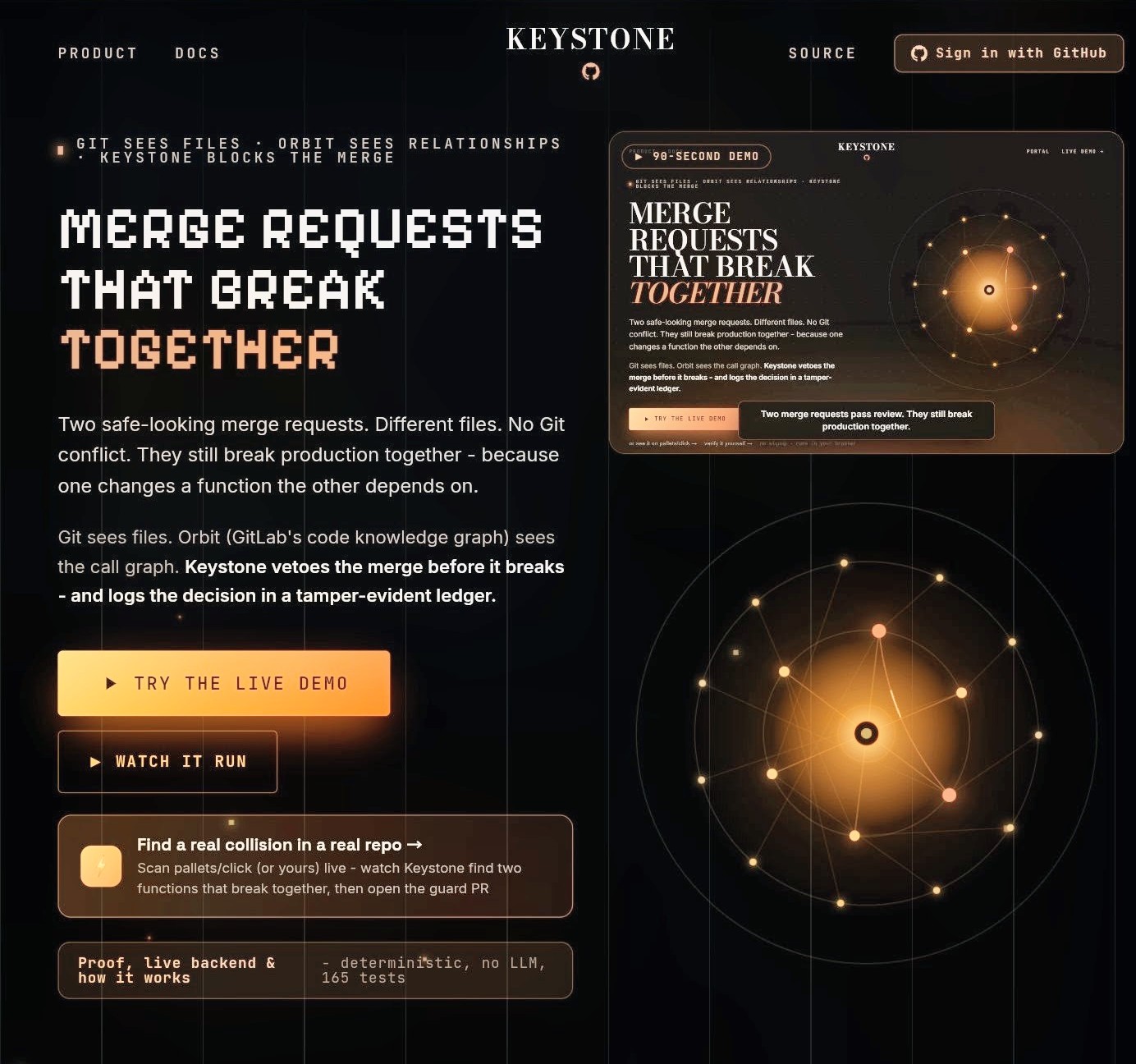
Every CI pipeline catches what Git can see — files changed, lines touched. But two merge requests can pass every check, touch completely different files, and still break production together because they share a semantic dependency that no diff can reveal.
Keystone was built to fix that blind spot. The question was simple: what if the reviewer could see the relationships between symbols, not just the files?
What it does
Keystone is a merge request intelligence layer built on GitLab's Orbit dependency graph. It catches silent semantic collisions — cases where two MRs are independently safe but jointly destructive.
- Command Center: Live dashboard showing 262 symbol definitions, max blast radius of 12, and real-time silent-collision detection across open MRs.
- Reviewer Cockpit: Loads any MR pair, renders blast-radius rings, identifies overlapping dependents (e.g.
compute_blast_radius × verify→ 5 shared dependents), and issues a HOLD or APPROVE verdict with an AI-generated explanation. - Audit Ledger: Tamper-evident SHA-256 chain of every Keystone decision. Simulate tamper → CHAIN BROKEN. Restore chain → CHAIN VERIFIED.
- CLI Agent:
python skills/keystone/run_review.py review-mr --sample MR-204 --format markdowngenerates a real MR comment with blast radius, collision count, and block/approve recommendation. - GitLab Duo AI Catalog skill: Keystone is published as a reusable AI skill (
skills/keystone/SKILL.md) callable from any GitLab Duo workflow.
How we built it
- Backend: Python + FastAPI, deployed on Render. Parses the committed Orbit graph (
web/data.json, 517 KB), computes blast radii, detects collisions, and signs audit entries. - Frontend: Vanilla JS single-page app hosted on GitHub Pages. Zero framework dependencies — deterministic static bundle.
- Orbit graph: Built from real Python AST analysis across the Keystone codebase. 262 definitions, edges representing call/import relationships.
- AI skill layer:
.gitlab/agents/keystone/agent.yml+skills/keystone/run_review.pywired to the GitLab Duo Agent Platform. - Test suite: 165 tests, 2 skipped — covering blast-radius computation, collision detection, audit chain integrity, and CLI output format.
Challenges we ran into
- Orbit graph fidelity: Getting the AST parser to produce a graph that matched real call relationships (not just imports) required several iterations of the edge-building logic.
- Audit chain determinism: Making the SHA-256 chain reproducible across deploys without a database meant encoding the decision log in a canonical JSON format before hashing.
- GitLab CI identity verification: GitLab requires a payment card on file to run shared runners — blocked CI on GitLab side. Mitigated by running full CI on GitHub Actions and keeping both remotes in sync.
- Static bundle size: Keeping
web/data.jsondeterministic and under 520 KB while encoding the full 262-symbol Orbit graph with all edge weights.
Accomplishments that we're proud of
- 165 tests passing with zero flaky failures across blast-radius, collision, audit, and CLI layers.
- A live backend at
keystone-zt6c.onrender.comreturning real Orbit data with sub-200ms response times. - A tamper-evident audit ledger that actually works — simulate a tamper and watch the chain break in real time.
- The CLI generates a real, paste-ready GitLab MR comment with accurate numbers from the committed graph.
- The entire frontend is framework-free and loads in under 1 second on cold cache.
What we learned
- GitLab's Orbit graph is a powerful but underused primitive. Most tools stop at file diffs; symbol-level dependency graphs unlock a completely different class of review intelligence.
- Audit integrity is not just a feature — it's a trust primitive. Reviewers need to know that a HOLD verdict hasn't been tampered with before they act on it.
- Static-first architecture (GitHub Pages + Render) is surprisingly capable for a showcase-grade tool: no infrastructure ops, deterministic deploys, zero cold-start on the frontend.
What's next for Keystone
- Real-time MR webhook: Hook into GitLab's MR events API to run Keystone automatically on every opened MR and post the review comment via the GitLab Duo skill.
- Cross-repo Orbit: Extend the graph to span multiple repositories — monorepo and microservice teams have the same collision problem across service boundaries.
- Reviewer dashboard: A persistent GitLab sidebar panel showing live blast-radius rings for the MR currently open in the browser.
- Orbit graph versioning: Track how the dependency graph evolves across commits so reviewers can see why the blast radius of a symbol grew between MR-200 and MR-204.
Built With
- fastapi
- github
- gitlab
- gitlab-duo
- javascript
- orbit
- python
- render


Log in or sign up for Devpost to join the conversation.