-
-
Real-World Application
-
Inspiration
Our inspiration for KeyRING came from a common challenge many of us face – forgetting our keys. The catalyst for this project was Aryaman getting locked out of his own room. This sparked the idea of creating a solution that would not only address forgetfulness but also contribute to the convenience of dorm life. Furthermore, lockout assists in the middle of the night are troublesome even for the RAs and require the resident to pay a $50 surcharge. This inspired us to find a more cost-effective solution to the problem.
What it Does
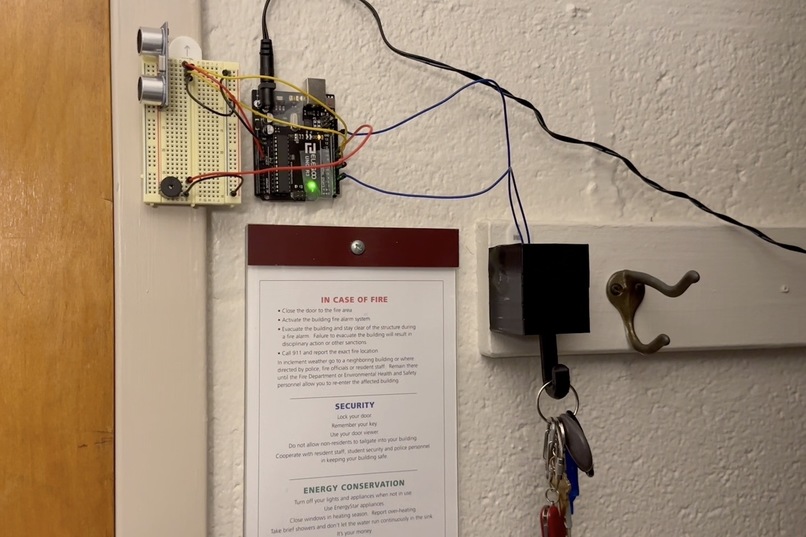
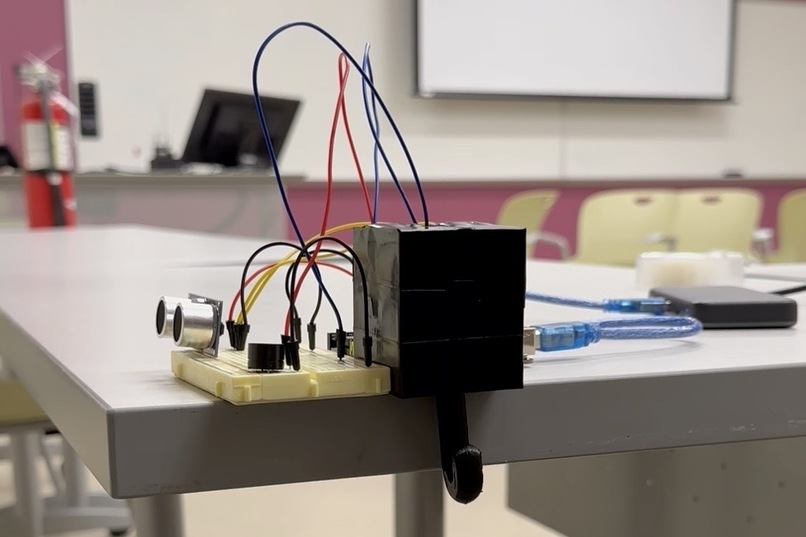
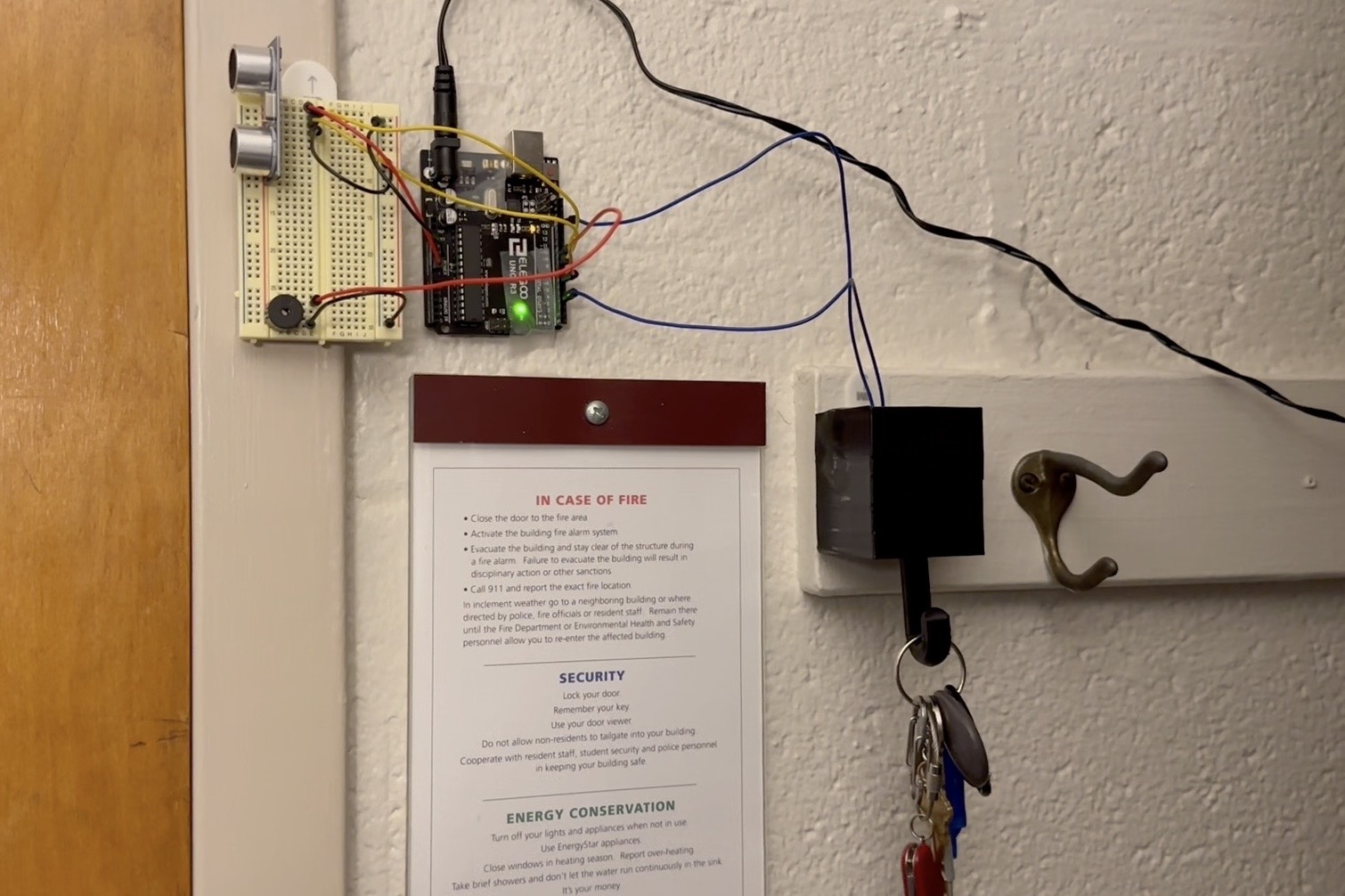
KeyRING is a smart key holder and alert system designed to mitigate the inconvenience of forgetting keys, a prevalent issue among college students. This electromechanical system incorporates a spring switch, sonar sensor, and buzzer. The sonar sensor detects door motion, and the buzzer activates only when the keys are on the hook, providing a practical way to avoid forgetfulness. This ensures that students leave their dorms with their keys, saving them from locked doors and reducing the workload for residential assistants.
How We Built It
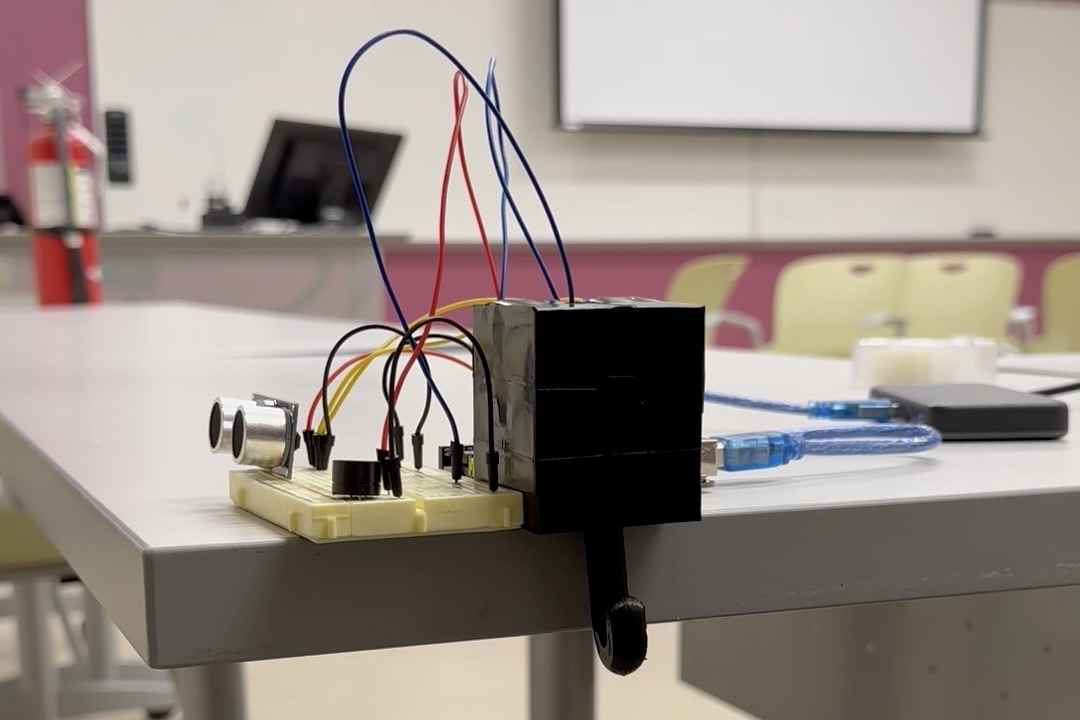
The project was built using an Arduino Uno, coded in C, and flashed with the hex file to directly control the ATMEGA328P microcontroller. The hardware setup included an HC-SR04 sonar sensor, a piezo buzzer, and a 3D-printed enclosure comprising a box, hook, and a mechanical spring. We carefully designed the system to be both functional and user-friendly, considering the specific needs of college students. We also utilized our knowledge of PWM inputs and outputs to effectively and accurately make use of the sonar sensor and buzzer. Furthermore, our self-made design for the mechanical spring found in the hook proved to be a reliable means of sensing the hanging keychain.
Challenges We Ran Into
One of the challenges we faced was the limitation of available 3D printing methods. We could only print the spring in PLA plastic instead of a more suitable flexible filament. This constraint required us to find creative solutions to maintain the functionality of the project while working within the available resources. We also found issues controlling the PWM inputs and outputs on C as we attempted to directly program the ATEMGA328P on the Arduino Uno rather than using the Arduino IDE. However, we were able to effectively tackle these issues.
Accomplishments That We're Proud Of
Despite the challenges, we successfully created a reliable, practical, and cost-effective solution for a real-world problem. Achieving a functional integration of the spring switch, sonar sensor, and buzzer demonstrated the effectiveness of our electromechanical design. We take pride in developing a project that not only addresses a specific need but also has the potential for broader applications in various contexts.
What We Learned
Through the development of KeyRING, we gained valuable insights into hardware integration, sensor interfacing, and 3D printing limitations. Additionally, the project allowed us to refine our skills in C programming for the ATMEGA328P microcontroller. The collaborative nature of the project enhanced our teamwork and problem-solving abilities.
What's Next for KeyRING
Looking ahead, we envision further refinements to KeyRING, including exploring more advanced sensors and materials for enhanced durability and usability. We also plan to gather user feedback to continually improve the design and functionality, ensuring that KeyRING remains a reliable solution for preventing lockouts in various environments. We theorize two future implementations of our project:
- More customizations on the 3D-printed hook and buzzer/speaker sounds. For eg. a cow-faced hook which moos when you forget your key and an owl-faced hook which hoots when you forget your key. This customization will also allow roommates to differentiate between their hooks.
- Using human conductance to sense the human hand on the doorknob to remind the resident to collect their keys even before they open their door for a more effective strategy. This can be done by theoretically designing a glove-like cover for the doorknob with two strips of disjoint conductive material that closes the circuit when a human hand tries to turn the doorknob and thus the device may beep if the key has not yet been collected.


Log in or sign up for Devpost to join the conversation.