-
-
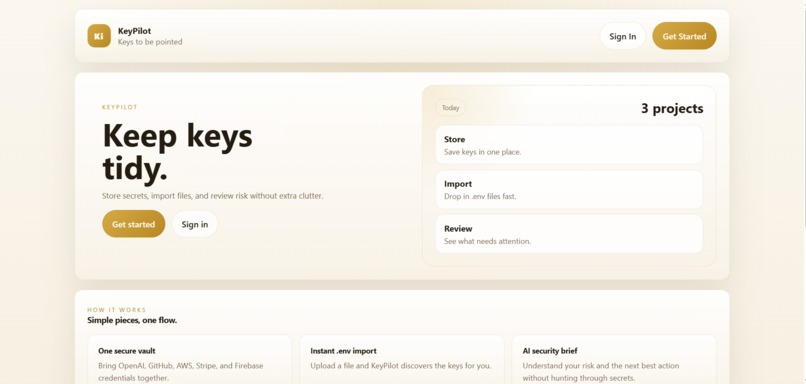
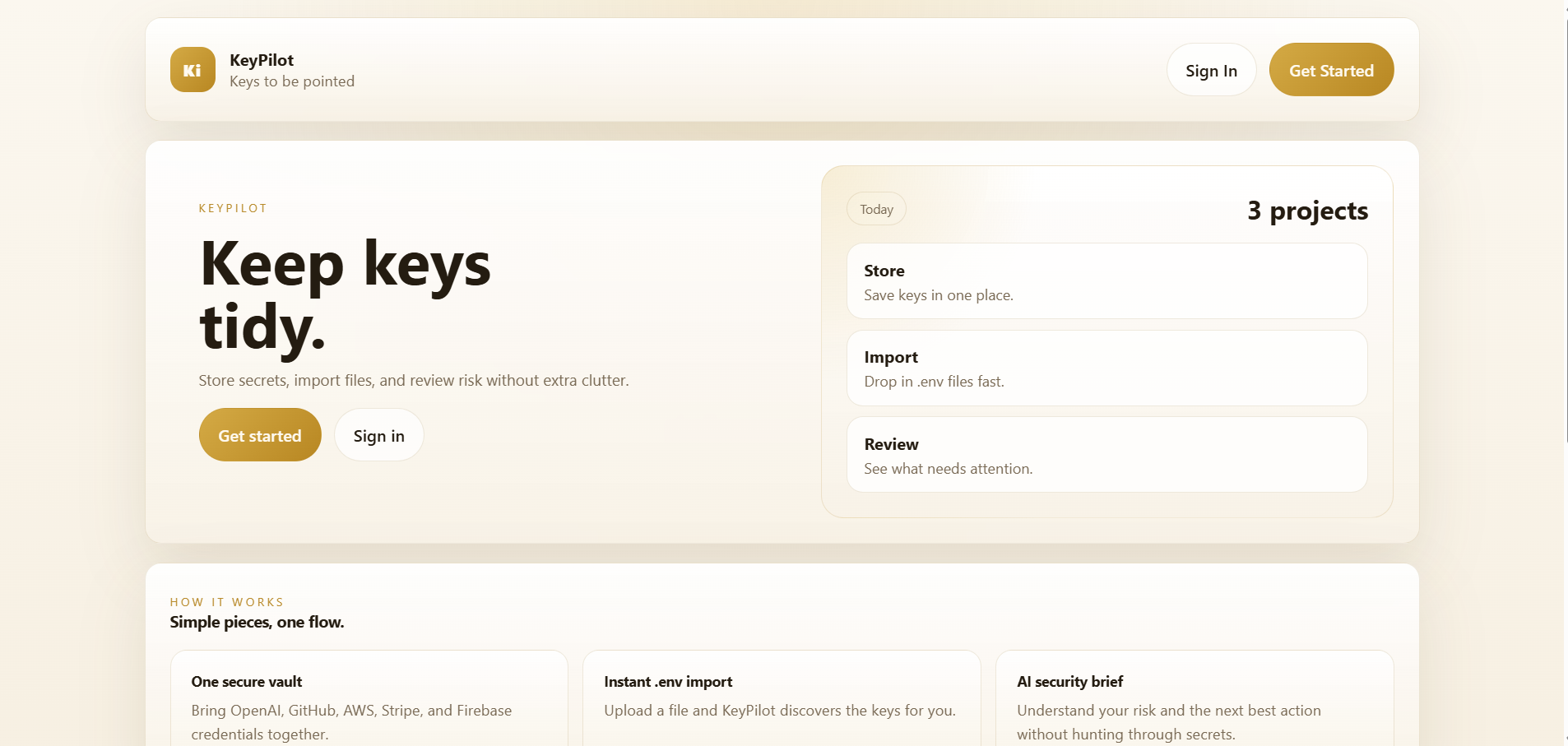
Home page
-
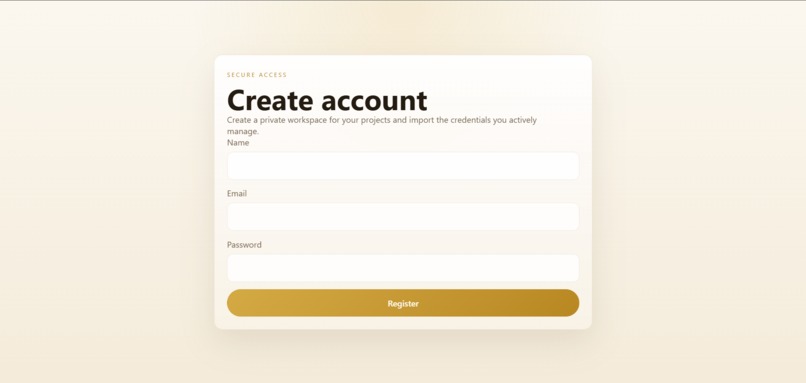
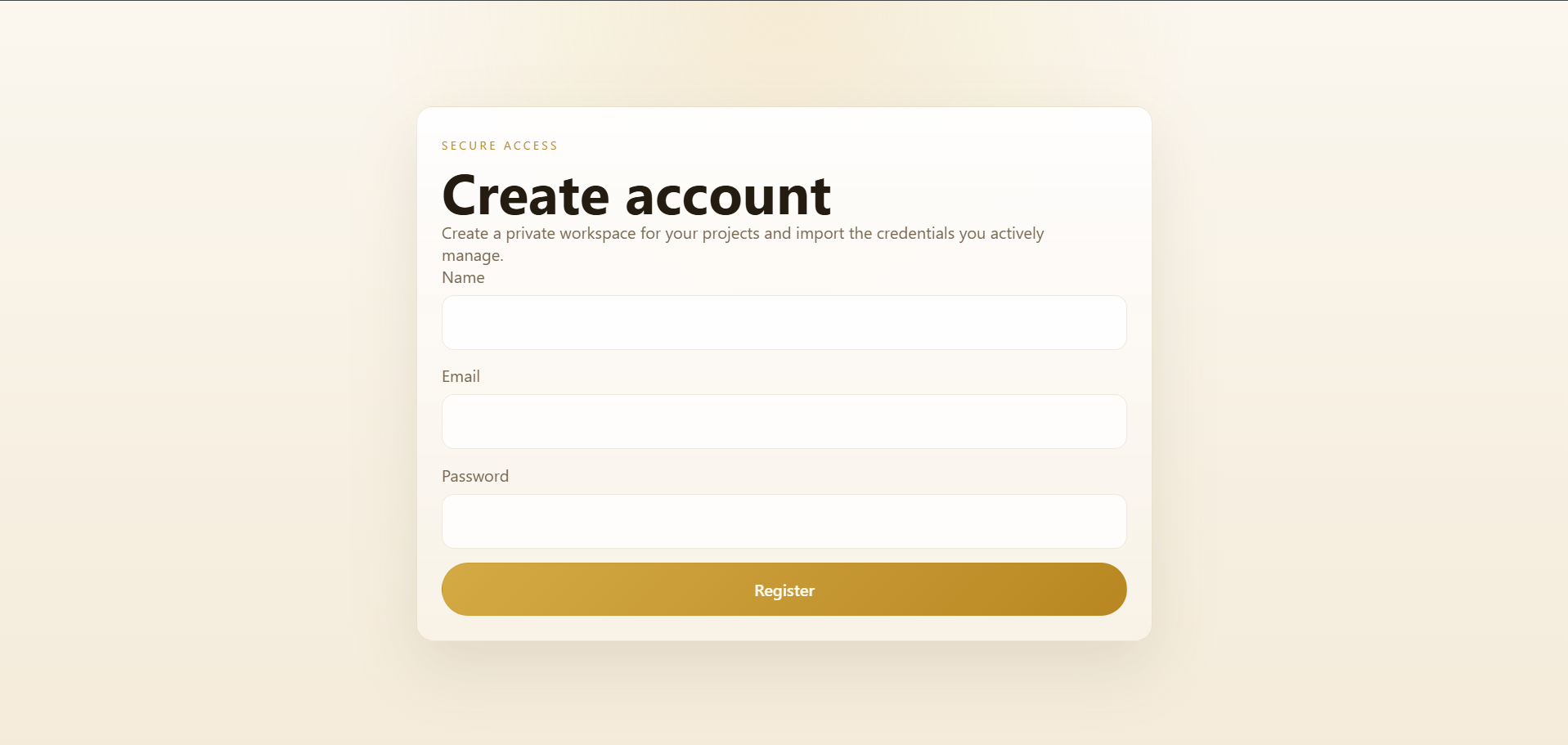
account creation
-
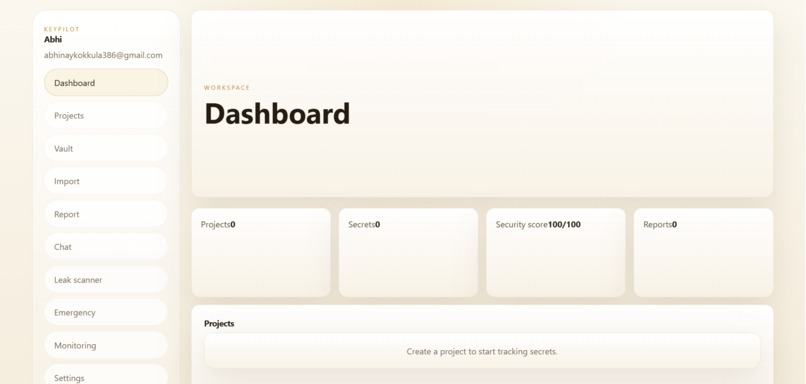
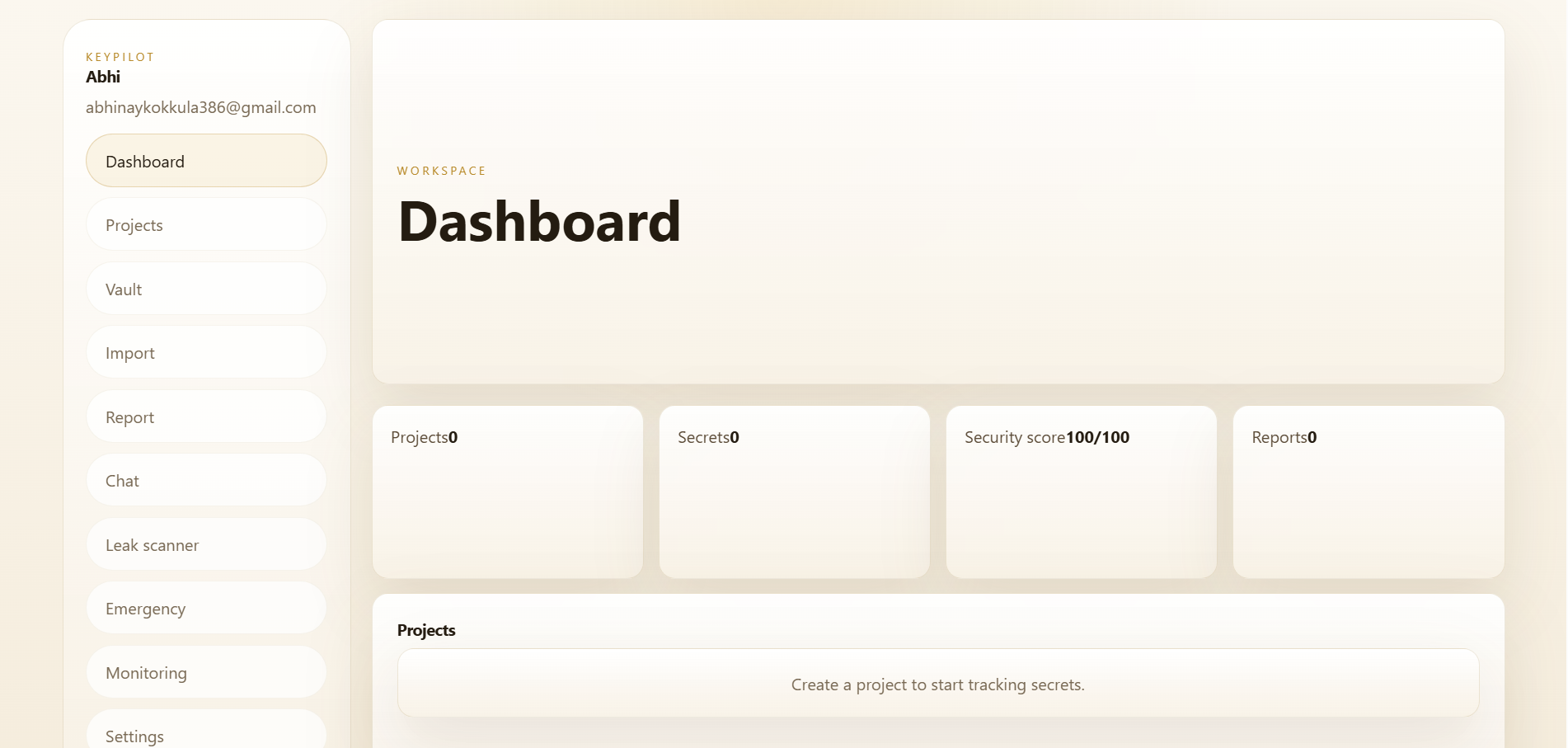
Dashboard
-
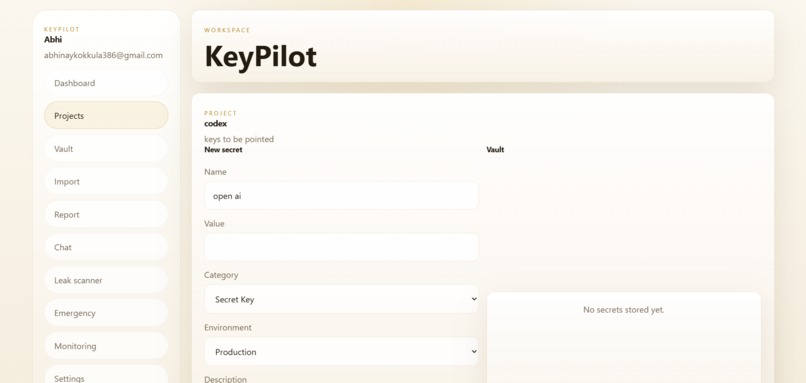
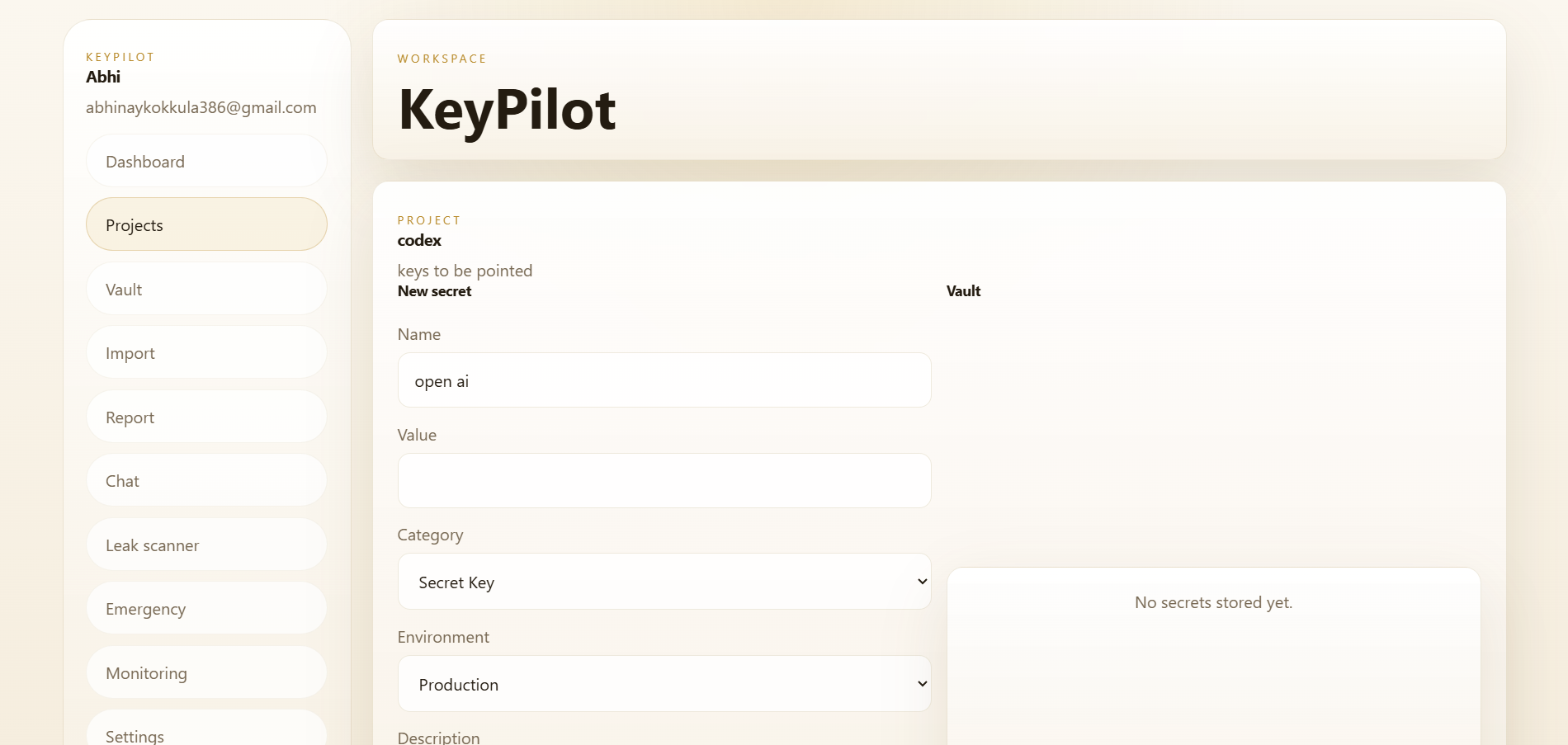
keypilot
-
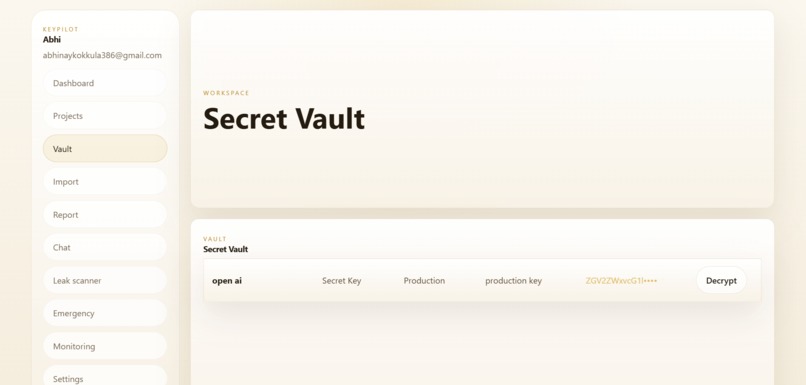
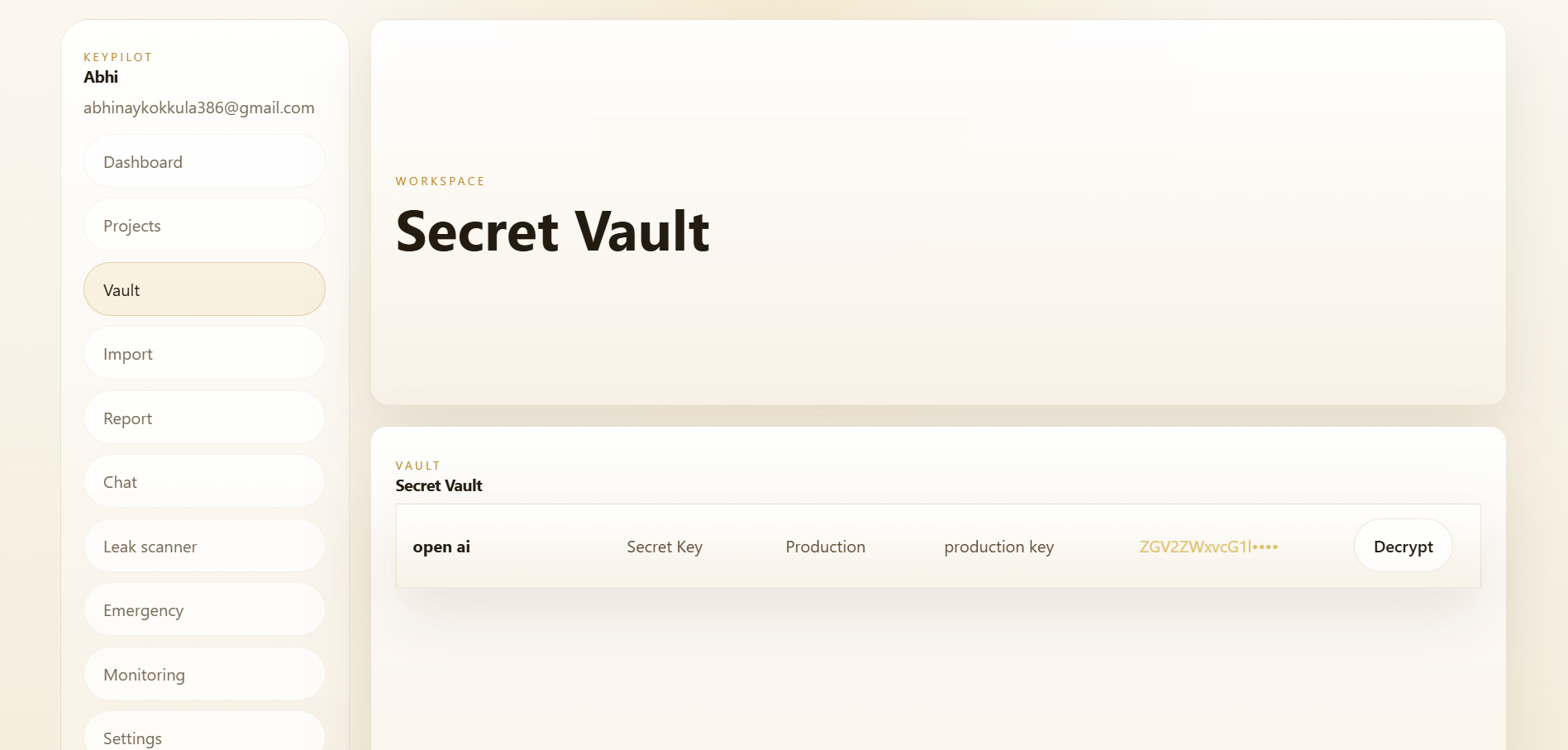
secret valut
-
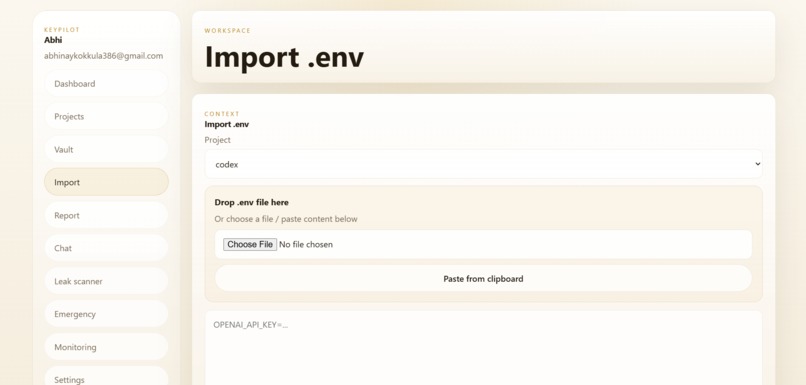
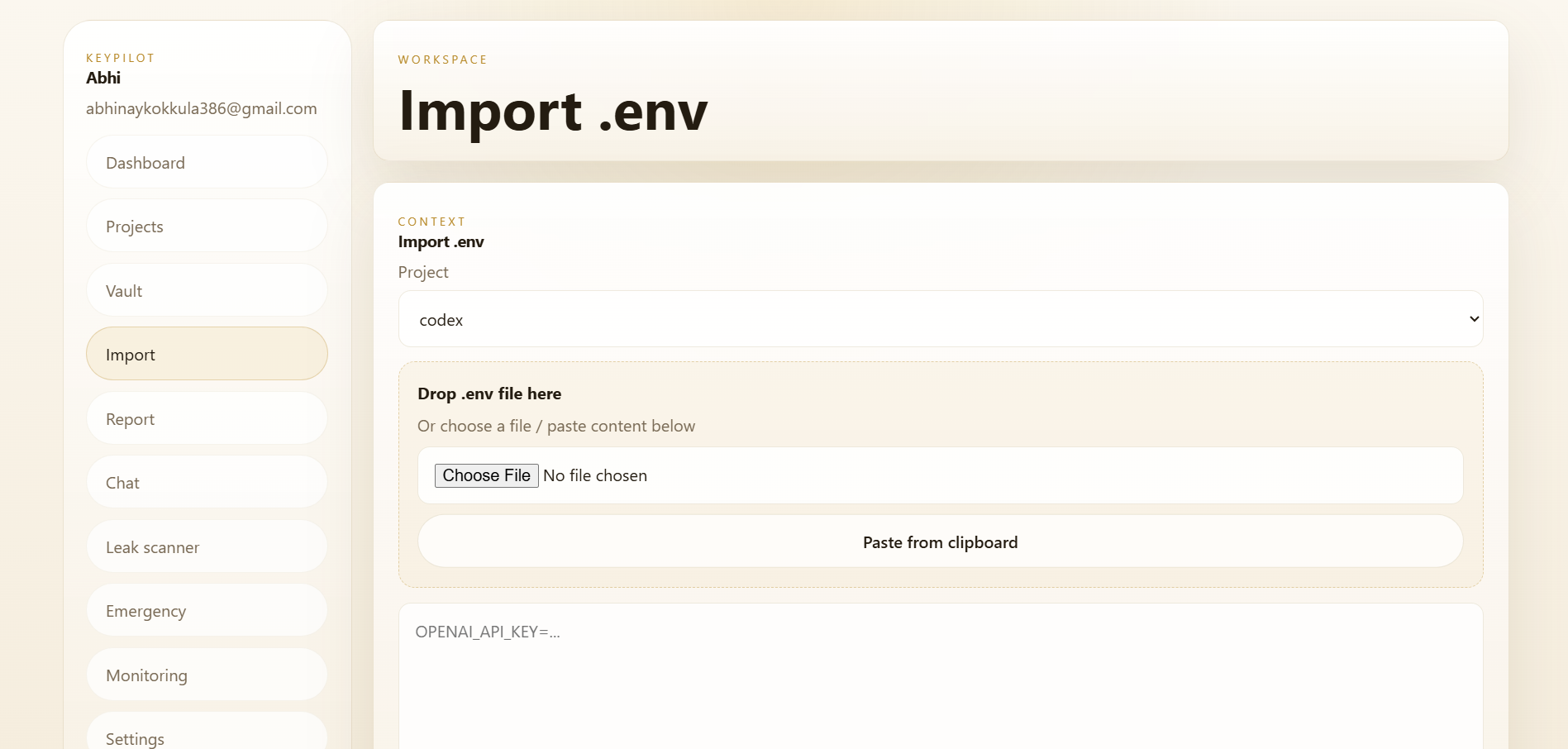
env files
-
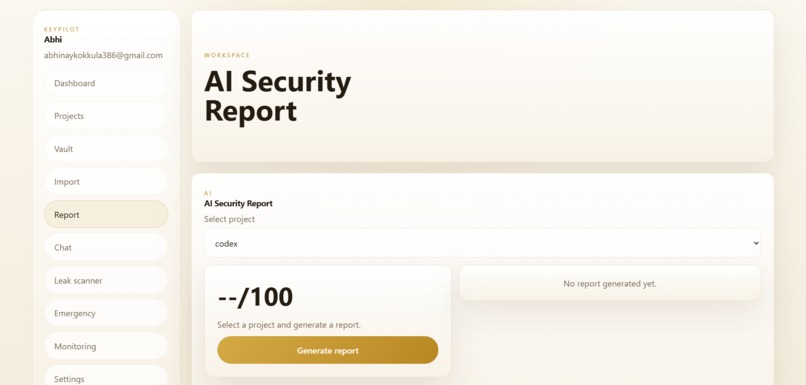
security report
-
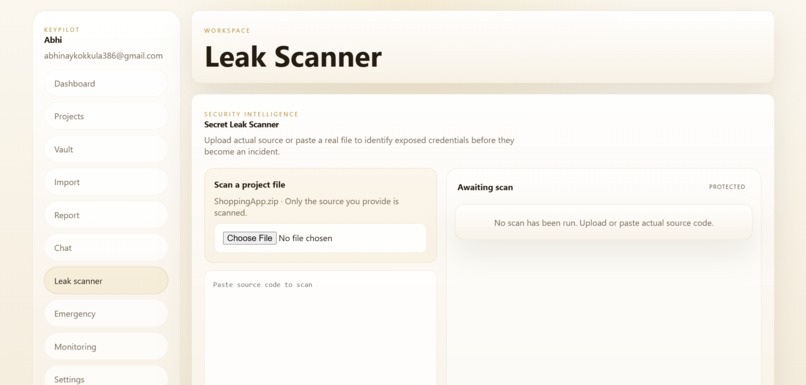
scanner
-
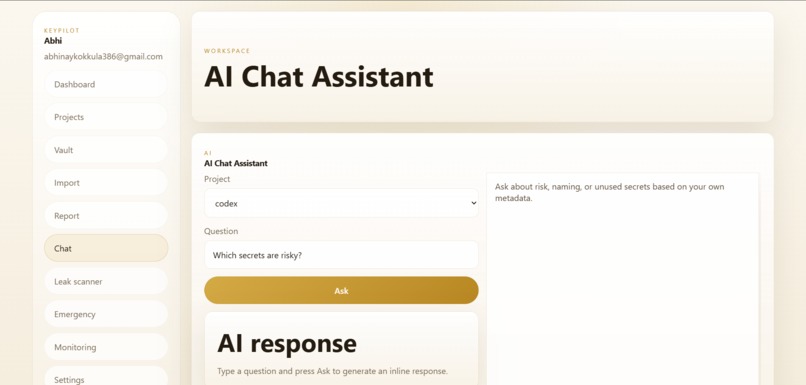
chat assistant
-
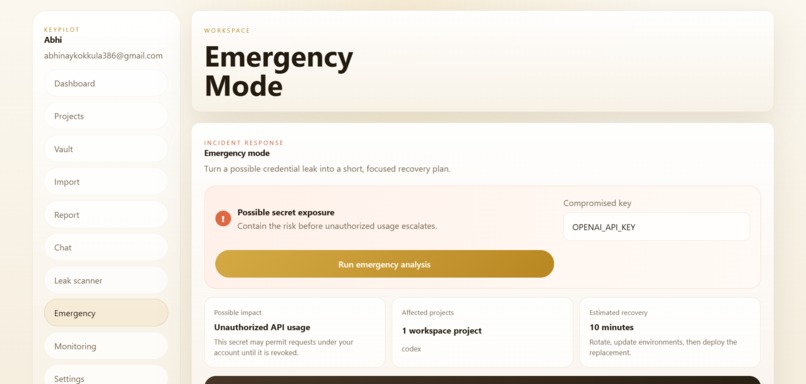
emergency
Inspiration
Every developer has experienced the same problem: API keys scattered across multiple places. Some live in .env files, some in .env.local, some in cloud dashboards, browser notes, messaging apps, or even old desktop folders. As projects grow, managing these secrets becomes increasingly difficult, leading to poor organization, forgotten credentials, accidental exposure, and security risks.
Existing secret managers focus primarily on storage. We wanted to build something more intelligent—a platform that not only stores API keys securely but also understands them, analyzes their security posture, and helps developers make better decisions.
That idea became KeyPilot, an AI-powered API Key Manager that acts as a security copilot for developers.
One of our goals for this hackathon was also to explore how modern AI-assisted development can dramatically accelerate software engineering. We challenged ourselves to build the entire project using the OpenAI Codex free plan, demonstrating that powerful developer tools can help small teams transform ideas into working products within a hackathon.
What it does
KeyPilot provides a secure, centralized workspace where developers can organize and manage API keys from multiple providers including OpenAI, GitHub, AWS, Stripe, Firebase, and many more.
The platform combines traditional secret management with AI-powered intelligence.
Centralized API Key Vault
Store and organize all API keys in one secure dashboard instead of keeping them across multiple files and platforms.
Automatic .env Import
Instead of manually adding every key, users simply upload a .env file.
KeyPilot automatically:
- Detects API keys
- Identifies providers
- Creates organized entries
- Eliminates manual work
AI Security Analysis
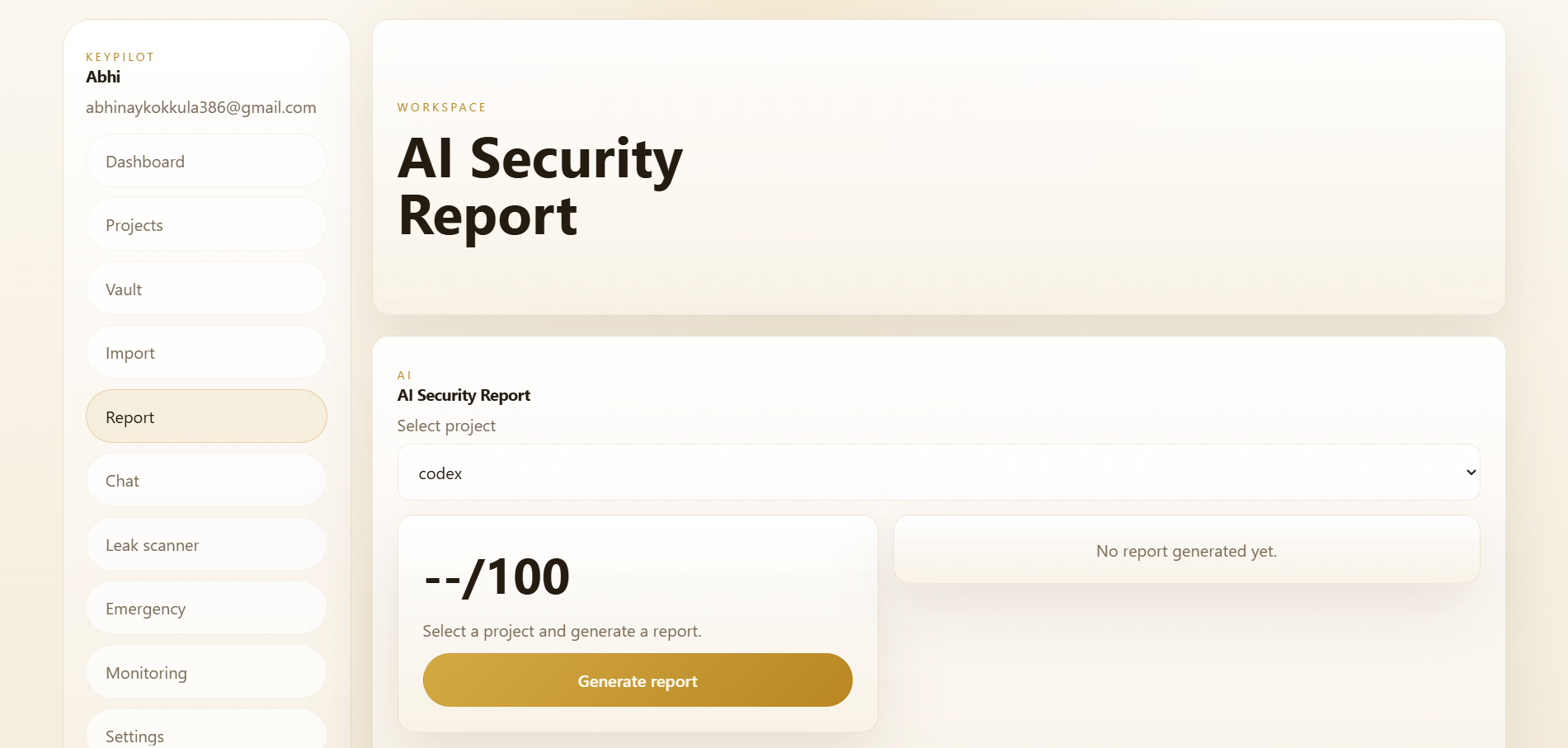
After importing, KeyPilot automatically analyzes the stored credentials and generates a security assessment.
The analysis includes:
- Overall security score
- Missing descriptions
- Stale or outdated credentials
- Keys shared across multiple projects
- Recommendations for improving security
This feature is powered by GPT-5.6, which evaluates the imported credentials and produces contextual security recommendations rather than simple rule-based warnings.
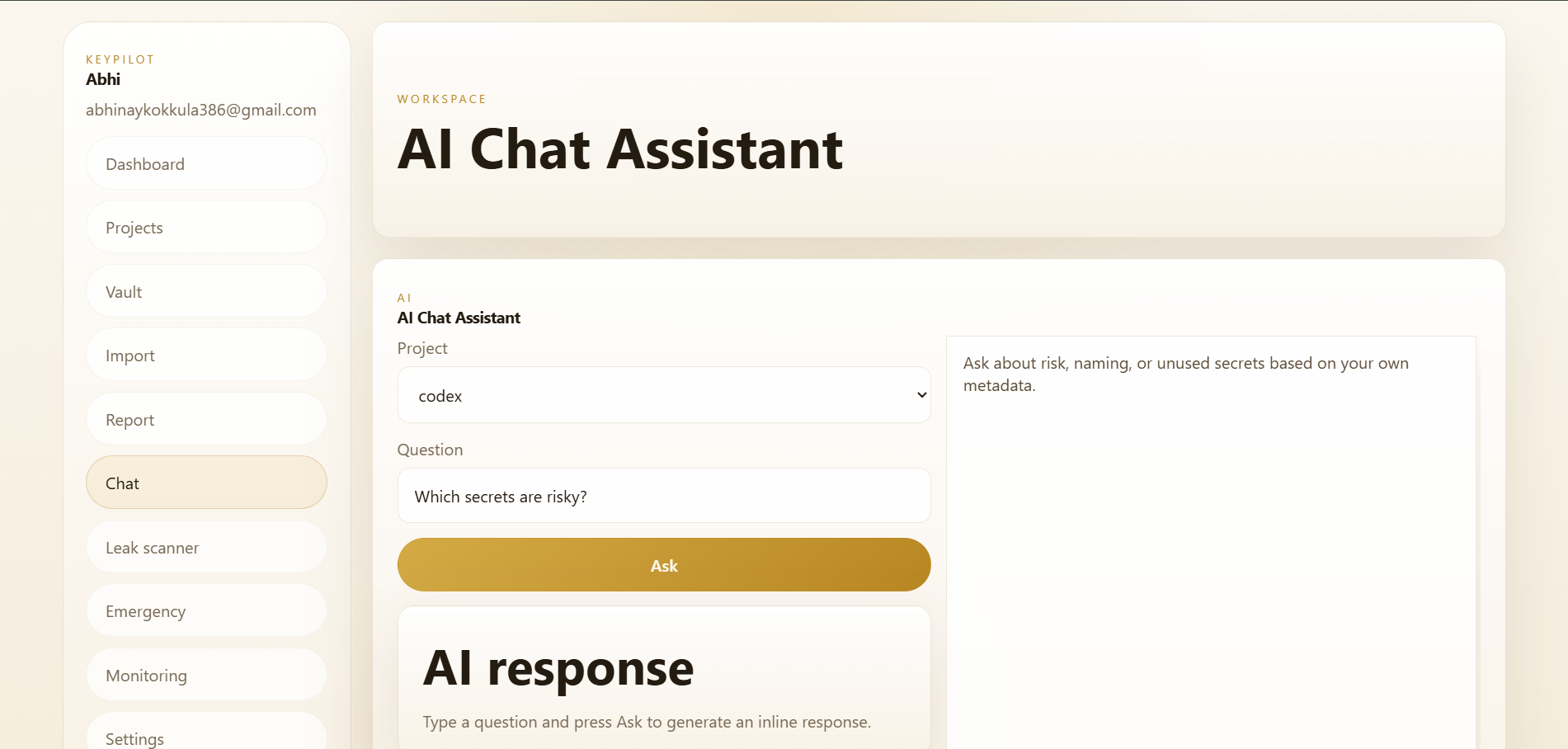
AI Assistant
Developers can interact with their secrets using natural language.
Examples include:
- Which keys are unused?
- Which key belongs to my ecommerce application?
- Which credentials should be rotated first?
- Show all production keys.
Instead of manually searching, developers simply ask. GPT-5.6 understands these natural language questions and generates relevant, contextual answers based on the imported API key metadata.
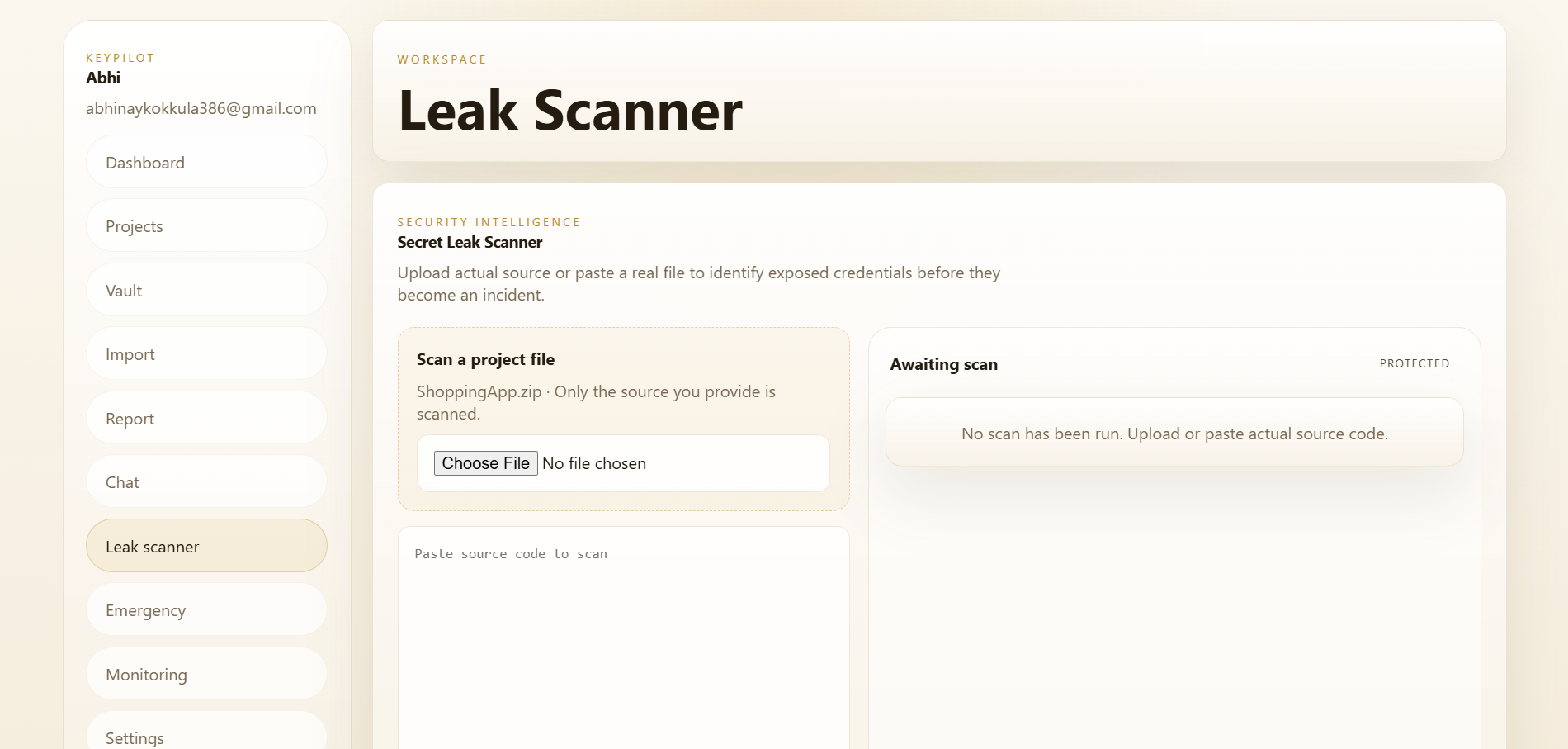
Secret Leak Scanner
Users can upload a project folder or ZIP archive.
KeyPilot scans source files for exposed secrets and reports:
- Secret type
- File location
- Risk level
- Recommended actions
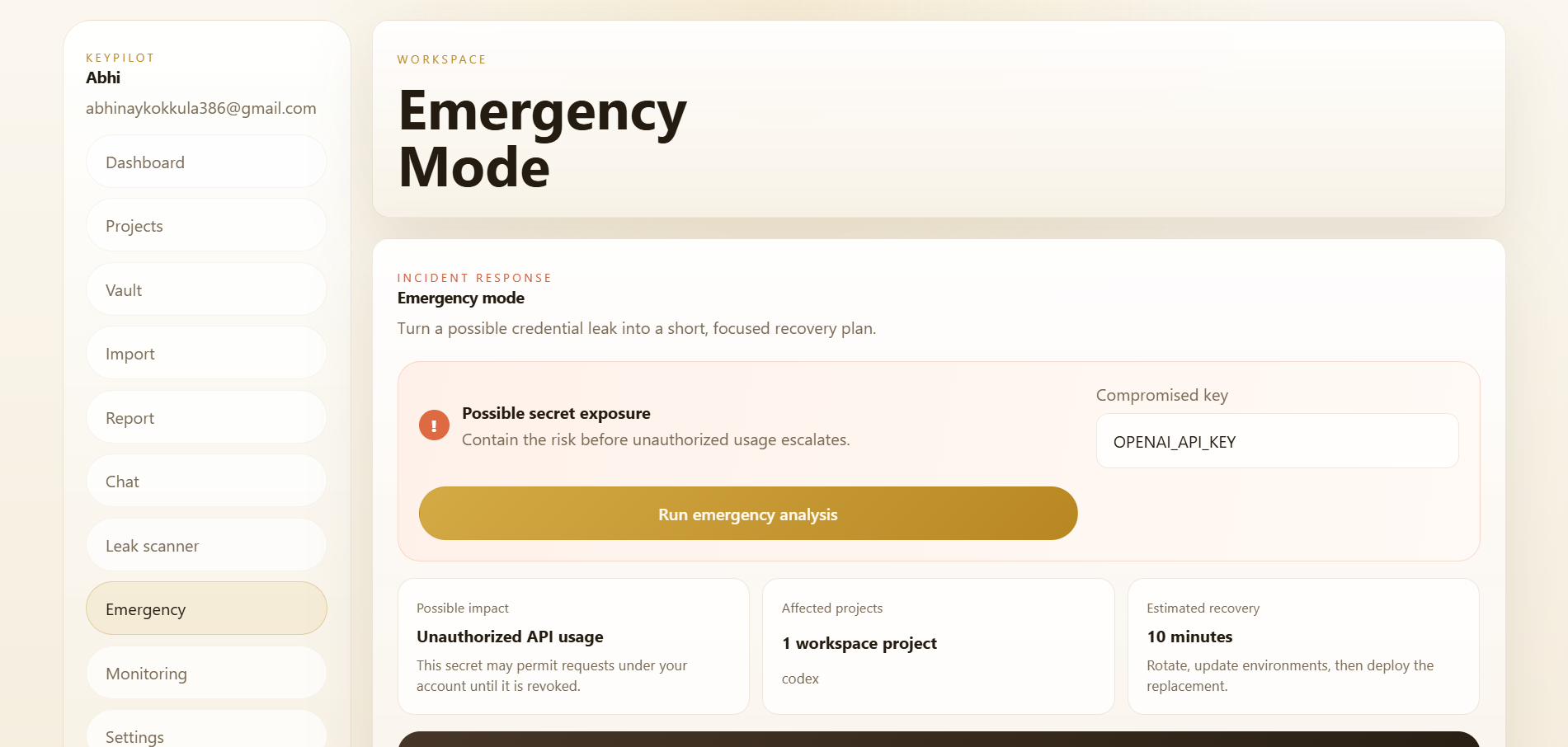
Emergency Mode
If a credential is compromised, KeyPilot performs an impact analysis.
It identifies:
- Potential consequences
- Affected projects
- Immediate recovery steps
- Estimated recovery effort
GPT-5.6 generates a personalized recovery strategy, helping developers respond quickly instead of only identifying the problem.
How we built it
KeyPilot was developed using a modern full-stack architecture focused on developer experience and security.
Frontend: React Vite Tailwind CSS
Backend: Node.js Express.js
Storage: Secure database for API key metadata
AI Layer GPT-5.6 for:
- Security analysis
- Natural language querying
- Emergency impact assessment
- Security recommendations
Using Codex Throughout Development
One unique aspect of this project is that the entire application was built using the OpenAI Codex free plan.
Codex acted as our AI development partner throughout the hackathon by helping us:
- Design the overall project architecture.
- Build React components and backend APIs.
- Generate boilerplate code.
- Debug implementation issues.
- Improve UI structure.
- Optimize prompts for GPT-5.6.
- Refactor and document the codebase.
- Accelerate development while maintaining code quality.
By combining deterministic security checks with GPT-5.6 reasoning, KeyPilot delivers recommendations that are practical, contextual, and easy to understand.
Challenges we ran into
Building an AI-powered security product introduced several interesting challenges.
One major challenge was deciding where AI genuinely adds value and where traditional programming is more reliable.
Another challenge was building the entire application within the hackathon timeline while relying only on the OpenAI Codex free plan as our AI coding assistant.
We also worked through challenges such as:
- Parsing multiple
.envformats reliably. - Detecting secrets while minimizing false positives.
- Designing prompts that produce actionable security recommendations.
- Building an intuitive interface for security information.
- Balancing usability, performance, and security within the limited hackathon timeframe.
Accomplishments that we're proud of
We are proud that KeyPilot goes beyond being another password vault.
Highlights include:
- Building an intelligent API key management platform.
- Automating
.envimports to eliminate repetitive manual work. - Creating GPT-5.6-powered security reports with meaningful recommendations.
- Developing a conversational AI interface for managing credentials.
- Building a practical secret leak scanner for real-world projects.
- Successfully building the complete application using the OpenAI Codex free plan during the hackathon.
- Delivering an end-to-end working prototype within the hackathon timeline.
What we learned
This project taught us that AI delivers the most value when paired with deterministic software engineering.
Throughout the development process we learned:
- Secure secret management principles.
- Prompt engineering for developer tooling.
- Building AI experiences that solve real problems.
- Combining rule-based security checks with GPT-5.6 reasoning.
- Designing products that improve developer productivity without sacrificing security.
- How AI coding assistants like Codex can significantly accelerate software development while allowing developers to stay focused on solving the core problem.
What's next for KeyPilot
Our vision is to transform KeyPilot into a complete AI security copilot for developers and engineering teams.
Future improvements include:
- End-to-end encrypted cloud synchronization.
- One-click API key rotation with supported providers.
- GitHub and GitLab integrations.
- Continuous secret monitoring.
- Browser extension support.
- Team workspaces with role-based permissions.
- CI/CD pipeline integration.
- Compliance and audit reporting.
- Enterprise security dashboards.
- Support for additional cloud providers and secret management platforms.
- Smarter GPT-powered security insights with historical risk tracking and proactive recommendations.
We believe secret management should not stop at storage. It should actively help developers prevent security incidents before they happen.
OpenAI Build Week
KeyPilot was created as part of the OpenAI Build Week Hackathon.
Throughout the project, we leveraged the OpenAI Codex free plan as our AI software engineering partner to design, develop, debug, and refine the application. We also integrated GPT-5.6 into KeyPilot to power intelligent security analysis, conversational querying, and emergency incident guidance.
This project demonstrates how modern AI can enhance both the software development process and the final developer experience, all while being built using freely available OpenAI tools during the hackathon.
Built With
- css
- express.js
- gpt-5.6
- node.js
- react
- tailwind
- vercel
- vite

Log in or sign up for Devpost to join the conversation.