-
-
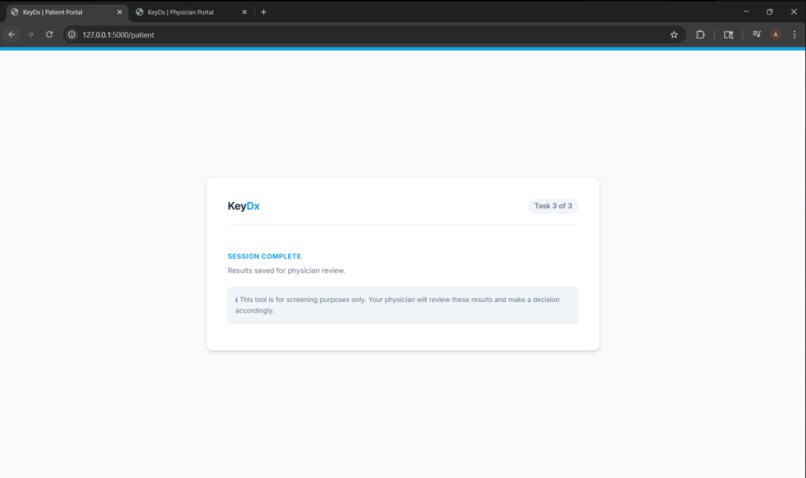
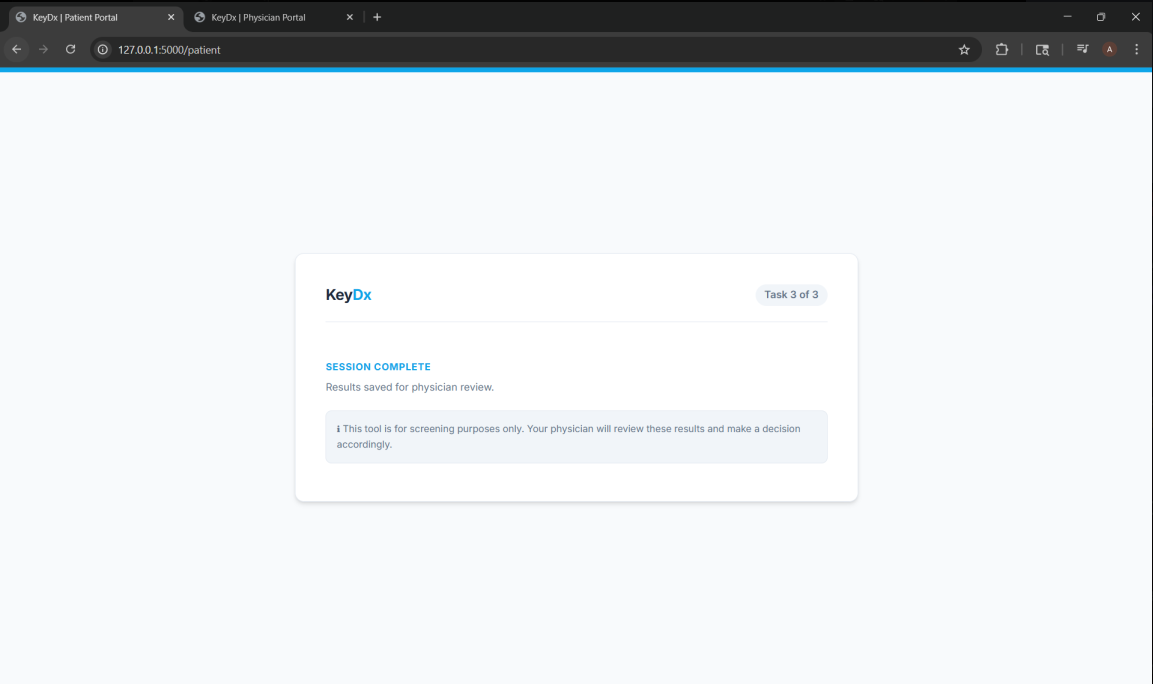
Patient Test Complete
-
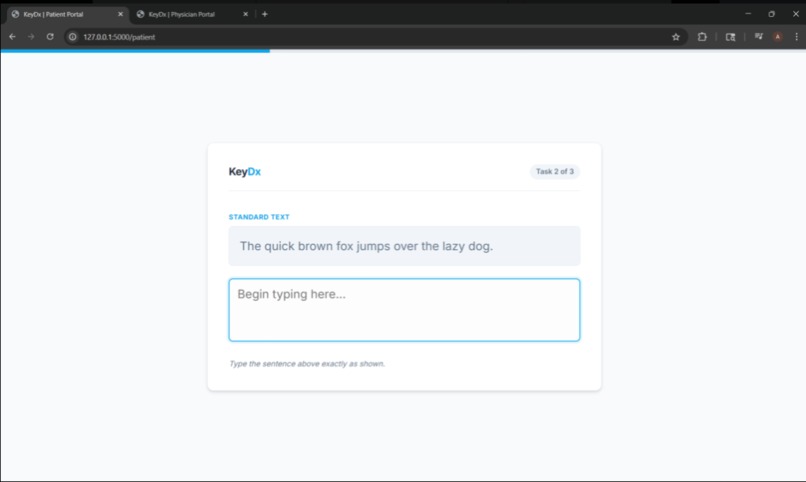
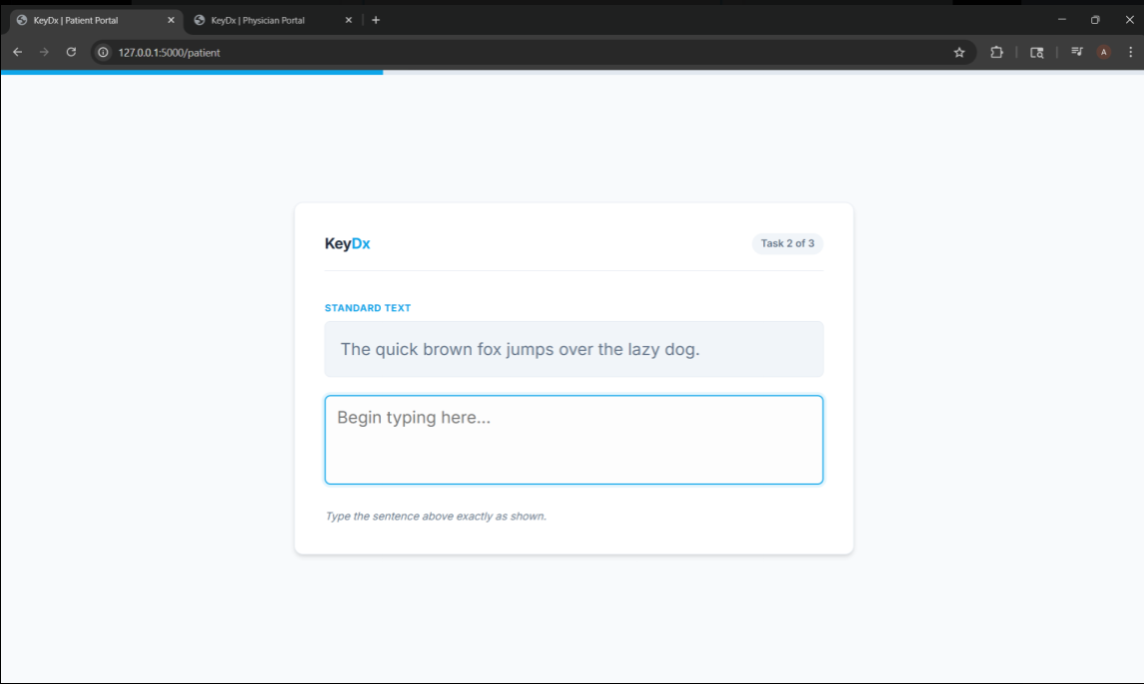
Patient Typing Test
-
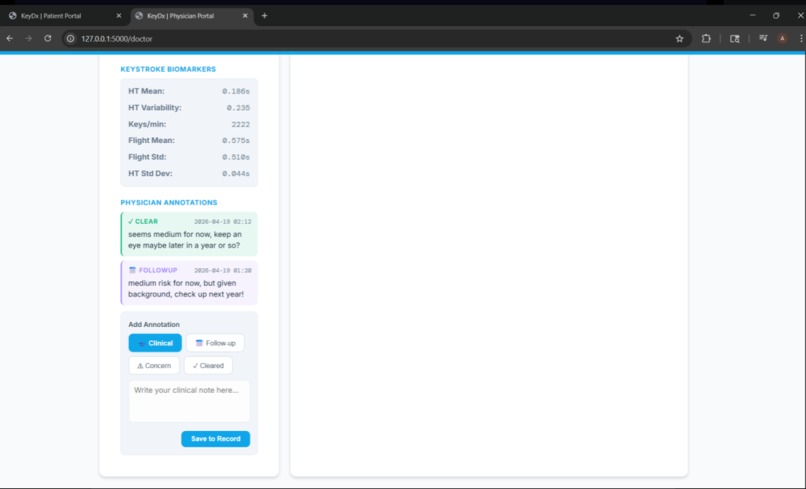
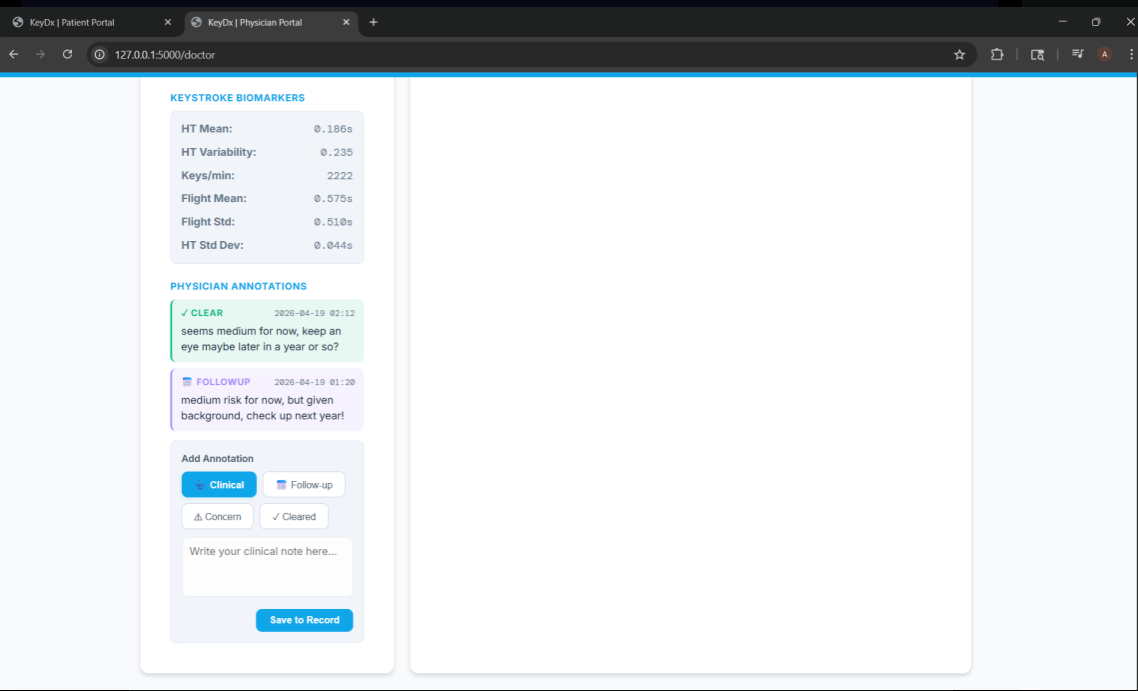
Patient Details Access for Doctor
-
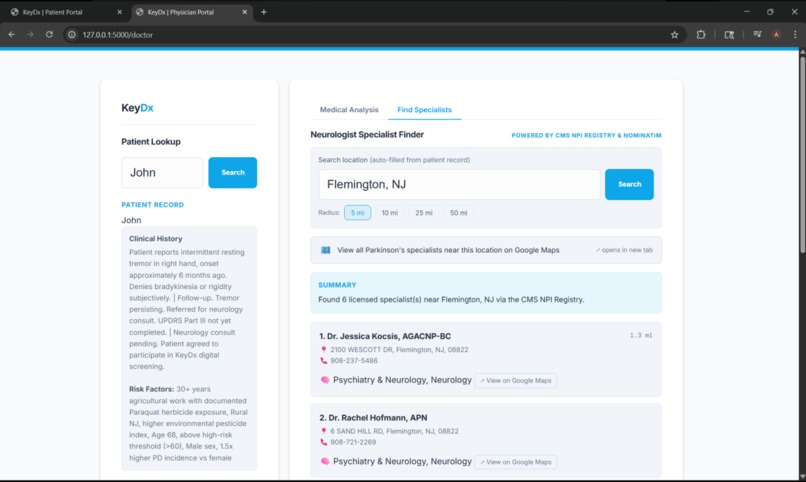
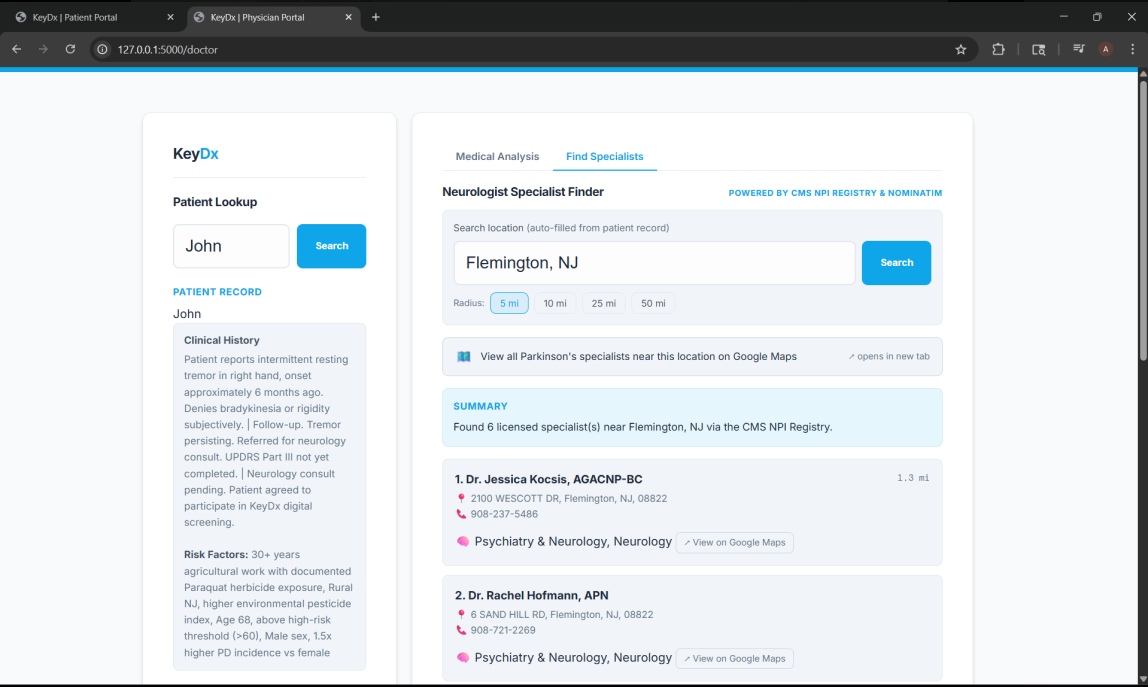
Specialist Locator Within Radius
-
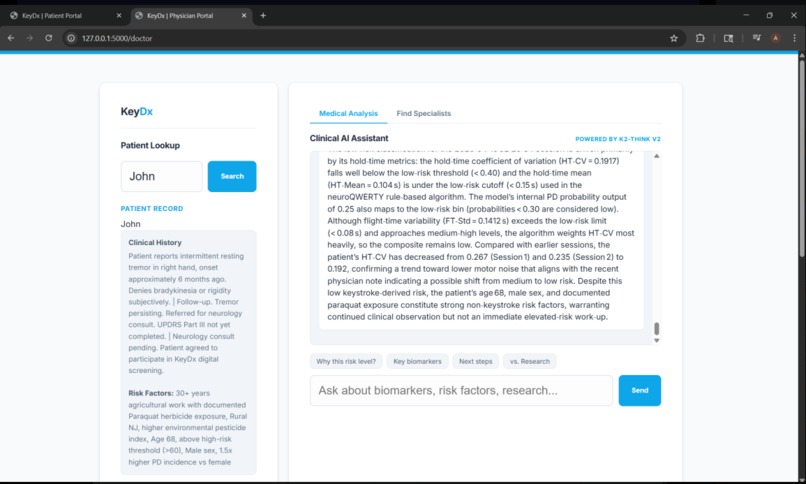
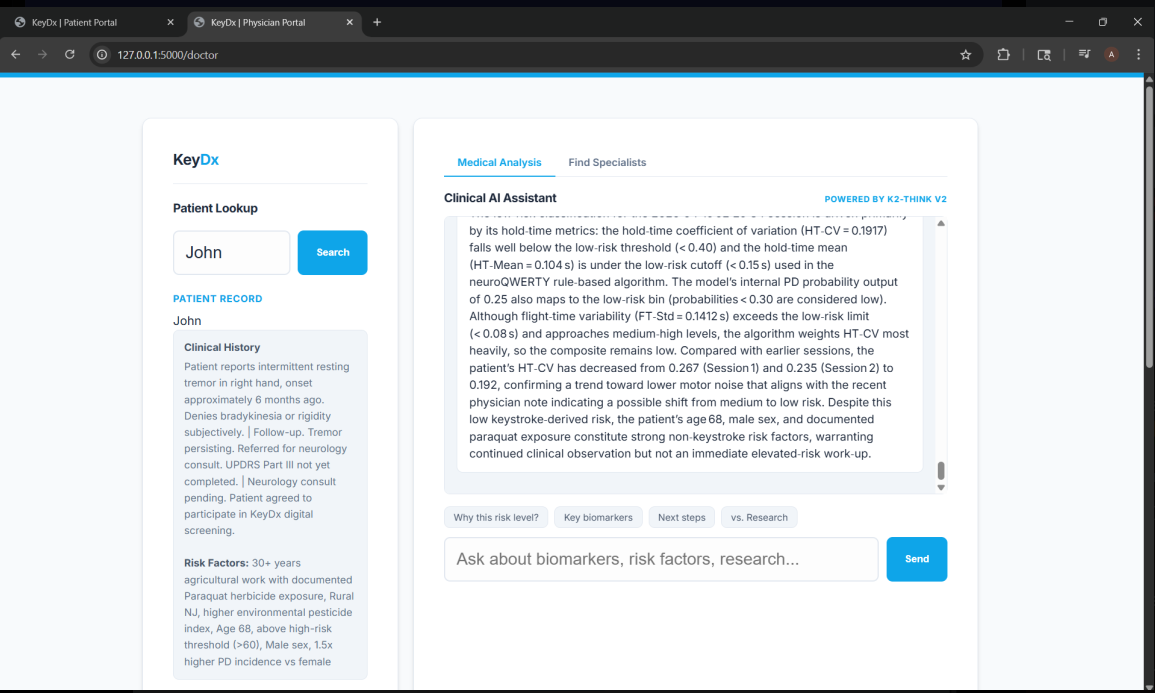
AI Assistant for Doctor
Inspiration
After discovering the neuroQWERTY dataset, which maps typing dynamics to Parkinson’s Disease (PD), we realized that a simple keyboard could serve as a non-invasive sensor for early neurological decline. Our mission was to build an end-to-end tool that empowers patients with early detection and provides doctors with AI-synthesized clinical reasoning.
What it does
KeyDx is a dual-interface platform designed for both patients and healthcare providers. Patient Interface: Users complete three specific typing tasks: repetitive, transcription, and natural rhythm, while the system captures raw keystroke timing. Doctor Portal: Clinicians can search for a patient by name to retrieve a diagnostic summary that integrates biometric analysis with pre-loaded clinical history. AI Diagnostic Assistant: Powered by the K2-Think-V2 model, the platform provides a "thinking" trace that explains how specific motor control variances in the data align with established research findings.
How we built it
The project was constructed as a robust full-stack application using an engineering-first approach: Data Science: We analyzed the MIT-CS1PD and CS2PD datasets in Python to identify high-stakes features. We focused on Hold Time $$HT$$ and its Coefficient of Variation $$HT_{cv}$$ where $$HT_{cv} = \frac{\sigma_{HT}}{\mu_{HT}}$$ Machine Learning: We trained a Random Forest Classifier that achieved a high AUC of 0.919 for early PD detection by prioritizing motor instability metrics. Backend: A Flask server serves as the "Medical Vault," managing data processing and hosting a centralized library of research papers for context. High-Reasoning AI: We integrated the K2-Think-V2 model via an OpenAI-compatible API to perform long-context synthesis of typing data, patient history, and research papers.
Challenges we ran into
Evolving Beyond Raw Typing: Initially, our project focused solely on keyboard typing dynamics, but we realized that raw metrics alone lacked the clinical depth necessary for high-stakes analysis. To overcome this, we integrated our platform with existing neuroQWERTY research, specifically focusing on the statistical significance of Hold Time $$HT$$ and Hold Time CV $$HT_{cv}$$ to ground our predictions in validated science.
Designing for the Clinical Workflow: We initially envisioned a generic tool, but pivoted to a specialized interface for Primary Care Physicians (PCPs). This required building a "Doctor Portal" that could bridge the gap between complex engineering biomarkers and actionable medical advice.
Building a Specialist Support System: Recognizing that a "High Risk" result is only the first step, we developed a specialized tab where doctors can immediately suggest neurology specialists. This ensures that patients at risk of Parkinson's have a clear pathway to professional care rather than just receiving a binary prediction.
Accomplishments that we're proud of
End-to-End Integration: We successfully connected raw hardware input (keystrokes) to a high-level reasoning model that can explain the "why" behind its diagnosis.
Standardized Precision: Our preprocessing pipeline strictly adheres to the neuroQWERTY standards, ensuring our front-end data is as scientifically valid as the original MIT study.
Dual-User Experience: We created a professional, consistent design for both the patient and the doctor, keeping the engineering complexity on the backend while providing a streamlined interface for the clinic.
What we learned
Long-Context Value: We learned that the K2-Think-V2's 256K context window allows us to bypass complex vector database setups by injecting entire research papers directly into the prompt for deep reasoning.
Biometric Nuance: Through data analysis, we learned that the variance in how long someone holds a key is often a more powerful indicator of early PD than the actual typing speed.
Clinical Human-in-the-Loop: We reinforced the lesson that AI in healthcare should not replace doctors but rather empower them with synthesized, data-driven insights.
What's next for KeyDx
Dynamic Patient Files: Transitioning the "Medical Vault" from a static backend structure to a dynamic database like PostgreSQL for real-time history tracking.
Running a Study: Working towards getting grants to run larger study with focus on KeyDx and its accuracy and credibility.
Mobile Support: Adapting the keystroke capture logic for mobile devices to monitor fine motor control through touchscreen interactions.
Built With
- css
- flask
- gemini
- html
- javascript
- openai
- pyth

Log in or sign up for Devpost to join the conversation.