Inspiration
QNX has a kernel event tracer, tracelogger, and a printer, traceprinter. The graphical view of those traces, the System Profiler, lives in the Momentics IDE. The author works on a Mac, and QNX SDP 8.0 has no macOS host tools. A trace could be captured but not looked at from the machine the code was written on.
A kernel trace is the best view of a real-time system. Perfetto's web UI runs in any browser and opens Trace Event JSON. A converter gives any host OS a timeline view, and gives scripts a way to ask questions about a trace.
What it does
kevscope reads the text that traceprinter prints from a tracelogger capture of QNX SDP 8.0. It has four commands:
convertwrites Trace Event JSON for ui.perfetto.dev.viewconverts, serves the file once on 127.0.0.1:9001, and opens the Perfetto UI pointed at it.statsprints per-thread CPU time, run counts and Ready-to-Running latency.blametakes one thread and shows which threads ran on the CPU it was waiting for while it was Ready or Mutex-blocked. This finds priority inversions.--sharesprints shares without durations.convert --from/--toexports only a time window, for looking at one event up close.
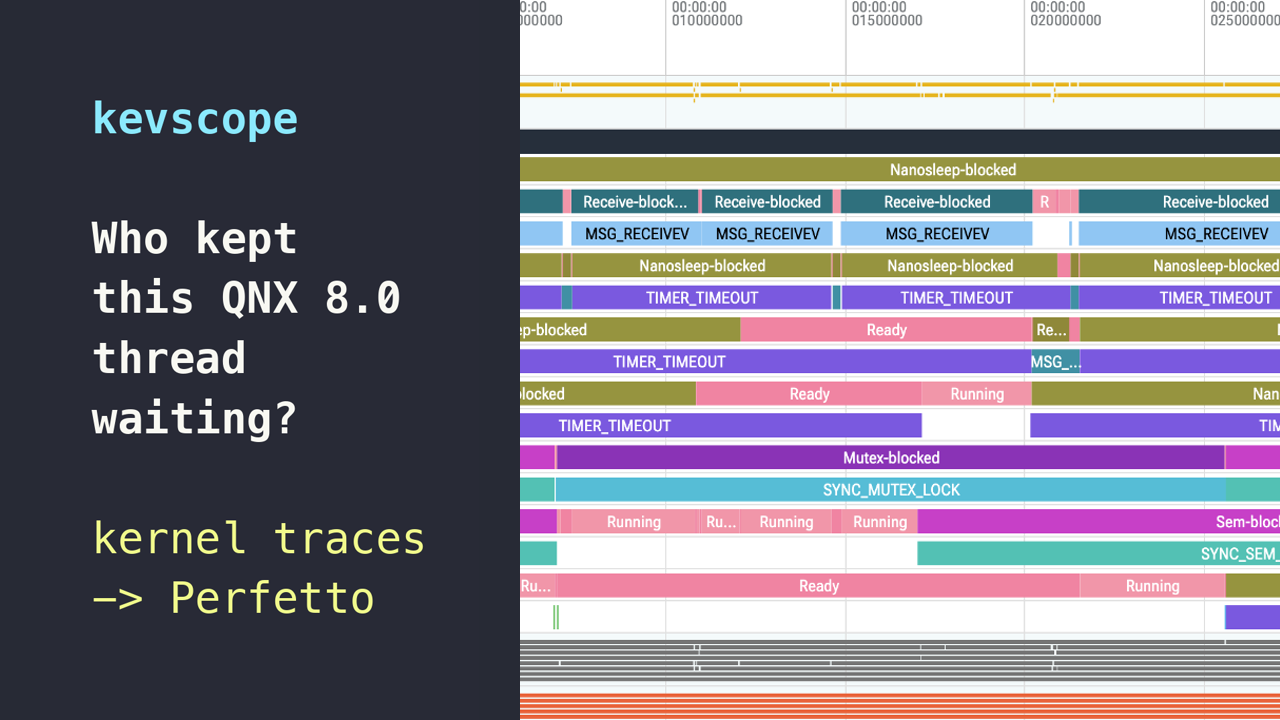
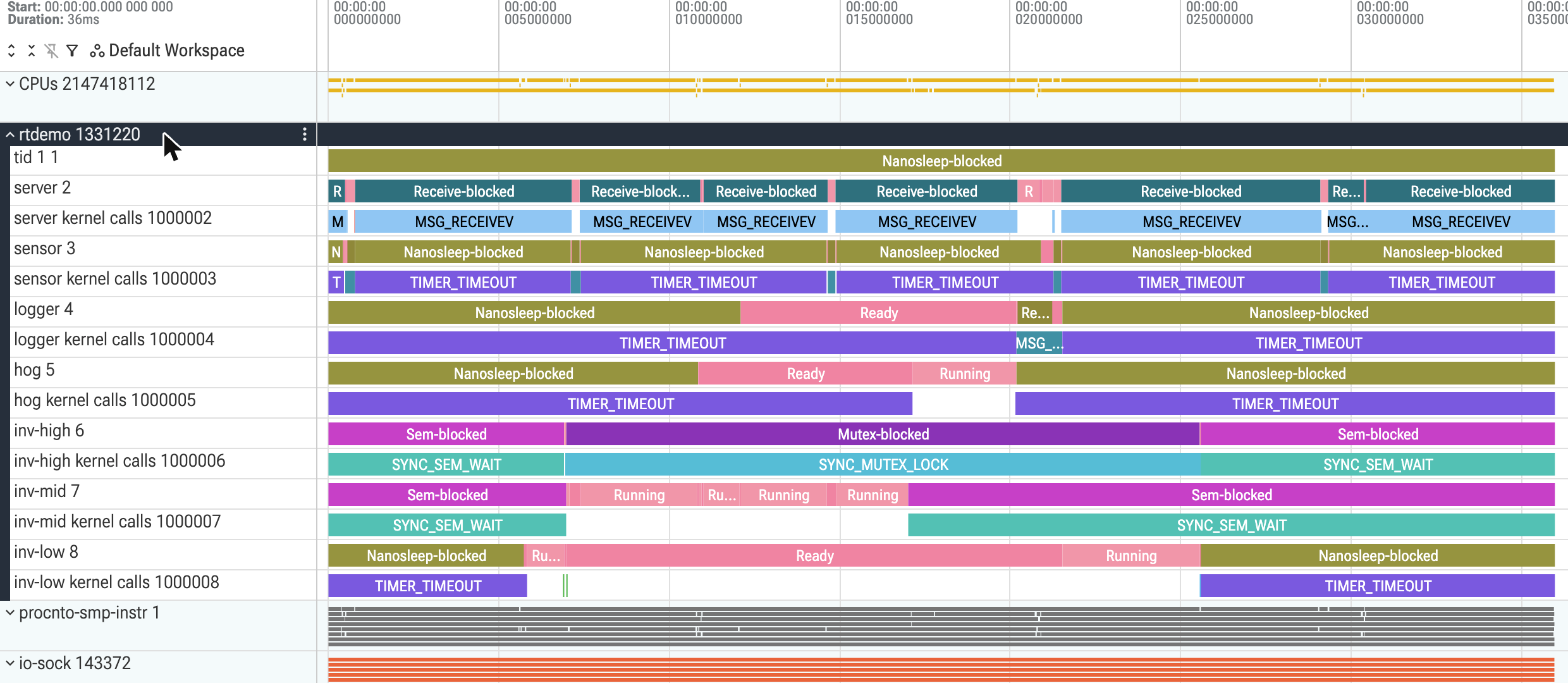
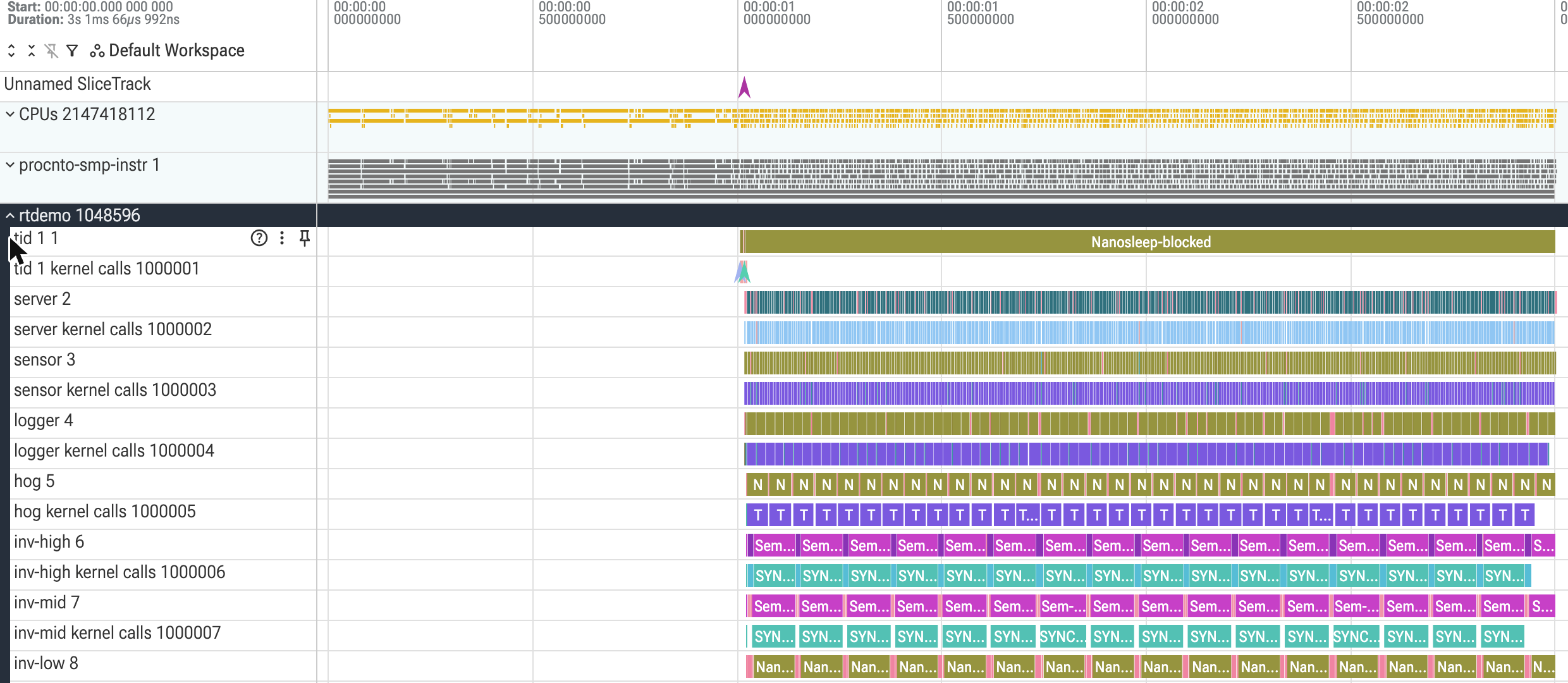
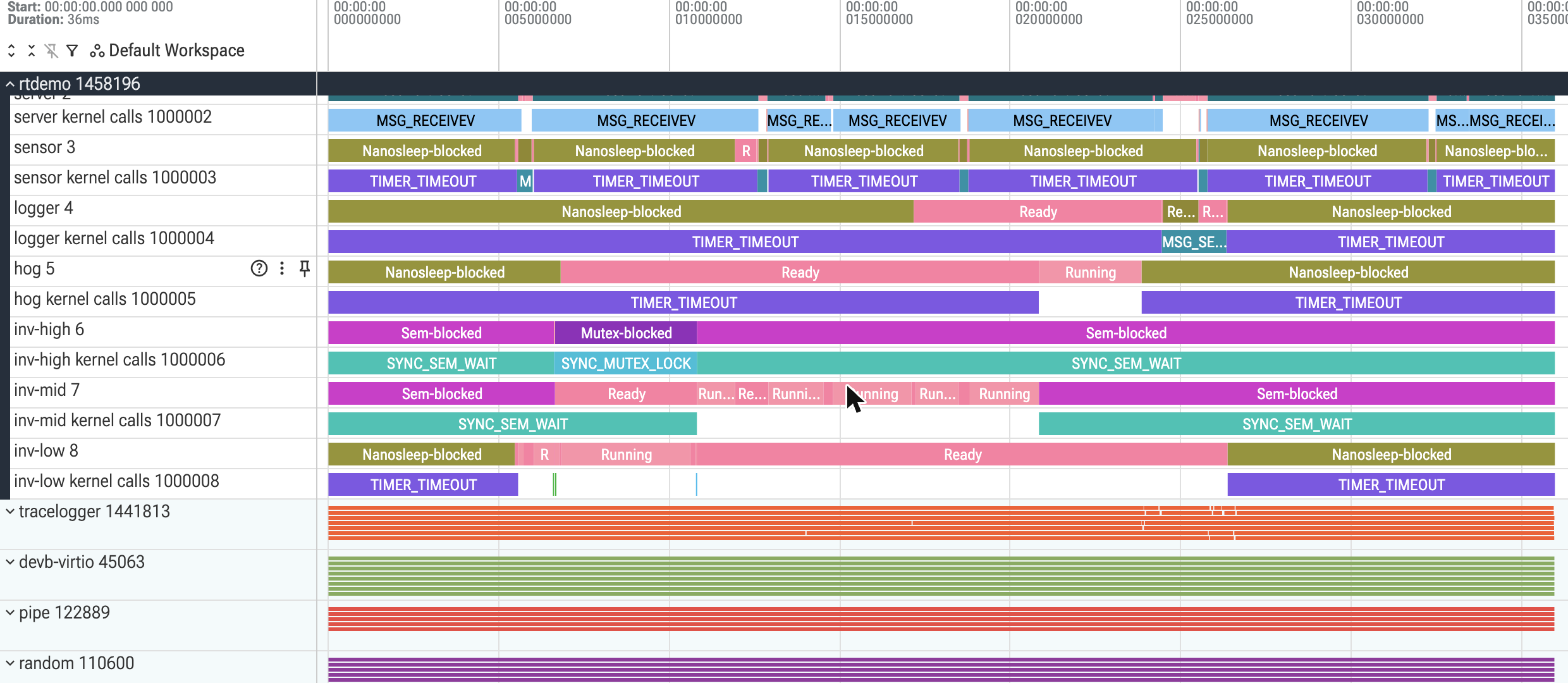
In Perfetto, each CPU has a track of which thread ran and a track of interrupts. Each QNX process is a group. Each thread has a state track (Running, Ready, Receive-blocked, Reply-blocked, Mutex-blocked and so on) and a kernel-calls track. Message passing is drawn as flow arrows. User trace events from trace_logf appear as markers.
The repository also has rtdemo, a QNX 8.0 C program that creates a classic priority inversion on purpose and can fix it with PTHREAD_PRIO_INHERIT. It is the test subject, and the demo runs it on QNX 8.0 in QEMU.
On the real run, without priority inheritance most of inv-high's mutex wait is spent with inv-mid on the CPU. With inheritance only the lock holder inv-low runs. No numbers from QNX are published, because the QNX Development License does not allow it. The examples in the repository come from a hand-written test fixture and are labelled that way.
How I built it
- Python 3.9+, standard library only. The pipeline is: text decoder, event model, timeline, then exporter and analyses.
- The decoder handles the QNX 8.0
traceprinterforms found on a real capture: 64-bit cycle counts,INT_DELIVERinterrupts,USREVENTtext and data words, and thread states that differ from the older public samples. - The workload
workload/rtdemo.cuses channels,MsgSend,MsgReceive,MsgReply, timer pulses, run masks,trace_logfand mutex protocols. It is built withqcc -Vgcc_ntoaarch64le(QNX SDP 8.0, gcc 12.2.0). - The Mac toolchain route: SDP 8.0 has no macOS host tools, so the Linux build of QNX Software Center and the SDP run in a linux/amd64 container (Docker Desktop with Rosetta).
docker/sdp.shwraps it. A fixed hostname and MAC keep the licence activation stable. The builtmkqnximageaarch64le image boots in Homebrew QEMU on the QEMUvirtmachine, using TCG.tools/trace-run.shrunstracelogger -won the target andtraceprinterin the container. - Claude Code (Anthropic) wrote most of the code under the author's direction. The author ran it, checked the results on QNX 8.0 in QEMU, and wrote the decisions about scope.
- 52 unit tests, using hand-written fixtures.
Challenges I ran into
- QNX SDP 8.0 has no macOS host tools. Solved with the Linux tools in an x86-64 container.
mkqnximagefailed with "Host file 'startup-qemu-virt' not available" until thetarget.qemuvirtpackage was installed.- HVF acceleration did not work. QNX's
startup-qemu-virtasserts ingic_v3.c, and QEMU 11 refuses GICv2 under HVF. The demo runs under TCG, which is slow. - QEMU 11 has no
virt-4.2machine, whichmkqnximage's runner requests. We usevirt-8.2. - QNX does not publish the binary
.kevlayout, so kevscope does not decode raw.kevfiles. It readstraceprintertext. - The QNX 8.0 trace text differs from the old public samples. We found the differences on a real capture.
- The Software Center login rejected passwords with a non-alphanumeric character.
- The licence forbids publishing measurements made on QNX, so every example in the docs is synthetic or qualitative.
Accomplishments that I'm proud of
- A Mac-hosted route from licence to a running QNX 8.0 system in QEMU, written down step by step in docs/codelab.md.
- A real QNX 8.0 trace opened in ui.perfetto.dev. Perfetto's SQL counts matched what the exporter wrote for states, kernel calls, interrupts and flows.
- A priority inversion caught by
blameand removed with one line of code, with the difference visible in both the report and the timeline. - 52 passing tests.
What I learned
- A priority inversion is easy to describe and easy to miss. It is plain in a timeline: a high-priority thread Mutex-blocked while an unrelated thread runs.
- QNX's tracing tools are good. The missing piece for a Mac was the viewer, not the data.
- Emulated QNX is slow but good enough to show scheduling behaviour. We did not use it to judge speed.
What's next for kevscope
- Decode raw
.kevfiles once the layout can be confirmed against real captures. - Confirm the
viewlocal-server path on more browsers. - Test on more than one machine, and on x86-64 QNX targets.
- Add more analyses, such as message round-trip time.
Where to find the QNX evidence
workload/rtdemo.c:ChannelCreate,ConnectAttach(_NTO_SIDE_CHANNEL),MsgSend,MsgReceive,MsgReply,MsgError,MsgSendPulse,timer_createwithSIGEV_PULSE_INIT,ThreadCtl(_NTO_TCTL_RUNMASK),pthread_setname_np,trace_logf,PTHREAD_PRIO_NONEandPTHREAD_PRIO_INHERIT. Functions:server_thread,client_thread,inv_low_thread,inv_mid_thread,inv_high_thread,main.workload/Makefile:qcc -Vgcc_ntoaarch64le.docker/Dockerfile,docker/sdp.sh: installs QNX Software Center and SDP 8.0, runsmkqnximage.tools/qemu-run.sh,tools/target.sh,tools/trace-run.sh,tools/demo.sh: boot, reach, trace and analyse a QNX 8.0 target.kevscope/textparse.py: parser for QNX 8.0traceprinteroutput.- The demo: QNX 8.0.0 in QEMU, console line
QNX qnx-a64 8.0.0 2026/10/30-09:09:47EDT QEMU_virt aarch64le, andrtdemoprintingrtdemo: ran 2 s on QNX, 7 threads, mutex without priority inheritance.
Build and run instructions name the version (QNX SDP 8.0, 8.0.0), the target (QEMU virt, aarch64le) and the toolchain (qcc -Vgcc_ntoaarch64le, gcc 12.2.0). They are in README.md and docs/codelab.md.
Links
- Code (Apache-2.0): https://github.com/Khozhijon/kevscope
- Codelab: https://github.com/Khozhijon/kevscope/blob/main/docs/codelab.md
- Demo video: https://youtu.be/d3WG5kz5NG0
Notices
- Built with help from Claude Code (Anthropic). The narration in the video is a synthesised voice.
- The project was started on 19 Nov 2026, inside the submission period.
- QNX is a trademark of BlackBerry Limited. kevscope is an independent project, not affiliated with or endorsed by BlackBerry.
- Limitations: no raw
.kevdecoding; HVF acceleration does not work (TCG is used); theviewlocal-server path was not confirmed end to end; tested on one Mac only.
