-
obscura
OBSCURA: AI-Powered Environmental Monitoring
Inspiration
Environmental pollution is a growing challenge that affects ecosystems, public health, and climate stability. Monitoring atmospheric pollutants across large geographical areas is difficult, especially in locations where ground-based monitoring stations are limited.
We were inspired by the potential of satellite imagery, environmental data, and machine learning to make environmental monitoring more scalable and data-driven.
Our goal was to explore how artificial intelligence could help estimate atmospheric pollution indicators across industrial facilities, including locations where direct measurements may be unavailable.
What it does
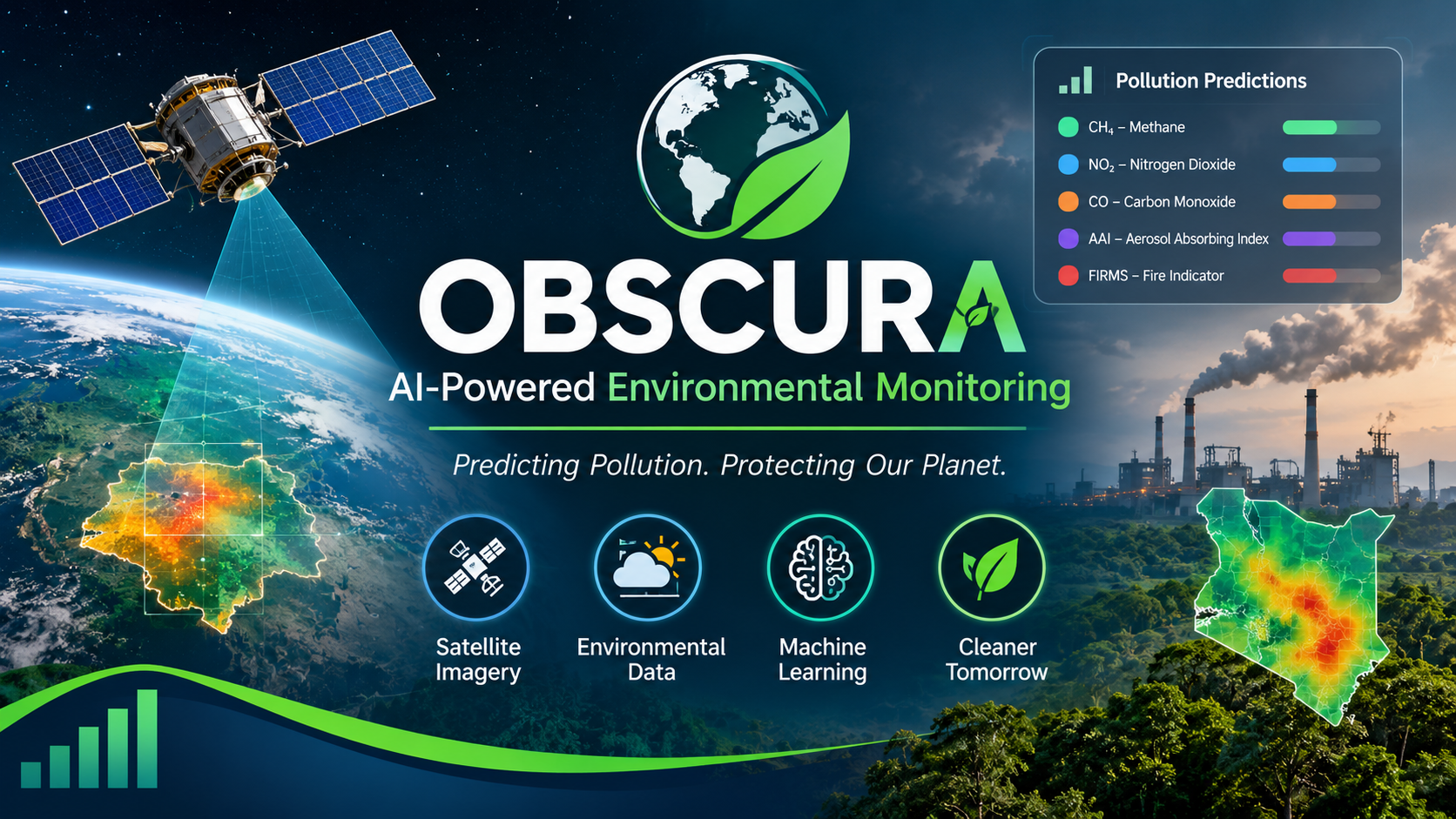
OBSCURA is a machine learning-based environmental monitoring project that uses satellite-derived features and environmental data to predict atmospheric pollution indicators at industrial locations.
The project focuses on predicting five environmental targets:
- Methane (CH₄)
- Nitrogen dioxide (NO₂)
- Carbon monoxide (CO)
- Aerosol Absorbing Index (AAI)
- FIRMS-related fire activity indicator
By combining environmental features with machine learning models, OBSCURA explores how pollution-related information can be estimated across different geographical locations.
The project demonstrates the potential of predictive analytics to support environmental research, pollution monitoring, and data-driven decision-making.
How we built it
We developed OBSCURA using Python and machine learning tools.
Our workflow involved:
- Data preparation: Loading and inspecting the training and test datasets, identifying missing values, and understanding the structure of the environmental features.
- Exploratory data analysis: Investigating target distributions, feature relationships, and patterns in the environmental data.
- Feature engineering: Exploring satellite-derived and environmental features that could improve model performance.
- Model development: Training and comparing regression models, including Random Forest, ExtraTrees, CatBoost, Gradient Boosting, and LightGBM.
- Model evaluation: Using cross-validation and target-specific RMSE analysis to compare models and identify weaknesses.
- Optimization: Applying hyperparameter tuning and selecting different models for different prediction targets.
- Submission: Generating predictions for the competition's test dataset and preparing the required Kaggle submission file.
Our technology stack included Python, Pandas, NumPy, Scikit-learn, Matplotlib, Seaborn, CatBoost, and LightGBM.
Challenges we ran into
One of our biggest challenges was predicting environmental indicators at locations that were not represented in the training data.
We also encountered:
- Missing values across different pollution targets.
- Significant differences in prediction difficulty between targets.
- Variability in model performance across validation folds.
- A gap between local validation results and public leaderboard performance.
- Difficulty improving predictions for targets with weak or noisy relationships to the available features.
These challenges required us to move beyond simply selecting the most complex model. We had to investigate how each target behaved and evaluate models more carefully.
Accomplishments that we're proud of
We are proud of successfully developing an end-to-end machine learning workflow for an environmental research problem.
Some of our key accomplishments include:
- Building a complete data preparation and modeling pipeline.
- Experimenting with multiple regression algorithms.
- Developing target-specific modeling strategies.
- Implementing cross-validation and hyperparameter tuning.
- Successfully generating and submitting predictions to Kaggle.
- Improving our public leaderboard score from 1.24498 to 1.18907.
Most importantly, we transformed a complex environmental dataset into a practical machine learning solution and gained experience working with real-world research challenges.
What we learned
Through OBSCURA, we learned that environmental machine learning requires more than training a model and evaluating its accuracy.
We gained practical experience in:
- Satellite-based environmental data analysis.
- Multi-target regression.
- Feature engineering and model selection.
- Grouped cross-validation.
- Understanding geographic and temporal generalization.
- Analyzing model errors and validation performance.
- Building reproducible machine learning workflows.
We also learned that a model with strong local validation performance may not necessarily generalize well to unseen geographical locations.
What's next for OBSCURA: AI-Powered Environmental Monitoring
We envision expanding OBSCURA from a competition-based machine learning project into a more comprehensive environmental monitoring platform.
Our future plans include:
- Improving prediction accuracy through further feature engineering and model experimentation.
- Exploring additional satellite and environmental data sources.
- Investigating more robust approaches to geographic and temporal generalization.
- Developing an interactive dashboard to visualize environmental predictions across locations.
- Incorporating maps and geographical analysis to make predictions easier to interpret.
- Exploring how OBSCURA could support environmental researchers, conservation initiatives, and pollution monitoring organizations.
Our long-term vision is to make environmental data more accessible and actionable through machine learning, helping transform satellite observations into meaningful environmental insights.
Built With
- artificial-intelligence
- catboost
- data
- data-science
- environmental-data
- kaggle
- lightgbm
- machine-learning
- numpy
- pandas
- python
- regression
- remote-sensing
- satellite-imagery
- scikit-learn
