-
-
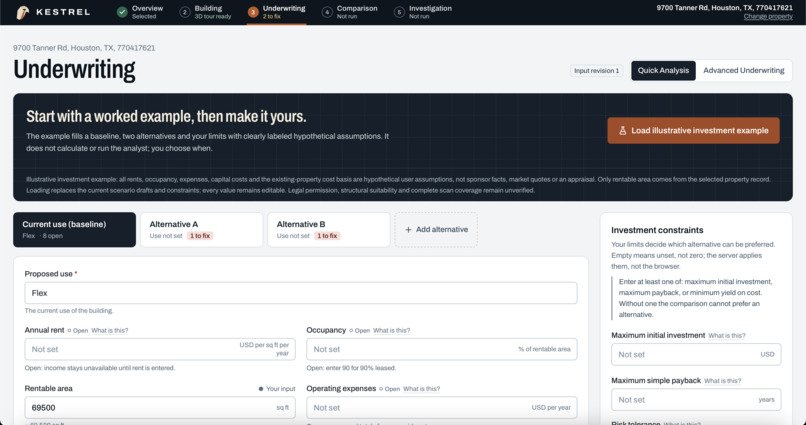
underwriting for property
-
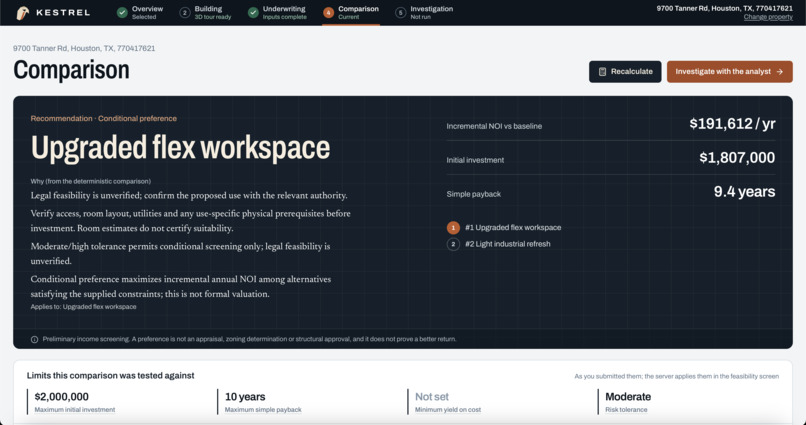
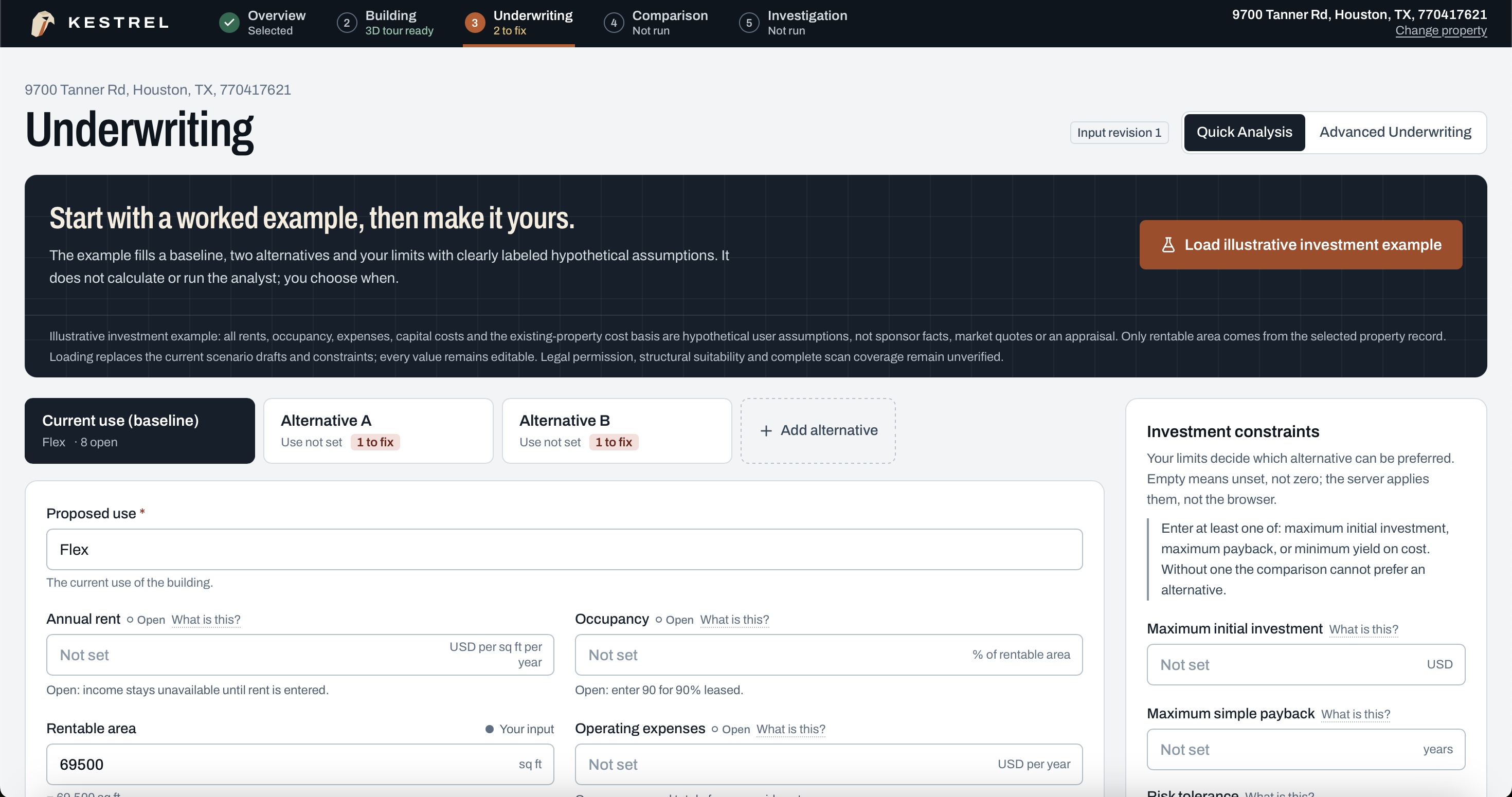
comparison math for underwriting constraints
-
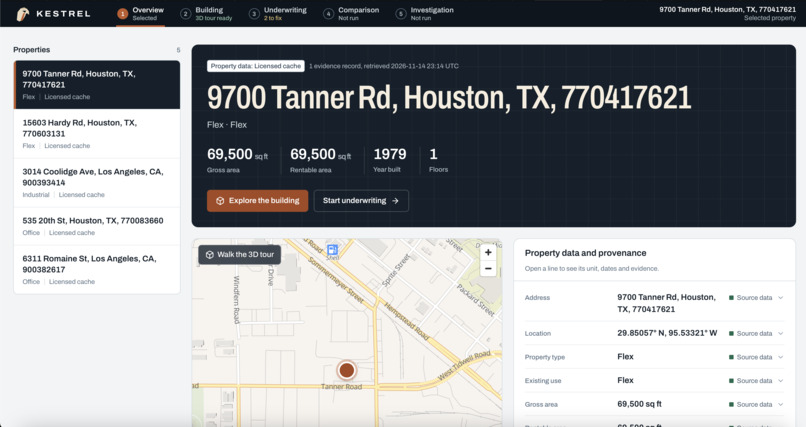
property selected
-
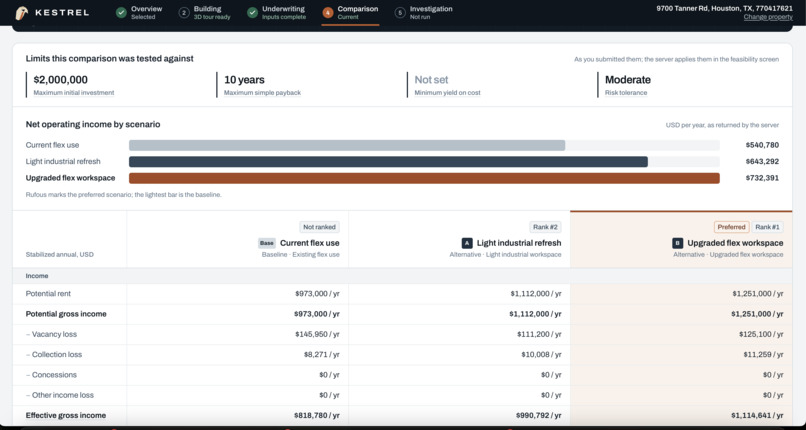
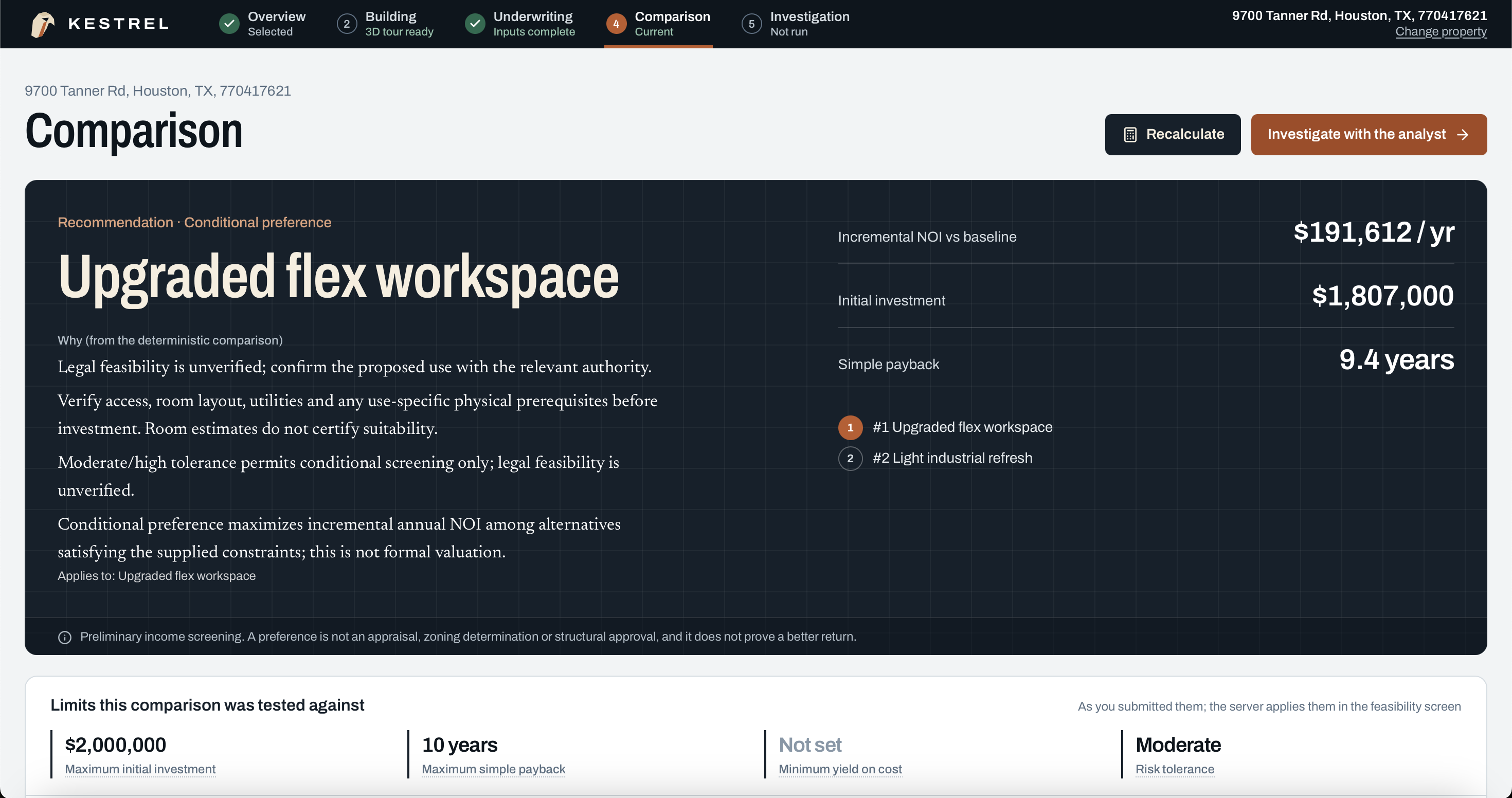
comparison charts
-
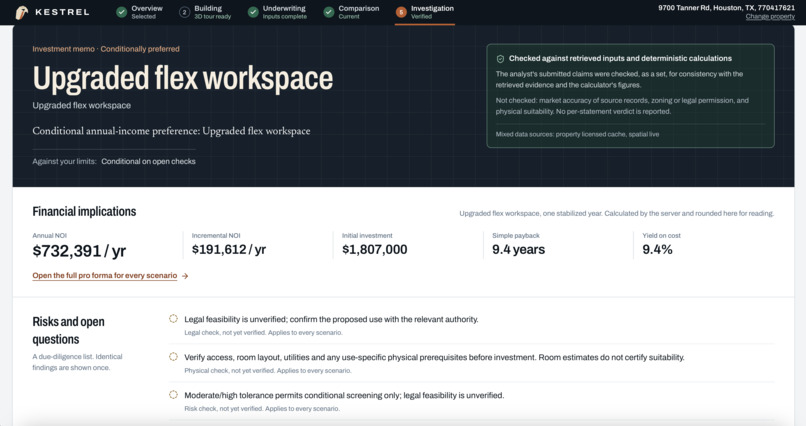
risk analysis
-
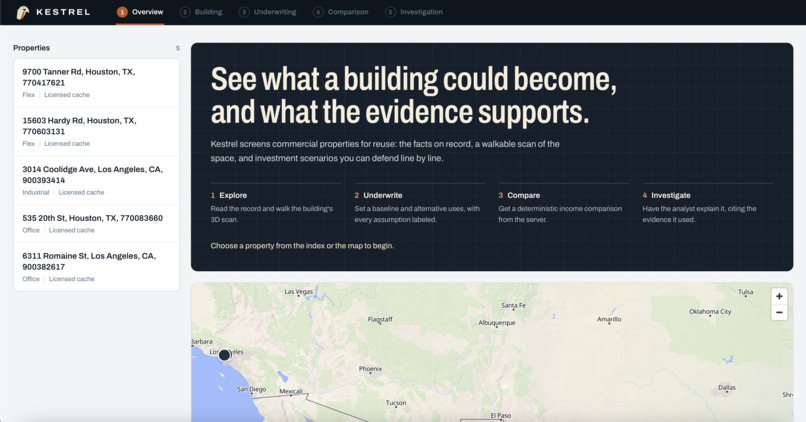
dashboard
Kestrel — From Property Data to Investment Decisions
Kestrel is an AI-powered commercial real estate intelligence platform that combines property records, interactive 3D building data, financial modeling, and agentic AI to help investors evaluate what a building could become.
Inspiration
Commercial real estate decisions involve much more than finding an available building. An investor needs to understand the property's characteristics, inspect its physical space, estimate renovation costs, evaluate potential uses, and determine whether an investment makes financial sense.
The problem is that this information often lives in disconnected places: property databases, floor plans, virtual tours, spreadsheets, and research reports.
I wanted to explore a simple question: What if you could investigate a building, model its investment potential, and understand the evidence behind the recommendation in one place?
That's why I built Kestrel.
What it does
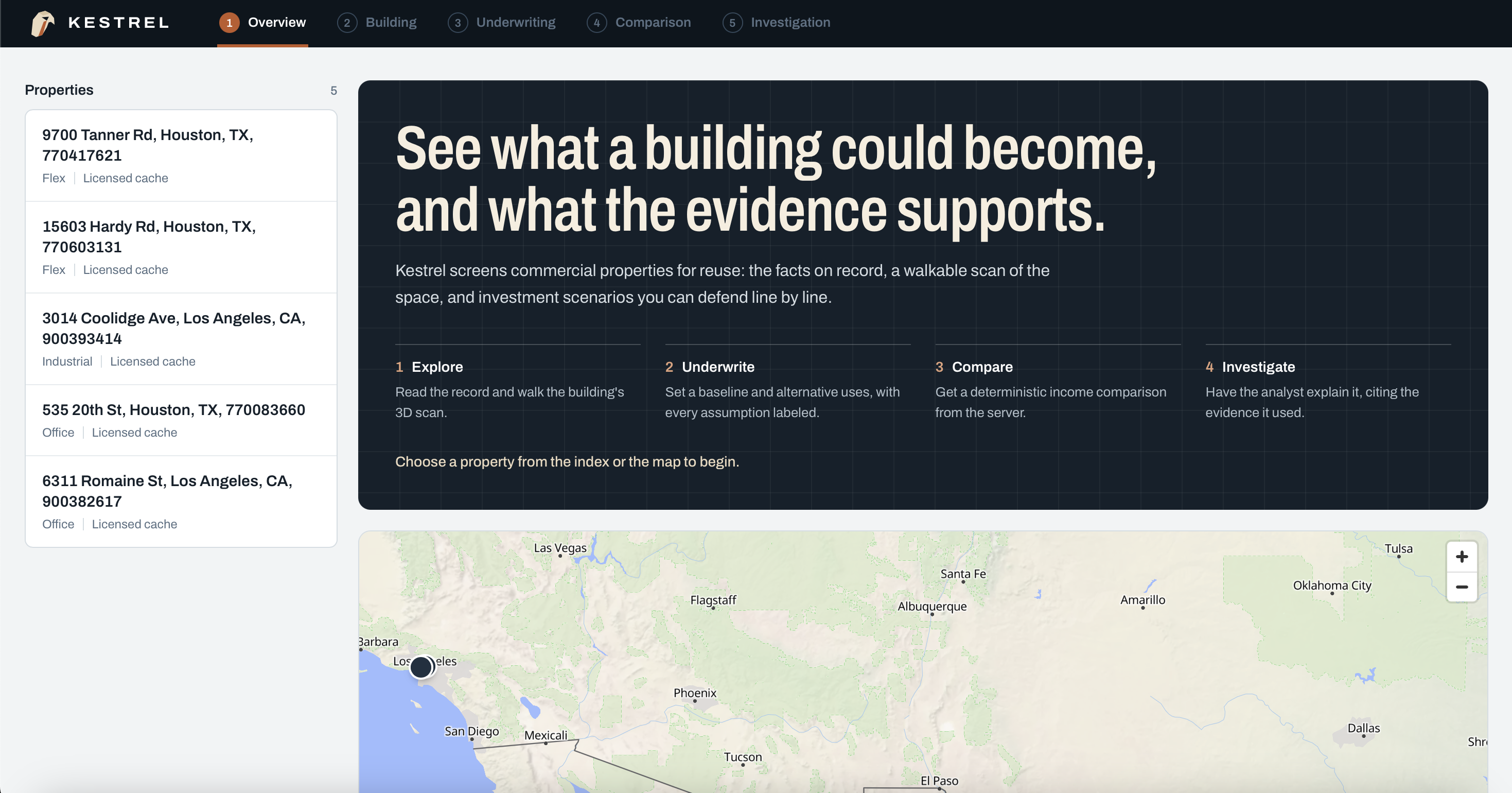
Kestrel turns commercial property data into an interactive investment-analysis workflow.
1. Explore real properties
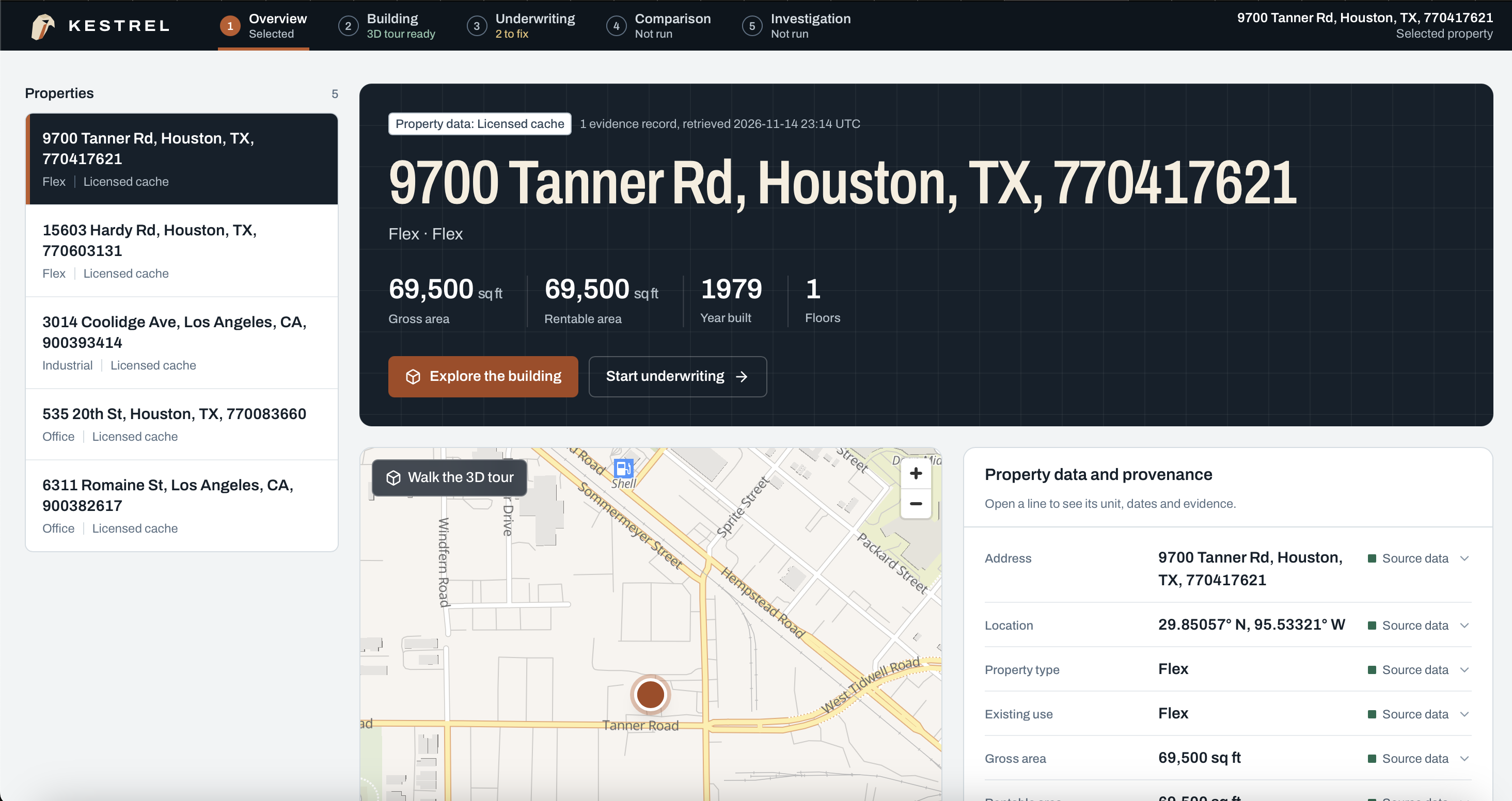
Kestrel integrates a licensed CoStar dataset containing commercial property information. Users can browse five real properties, inspect their characteristics, and see which facts are supported by source evidence.
2. Understand the physical building
Using Matterport, Kestrel connects property records to verified spatial models. Users can explore available 3D digital twins, inspect room measurements, and understand physical characteristics relevant to potential reuse.
3. Compare investment scenarios
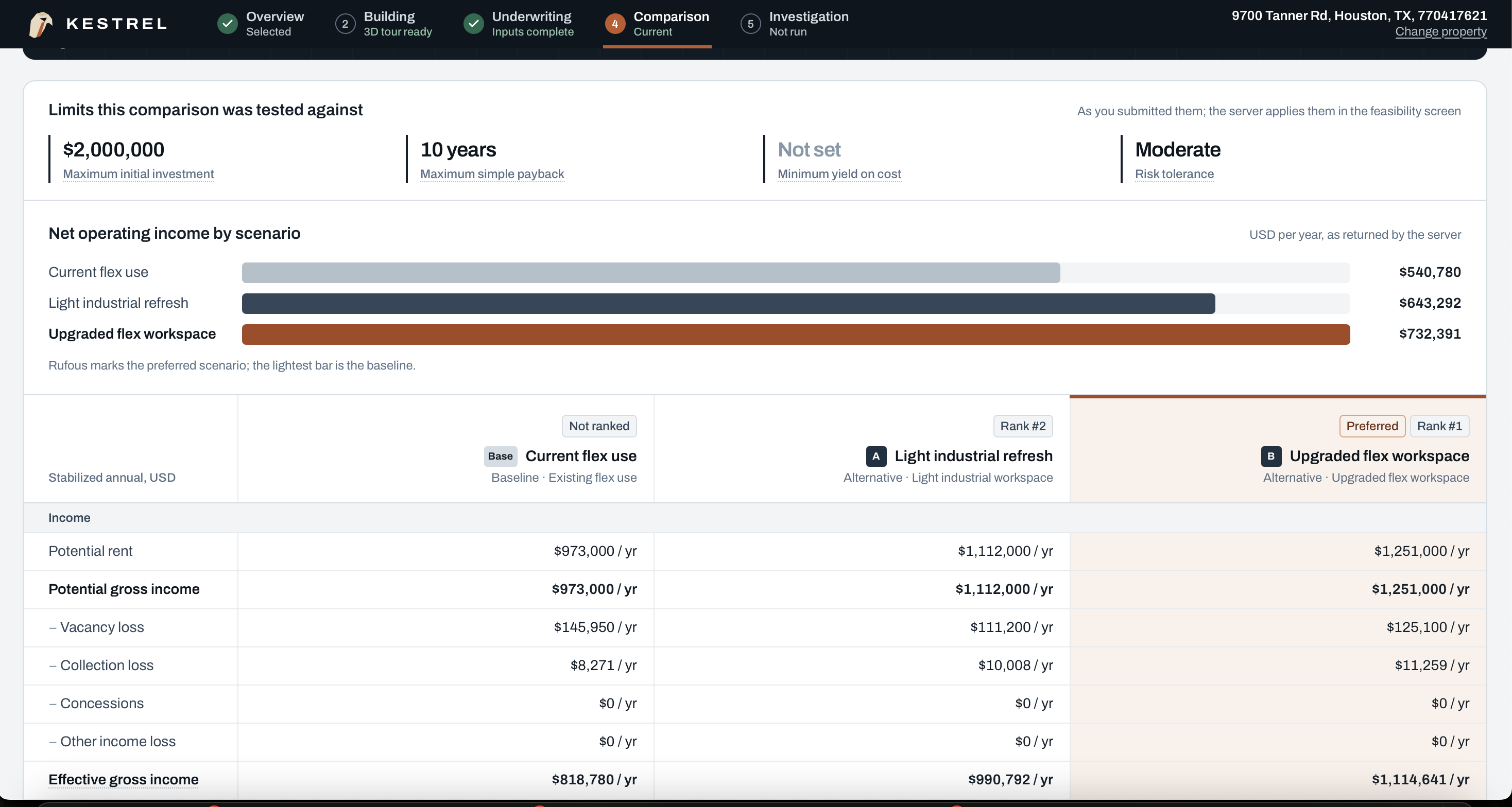
Kestrel models a property's current use alongside two alternative investment strategies. Users can adjust rent, occupancy, operating expenses, renovation costs, and investment constraints.
A deterministic financial engine calculates metrics such as net operating income, capital requirements, yield on cost, and simple payback period.
The comparison adapts when constraints change. For example, a redevelopment strategy that is attractive under a $2 million capital budget may become ineligible when the budget falls to $1 million.
4. Investigate with AI agents
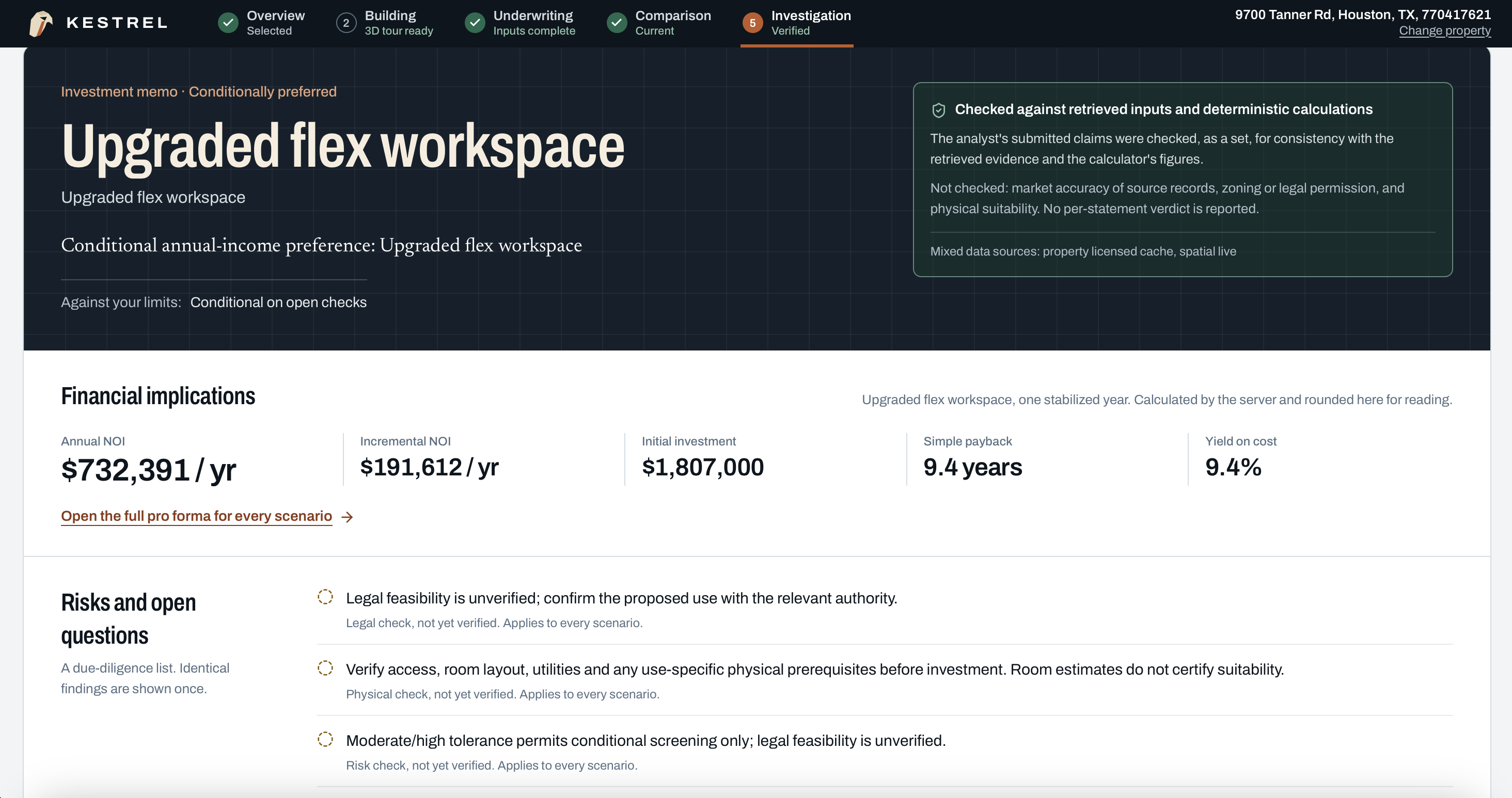
Kestrel uses LangChain Deep Agents and Google's Gemini API to investigate the available evidence, execute structured tools, evaluate alternatives, and produce a conditional investment recommendation.
This is not simply a chatbot generating financial advice. The agent works with real application tools and existing financial calculations.
5. Verify the reasoning
One of Kestrel's most important features is independent output verification.
The application checks the agent's submitted claims against financial calculations, property evidence, and executed tool results. It also distinguishes verified facts from assumptions and unresolved questions.
This makes the analysis more transparent than a conventional AI-generated recommendation.
How I built it
I built Kestrel using Next.js, React, TypeScript, and Tailwind CSS for the application, MapLibre for geospatial presentation, and Matterport for interactive building exploration.
The backend handles property normalization, verified spatial matching, financial computations, and structured API contracts.
For AI orchestration, I integrated LangChain Deep Agents with the Gemini API, allowing the agent to perform actual tool-assisted investigations.
I deliberately separated deterministic financial calculations from AI reasoning. The model can investigate and explain investment alternatives, but it cannot redefine the financial results calculated by the application.
I used AI-assisted development tools during the hackathon to accelerate implementation and iteration, while directing the architecture, integration, testing, and product decisions.
Challenges I faced
Connecting two different data sources. CoStar property records and Matterport spatial models represent buildings in different ways. Matching them correctly was essential: a convincing 3D tour is worthless if it belongs to the wrong property.
Making financial results trustworthy. I had to handle incomplete data, distinguish source facts from user assumptions, and ensure that changing investment constraints produced consistent results.
Building reliable agentic AI. The challenge wasn't just getting Gemini to respond. It was making the agent call real tools, respect execution limits, and produce outputs that could be independently checked.
Designing for usability. Commercial real estate underwriting involves many inputs. I worked on making the workflow approachable without sacrificing access to detailed assumptions.
Integrating everything under hackathon constraints. Combining licensed property data, spatial visualization, deterministic finance, AI orchestration, and a usable frontend required careful testing and coordination.
What I learned
This project taught me that the most valuable use of AI isn't necessarily generating more information. It's connecting existing information, taking useful actions, and making the results understandable and verifiable.
I also gained practical experience with commercial real estate concepts, agent tool execution, evidence provenance, financial modeling, and integration testing.
What's next
I'd like to expand Kestrel with user-uploaded property datasets, automated comparable-property research, saved investment workspaces, and more advanced underwriting tools.
My long-term vision is a platform where an investor can bring their own property evidence and quickly turn it into a transparent, actionable investment investigation.
Kestrel doesn't just show you a building. It helps you understand what that building could become—and what evidence supports the decision.
Built for HackPrinceton Fall 2026 using Next.js, React, TypeScript, Tailwind CSS, MapLibre, Matterport, CoStar-provided data, LangChain Deep Agents, and the Gemini API.
Built With
- deepagents
- gemini
- github
- javascript
- langchain
- maplibre
- matterport
- nextjs
- node.js
- playwright
- tailwindcss
- typescript
- vitest
- zod
