Inspiration
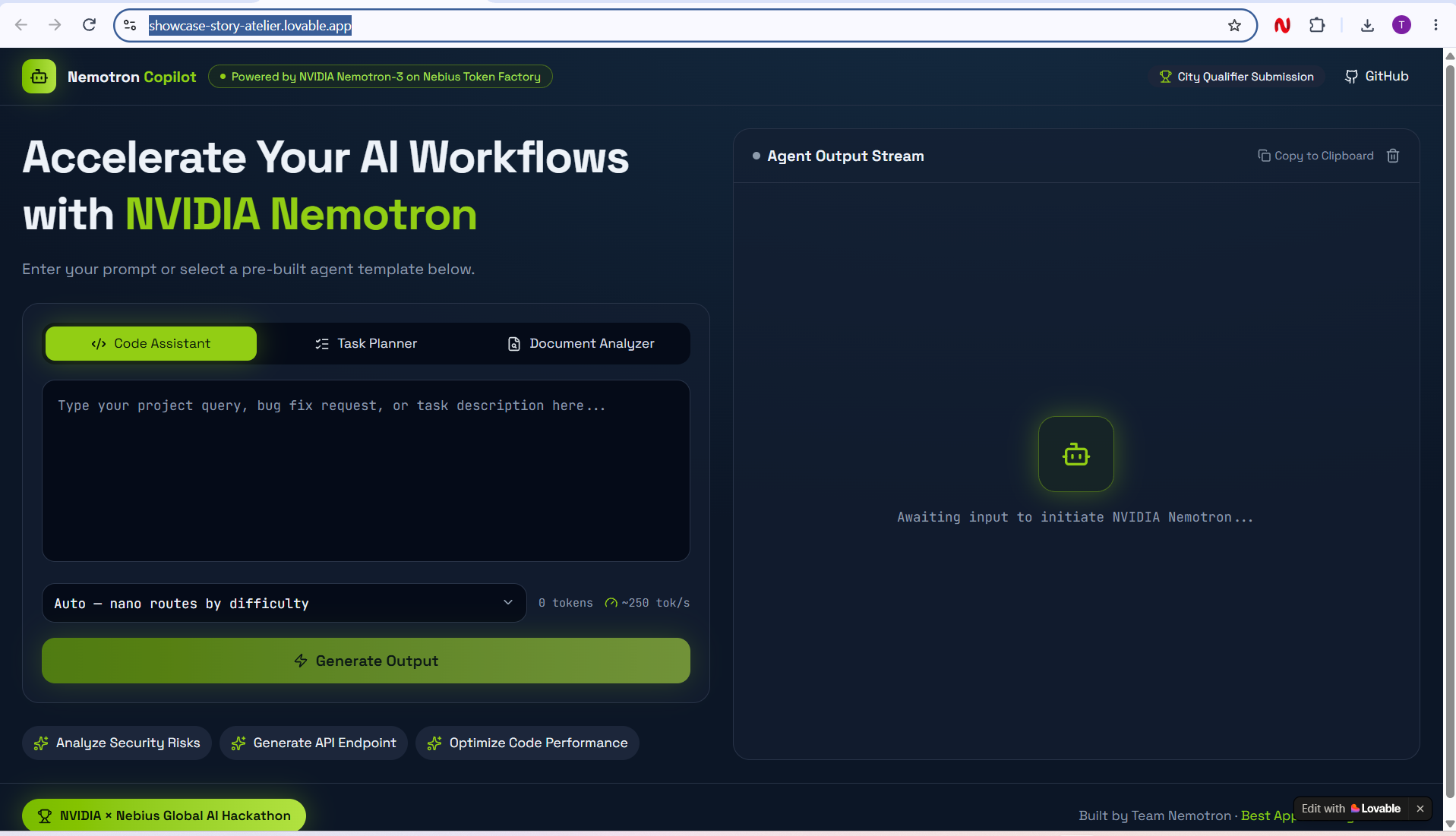
Developers working with AI today need to make a difficult choice between using a light-weight model for fast response times ($\text{latency} < 1\text{s}$) or using a huge frontier model for complex reasoning but at the expense of speed and computational cost. Additionally, client-side web applications often leak private API keys in network traffic. This inspired us to develop KERNEX, an all-in-one high performance AI copilot utilising the NVIDIA Nemotron range of models through the Nebius Token Factory API. This removes the need to make this choice by incorporating a smart routing system which dynamically routes requests to the appropriate model complexity, whilst being secured through a zero-trust backend proxy.
What it does
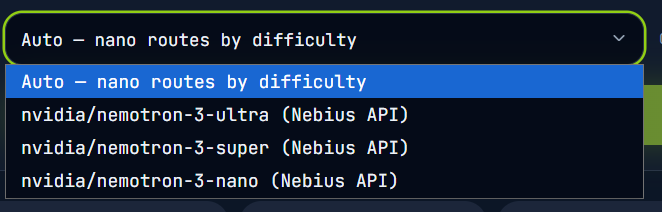
KERNEX intelligently routes each user prompt through an intelligent three-tier system:Nano tier: ultra-fast classification, very fast C/C++ code generation, and fast querying.Ultra tier: deep logical processing, system restructuring, and complex optimisation of code.Super tier: complex multi-modal processing (image and diagram understanding), and high level reasoning. Generation speed is monitored in real-time ($\text{tok/s}$), and only clean code is generated with no comments. The code is written in standard ASCII format ($\text{!=}$ rather than $\neq$).
How we built it
KERNEX is built using a modern full stack architecture based round NVIDIA's leading AI models. The system works as follows: Routing Engine: Prompts are passed through Nemotron-3.5 Nano/Nemo ($\sim 30\text{B}$ MoE, 3B parameters) which calculates the complexity of the prompt, this acts as an inline classifier ($C(x)$). Dynamic Routing Based on the mathematical complexity of the prompt($$f(x) = \begin{cases} \text{Nemotron-3.5 Nano/Nemo}, & C(x) \le \theta_{\text{low}} & \text{(Simple Queries / Rapid Code)} \ \text{Nemotron-3 Ultra}, & \theta_{\text{low}} < C(x) \le \theta_{\text{high}} & \text{(System Logic / Refactoring)} \ \text{Nemotron-3.5 Super-VL}, & C(x) > \theta_{\text{high}} & \text{(Complex Vision / Multi-Step Reasoning)} \end{cases}$$) Frontend & Telemetry: Built using React, TypeScript and TailwindCSS. Live token throughput data is streamed from the frontend. Calculated inside the browser ($$T_{\text{rate}} = \frac{\Delta \text{Tokens}}{\Delta t} \quad (\text{measured in tok/s})$$). Security A Python/Flask backend proxies the NEBIUS_API_KEY in the backend environment variables. This ensures that there is no exposure of any credentials.
Challenges we ran into
Strict Code Output Rules: Enforcing that the LLM will only output compilable C/C++ code with the appropriate headers($\text{#include } \langle \text{stdio.h} \rangle$). Multimodal Data Handling: Passing Base64 encoded image data cleanly through our Flask security proxy to Nemotron-3.5 Super-VL. Cross-Origin Request Handling: Handling CORS requests when passing requests between React front-end and local/cloud based Flask proxies.
Accomplishments that we're proud of
Developed functional 3 tier model routing system on Nebius Token Factory Implemented comment free C code generation to clipboard Secure $100\%$ keys using zero trust proxy server architecture Integrated live token telemetry including speed of token generation ($\text{tok/s}$) and overall volume
What we learned
Optimizing compute resources by dynamically adjusting compute complexity $C(x)$ to model parameters rather than overprovisioning. Using MoE models such as NVIDIA Nemotron to generate responses in less than a second. Best practice for securing API proxies in AI web applications.
What's next for KERNEX
Add local compiler validation, linking WebAssembly GCC/Clang to auto-test generated C code in the browser.
Expand multimodal analysis to allow multiple images of architectural diagrams, and PDF documents to be parsed.
Automatically track costs and resources for each model tier.
Built With
- python
- react
- tailwindcss
- tanstack
- typescript

Log in or sign up for Devpost to join the conversation.