Does your test suite really protect your Triton kernel? Plant small bugs, let Nemotron write the missing tests, and accept a test only if running it proves it works.
Inspiration
A Triton kernel can pass its tests and still hide a dropped mask, a shifted loop boundary or a half-precision accumulator, because the tests never exercise that line. Mutation testing finds such gaps, but a surviving mutant leaves you with a question: is my test weak, or is the mutant harmless? We wanted a loop that answers it without trusting a language model's word.
What it does
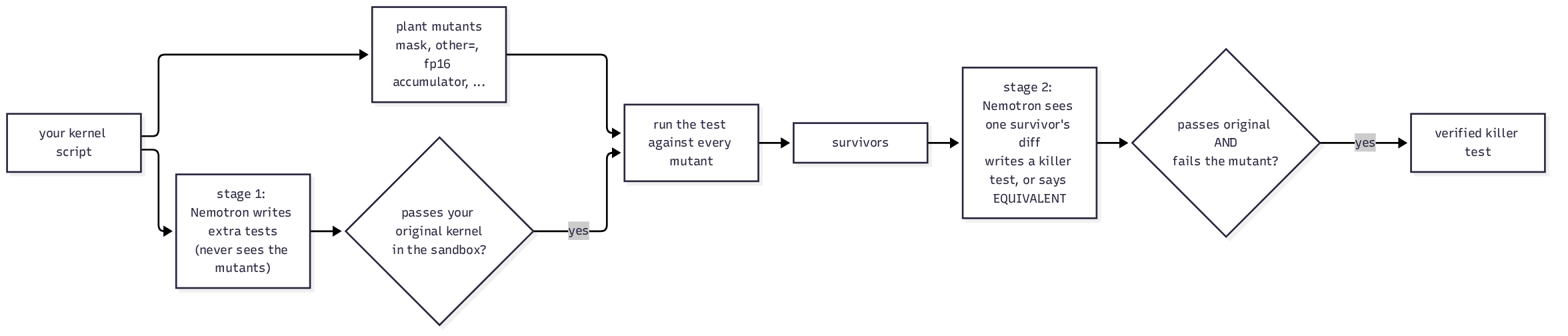
mutant-gate run kernel.py takes an ordinary Triton file and:
- Plants mutants: small rewrites such as dropping
maskorother=,<to<=, or an fp32 accumulator to fp16. - Nemotron writes extra tests (stage 1). It never sees the mutants. A generated test is kept only if it passes your original kernel in a sandbox; if it fails there, the error goes back to Nemotron and it tries again (up to a few attempts).
- Runs every mutant against the kernel's own check plus that test inside a disposable Nebius sandbox (Triton CPU interpreter, out-of-bounds checks on). Mutants that get through are the survivors.
- Nemotron targets each survivor (stage 2). It sees one survivor's diff and either writes a killer test or answers
EQUIVALENT. A killer test counts only if it passes the original and fails the mutant, checked by running the code.
This is an agentic loop with execution as the judge: Nemotron proposes a test, the sandbox runs it, a failure on the original kernel is fed back for another attempt, and nothing is accepted on the model's say-so.
Two extra checks keep the report honest:
--compile-checkcompiles every survivor for CUDA (sm_75, no GPU needed) in the same sandbox and sets aside survivors that are not valid GPU programs.--diff-oracleinvolves no model. It runs each survivor next to the original with the same seeds and compares every tensor after every launch, so the report says "outputs identical on all N launches" or "outputs differ inRstd(max abs 316); the test passes anyway".
The replay demo (https://alexxony.github.io/triton-mutant-gate/) shows recorded runs: forty planted bugs across four kernels as a grid, where a click on a red square shows the change and the test Nemotron wrote for it. It is a static page, so you can explore without a key.
How we used Nebius and NVIDIA
- NVIDIA Nemotron on Nebius Token Factory writes the tests (stage 1) and the per-survivor verdicts (stage 2). Default model
nvidia/nemotron-3-super-120b-a12b; Nano-30B-A3B and Ultra-550b-a55b were also run. Every call checks that the response names the requested model. - Token Factory made the study repeatable. The original five repeats of all three models used about 1.5M tokens; the Super-only part (343,276 tokens) cost about $0.17 at list price (our calculation, as stated in the repo README).
- Nebius Sandboxes (through
contree-sdk) run every test, original and mutant. Generated code never runs on the user's machine.
Results (and what they do not show)
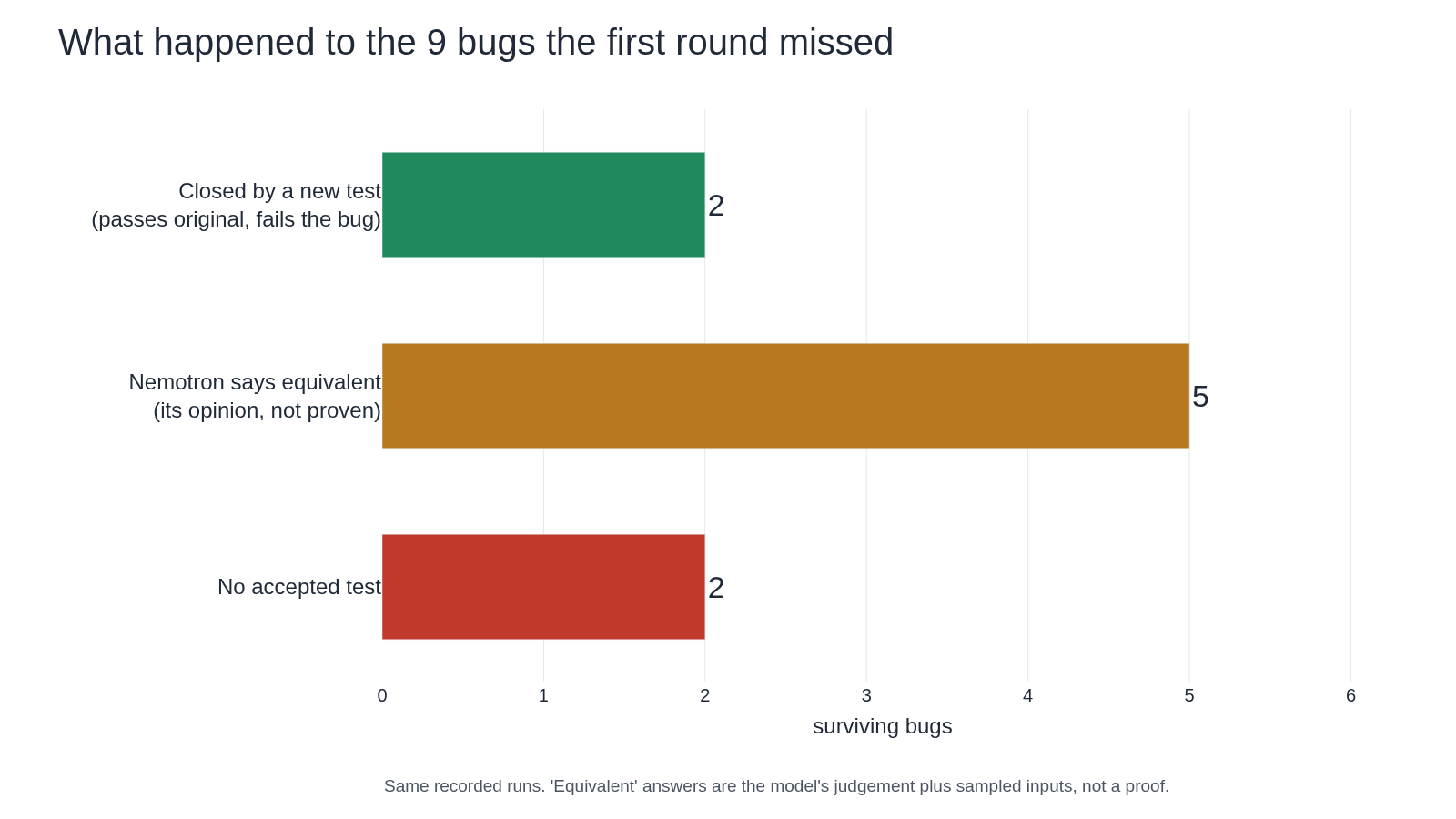
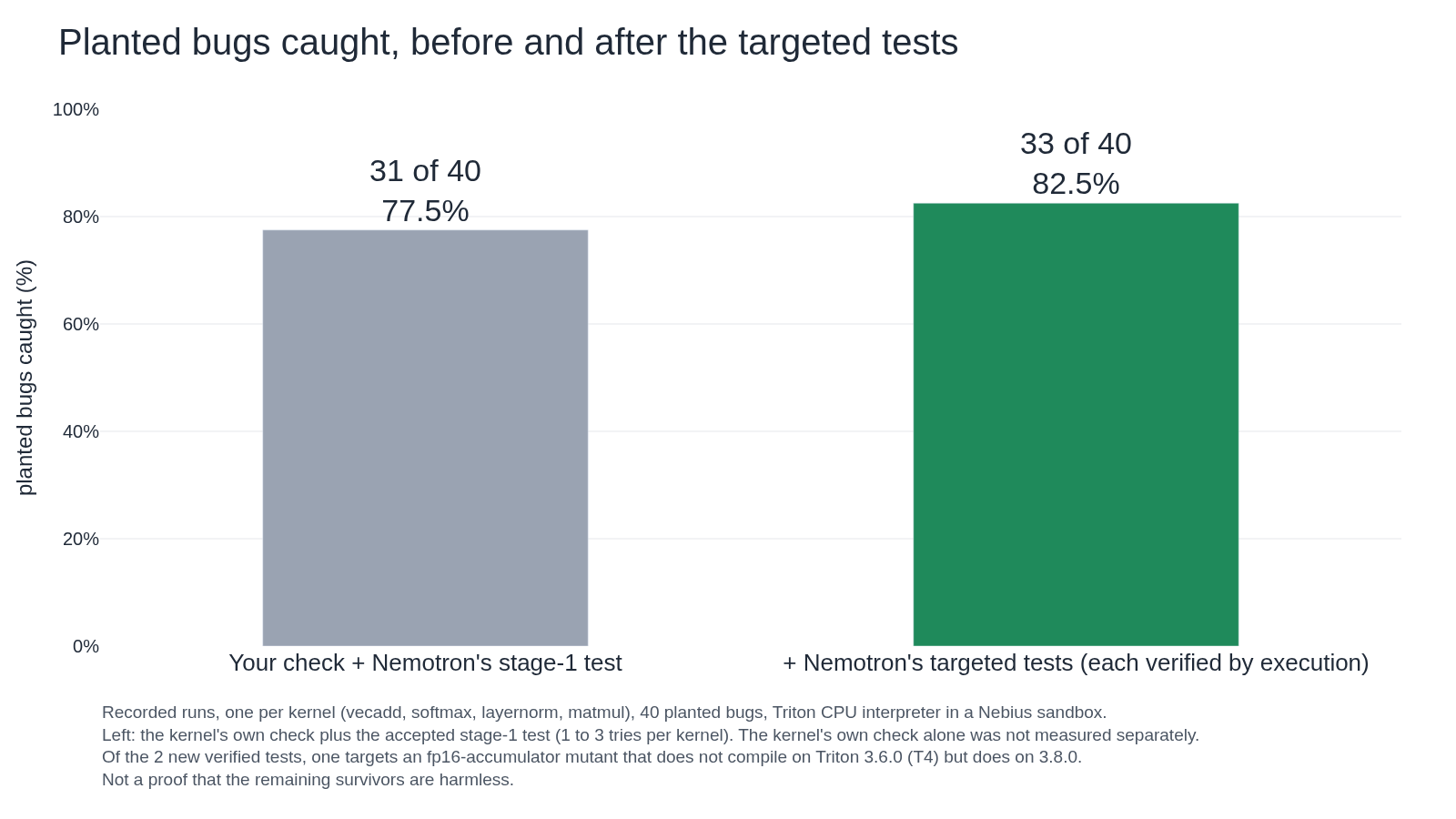
- Forty planted bugs, four tutorial-style kernels, one run per kernel: the kernel's own check plus the stage-1 test Nemotron wrote (accepted on the first try for two kernels, after retries for the other two) caught 31 of 40 (77.5%); the kernel's own check alone was not measured separately, and all verdicts come from the CPU interpreter. Adding Nemotron's verified killer tests for the survivors: 33 of 40 (82.5%). One of those two killer tests targets an fp16-accumulator mutant that does not compile in the T4 environment (Triton 3.6.0; it compiles in the 3.8.0 sandbox image). Of the remaining 7 survivors, Nemotron called 5 equivalent and found no accepted test for 2. This illustrates the loop; it is not a benchmark.
- The Triton CPU interpreter is not a compiler. In a pre-registered check on a Colab T4 (Triton 3.6.0), 3 of the 9 survivors were fp16-accumulator programs that do not compile. They were not test gaps. That finding became
--compile-check, which agreed with the T4 run on 43 of 44 programs; the one disagreement was a Triton version difference (3.8.0 in the sandbox image). - The output oracle was pre-registered before its first run (4 of 5 predictions right). It flagged a gap the model's stage 2 did not close: in layernorm, a
<to<=mutant moves oneRstdelement by 316 while the test still passes. For the 5 survivors Nemotron called equivalent, no claim was contradicted. "Identical" only means no contradiction on the launches the test makes; it is not a proof. - Files we did not write. Unmodified tutorials from
triton-lang/triton, run with small sandbox shims: 04 ran (7 mutants, 7 caught), 03 ran (13 mutants, 10 caught, 3 survived; compile check skipped for this file), 02 is out of scope (it builds a GPU-compiled object).@triton.autotunefiles run, but only the first config is exercised in the sandbox. - ** A compiled run on a small plain file. For autotune_axpy (9 mutants, 2 survivors in the sandbox) we ran the original and every mutant on a Colab T4 (Triton 3.6.0), compiled and in the interpreter, with predictions committed before the run. Both survivors (other= changed on masked-out lanes) also passed compiled, as predicted: consistent with equivalence on this hardware, not a proof. Of the 6 dropped-mask mutants, 4 passed compiled although the sandbox's bounds checks had caught them; 2 were caught. One file, one GPU, one Triton build. Tutorial 03's original needs about 700 s to compile on that T4 (mostly compiling autotune configs), so its 13 mutants take about 2.5 hours; the first attempt lost its Colab VM twice (cause unknown) and finished 8 of 14 programs, so we re-ran the other 6 in a third session with the change pre-registered (Amendment F); that session finished. All 14 programs now have a compiled result, from two sessions on the same Triton build. The 3 sandbox survivors behaved as pre-registered: two other= changes compiled and passed, and the fp16-accumulator one failed to compile. Of the 10 mutants the sandbox had caught, 9 passed compiled (all 7 dropped-mask mutants and both drop_modulo_wrap mutants) and 1 was caught compiled (k_loop_floor_div). Each of those 9 is a mutant a compiled run on this T4 did not flag with one generated test; we have not shown any of them to be equivalent. Raw results and the pre-registration are in experiments/compiled_external/.
What we are careful about
Mutants come from fixed rewrite rules, not real bug reports. "Equivalent" is a model's opinion plus sampled inputs. A model that only read the test and the diff predicted catch/survive correctly 86.9% of the time against a 79.4% always-"caught" baseline, so execution is not shown to be strictly necessary; it matters most for numeric behaviour. Every part of the idea (LLM test generation against mutants, mutation analysis of GPU kernels, equivalent-mutant detection) exists in earlier work (docs/PRIOR_ART.md). This is a combination, not a new method. We did not rank the three Nemotron models, because the data does not support it.
Challenges
- The unmodified file must run in a CPU sandbox first. Real files hit GPU-driver queries,
triton.testingbenchmarks and missing packages, so the sandbox loads a small shim; the cost is that a file branching on device type takes the CUDA branch with CPU tensors. - Reproducibility: a generated test that seeds itself with
hash(str)made the original unstable across processes (fixed withPYTHONHASHSEED=0), and the sandbox API returned transient HTTP 5xx (retried). - Keeping claims below the evidence. The pre-registrations record what we guessed before each run, including the wrong guesses.
What's next
Tests against real bug reports instead of fixed rewrite rules, mutants that compile and run on a GPU, and more files from real repositories (so far only tutorials and two small plain files).
Built With
- c++
- performance-profiling
- reverse-engineering
- triton


Log in or sign up for Devpost to join the conversation.