Inspiration
Academic research is full of ideas, but most research papers never make it beyond academia. We wanted to explore a simple question: what if you could look at a research paper and quickly understand whether there is a startup hiding inside it?
The inspiration for Kernel came from the gap between research and commercialization. Finding an interesting paper is easy. Figuring out what problem it actually solves, where the research is incomplete, and whether those gaps could become a viable product is much harder.
We built Kernel to act as a bridge between the two. Instead of simply summarizing a paper, Kernel asks: "What could this become?"
What it does
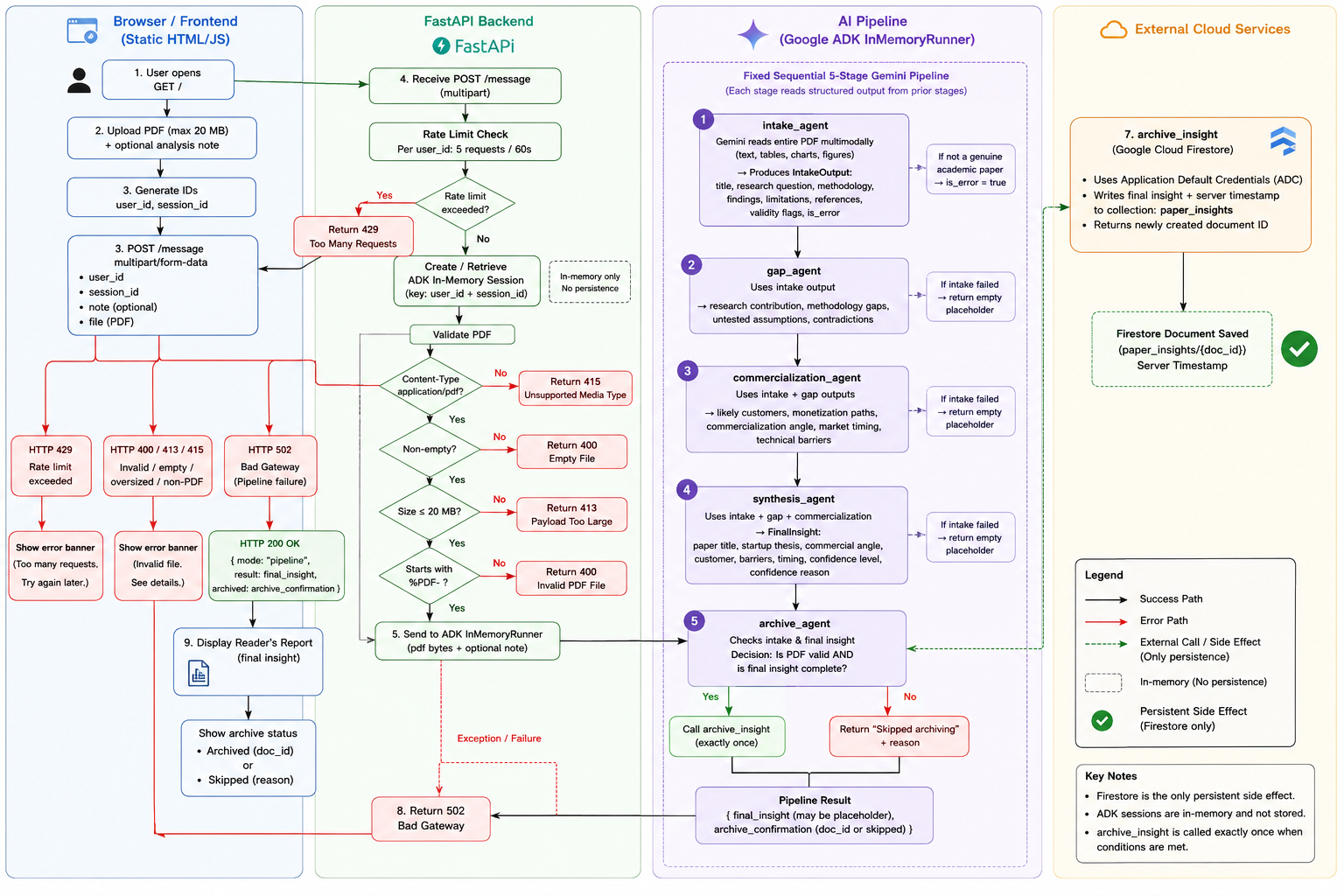
Kernel is a local web application that turns an academic paper into a structured startup insights report.
Users upload a PDF and can optionally provide additional context or an analysis note. Kernel then processes the paper through a five-stage AI pipeline:
- Intake: Extracts the key facts, methods, findings, and limitations from the paper.
- Gap Analysis: Identifies unanswered questions, limitations, and research gaps.
- Commercialization: Explores how those gaps or findings could translate into products, services, or business opportunities.
- Synthesis: Combines everything into a coherent startup thesis.
- Archive: Stores successful analyses in Google Cloud Firestore for future reference.
The application uses Gemini to understand the paper, including its tables and figures, rather than treating the PDF as plain text.
Kernel also includes practical safeguards such as PDF validation, a 20 MB upload limit, and rate limiting to prevent excessive requests.
How we built it
We built Kernel as a Python application using FastAPI for the backend and a lightweight HTML/CSS/JavaScript frontend.
The core of the application is a five-stage Google Agent Development Kit (ADK) SequentialAgent pipeline. Each stage has a specific responsibility and passes structured information to the next stage.
We used schemas to keep communication between the agents consistent instead of passing around unstructured text.
For the AI layer, we used the Google GenAI SDK and Gemini to analyze the uploaded research papers. The resulting insights can then be archived using Google Cloud Firestore.
The overall flow looks roughly like:
$$ \text{Paper} \rightarrow \text{Facts} \rightarrow \text{Research Gaps} \rightarrow \text{Opportunities} \rightarrow \text{Startup Thesis} \rightarrow \text{Archive} $$
We also built unit tests around the API, PDF validation, and rate-limiting behavior to make sure the application was not just a prototype that worked once.
Challenges we ran into
One of the biggest challenges was figuring out how to divide the reasoning process between agents.
It is tempting to give an LLM a paper and simply ask, "Find me a startup idea." However, the results can become vague or disconnected from the actual research. We found that forcing the analysis through distinct stages made the process much more structured.
Another challenge was dealing with academic papers themselves. Papers can contain dense technical language, tables, figures, and sometimes information that does not directly translate into a business opportunity. We had to design the pipeline so that commercialization ideas were grounded in what the paper actually said rather than simply generating generic startup ideas.
We also had to think about the less exciting parts of building an application, including file validation, request limits, Firestore authentication, configuration management, and making sure API credentials were never accidentally exposed.
Accomplishments that we're proud of
We're proud that Kernel goes beyond being another academic-paper summarizer.
The most important part of the project is the reasoning pipeline that connects research to potential commercialization. Each stage builds on the previous one, creating a more deliberate path from a technical paper to a startup thesis.
We're also proud of building the entire system end-to-end. A user can go from:
Upload PDF → AI analysis → structured report → Firestore archive
without needing to interact with the underlying agent system.
Finally, we put effort into making the project robust enough to actually test. We added validation, rate limiting, automated tests, configuration checks, and a verification script rather than stopping at the AI demo.
What we learned
We learned that building an AI application is not just about choosing a powerful model.
A large part of the work is designing the process around the model. Breaking a complicated task into smaller, well-defined stages can make the output much more useful and easier to reason about.
We also learned a lot about building applications around LLMs, particularly structured outputs, agent orchestration, API design, cloud databases, authentication, and handling real user inputs.
Most importantly, Kernel changed how we think about research papers. A paper is not necessarily just a collection of results. Its limitations, unanswered questions, and assumptions can themselves be sources of opportunity.
What's next for Kernel
We want Kernel to become more than a tool that analyzes one paper at a time.
Next, we want to explore:
- Multi-paper analysis, allowing Kernel to connect ideas across several papers.
- Research landscape mapping, showing how different papers relate to each other.
- Competitive analysis, comparing potential startup ideas against existing companies and products.
- Better opportunity scoring, evaluating ideas based on factors such as market size, technical feasibility, and research maturity.
- Persistent research workspaces, allowing users to build a collection of papers and continuously develop ideas from them.
- Human-in-the-loop refinement, where researchers and founders can challenge the AI's assumptions and guide the analysis.
Ultimately, we want Kernel to help answer a question that sits between academia and entrepreneurship:
"This research is interesting, but what could we actually build with it?"
Built With
- api
- css
- fastapi
- firestore
- gemini
- google-cloud
- googleadk
- html
- pytest
- python
- research
- startups

Log in or sign up for Devpost to join the conversation.