-
-
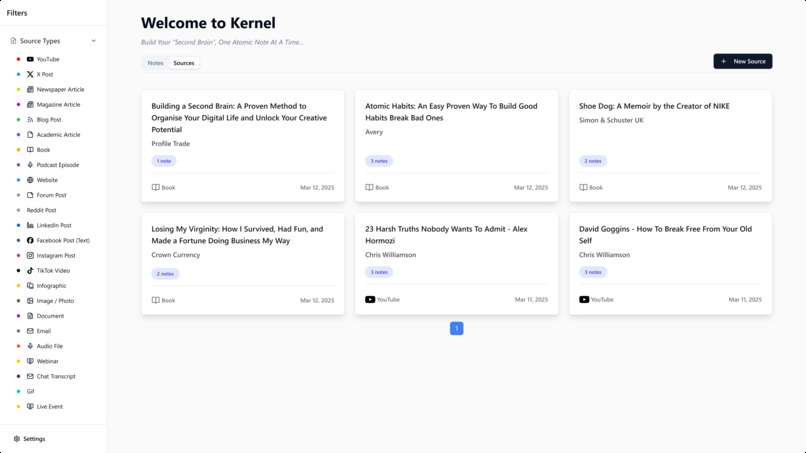
Dashboard for sources
-
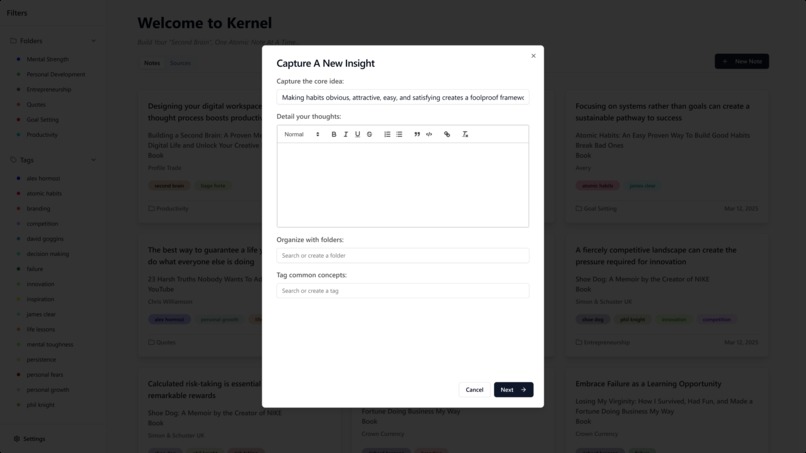
Create an atomic note
-
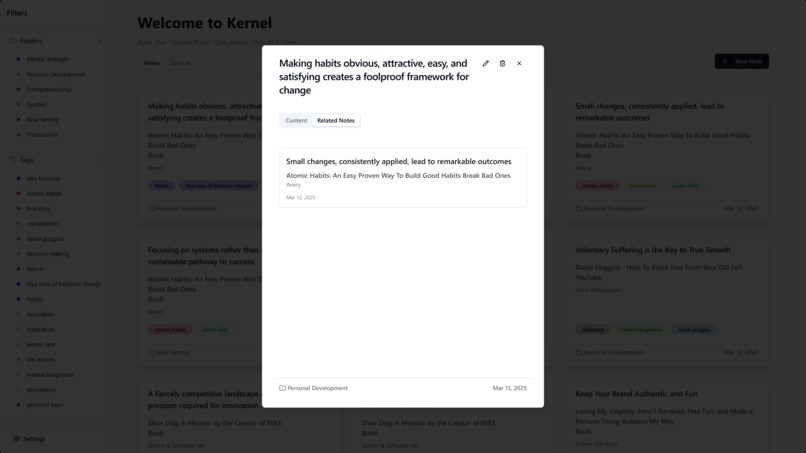
View related Notes
-
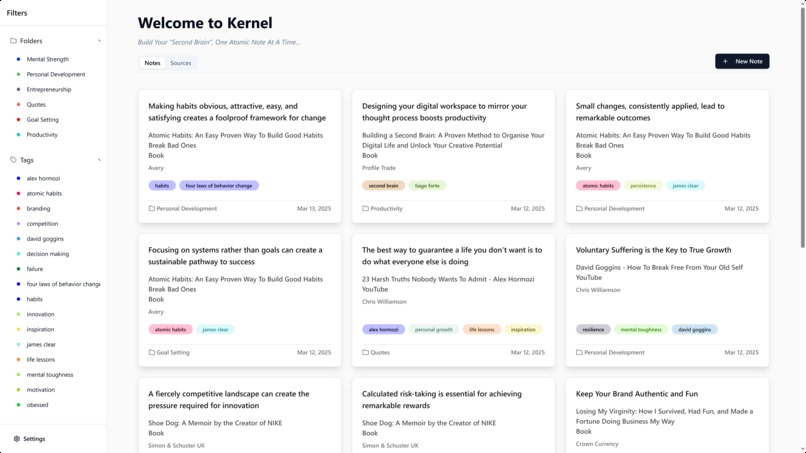
Primary dashboard for notes
-
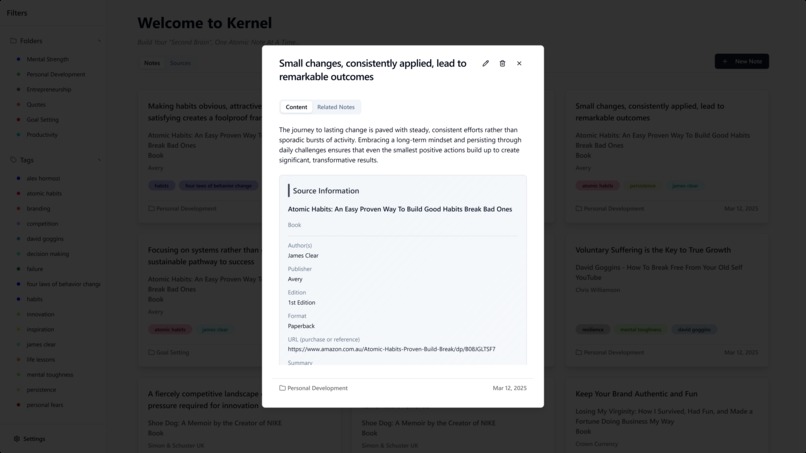
View an existing atomic note


Inspiration
Kernel was born out of a personal need. As someone who loves to learn, I was constantly taking in knowledge from books, podcasts, YouTube videos, and websites—but I could never find a tool that helped me capture and connect those insights the way I wanted. Existing tools felt either too generic or overly complex. I wanted something simple, fast, and purpose-built for building a Second Brain—so I decided to create it myself.
What it does
Kernel lets users build their own Second Brain one atomic note at a time. It’s designed for doers, thinkers, and learners who want to save information from any source—books, videos, podcasts, articles, or real-life experiences. Each note is:
- Atomic: Focused on a single insight or idea.
- Organized: Tagged and placed into folders.
- Linked: Connected to a specific source and discoverable by source type (e.g., book, podcast).
- Relational: Notes can be linked by tags, folders, or shared sources, making it easy to surface everything you’ve learned about a topic.
How I built it
Kernel is built with a clean separation of backend and frontend architecture. I used:
- Node.js + Express + MongoDB for the backend.
- React + TanStack Query for the frontend.
- Custom tagging, folder, and source management systems to support rich knowledge relationships.
- I also used AI (like ChatGPT and Claude) to help accelerate development, brainstorm features, and troubleshoot bugs.
Challenges I ran into
- Designing a data model that could support rich relationships between notes, tags, folders, and sources while remaining intuitive.
- Getting AI to understand and generate testable, production-ready code consistently.
- Finding the right UX balance between simplicity and power.
- Debugging edge cases in linking and filtering functionality as the app scaled.
Accomplishments that I'm proud of
- Created a tool that finally captures knowledge in the exact way I always wanted.
- Built a powerful system for linking notes by source and attribute without overwhelming the user.
- Maintained a transparent, build-in-public process—documenting the entire journey on YouTube to inspire and help others.
- Designed Kernel to support productivity methods like PARA and workflows based on Zettelkasten, even though it remains beginner-friendly.
What I learned
- People learn and think in different ways, but they all need clarity and structure to unlock deeper insight.
- Building in public not only motivates progress—it creates early feedback loops and fosters community.
- AI can be a powerful coding partner, but you still need to know your stuff to guide it properly and spot mistakes.
- Simple UX is hard—but worth it.
What's next for Kernel
- Launching public beta to onboard early users and get feedback.
- Building AI-assisted note creation from imported sources (e.g., summarizing YouTube videos, podcasts, and articles into atomic notes).
- Adding collaboration features so small teams can share and grow a collective Second Brain.
- Continuing to refine the user experience, especially around filtering, tagging, and surfacing related knowledge.

Log in or sign up for Devpost to join the conversation.