-
-
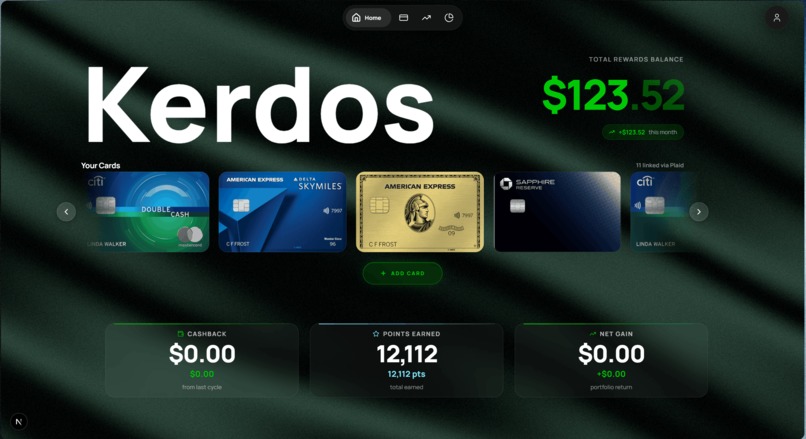
Homepage
-
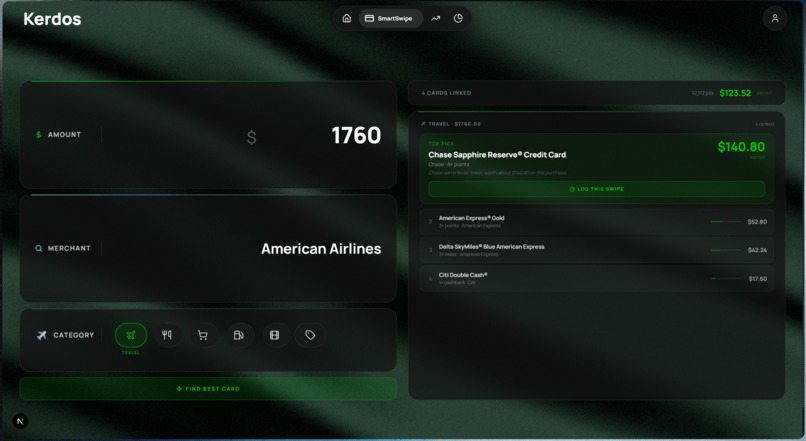
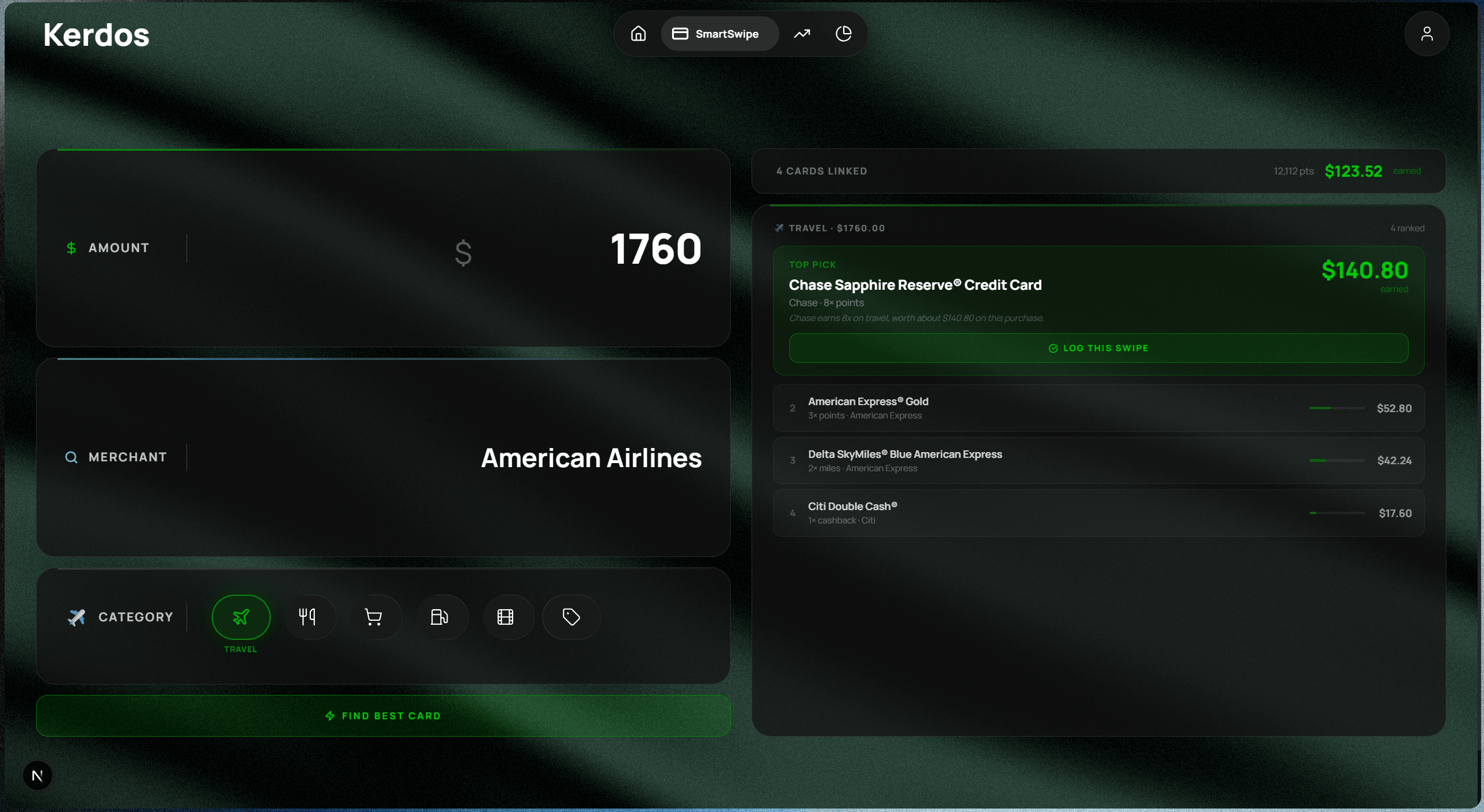
SmartSwipe
-
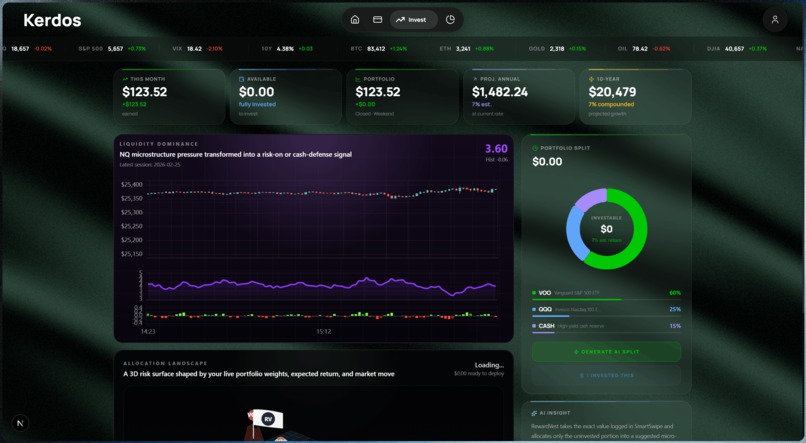
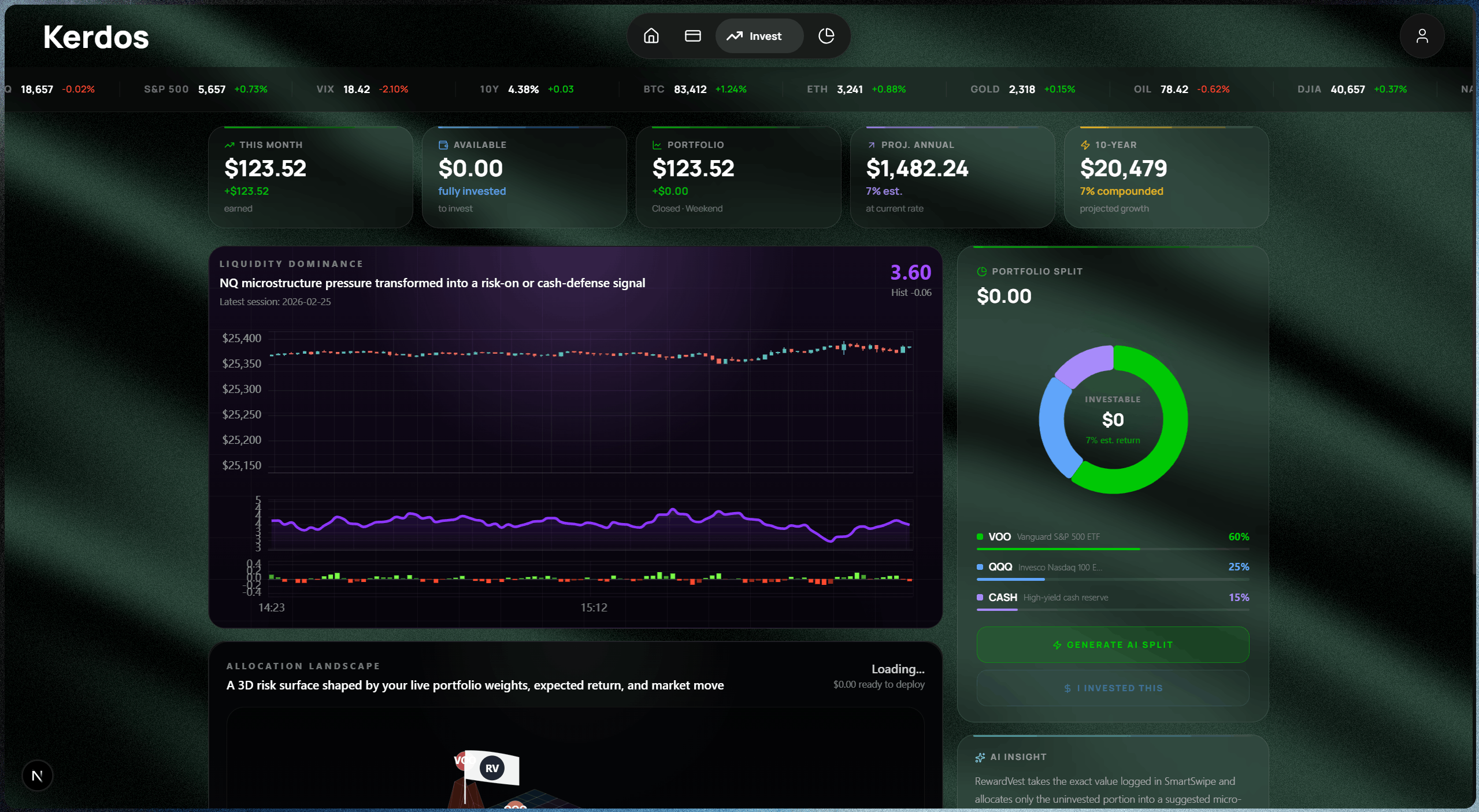
RewardVest
-
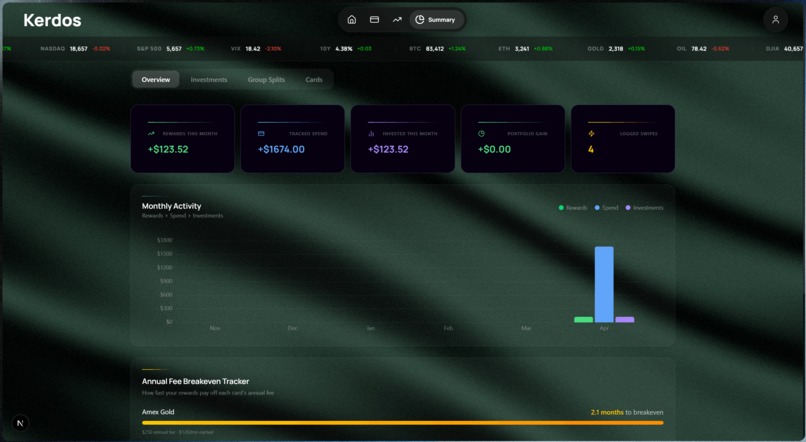
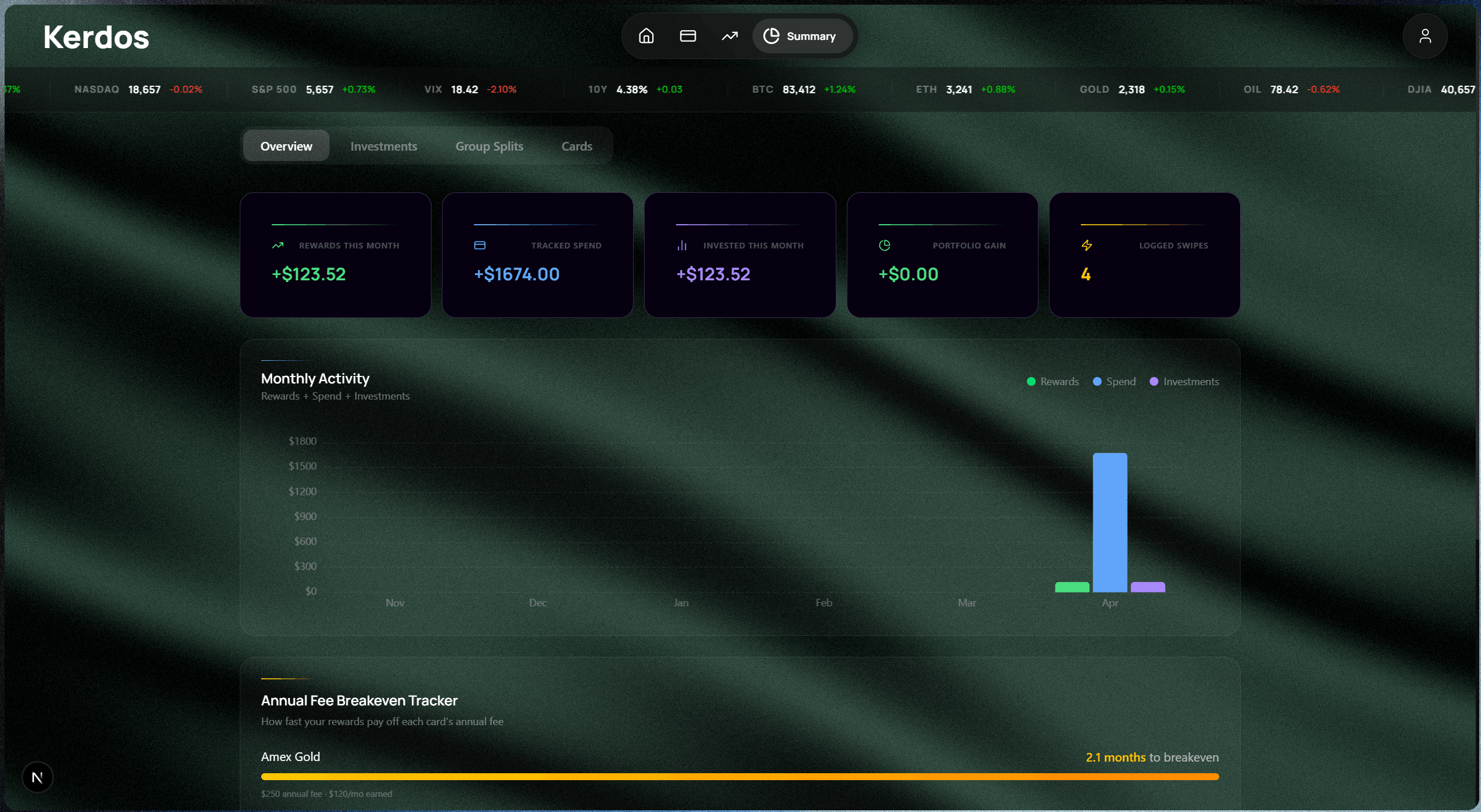
Summary
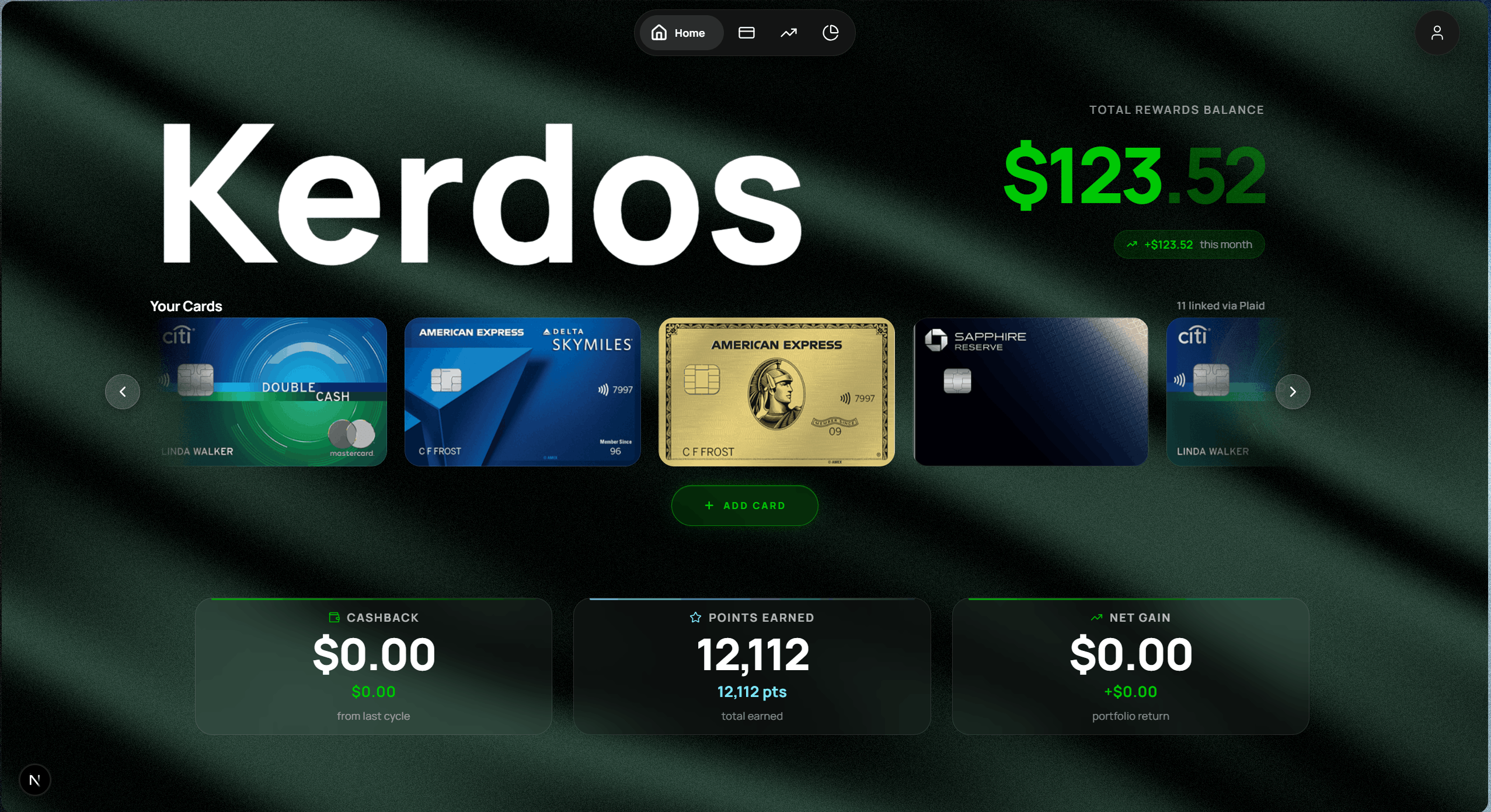
The Problem We Couldn't Ignore
The average American holds 5 credit cards. Each one has different cashback rates, reward points, airline miles, dining credits, and signup bonuses. And yet almost nobody actually knows which card to swipe at any given moment.
The result? Hundreds, sometimes thousands of dollars left on the table every year.
We'd all been guilty of it ourselves. Swiping whatever card was on top of the wallet. Letting rewards pile up and expire. Never once connecting those rewards to real financial growth. That frustration is what built kerdos.
What "kerdos" Does
kerdos is a three-feature AI-powered finance companion built around one idea: your credit cards should work as hard as you do.
Feature 1: SmartSwipe
Before any purchase, tell kerdos the merchant or category. It scans all your linked cards and instantly tells you which one earns the maximum return, showing exact cashback value, points, and miles per card.
Use Amex Gold: 4x Membership Rewards on dining = $0.96 back. Chase Sapphire = $0.72. Citi Double Cash = $0.49.
The scoring algorithm is deterministic and fast: multiply each card's reward rate for the category by its point valuation, then by the transaction amount. kerdos runs this across every linked card and surfaces the winner with a full breakdown. No AI required, pure math, instant results.
Feature 2: RewardVest
Most people redeem rewards for gift cards or statement credits and forget about them. We asked: what if rewards were treated as investable capital?
RewardVest tracks your total earned cashback in real time and generates a personalized micro-portfolio using two layers. First, a custom market signal engine called BQuant analyzes pre-loaded NQ futures bar data (momentum, session delta, VPIN, institutional absorption) and classifies the current regime as bullish, defensive, or mixed. Second, a deterministic portfolio rules engine uses that regime signal, your reward amount, and your risk tolerance to produce an allocation across ETFs like VOO, QQQ, and BND. A DeepSeek V3 model via Featherless.ai then wraps the output in a plain-language summary. Live ETF prices are pulled via Alpha Vantage and shown in the market ticker.
You earned $340 this month. BQuant score: 7.2/10, bullish. Suggested split: 55% VOO, 30% QQQ, 15% cash reserve.
No existing app connects credit card rewards to investment intelligence. This is the feature that makes the flywheel real.
Feature 3: WealthSplit
A financial command center that shows the complete picture: total rewards earned, cashback in dollar value, card fee breakeven timelines, investment gains from RewardVest, and group expense splits, all in one dashboard.
This month you're up $847 net across rewards, savings, and investment returns.
How We Built It
The stack: Plaid Sandbox for financial data, rewardscc.com API for card reward rates, Alpha Vantage for live ETF prices, DeepSeek V3 via Featherless.ai for natural language summaries, and Next.js with Tailwind and Framer Motion on the frontend, backed by Next.js API Routes.
For the reward scoring engine, we mapped Plaid's merchant category codes to each card's bonus categories from the rewardscc API, calculated real dollar-equivalent values per card, and ranked them on every query.
The BQuant signal engine reads NQ futures bar data and computes a composite 0-10 score from price momentum, session delta, VPIN, RSI, buy pressure, and institutional absorption. It runs entirely without an external market API; the signal is deterministic and reproducible.
Challenges We Faced
Reward rate normalization was the first hurdle. Different cards express rewards in points, miles, percent cashback, and multipliers, so unifying those into a single comparable dollar value required careful point valuation mapping. Plaid sandbox data doesn't always reflect real merchant category codes cleanly, so we built a fuzzy-matching layer to handle edge cases. Getting the LLM to generate genuinely useful investment summaries (not generic ones) required significant prompt engineering with market regime context injected directly. And doing all of this in 36 hours is exactly as hard as it sounds.
What We Learned
Plaid's sandbox is remarkably powerful for rapid prototyping financial products. Separating deterministic logic from AI-generated language meant the core product worked reliably even when the LLM was unavailable. And the hardest part of a multi-feature app isn't building the features; it's making them feel like one product.
What's Next
Real Plaid production credentials for live bank connections, Auth0 for Google and Apple login, support for non-US cards (Avios, Nectar, Amex UK), a browser extension version of SmartSwipe for online checkout, and automated reward-to-investment execution via brokerage API.
We turned 5 credit cards into one financial brain, and we did it in 36 hours.
Built With
- alpha
- auth0
- credit-card-bonuses-api
- css
- framer
- gpt-4o
- html
- javascript
- mini
- motion
- next.js
- node.js
- openai
- postgresql
- react
- recharts
- rewardscc
- supabase
- tailwind
- typescript
- vantage
- vercel

Log in or sign up for Devpost to join the conversation.