-
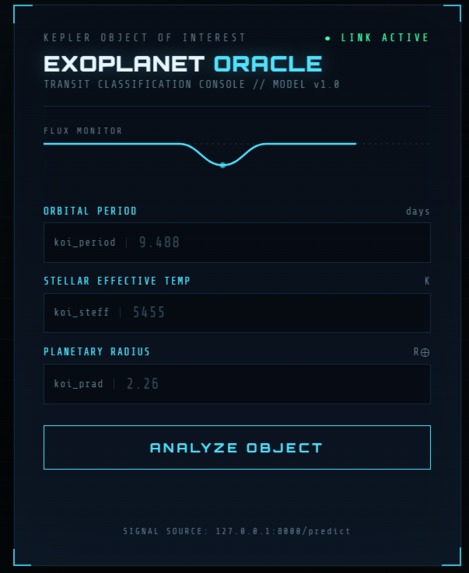
Interactive sci-fi dashboard connecting to the FastAPI backend. Users input Kepler telemetry for instant AI-driven classification.
-
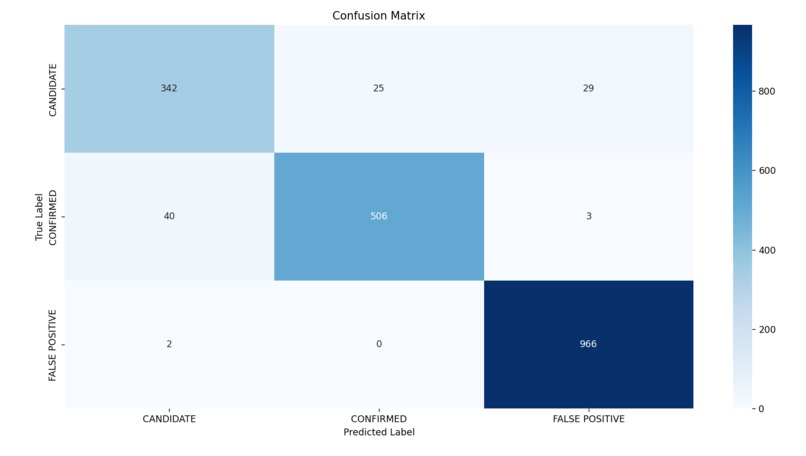
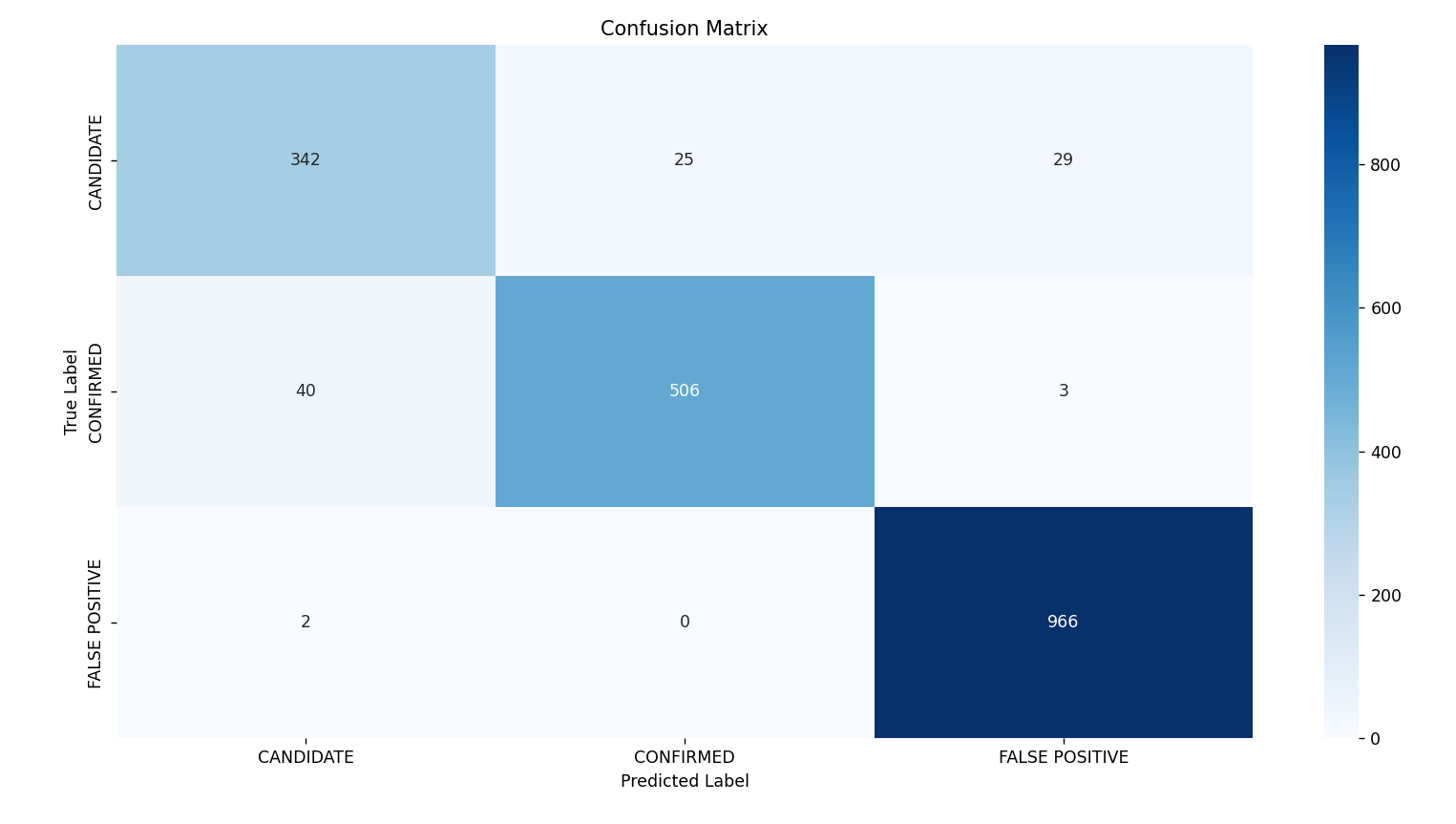
Confusion matrix demonstrating our Random Forest model's 95% accuracy across Confirmed, Candidate, and False Positive classifications.
-
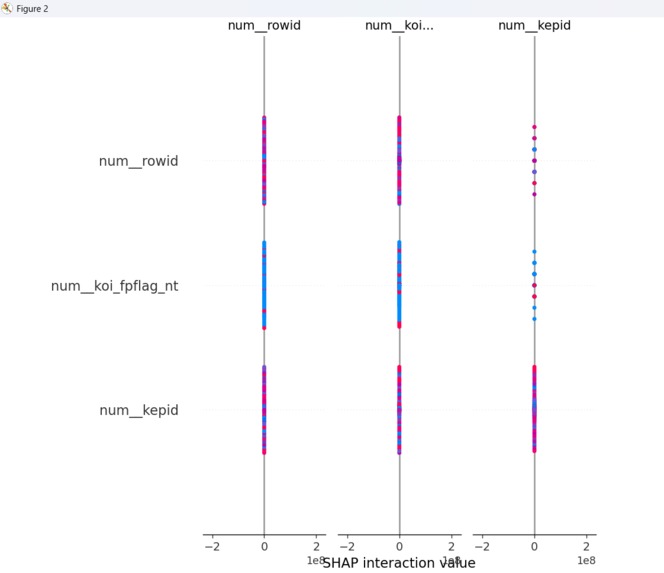
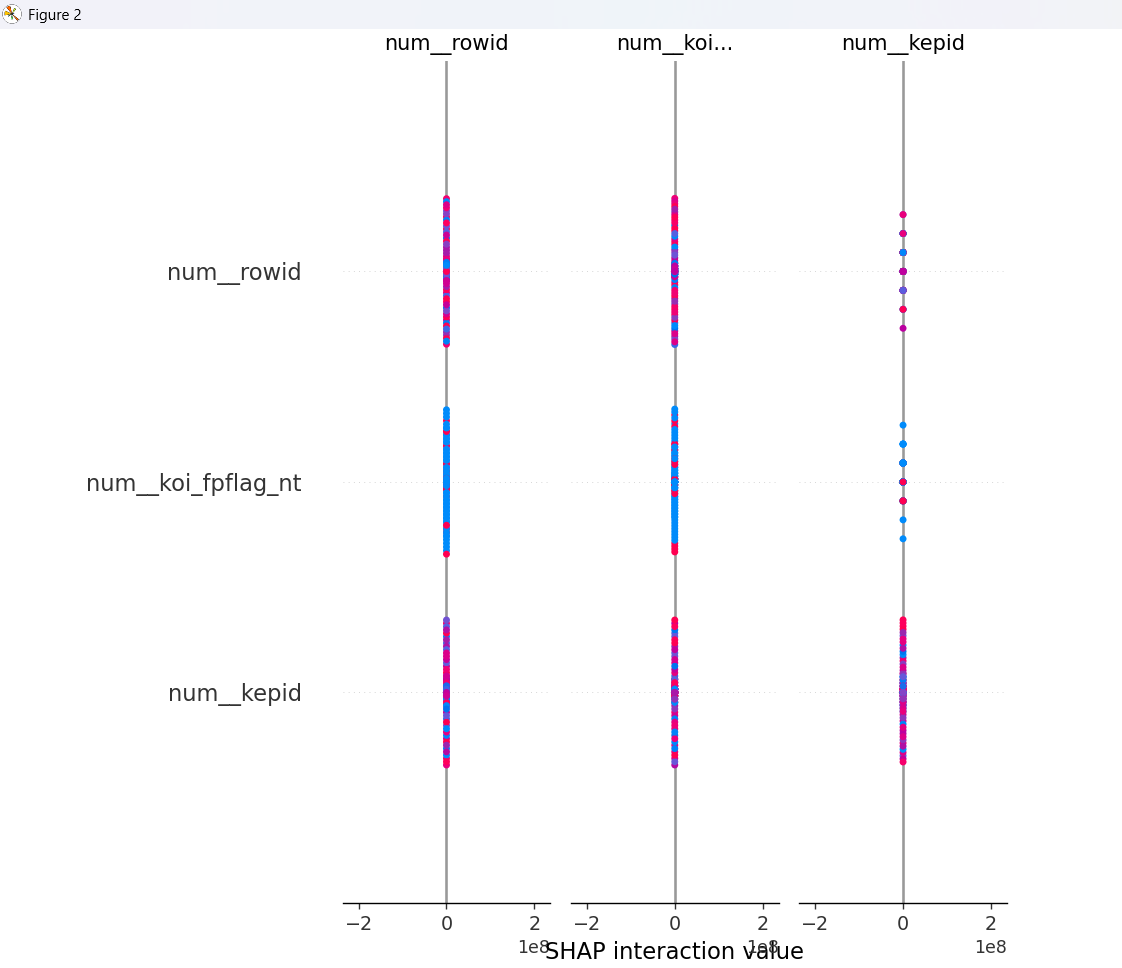
SHAP interaction plot providing Explainable AI transparency. It maps exactly how specific Kepler telemetry influences model predictions.
💡 Inspiration
NASA's Kepler space telescope gathered vast amounts of planetary light-curve telemetry, producing far more candidate objects than astronomers can manually classify. Finding potentially habitable worlds requires analyzing complex signals buried in noisy data. I wanted to build an accessible, highly accurate, and fully transparent machine learning application that allows anyone to classify Kepler Objects of Interest (KOI) in real time.
🚀 What it does
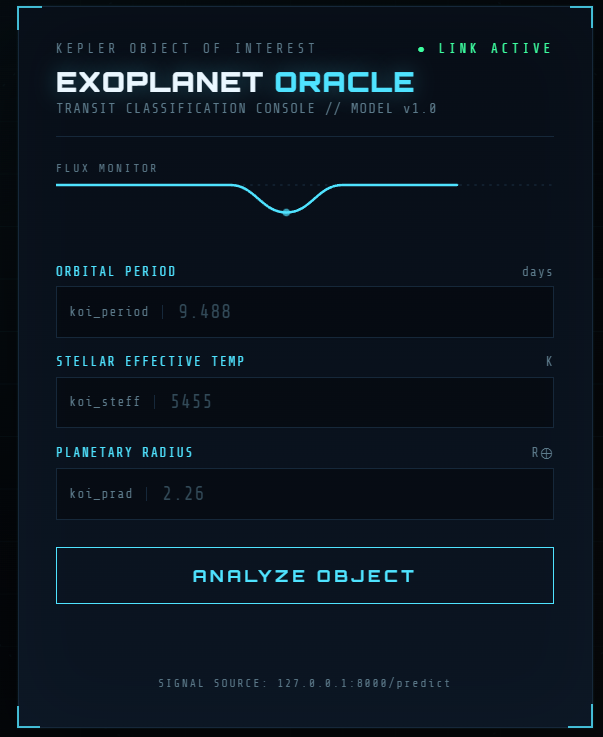
Kepler Exoplanet Oracle is an end-to-end classification engine and mission-control styled dashboard. Users input key telescope measurements—such as Orbital Period (koi_period), Planetary Radius (koi_prad), and Stellar Effective Temperature (koi_steff)—and instantly receive an AI-driven prediction classifying the candidate object as CONFIRMED, CANDIDATE, or FALSE POSITIVE.
🛠️ How I built it
- Data Processing & EDA: Preprocessed the
KOI_Cumulative_clean.csvdataset. To resolve severe class imbalance between false positives and confirmed exoplanets, I applied SMOTE (Synthetic Minority Over-sampling Technique). Missing attributes were imputed using median statistical strategies. - Domain-Aware Feature Selection: Isolated physical telemetry variables—orbital timing, host star temperature, and planet radius relative to Earth—to train domain-accurate decision boundaries.
- Machine Learning Pipeline: Trained a Random Forest Classifier using Scikit-Learn, achieving an overall 95% accuracy on unseen test data.
- Explainable AI (XAI): Integrated SHAP (SHapley Additive exPlanations) to generate feature importance summaries, converting black-box model decisions into clear, verifiable insights.
- Backend API: Built a high-performance REST API with FastAPI and Uvicorn to handle request payloads and model inference via
joblib. - Frontend UI: Designed a custom sci-fi themed dashboard using HTML5, CSS3, and JavaScript, complete with a visual flux monitor and live status output.
⚡ Challenges I ran into
- Class Imbalance: Raw telescope telemetry naturally skews heavily toward false positives. Applying SMOTE without overfitting required careful validation tuning.
- API Pipeline Preprocessing: Handled live payload edge cases in FastAPI by enforcing baseline imputation routines for non-input parameters.
- Clean Repository Architecture: Properly configuring
.gitignoreto exclude large Python virtual environments while keeping essential serialized.pklmodels tracked.
🎉 Accomplishments that I'm proud of
- Developed and deployed the entire end-to-end full-stack machine learning application as a solo developer.
- Reached 95% classification accuracy while maintaining full model interpretability through SHAP.
- Built a custom, responsive, sci-fi UI that transforms raw data prediction into an engaging user experience.
🎓 What I learned
- Advanced multi-class resampling strategies using SMOTE.
- Productionizing machine learning models with FastAPI and Uvicorn.
- Communicating complex AI predictions using SHAP feature attribution.
🔮 What's next for Kepler Exoplanet Oracle
- Deploying the FastAPI backend and frontend to cloud hosts like Render or Vercel.
- Adding real-time transit light-curve visualizations directly into the UI.
Built With
- css3
- fastapi
- html5
- pandas
- python
- scikit-learn
- shap
- uvicorn


Log in or sign up for Devpost to join the conversation.