Inspiration
A beverage manufacturer needs a new packaging supplier approved before the Q4 run. Any agent can do that in a minute: read the packet screen the name, create the record. Then the certificate of insurance expires in March, and the agent that created the record is long gone. Someone has to notice, chase the renewal, and decide whether it is still safe to buy. Every onboarding tool we looked at retires the day the ERP record is created, and the ongoing work goes back to a person with a calendar reminder.
That gap is the whole project. Approval was never the hard part; the hard question is whether an agent can stay accountable for an obligation across months. The name is the answer we wanted: Kepler's breakthrough was not noticing that planets move, it was showing that their motion obeys law. An agent that runs for minutes can improvise. One that stays for months has to obey policy, and the policy has to be something you can read.
What it does
Keplaria stays. One durable case per supplier onboards it into a real ERP, then wakes months later on its own clock: it emails the supplier for renewed evidence, places a reversible purchasing hold when the certificate lapses, reads the renewal that eventually arrives, checks every extracted value against the document it came from, screens the name again, scores the case against a versioned policy, and releases the hold. None of that is a chat. The system decides, and it writes those decisions into the ERP.
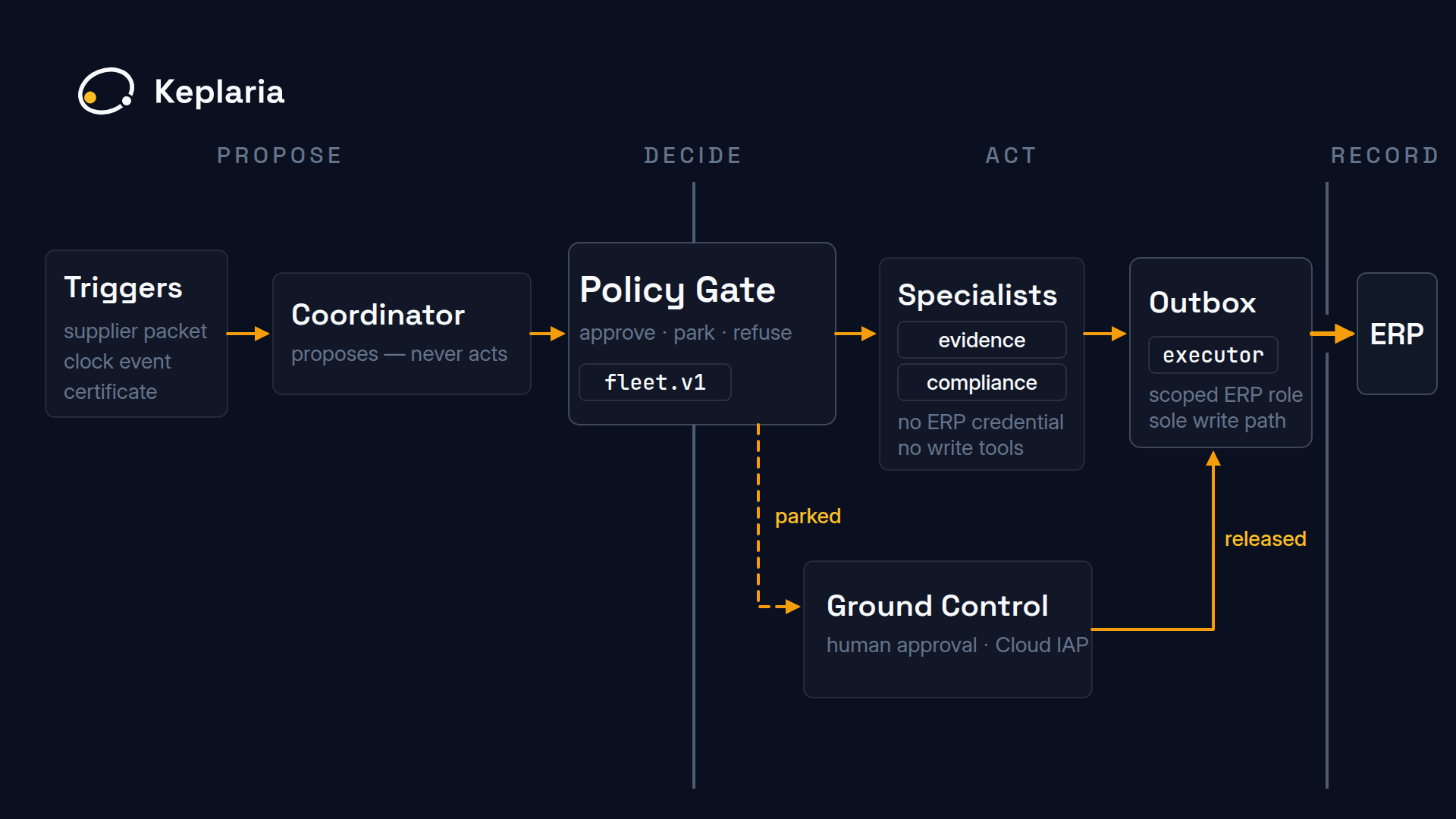
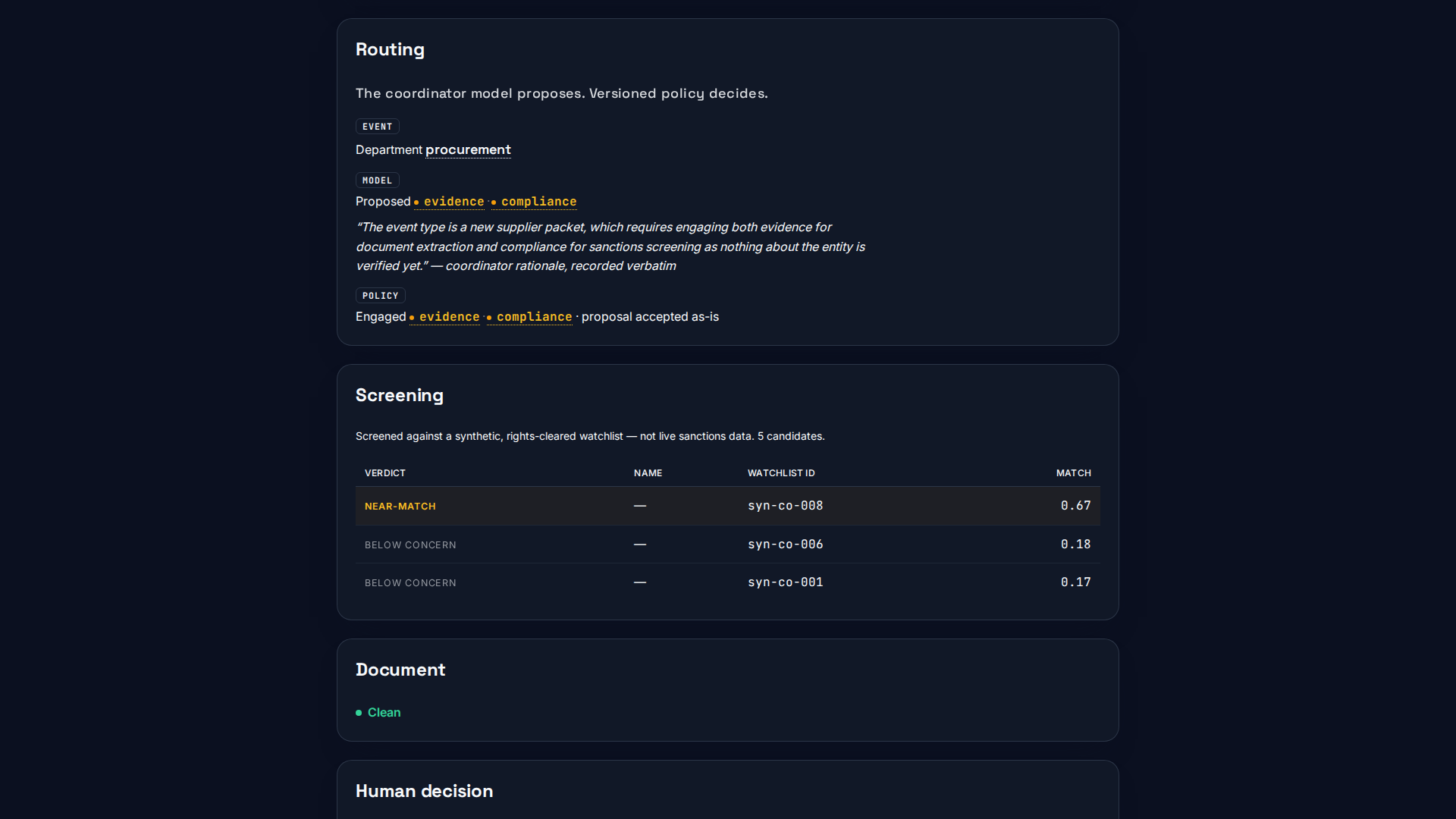
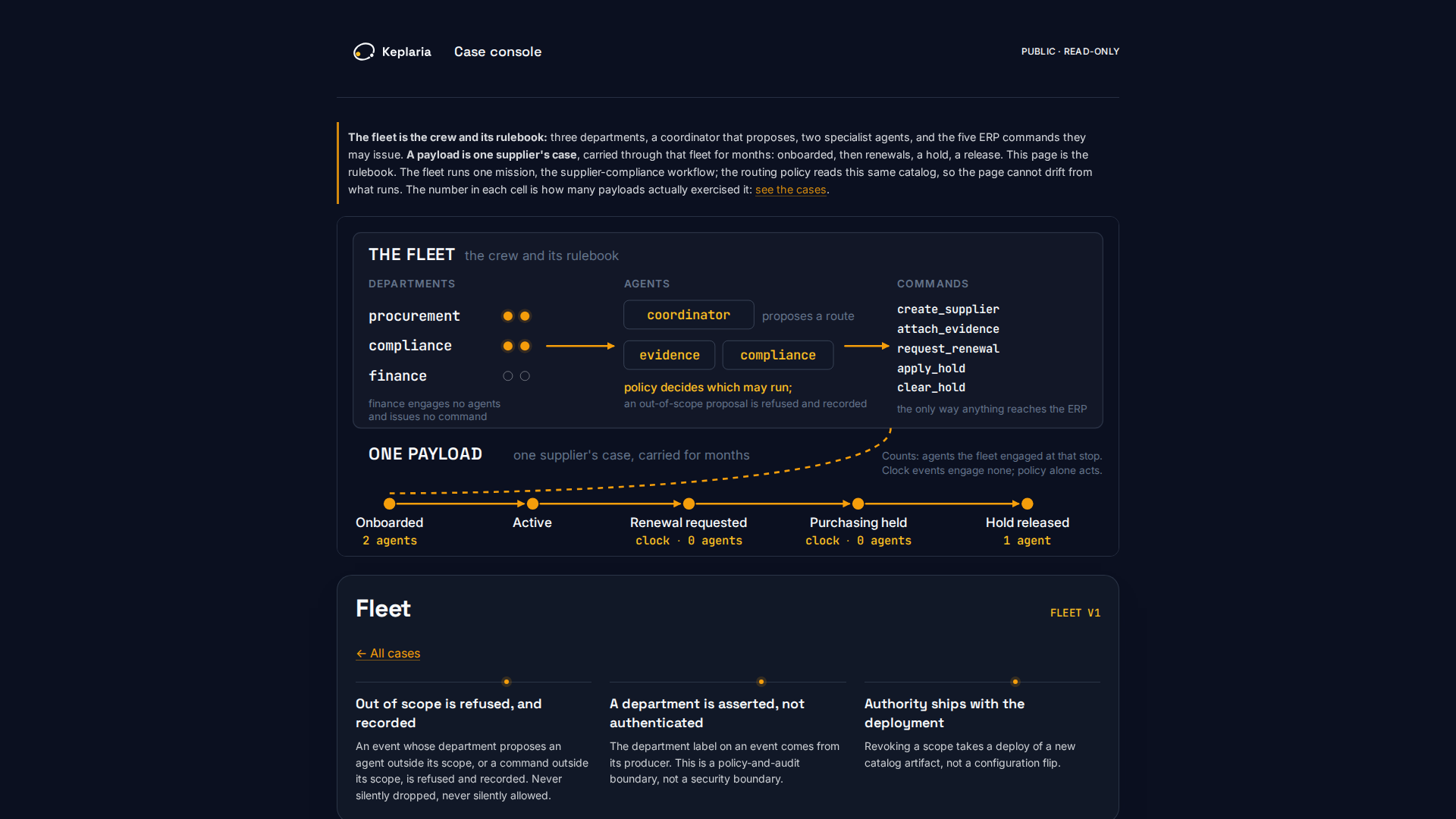
Two nouns carry the design. The fleet is the crew and its rulebook: three departments, a coordinator that proposes, two specialist agents (evidence and compliance), and the five ERP commands they may issue. A payload is one supplier's case, carried through that fleet for months. The coordinator model proposes which specialists an event needs; a deterministic policy layer decides, against a versioned catalog, and records what it dropped or added. The public console shows both: every case grouped under its supplier, and the fleet's rulebook with a live count of how many cases exercised each rule.
It stops exactly where policy requires a person, and nowhere else. A sanctions near-match parks the case for a reviewer at Ground Control, the human decision console, with its ERP writes queued but unexecuted. One reviewer, one click, and the record appears in the ERP the same moment. A rejection is equally binding. A protective hold never waits for anyone: it is already applied before a reviewer opens the page, because refusing to hold a risky supplier during a review would invert the point of the review.
The other side of the relationship is the one nobody builds for. The party who has to keep a certificate current is often a small supplier with no compliance department and no room for one more portal. Keplaria asks nothing of them: no portal, no login, no account, no training. The renewal request is a real email, queued and dispatched by the ERP's own mail queue; the demo suppliers carry example.com addresses, which have no MX record, so no message is delivered to a real mailbox. One boundary is stated rather than implied: in this prototype the returned certificate enters as a published event; ingesting the reply from a mailbox is design intent, not built, and the video labels it that way on screen.
Measured, not asserted. One deployed run of the whole lifecycle, two suppliers (one parks for a human, one runs unattended from onboarding to hold release), with every figure below read from the run's own evidence file in the repository:
- 45.1 s of machine time against a 130s budget, plus a single 22.4 s human approval, timed separately because it is a person's time.
- By hand, the same work took 663.5 s over 20 steps, 19 of which the run removes; the twentieth is the approval policy requires. Author-timed, not practitioner-reviewed; labelled that way everywhere it appears.
- 22 fields written to the ERP with nobody retyping them.
- 1 policy-required intervention, and the system stopped for it rather than deciding it.
- 5 enforced hold days: claimed only because both the hold and its release executed in the ERP.
- 0 duplicate writes after a retry. The retry that proves it is a real
failed
clear_holdcommand re-driven to completion by the unattended sweep (core contracts); the recorded run itself needed no retry. - 380 simulated business days, about a year and a half of a supplier's life, inside one recording; the compression is disclosed on screen.
How we built it
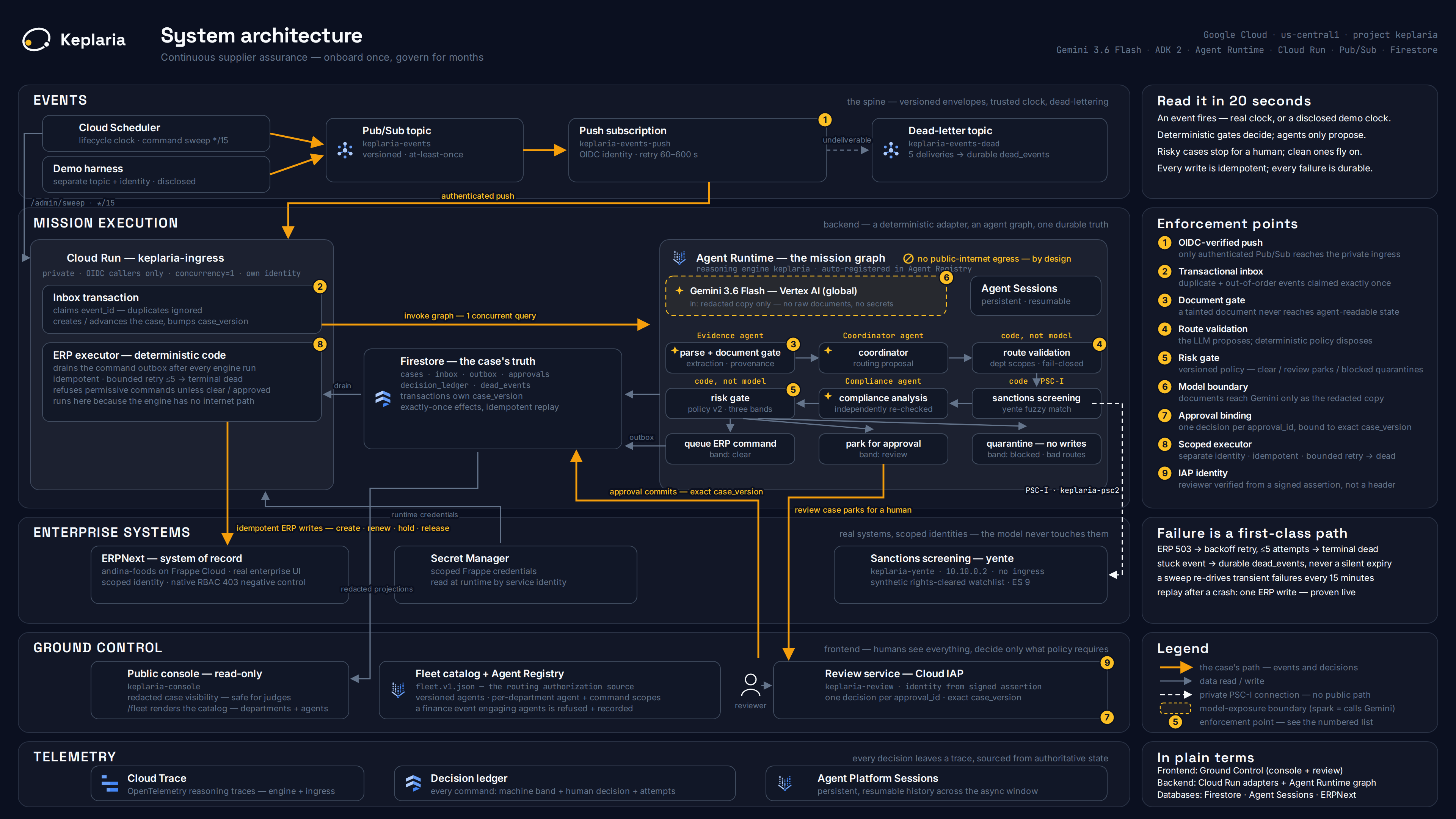
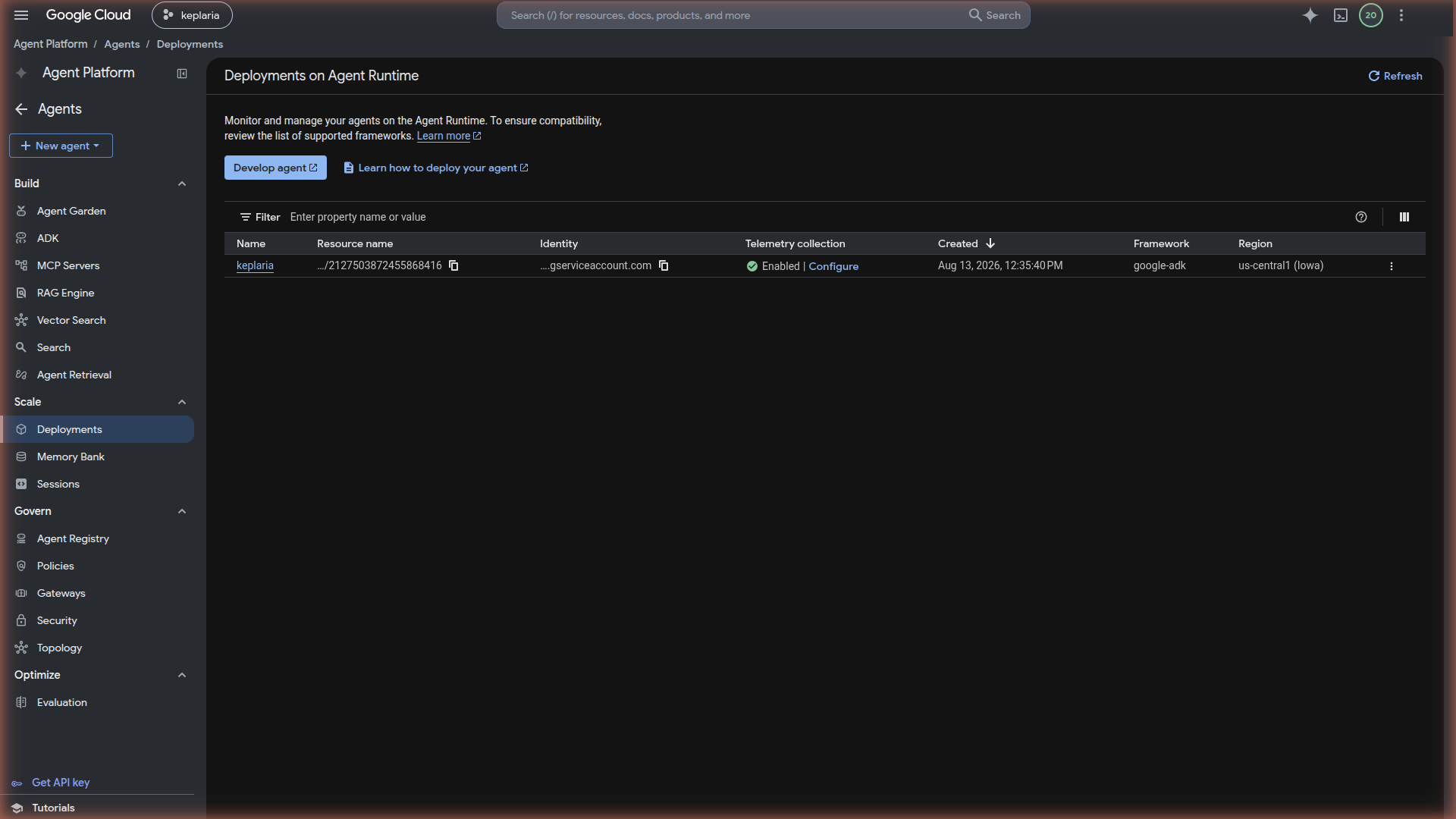
Two runtimes, one boundary. The agent graph is built on the Google Agent Development Kit (ADK) for Python, runs on Gemini 3.6 Flash, and is hosted on Agent Runtime as a reasoning engine: it auto-registers in Agent Registry, keeps execution state in Agent Platform Sessions, and reaches a private screening VM over Private Service Connect (no external IP, not reachable from the internet). Three Cloud Run services surround it: an authenticated Pub/Sub push adapter, the only component that can drive a state change through the graph; the public read-only case console; and the review console behind Cloud IAP, where the reviewer's identity is read from a signed assertion, never from a header a caller could set.
Separation of concerns is enforced, not described. The fleet catalog is one committed, versioned artifact: every agent, the route for every event type, and the agents and commands each department may use. The same file that the console renders is the file routing enforces, so what a judge sees cataloged is literally what runs. A proposal that reaches across a department boundary is refused and recorded, never quietly corrected; a catalog that fails to load refuses every proposal rather than falling back to stale data. Each specialist has its own context and tool surface, and no agent holds a credential.
State is durable and replay-safe. Authoritative case state lives in Firestore, transactionally: the case version, the event claim that makes duplicate and out-of-order events impossible, the approval keyed to the case version it was taken against, and the command outbox whose ids derive from the case and its cycle, so a retried command leaves exactly one ERP record. The one stated exception is outbound mail, which the ERP does not deduplicate: a lost response can repeat a message, never a record. Generative memory is deliberately not trusted with compliance facts.
Credentials are scoped and confined. Secrets come from Secret Manager; each service runs as its own service account; the ERP credential belongs only to the deterministic executor, never to an agent, and to a purpose-made ERP user whose single role can read, write and create supplier records, send mail about one, and create correspondence and attachments, and nothing else: it cannot delete what it created, widen its own permissions, or read an invoice. Those limits are measured against the live site on every run of the check.
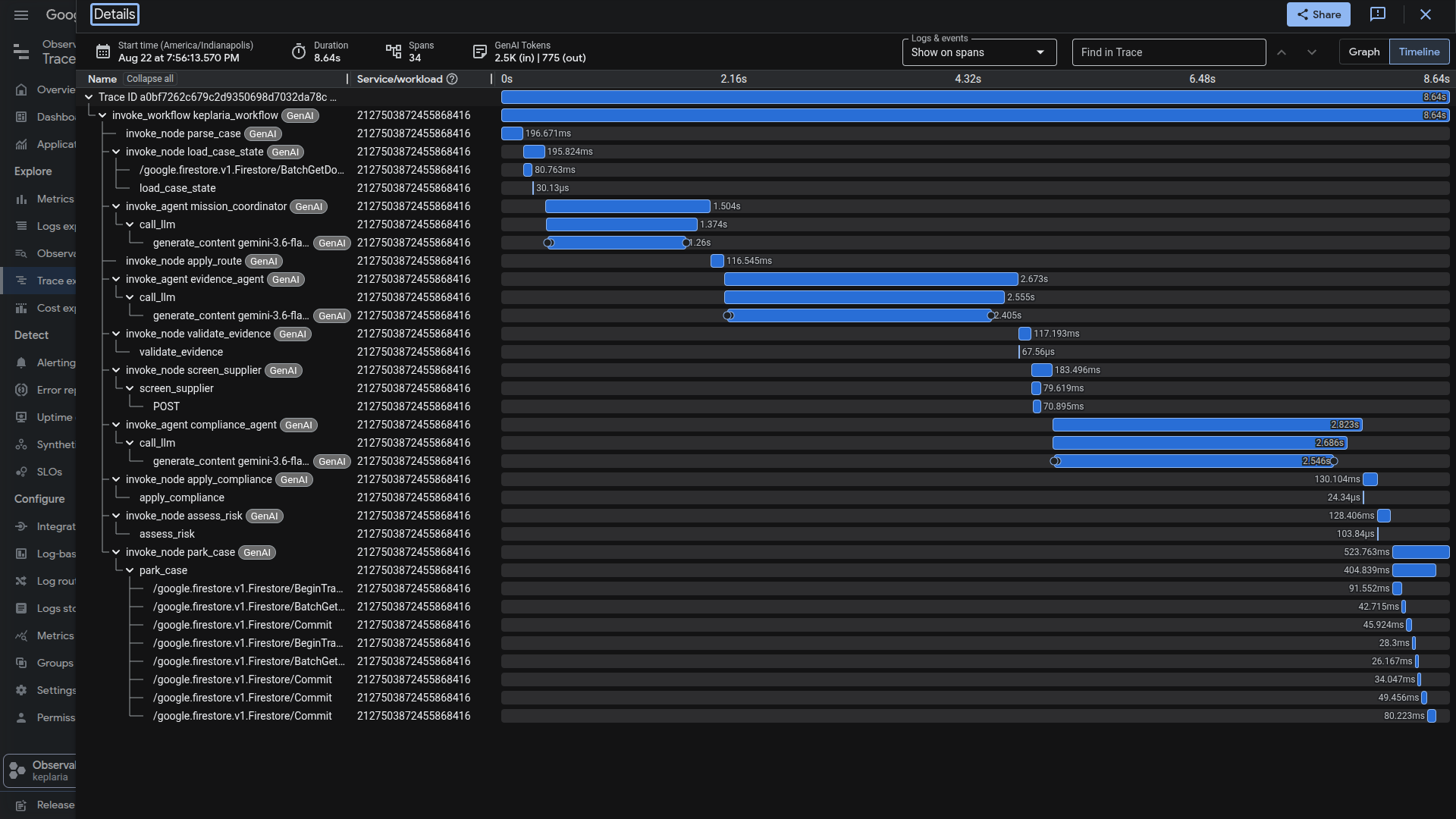
Failures are handled where they happen. Bounded retries with a dead-letter topic and an unattended sweep; a schema-valid but source-unsupported worker value is rejected, retried within bounds, and quarantined for a human instead of reaching the ERP. Traces go to Cloud Trace and are load-bearing: a 10.6 s rise in run time was diagnosed node by node against them and traced to model reasoning length, not code.
The enterprise systems are real; the data is not. A hosted ERPNext site holds the supplier records and a self-hosted yente screening service answers the sanctions calls, but every document, supplier, and watchlist entity is synthetic and was authored for this project; nothing is customer data or a de-identified derivative of it. Case documents are authored fixtures, and every field extracted from them must resolve to a verbatim span or the case quarantines. The screening index is a synthetic watchlist; no OpenSanctions content is indexed. The ERP is a dedicated demonstration site, and every mutation is sandboxed to it. Third-party code, assets, and AI assistance are itemised in the repository.
Challenges we ran into
The hard problem was never the agents; it was making their work safe to replay. Every serious failure in this build had the same shape: an event arrives twice, a process dies mid-write, a retry fires after the first attempt already succeeded. Correct-looking agent code plus an at-least-once event system produces duplicate suppliers and approvals that apply twice. The fix was to stop treating durability as a property of the agent and make it a property of the state. 0 duplicate writes after a retry is the output of that design, and a test would fail if the design were removed.
Grounding is not trust. An agent that obeys an instruction hidden in a document will cite a genuine span for the value it was told to produce, and the provenance check passes, because the provenance is real. So the injection defence had to sit elsewhere: a tainted document never reaches a state key an agent can read.
The engine cannot reach the internet, on purpose. The graph runs behind a private interface with no public egress, so the deterministic ERP executor had to live in the Cloud Run ingress rather than in the graph. What began as a workaround became the cleanest boundary in the system: the component that reasons and the component that writes are different processes under different identities.
Evidence rots quietly. A committed evaluation score once outlived the behaviour it graded by two days, and a routine cleanup once deleted the only live records proving a contract about deployed state. So the harness now discovers what it verifies instead of naming it, and re-runs everything it cites.
Accomplishments that we're proud of
Every number in this submission has a checker. The graded domain suite runs 24/24 at a 100% mean score on a deterministic pass metric: whether the enforcement outcome was the required one, not whether a model liked the prose. 629 passed of 629 contract and unit tests, re-executed by the run that reports them. Nine contracts, from replay safety to one ERP write after a retry, are re-verified at capture time. Ten consecutive deployed runs, two of them cold starts, finished inside the budget before anything was recorded. And a claim ledger binds every public number above to the evidence file and field that produced it, so a number that drifts from its source is reported rather than published.
A protective hold that does not wait. Proven on the deployed system by a reviewer signed in through IAP: the ERP hold was written eleven minutes before the rejection that withheld everything else, both timestamps server-side.
A console a stranger can read. Two readers with no context were given the case console's URL and nothing else; both said what the fleet is, what a payload is, and how they relate, and both said the page told them in under ten seconds. Their verbatim answers are kept in the repository as evidence.
What we learned
A commercial safety filter is not automatically better than the check you have. A managed prompt-injection filter was measured against this project's own corpus before being adopted; it missed the planted injection the existing check catches, because a few lines of ordinary certificate prose ahead of it dilute the match. Turned down on that evidence, measurement published.
A model can read perfectly and still be unusable. An open-weights Gemma 4 read 6 of 6 test documents correctly, including the one with a planted instruction beside a decoy date, and returned the required output structure on 0 of 6, in three different shapes across identical calls. The same weights run locally, where generation is constrained to the schema, scored full marks on both. What differed was how the model was served, not how it read. Not adopted; measurement published.
What's next for Keplaria
Each of these is stated as a limit today, on the surface that would otherwise overclaim it.
- Ingest the supplier's reply from the mailbox. It is the first thing to build; today the returned certificate enters as a published event.
- A real document preprocessor. Documents are page-text fixtures; the PDF, OCR and redaction stage that would produce the same derivative from a scan is next.
- A live pause on the review branch. A parked case is durable state, not a suspended run; reinstating a genuine mid-run pause on the same branch is the next milestone.
- Let quarantine restrict. A blocked case claims nothing, so a supplier who becomes sanctioned after onboarding cannot yet be held; letting the quarantine terminal claim restrictive commands closes that.
- A practitioner's eye on the baseline. The manual walkthrough is author-timed; one review of the twenty-step list by a procurement or compliance practitioner would close the qualifier.
Built With
- adk
- firestore
- google-cloud
- opensactions
- python
- yente

Log in or sign up for Devpost to join the conversation.