-
-
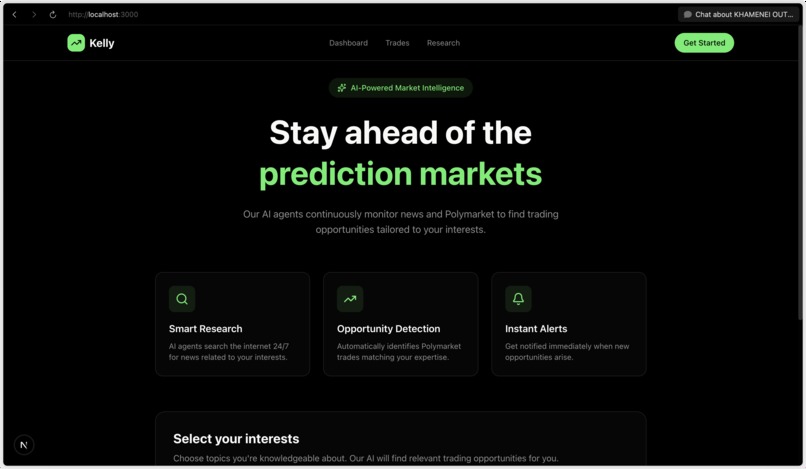
onboarding
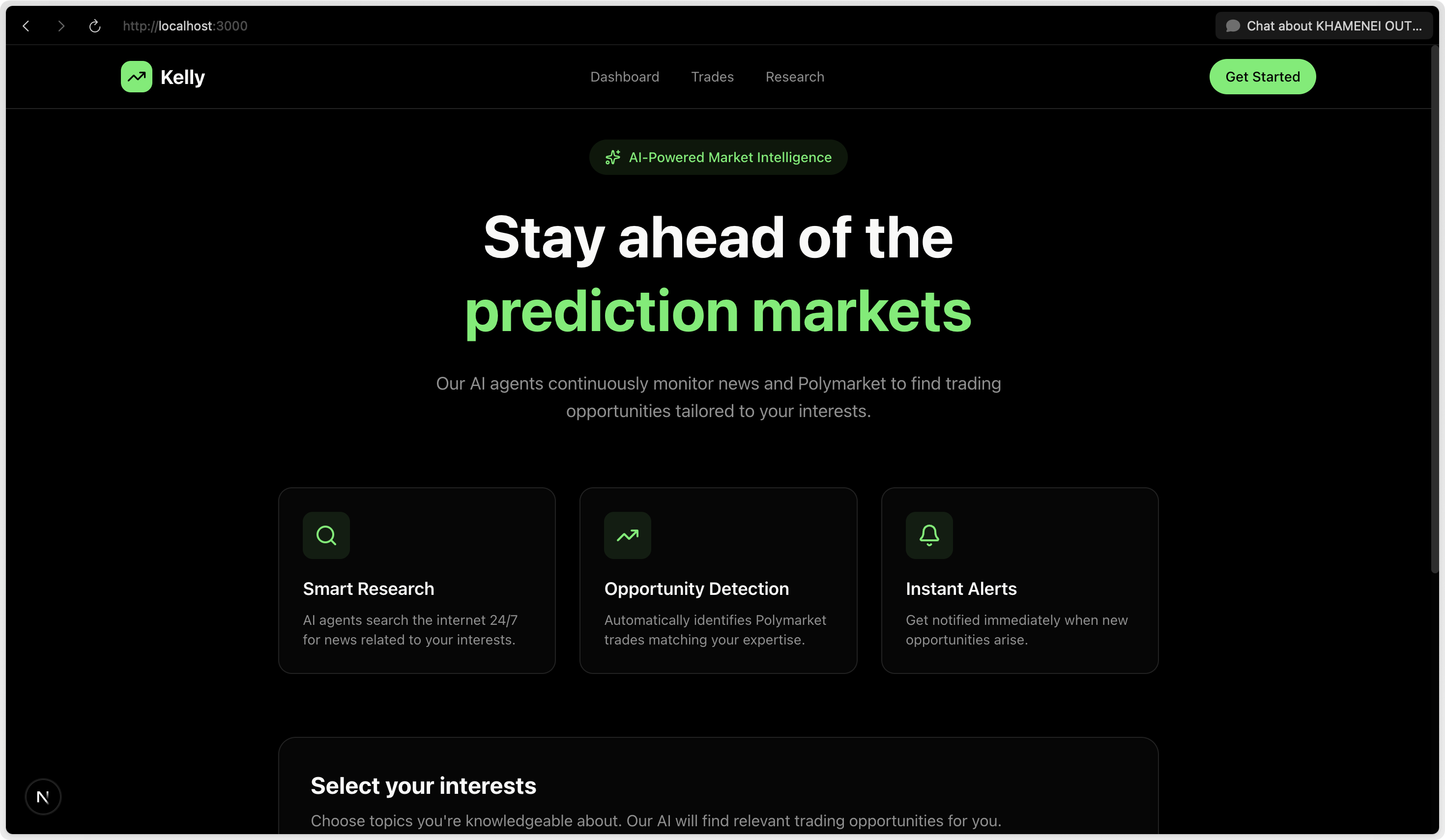
# Kelly - AI-Powered Polymarket Intelligence
## Inspiration
Prediction markets like Polymarket contain valuable insights, but staying informed across hundreds of markets is overwhelming. We wanted to build an AI agent that acts like a personal research assistant - monitoring markets 24/7, connecting news events to trading opportunities, and surfacing only what matters to you. The goal: make prediction market intelligence as accessible as checking a news feed.
## What it does
Kelly is an intelligent agent system that helps users discover and track Polymarket prediction markets through natural language:
Core Features:
- Interest-Based Discovery - Select topics (crypto, sports, politics, etc.) and Kelly finds relevant markets automatically
- AI Chat Interface - Ask questions like "What are trending crypto markets?" and get instant, contextualized answers
- Real-Time Market Data - Fetches live data from Polymarket's API including prices, volumes, and probabilities
- Smart Filtering - Uses word-boundary matching to accurately filter markets by topic (e.g., "AI" won't match "Raiders")
- News Integration - Web search tools (Tavily/Perplexity) connect market movements to real-world events
- Streaming Responses - Server-sent events for real-time AI responses
- Production Monitoring - Sentry integration for error tracking, performance monitoring, and user logs
Agent Architecture:
- Orchestrator Agent - Routes requests and synthesizes multi-source information
- Polymarket Agent - Searches markets, gets details, tracks trending opportunities
- Research Agent - Web/news search to provide context for market analysis
- Database Layer - SQLite stores user interests, watched markets, and notifications
## How we built it
Frontend (Next.js 16 + React 19)
- Next.js with App Router and React Server Components
- Tailwind CSS v4 for styling with custom design system
- TypeScript for type safety
- Sentry integration for error monitoring, performance tracking, and user session logs
- Custom API client with streaming support
Backend (Node.js + Express)
- Express API server with RESTful endpoints
- TypeScript throughout the backend
- Claude Sonnet 4.5 via Anthropic API for AI reasoning
- Vercel AI SDK v4 for tool calling and streaming
- Zod for schema validation
- better-sqlite3 for local persistence
AI & APIs:
- Anthropic Claude - Main reasoning engine with 11 tools available
- Polymarket Gamma API - Free, unauthenticated market data (fetches 200+ events)
- Tavily/Perplexity - Web search for news and context
- Sentry - Real-time error tracking, logs, and performance monitoring
- Streaming Architecture - SSE for real-time chat responses
Key Technical Decisions:
- Used AI SDK v4 (not v6) - v6 had breaking changes we couldn't afford mid-hackathon
- Client-side filtering for Polymarket search since title_contains param didn't work reliably
- Word boundary regex for short topics (e.g., \bAI\b) to avoid false matches
- Fallback to trending when no topic matches found
- Both streaming and sync chat endpoints for flexibility
- Sentry for production observability from day one
## Challenges we ran into
AI SDK Version Hell
- Started with v6, hit breaking changes with tool definitions
- Downgraded to v4 (stable) mid-development
- Had to manage zod compatibility (v3 vs v4)
Polymarket API Quirks
- Discovered outcomes/prices returned as JSON strings, not arrays ("[0.5, 0.5]" not [0.5, 0.5])
- title_contains query param didn't work - had to fetch 200 events and filter client-side
- No authentication required but rate limiting concerns
Short Keyword Matching
- "AI" was matching "Raiders", "Saints", "Raimondo"
- Solved with word-boundary regex: \bAI\b
Frontend Merge Conflicts
- Lost tsconfig.json and PostCSS config during branch merge
- CSS wasn't loading until we recreated PostCSS config for Tailwind v4
Hydration Errors
- Browser extension (JotForm) injecting attributes into SSR HTML
- Not actually our bug, but scary at first
## Accomplishments that we're proud of
- Full-stack integration - Frontend, backend, AI, and real APIs all working together
- 13 comprehensive tests - 92% pass rate with real API calls (about $0.42 total cost)
- Smart filtering - Word-boundary matching correctly filters niche topics
- Streaming chat - Real-time AI responses with SSE
- Production-ready error handling - Sentry logging, graceful fallbacks, connection status indicators
- Clean architecture - Separation of concerns: API client, agents, tools, database
- Real market data - Not mocks - actual Polymarket markets updating live
- Observability from start - Sentry integrated for debugging and monitoring user behavior
Technical Wins:
- Orchestrator agent successfully routes between 11 tools
- Interest sync between frontend localStorage and backend database
- Proper TypeScript throughout (no any abuse)
- Responsive UI that works offline with clear status indicators
- Sentry logs capture user actions, errors, and performance metrics
## What we learned
AI/LLM Development:
- Tool calling works incredibly well for structured tasks like API queries
- Streaming is essential for good UX - users see progress immediately
- Version pinning is critical for AI SDKs (v6 broke us, v4 saved us)
- Claude Sonnet 4.5 is excellent at synthesis and multi-step reasoning
Prediction Markets:
- Polymarket's API is generous (no auth) but has quirks
- Volume is a better sorting metric than recency for discovery
- Users need filtering - 1000+ markets is overwhelming
- Topic matching needs to be precise (word boundaries matter)
Full-Stack Integration:
- Next.js 16 + React 19 is fast but docs are catching up
- Tailwind v4 requires explicit PostCSS config (unlike v3)
- Server/client separation is crucial for features like localStorage + DB sync
- Error boundaries and fallbacks make or break UX
- Sentry integration early saves hours of debugging later
Hackathon Strategy:
- Start with stable versions, not bleeding edge
- Test with real data early (we caught API bugs on day 1)
- Have fallbacks for everything (trending when no matches, localStorage when backend down)
- Document as you go (our TEST_REPORT.md was lifesaver for debugging)
- Add monitoring tools like Sentry immediately for faster iteration
## What's next for Kelly
Short-term (MVP to Beta):
- Background monitoring - Cron jobs to check markets every hour
- Price alerts - Notify when probability crosses thresholds
- WebSocket updates - Push notifications for real-time market changes
- Market watchlist - Save specific markets to track closely
- Historical data - Track price changes over time
- Enhanced Sentry analytics - Custom dashboards for user behavior patterns
Medium-term (Beta to v1):
- User accounts & auth - Multi-user support with NextAuth
- Advanced filters - Date ranges, min volume, probability bands
- Market analysis - AI-generated summaries of why probabilities changed
- Portfolio tracking - Connect wallet to track actual positions
- Mobile app - React Native for iOS/Android
- Sentry performance optimization - Identify and fix slow queries
Long-term (v1+):
- Custom agents per topic - Specialized agents for sports, politics, crypto
- Social features - Share market insights, follow other users
- AI trading suggestions - Not just discovery, but actual trade recommendations with reasoning
- Integration with other markets - Kalshi, Manifold, etc.
- News correlation engine - Automatically link news articles to market movements
- Advanced Sentry alerting - Anomaly detection for unusual market activity
Technical Improvements:
- Migrate to Anthropic Bedrock for better rate limits
- Add Redis for caching market data (reduce API calls)
- Implement rate limiting and request queuing
- Add fuzzy search for better market discovery
- Build admin dashboard for monitoring agent performance
- Sentry profiling for frontend and backend performance optimization
Built With
- claude
- next.js
- node.js
- sentry
- typescript

Log in or sign up for Devpost to join the conversation.