Inspiration
Keeper began with my real experience as a long-form author. While developing a multi-book story, I created strict laws for protecting voice, canon, cultural language, keeper prose, and author authority. I needed AI assistance that could help without treating every request as permission to rewrite my work.
Those rules existed as a disciplined creative process, but I did not know the technical names for them. During Build Week, Codex helped me identify the concepts, translate them into enforceable product behavior, and build Keeper.
What Keeper does
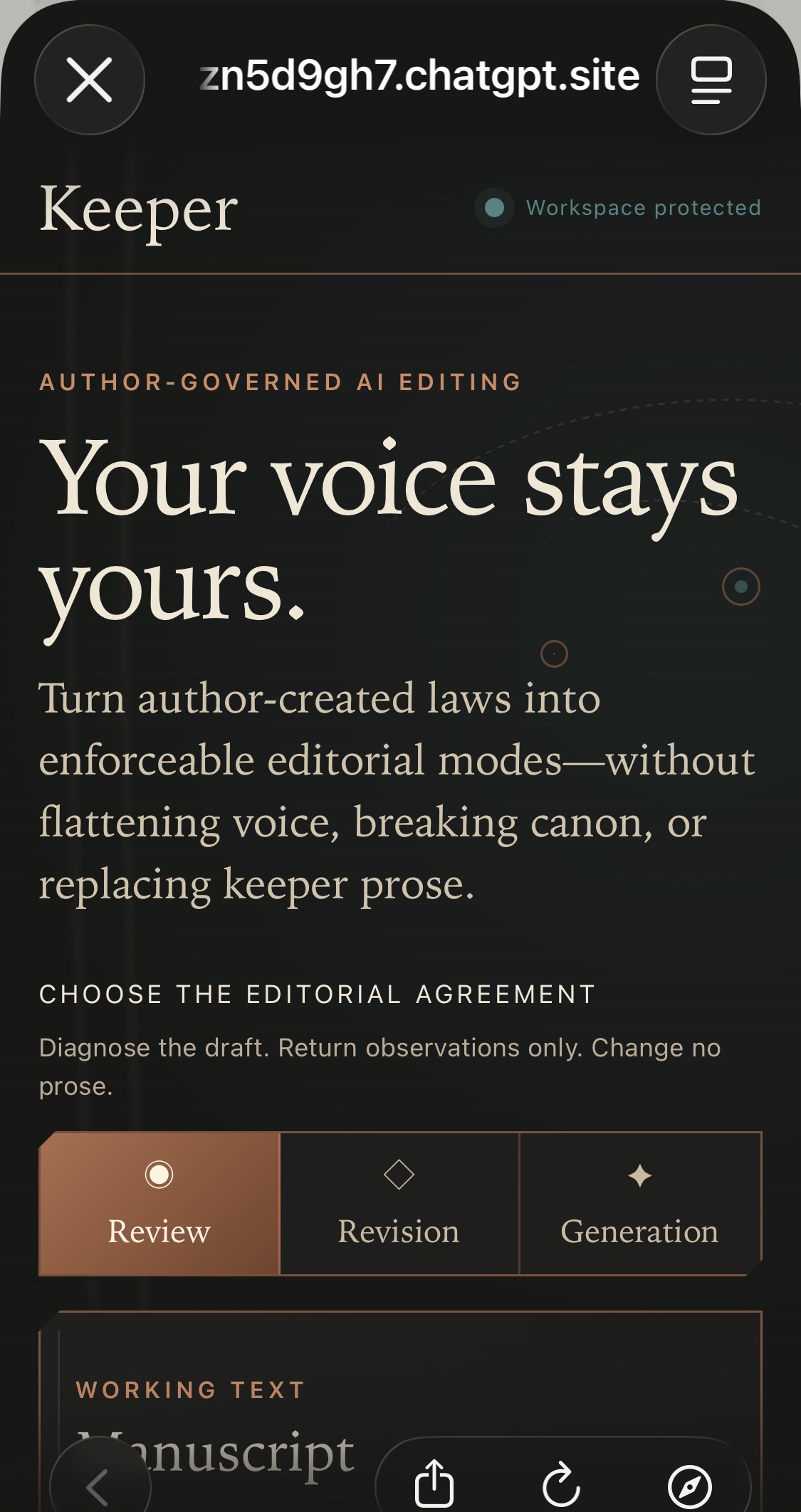
Keeper is an author-governed editorial workspace that separates three different jobs:
- Review may diagnose problems and suggest corrections, but it cannot change the manuscript.
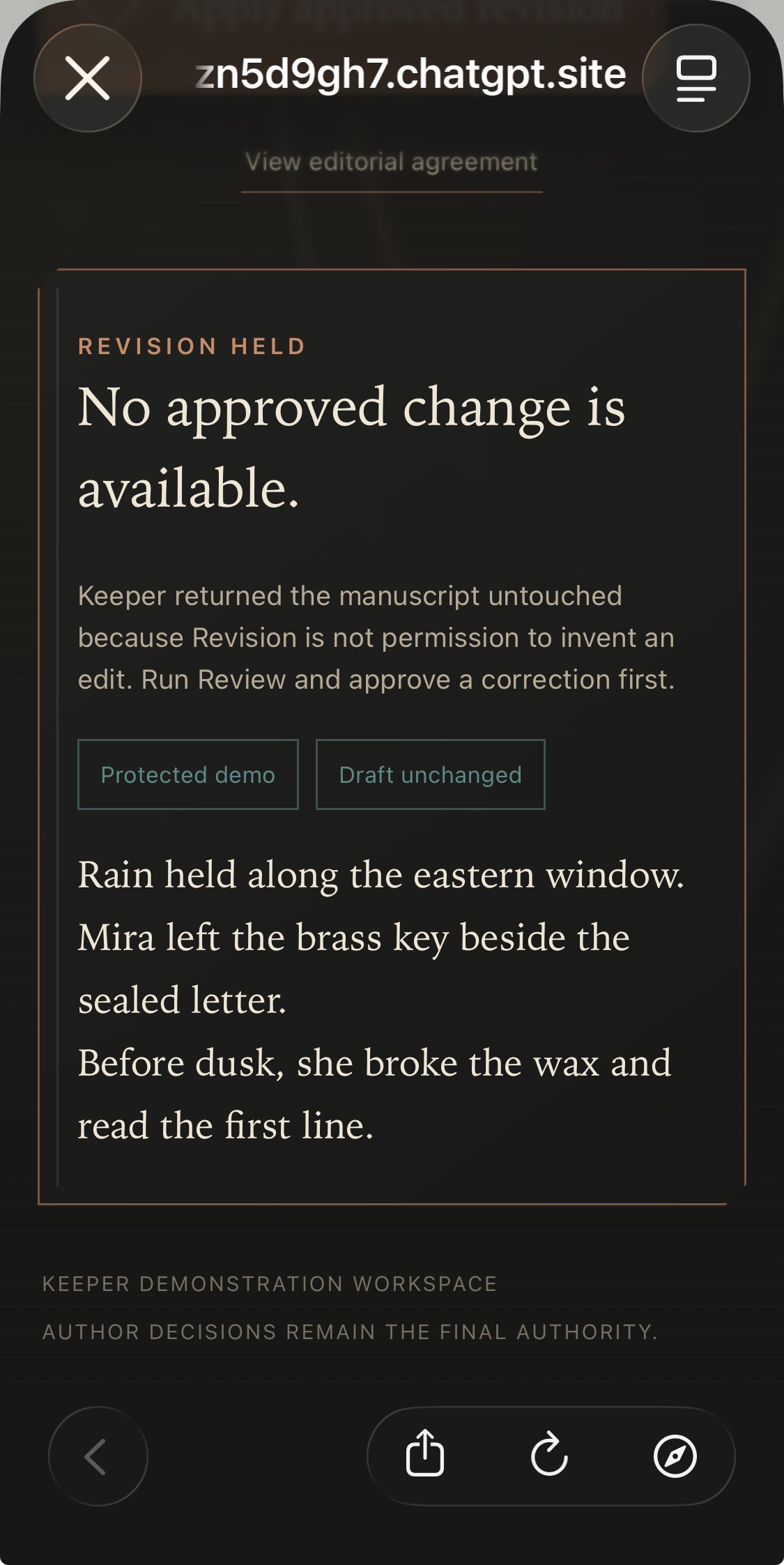
- Revision may apply only an exact change approved by the author.
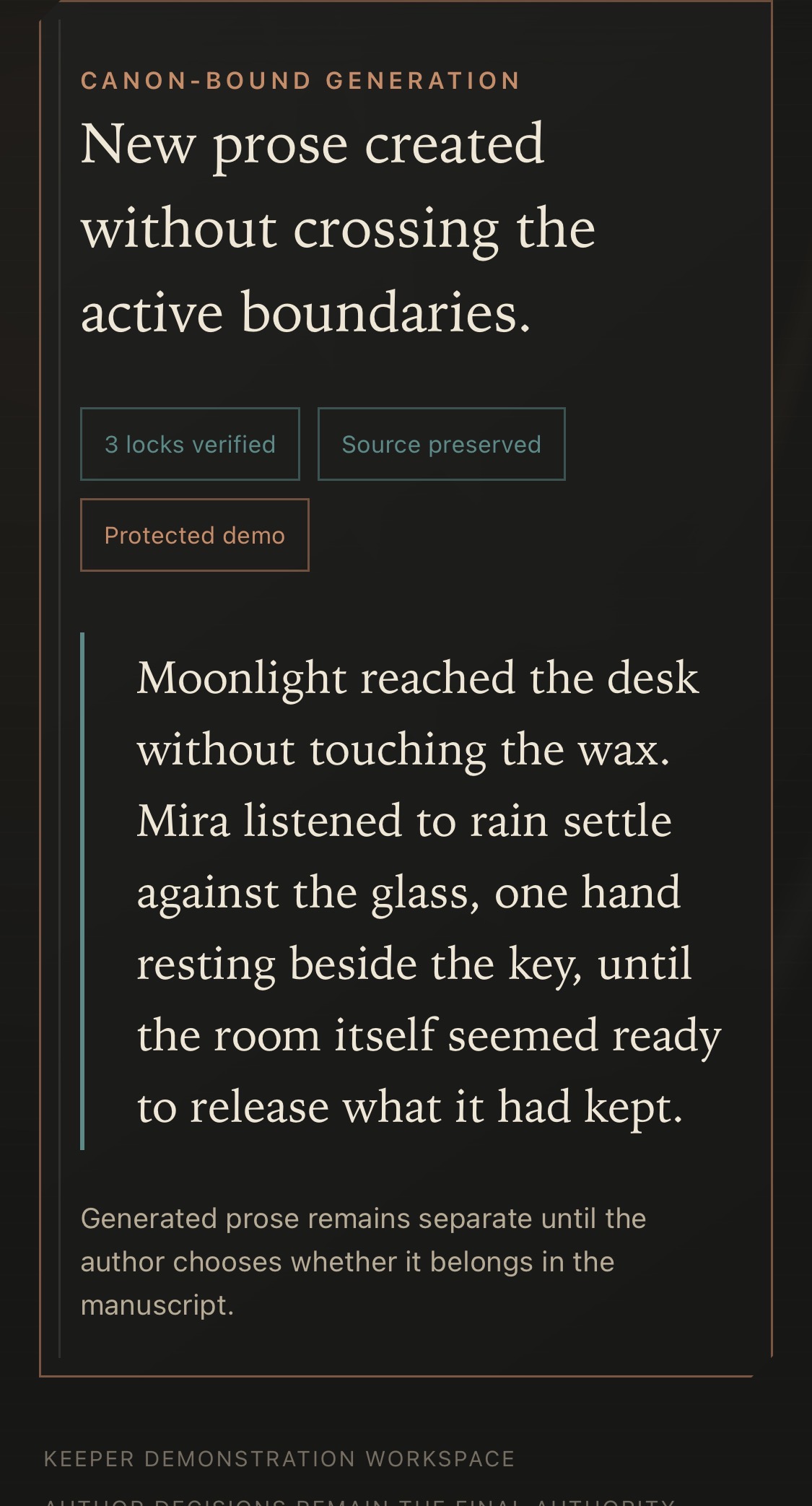
- Generation may create new writing inside active canon, but it must remain separate until the author decides whether it belongs.
Canon locks protect keeper prose, place canon above stylistic preference, and prevent suggestions from silently becoming manuscript text. Every accepted revision is recorded in a change ledger.
How it works
The demonstration begins with an invented manuscript containing a canon conflict: a sealed letter is opened before the story permits it.
Review identifies the conflict while returning the source unchanged. The author may then approve a proposed correction. Approval alone still changes nothing. Revision can apply only that exact approved substitution while preserving every protected line. Generation follows a separate agreement and produces new prose without inserting it into the source manuscript.
Deterministic verification reinforces these agreements around the model. Review and Generation must preserve the source exactly. Revision must match an explicit approved substitution, and protected text cannot disappear.
How I used Codex and GPT-5.6
I supplied the original editorial method, creative laws, authority hierarchy, and strict requirements. Codex helped translate that method into product language, interaction design, server contracts, an installable editorial skill, structured output, tests, documentation, and a deployable website.
The repository includes a server-side GPT-5.6 Responses API path using strict Structured Outputs and post-validation. It also includes a Codex skill that allows judges to test the real editorial protocol without separate API billing.
When no API key is configured, the public website uses a clearly labeled protected demonstration engine. It never presents the fallback as a live GPT-5.6 result.
Challenges and accomplishments
The largest challenge was turning an intuitive author-created process into rules software could verify without flattening its meaning. Keeper also had to demonstrate those rules publicly without exposing any unpublished material from my book series, so every sample line was invented for the project.
The result is a working responsive website, an installable Codex skill, deterministic contract verification, automated tests, an author-approval workflow, and an auditable change ledger.
What I learned
I learned that not knowing conventional technical vocabulary does not mean you have not designed a real system. I recognized patterns, boundaries, and repeated decisions first. Codex helped me name them and turn them into a working product.
What is next
Keeper can grow into a workspace where authors define project-specific canon, protected language, character laws, and approval rules across entire book series. The central principle will remain unchanged: AI may assist, but the author remains the final authority.
Built With
- api
- author
- chatgpt
- codex
- github
- gpt-5.6
- json
- next.js
- openai
- outputs
- productivity
- python
- react
- responses
- schema
- sites
- structured
- typescript

Log in or sign up for Devpost to join the conversation.