-
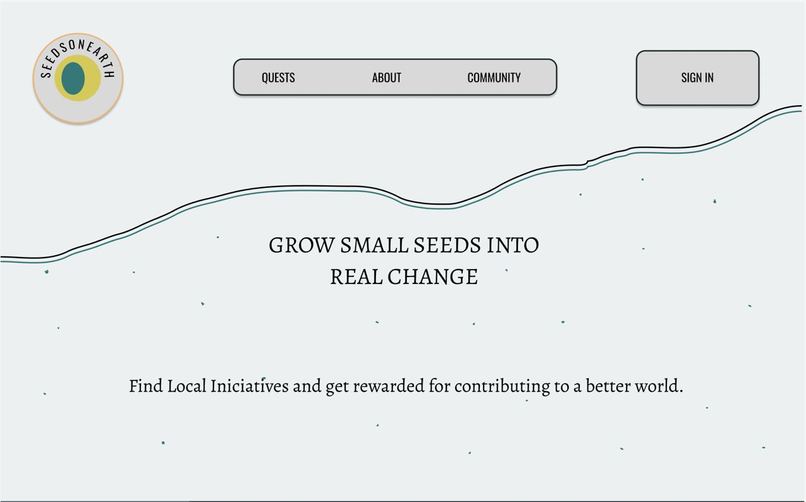
Homepage
-
Logo

Inspiration
We see several problems in the world, related to the environment:
(1) collapse of the living world (e.g. Albert Einstein allegedly said: “If the bee disappears from the surface of the Earth, man would have no more than four years left to live.” As a matter of fact, the disappearance of bees and other pollinating insects would decrease agricultural production and increase food prices, aggravating the current global food crisis. Bees have an excess mortality rate, which reaches 30-35%, which in some cases reaches 50% of winter losses);
(2) deterioration of ecosystems (e.g. 8 million tons of waste end up in the ocean each year);
(3) eco-anxiety phenomena (e.g. studies show that 2/3 of people feel at least a form of eco-anxiety).
We observe and experience that people feel powerless watching the increasing environmental issues on earth.
- They don’t think that their small actions can cause any positive impact.
- They don’t know what to do to cause a positive impact (even if they have time).
- They have no time to cause a positive impact - but maybe money.
This inspired us to think about a solution that helps to empower people to act for the environment - with small activities.
Our VISION is: We want to combine the limited influence of each individual to a collective global power to have an environmental impact together.
Our MISSION with our solution is: We are connecting and empowering humans (crypto-native, institutional sponsors, users) and incentivizing them to act individually in small steps as a part of a global community for environmental impact (through financial nudges and on-chain proof). We do that in an easy, convenient, secure, transparent and verifiable way.
What it does
“Seeds on Earth” is a p2p impact bounty marketplace connecting humans (crypto-native, institutional sponsors, users) and incentivizing them to act for the environment through financial and tax nudges and on-chain secure and verifiable processes to help them demonstrate their good deeds:
- Private individuals can search and pick up small environment quests on the marketplace. Once they complete a quest, it gets verified. Verified completed quests lead to a secure bounty payment transaction and on-chain proof of impact.
- Private and institutional sponsors alike can either create specific local quests and provide a bounty reward for completion (e.g. cleaning X km of beach, the park nearby someone's house, …) or donate for a common cause (e.g. safeguarding the bees). Each sponsoring quest or cause leads to an on-chain proof of impact, as well as can be used for tax reductions for both private and institutional sponsors. Furthermore, institutional sponsors can use said on-chain proof of impact in the context of their ESG commitments.
- Local quests can also be advertised at the local spot by printing a quest-related QR code which then can be scanned by e.g. people locally (e.g. on the beach).
- Completing and sponsoring quests both lead to a dynamic development of the NFT tree on users’ profiles. This is a gamified and individual proof and status symbol of users’ and sponsors’ environmental actions.
- The blockchain DeFi solution ensures a secure, trustless and trackable bounty transaction and verification process for all marketplace participants.
Verification process ( example: specific beach cleaning quest by a private sponsor)
- The sponsor uploads the quest with detailed information on the marketplace, i.e. with the photo of the current state of the beach (before) and provides the bounty reward, which will be frozen on chain.
- The user picks up the quest - which freezes the quest - and can no longer be completed by other users. Once the user has completed the quest, they take a video demonstrating the before-and-after-transition.
- Option A. The sponsor validates the completed quest and the user can claim the bounty reward.
- Option B. The sponsor does not validate the completed quest. A committee of trusted persons decides whether the quest has been completed (based on comparing the before-video with the after-video. If not accepted by the committee, the reward bounty will not be transferred and the quest gets uploaded again on the marketplace.
With our solution, we create value for users as well as sponsors as they:
- are part of a global movement and community
- can leverage their individual impact
- will get empowered to do something good
- will receive social recognition based on their provable actions (individuals)
- get facilitation related to tax reduction (private sponsors)
- get facilitation to meet ESG commitments and tax reduction (institutions)
POTENTIAL IMPACT IN FIGURES
- Cleaning environmental spaces (e.g. Collecting trash from the beach): We assume, that in the first year after launch we will have 1.000 quests for cleaning the beaches. Each quest will include approx. 8.000 square meters of the beach (100 m length x 80 m width). For the sake of the calculation: The busy public beach of Weligama (Sri Lanka) was the most polluted by count (157 microplastic items per square meter) as well as weight (5.98 grams per square meter). Thus in a year, it will be approx. 48 kg of microplastic (8.000 * 5.98 grams) * 1.000 quests = 48.000 kg of microplastic
- Help reduce CO2 emissions (by planting the trees): A typical tree can absorb around 21 kilograms of carbon dioxide (CO2) per year. However, this figure is only achieved when the tree is fully grown. Many trees at the equator reach maturity in as little as ten to twenty years. We assume that we will have 500 quests to plant one tree. Thus we expected to have approx. 10.500 kilograms of carbon dioxide saving in 15 years (21 kg * 500). ****
- Living World: we expect to have 50 quests and a 5 animals pro quest in the first year. Thus 250 animals (50 quests * 5 animals) in the first year. ****
How we built it
We are building on the Celo, Cronos, Polygon and Ethereum Blockchain, using Solidity. Next to this, we are making technological use of the following:
- solidity
- OpenZeppelin
- Hardhat
- ethers.js
- web3.js
- react
- node.js
- chai
WHY ON BLOCKCHAIN?
- DeFi
- Secure bounty transaction process on the blockchain (money / tokens from the sponsor is locked until the quest has been completed and then paid out after verification)
- NFT as a proof (for web3 users)
- of impact activities / engagement for individuals: Usage of the dynamic NFT for a proof of commitment (e.g. for applications), which unlocks further in real-life benefits (e.g. access to events).
- of donation / ESG commitment for institutions: By using the NFT as a proof of donation / sponsoring, companies can prove their ESG commitment, also for the tax department.
Roadmap & Next steps
- Frontend development of the web application as well as the mobile dapp
- NFT art development and implementation of the smart contract
- User research and iterative adaptation of the marketplace to the users' needs, improvement of user experience
- Community building: social media communication, local ambassador program, local QR code distribution
- Partner development: Acquisition and onboarding of first
- Sponsors for specific bounties and general bounties on the platform (monetary incentive)
- Partners for non-monetary incentives transferred through the NFT status to users, e.g. access to events, scholarships, education programs, etc
- Partners to implement the impact NFT proof as an entry requirement, e.g. HR / recruiting, universities, grants, sponsoring, …
- Implement further gamification mechanisms, e.g. impact winner of the month / region, …
Challenges we ran into
- Time restriction and time management: We spent a lot of time just for ideation, idea structuring and teambuilding (the complete first day)
- Lack of essential skills: We had just one backend developer and no frontend or full stack developer.
- Communication: multi-linguistic communication
Accomplishments that we're proud of
- We all believe in the idea and the project and have an intrinsic motivation to solve a real-world environmental issue.
- We have built a team and work environment that is very empathic and with complementary skills and strengths.
- We all learned new skills in a short time.
- We were very open for criticism, reflection and included feedback from experts in different areas.
What we learned
- We first tried to tackle a pressing world issue, but realized there was a barrier, with integrating crypto in the real world to solve a real world issue.
- Based on research data, we then figured we can create a bridge with crypto natives that have money but no time to act for the environment and non-cryptonative that have the will to do physical tasks for good and would enjoy financial and moral incentives.## What's next for SeedsONEarth


Log in or sign up for Devpost to join the conversation.