


Inspiration
Planner-driven AI interviews are becoming increasingly capable, but improving them safely remains difficult.
Traditional validation can detect structural issues such as missing fields, invalid transitions or duplicated questions, but it cannot reliably identify semantic problems like missed information, unresolved contradictions, unsupported hypotheses or multi-domain patient responses.
We wanted to explore how GPT-5.6 could act as a review layer for completed interviews rather than as another interview generator.
What it does
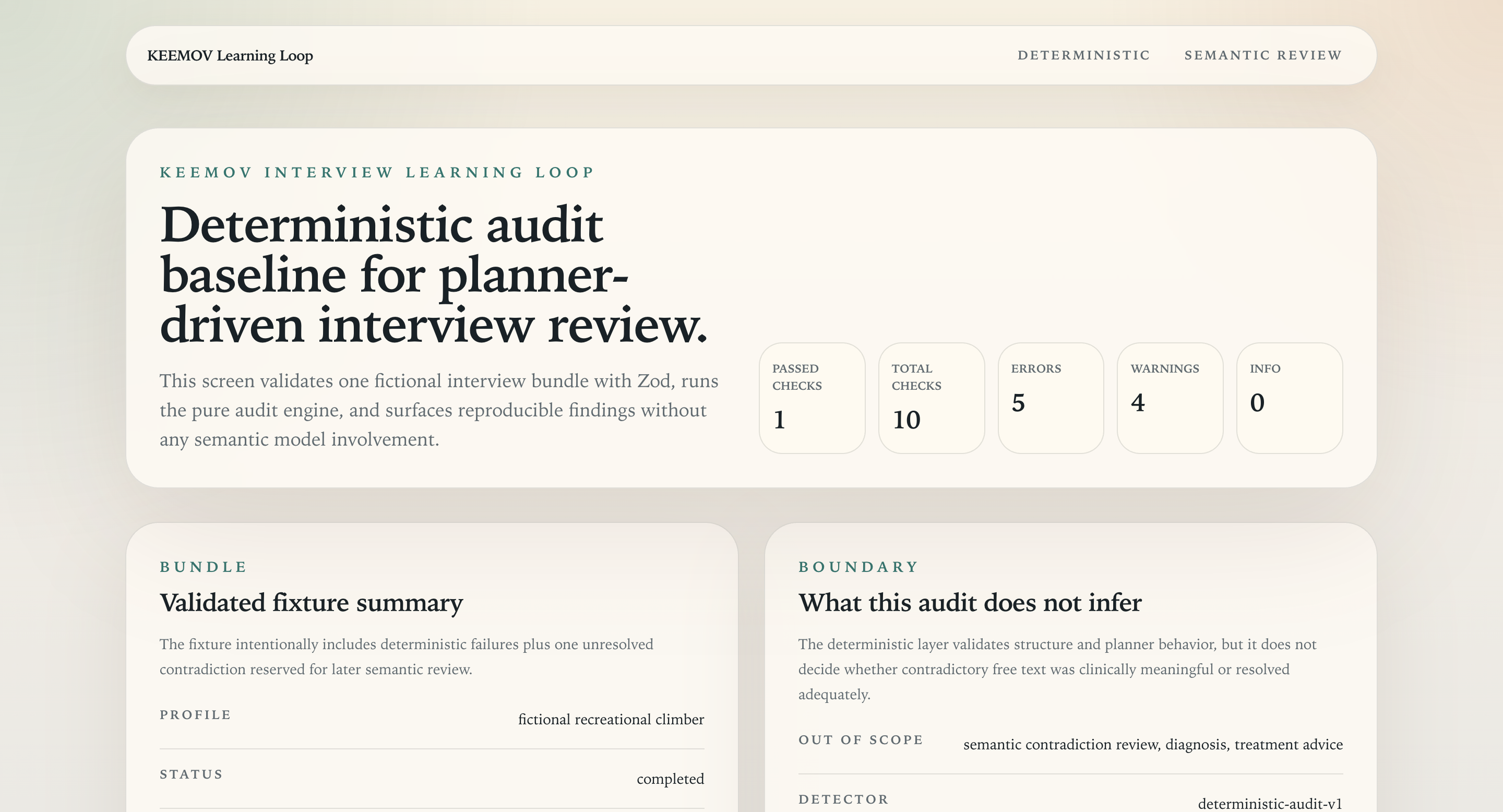
KEEMOV Interview Learning Loop is a standalone prototype that reviews a completed fictional clinical interview using two complementary validation layers.
The first layer performs deterministic validation, checking planner behaviour, interview structure, evidence integrity and workflow consistency through fully reproducible rules.
The second layer uses GPT-5.6, via a Codex Agent Skill, to perform semantic review. It identifies evidence-grounded findings, recalibrates hypotheses, proposes probable root causes, generates improvement proposals and creates regression cases.
Every proposed improvement requires explicit human approval before any production change can be considered.
How we built it
The application was built with:
- Next.js 16
- TypeScript
- React
- Vitest
- Zod
- Vercel
Semantic review artifacts were generated with GPT-5.6 through a Codex Agent Skill.
The project intentionally separates deterministic validation from semantic reasoning to provide a transparent and auditable review workflow.
Challenges we ran into
The biggest challenge was designing a workflow where GPT-5.6 adds meaningful semantic analysis without becoming an autonomous decision-maker.
We wanted every conclusion to remain grounded in transcript evidence while ensuring that no production behaviour could change without explicit human approval.
Another challenge was presenting semantic findings in a way that developers could immediately transform into actionable engineering work.
Accomplishments that we're proud of
We built a complete review workflow that combines deterministic validation, semantic reasoning, root cause analysis, improvement proposals and regression packs into a single developer experience.
Rather than replacing existing validation, GPT-5.6 complements it by reviewing aspects that deterministic rules alone cannot reliably capture.
What we learned
Separating semantic review from production execution creates a much safer architecture.
Instead of allowing AI to modify prompts or interview behaviour automatically, GPT-5.6 becomes a collaborative reviewer that helps engineers continuously improve interview quality while maintaining full human oversight.
What's next
This prototype currently reviews a validated fictional interview fixture.
Our next step is to connect it directly to KEEMOV Intake AI by exporting completed interview bundles containing transcripts, planner decisions, canonical interview state and final outputs.
That integration would enable continuous quality improvement for planner-driven interviews without allowing autonomous production modifications.
Built With
- codex
- gpt-5.6
- next.js
- react
- typescript
- vercel
- vitest
- zod


Log in or sign up for Devpost to join the conversation.