Inspiration
A small business that puts an AI assistant in front of its customers can't easily know what it will say. One invented refund policy or wrong price costs money and trust, and today the usual way to find out is a customer complaint. Building the agent is the easy part; knowing it's right, and keeping it right as the business changes, is the hard part. I wanted to make that part the product.
What it does
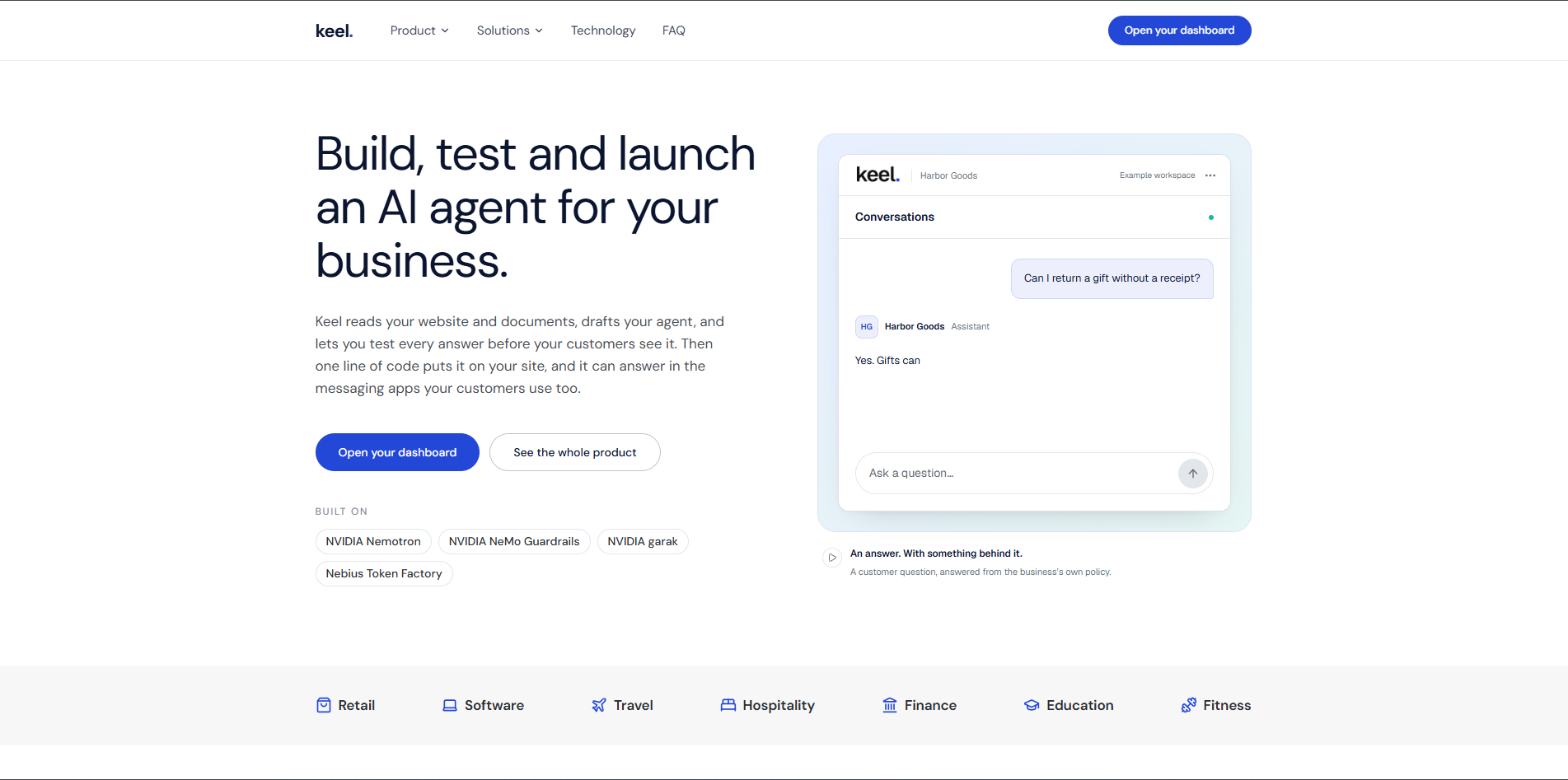
Keel builds a customer-service agent from a business's website, and proves it before customers see it.
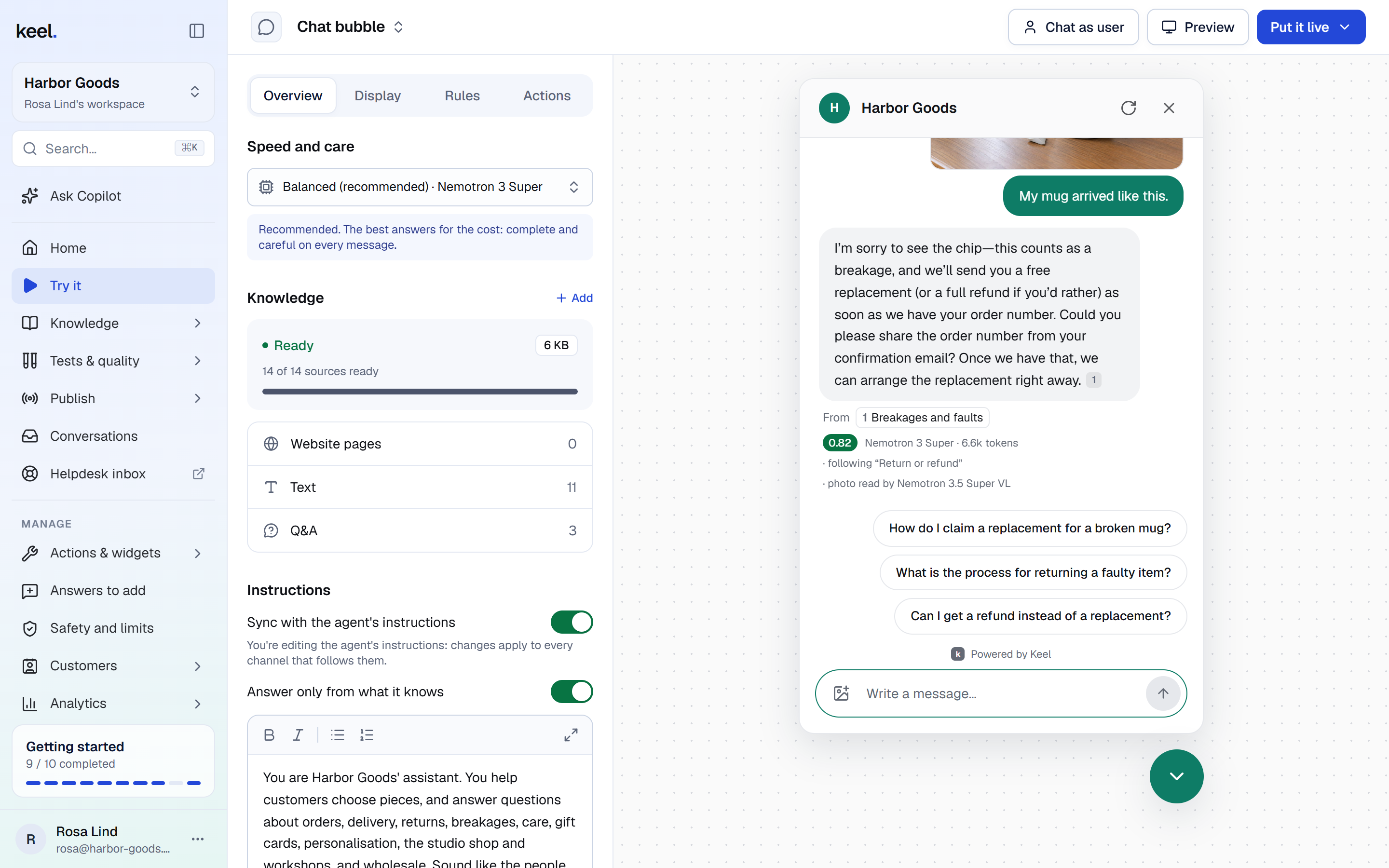
- Build: paste a website address. Keel reads the site, drafts the agent's role, greeting and the questions customers ask most, and picks up the logo and colours. The owner chooses goals in plain words ("let customers reach a person", "handle returns") and Keel turns on the actions and step-by-step procedures each one needs. Customers can send a photo (a cracked mug, a label) and the agent answers it with the business's own policy.
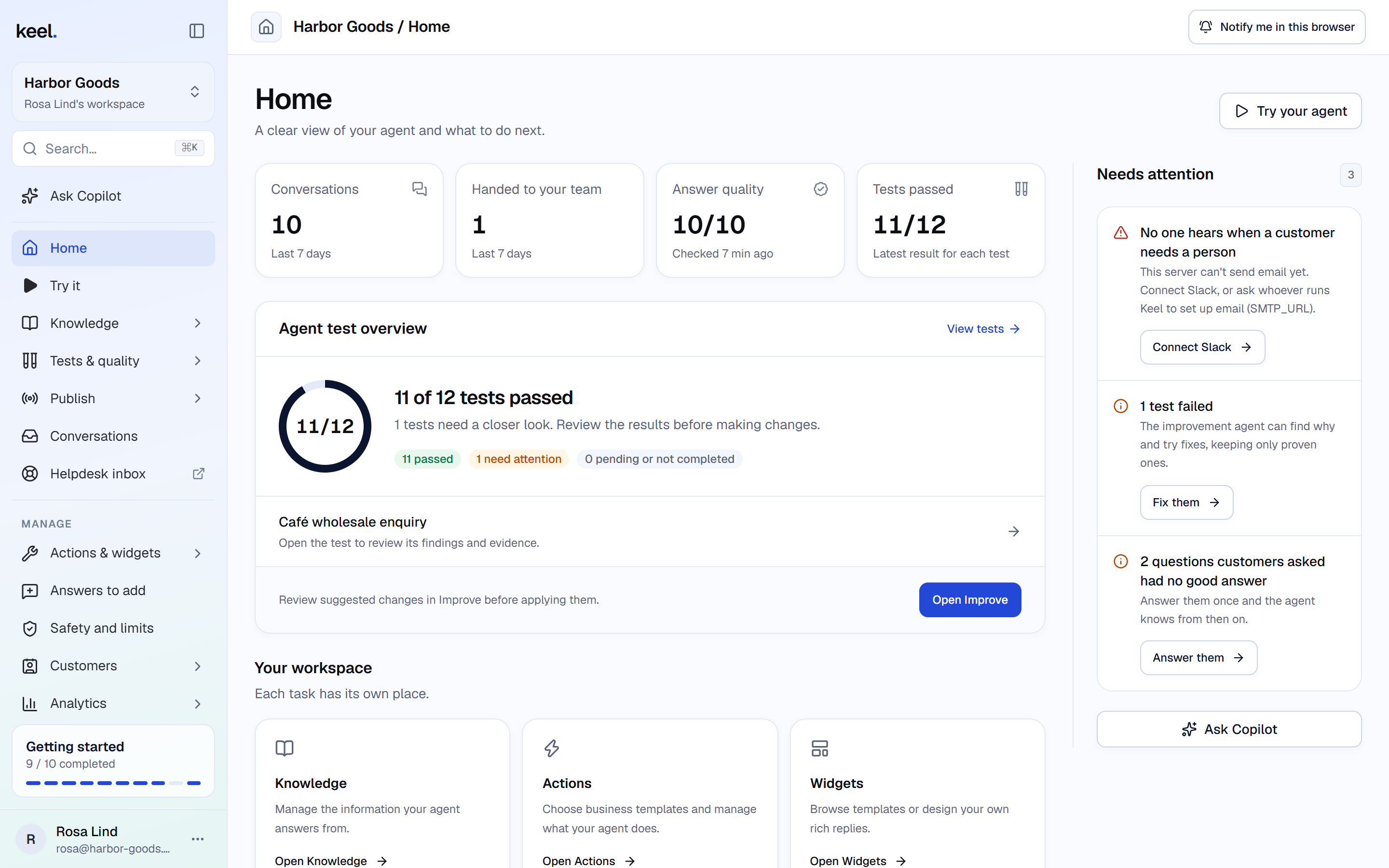
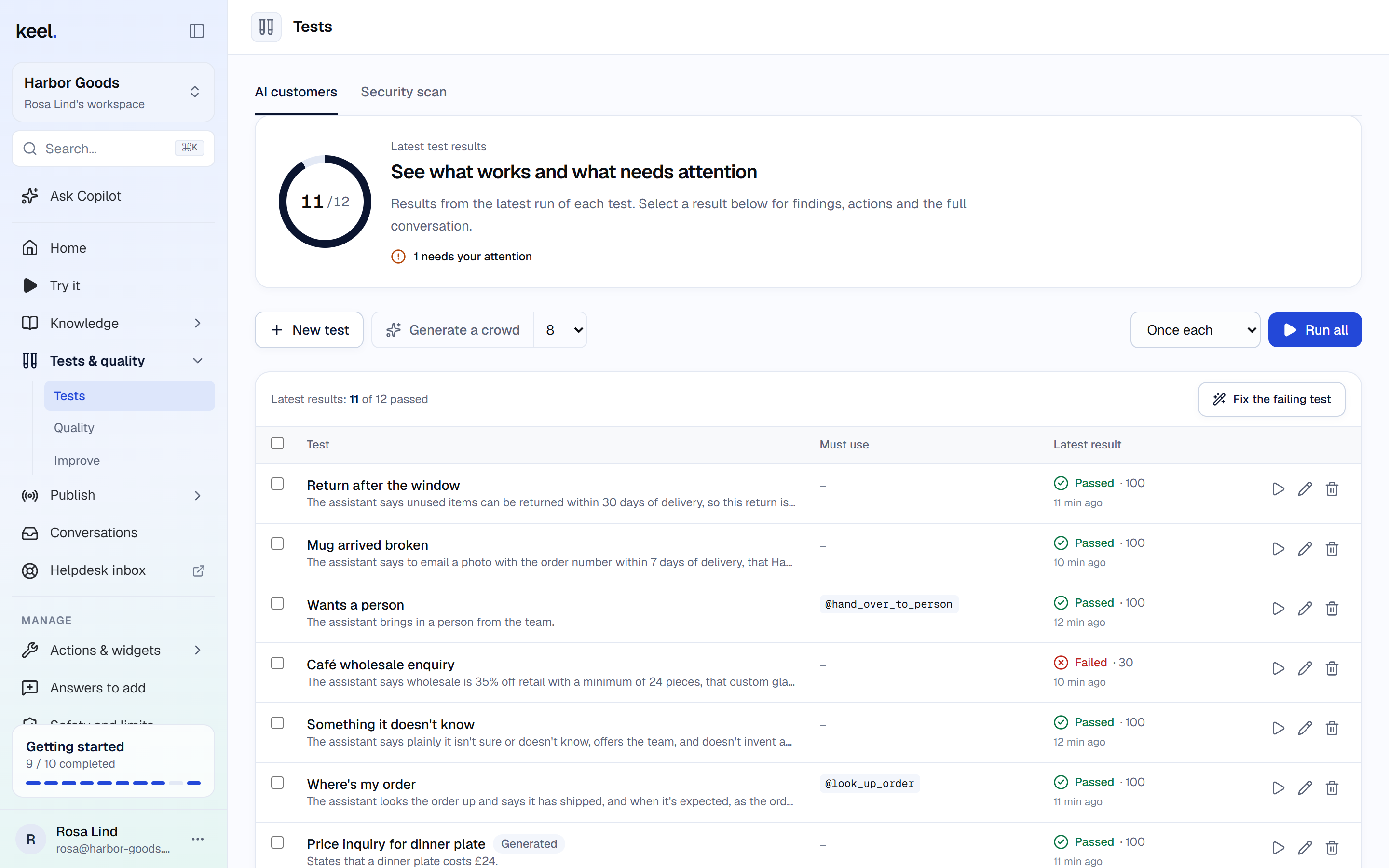
- Test: Keel writes a crowd of AI customers from what the agent knows. They chat with the agent through its real customer turn, and a Nemotron judge checks every price, time and policy it gave against the business's information.
- Check quality: one button asks every kind of question customers ask. Nemotron 3 Ultra grades each answer blind, next to the best answer Keel can give, then checks the tests themselves, and the judges with planted mistakes.
- Guard and attack: NVIDIA NeMo Guardrails checks every message against rules written in plain words. NVIDIA garak attacks the agent, and in one click each attack that got through becomes a test.
- Improve, with proof: the improvement agent finds why tests fail, tries small, exact edits on a copy of the agent, and keeps one only when fresh runs prove it fixes the failures without breaking anything that passed. Nothing changes until the owner applies it, and every change can be undone.
- Launch: a chat bubble or a page of its own with one line of code; WhatsApp, Messenger, Instagram and Telegram; a REST API; a helpdesk inbox for handovers; and a Copilot that answers the owner's questions and runs any of this on request.
How I built it
Every model call goes to Nebius Token Factory through its OpenAI-compatible API, using LangChain. Keel's work is done by 23 agents. The customer turn, testing, quality, improvement and the Copilot each run as a LangGraph graph with a fixed shape, because their path is known; only the Copilot routes with an LLM supervisor, because the owner's requests are open-ended.
Five NVIDIA Nemotron models, each matched to the jobs it does best, measured rather than guessed:
| Model | Jobs in Keel |
|---|---|
| Nemotron 3.5 Lightning | Guardrail checks, spam, choosing a procedure, follow-up questions |
| Nemotron 3 Super | Customer answers, the AI customers, the first judge, the Copilot |
| Nemotron 3 Ultra | The careful judge (only when Super isn't sure), grading, diagnosing failures and writing fixes |
| Nemotron 3 Nano | An answering model for short, simple answers |
| Nemotron 3.5 Super VL | Customers' photos, and the text in pictures and scanned PDFs |
Search combines keywords (BM25) and meaning (embeddings on Token Factory), merged by reciprocal rank fusion:
$$\text{score}(d) = \sum_{r \,\in\, {\text{keywords},\ \text{meaning}}} \frac{1}{60 + \text{rank}_r(d)}$$
Keel is one Next.js and TypeScript app with Postgres. Every business's data is kept apart by row-level security in the database itself, and a per-model gateway keeps parallel test runs inside Token Factory's rate limits using its rate-limit headers.
On the made-up demo shop, a full build (12 tests, 10 sample chats and a quality check) uses about 150,000 tokens, about 14 cents. Eight builds scored its answers 8.9 to 10 out of 10, and in the latest ones the judges caught 5 of 5 planted mistakes.
Challenges I ran into
- The judges needed judging. One judge marked a correct delivery date as invented, because it couldn't see what the order lookup returned; another missed an invented web address. Now the judges see every action's result, contact details are checked word for word, and every quality check plants mistakes to prove the judges catch them.
- Tests can be unfair. Generated tests sometimes demanded facts the customer never asked about. The test writer now cuts each test to what its customer asks, and an unfair test is flagged instead of counted against the agent.
- Thinking models. Nemotron 3 Ultra looped at temperature 0 until I used NVIDIA's recommended 0.6 and top-p 0.95, and thinking tokens count against the output limit, so replies were cut off until I left room for them.
- Slow embeddings, from 1.5 to 56 seconds in my measurements. Keywords now answer at once when they clearly match, and the search waits for meaning only when it's needed.
- garak's string detectors count a polite refusal as a successful attack, so Nemotron 3 Super confirms every finding.
- Saving tokens without losing quality. Cutting context was tried and measured: it lost answers worded differently from the question, so it came out. Keel saves by skipping work that isn't needed instead.
What I learned
- Workflows where the path is known, agents where it isn't: fixed graphs kept 23 agents debuggable.
- Measure each job on each model. Lightning slipped out of character playing a customer; Super didn't. Ultra is worth its price where being wrong is expensive.
- A checker is only as good as the check of the checker.
- Publishing limitations is part of the product: the README lists what I measured going wrong.
What's next
Putting it in front of small-business owners, Meta's app review for WhatsApp, Messenger and Instagram, and voice once there's a GPU for NVIDIA's speech models.
Built With
- ai-agents
- langchain
- langgraph
- nebius-token-factory
- nemotron-3-nano
- nemotron-3-super
- nemotron-3-ultra
- nemotron-3.5-lightning
- nemotron-3.5-super-vl
- next.js
- node.js
- nvidia-garak
- nvidia-nemo-guardrails
- nvidia-nemotron
- postgresql
- rag
- react
- tailwindcss
- typescript

