-
-
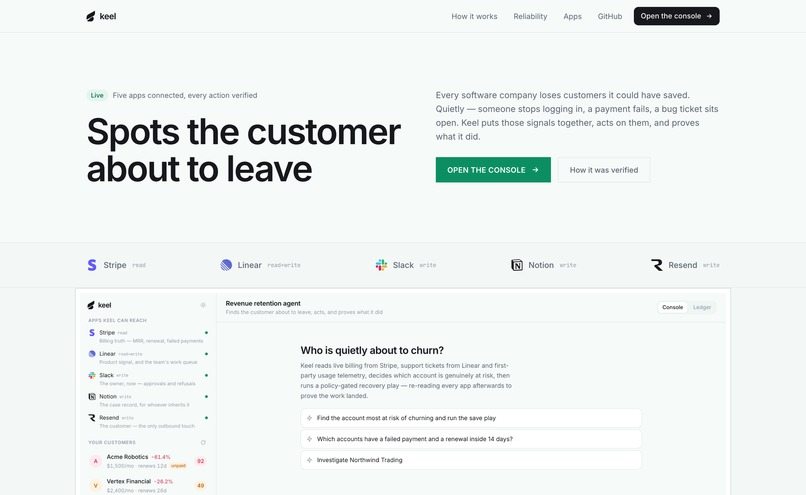
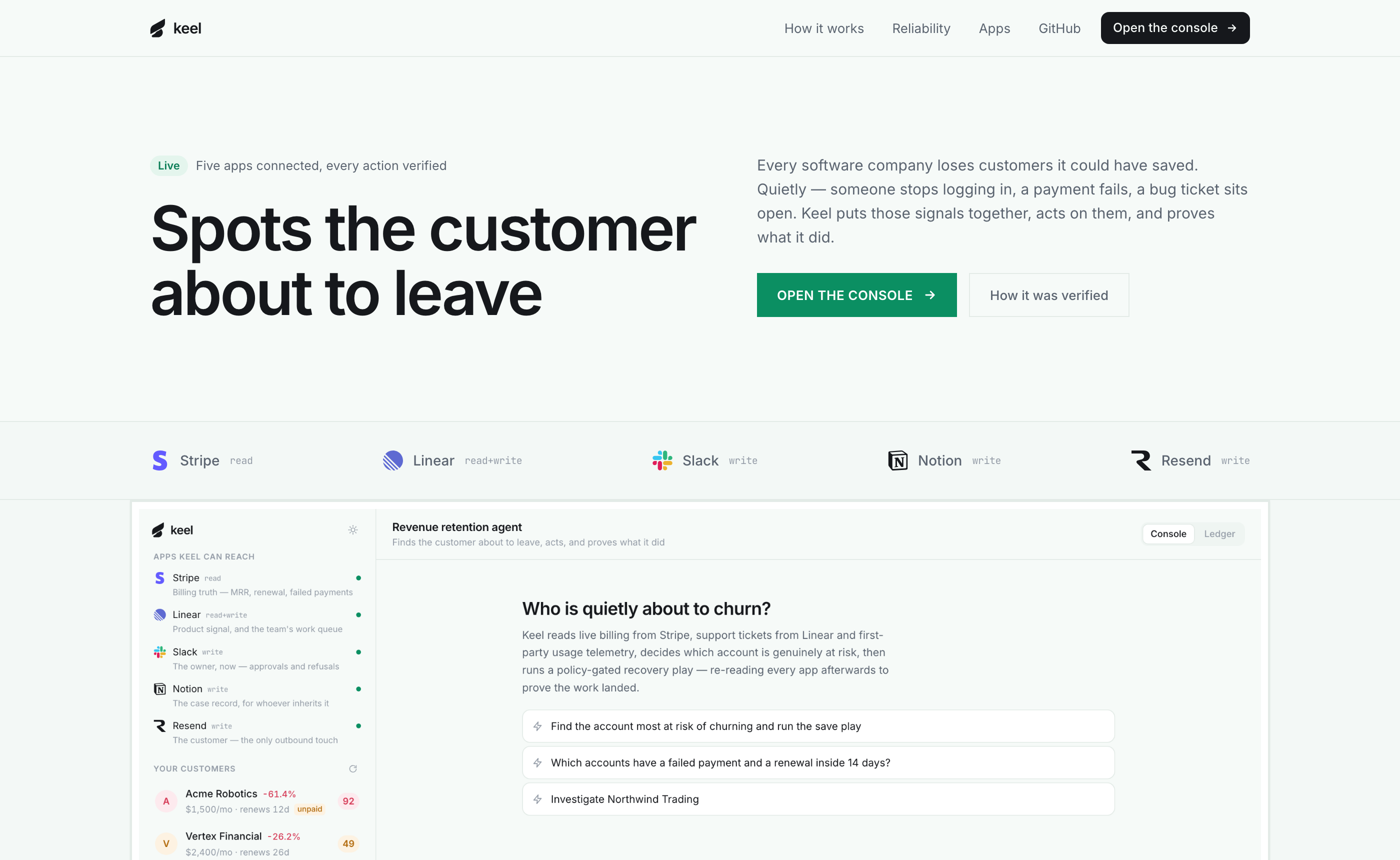
Keel reads live billing from Stripe, support tickets from Linear and first-party usage, then decides which account is genuinely at risk.
-
-


What it does
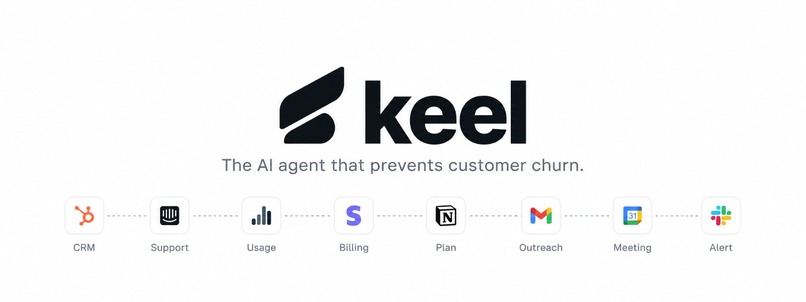
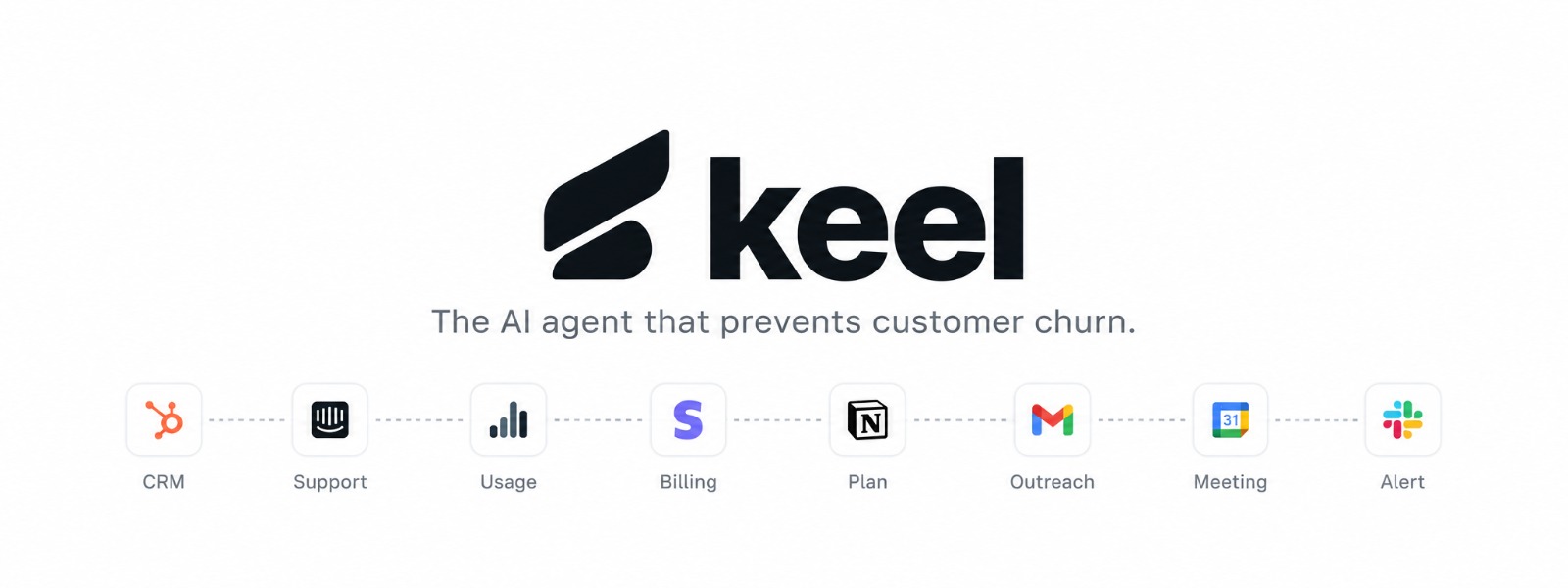
Keel is an autonomous revenue-retention agent. It investigates an account across five real apps, works out why it is declining, runs the recovery play, and proves every action by re-reading it from the app that performed it.
| App | Direction | Its job |
|---|---|---|
| Stripe | read | Billing truth — MRR, renewal date, failed payments |
| Linear | read + write | Reads the support queue to find the cause; writes the recovery task |
| Slack | write | Alerts the account owner, including when Keel refuses to act |
| Notion | write | The case record, for whoever inherits the account |
| Resend | write | The customer email — the only outbound, irreversible touch |
Inspiration
Every churn dashboard tells you an account is at risk. Not one tells you what went wrong, and that is the only part anybody actually needs, because the symptom and the cause are never in the same tool. The usage curve lives in product analytics. The cause is a support ticket somebody filed six weeks ago. Joining them by hand is about forty minutes per account, which is exactly why it does not happen until the quarter is already lost.
That gap is what makes this a multi-app problem rather than a dashboard feature.
How I built it
Two phases, and the split is the whole design.
Phase 1 is genuinely agentic. A streamText tool-calling loop against
claude-opus-5 gets read-only tools and chooses its own path — which accounts to open,
which signals to chase, how deep to dig, when it has seen enough. Nothing in the code
sequences those calls or branches on an account id.
Phase 2 never consults the model at all:
propose → policy → approval gate → idempotency → execute (1 retry) → verify by read-back → ledger
A model can be wrong about judgment and recover. It cannot be allowed to be wrong about whether an email has already been sent.
The cause is computed, not guessed. lib/diagnose.ts finds the onset of the
sustained usage decline, then scores every open ticket on temporal alignment — a cause
must precede its effect — and on severity. A ticket filed after the decline began is
ruled out, and Keel says so rather than dropping it silently.
Challenges I ran into
The agent hallucinated causation for most of this project's life. It blamed the wrong ticket on every single run — fluently, with citations, and completely wrong. The ticket it kept naming was the newest and most escalated on the account, which is exactly what a human skimming the queue reaches for and exactly what a language model invents a story about. It postdated the decline by a month.
No test caught it, because all 18 of my tests exercised the deterministic half and not one of them read a word the model produced.
So I built a second eval layer. pnpm eval:grounding runs the live agent and measures
its prose against what was computed: every citation must resolve to a real record, and no
ruled-out cause may be blamed. Deterministic on purpose — an LLM judge is easier to write
and far easier to fool.
Writing that test then found two bugs in the test itself, which is the part I am most glad about. It flagged the agent for correctly explaining a ruling-out, and it flagged legitimate cross-account citations. A test that fails on correct behaviour is worse than no test.
What I learned
Instrument before you optimise. I added per-run token and per-phase latency
recording, and it immediately surfaced two things reading the code never would: a
temperature setting the SDK was silently discarding, and a completely cold prompt cache
— 26,782 input tokens, 0 cached, on a run whose tool schemas are identical at every step.
One cache breakpoint took cached input to 33–52%.
Refusal is a feature, and it has to be visible. Two of the three verdicts
diagnose() can return are the system declining to name a cause: no ticket explains the
timing, and silent — nobody filed a ticket. Five of the eighteen eval cases assert
that Keel does nothing.
Verify it yourself in 30 seconds
git clone https://github.com/ShaanGS/keel && cd keel
pnpm install && pnpm eval
18/18 cases passed · 5/5 must-not-act cases passed
No API keys required. Fixture mode stubs only the third-party network boundary — policy, idempotency, retry, read-back verification and the ledger all execute for real, which is why this same command runs in CI on every push with no credentials configured.
Built With
- anthropic-claude
- github-actions
- linear
- next.js
- node.js
- notion
- react
- resend
- slack
- stripe
- tailwindcss
- typescript
- vercel
- vercel-ai-sdk
- zod


Log in or sign up for Devpost to join the conversation.