Project name
Kayit
Tagline (≤ 200 chars)
The ndawtal notebook that can't be lost, forged or forgotten: ceremony gifts as Bitcoin ecash envelopes, co‑signed by giver and host.
Links
- Code: https://github.com/ashank-crazy/kayit (public)
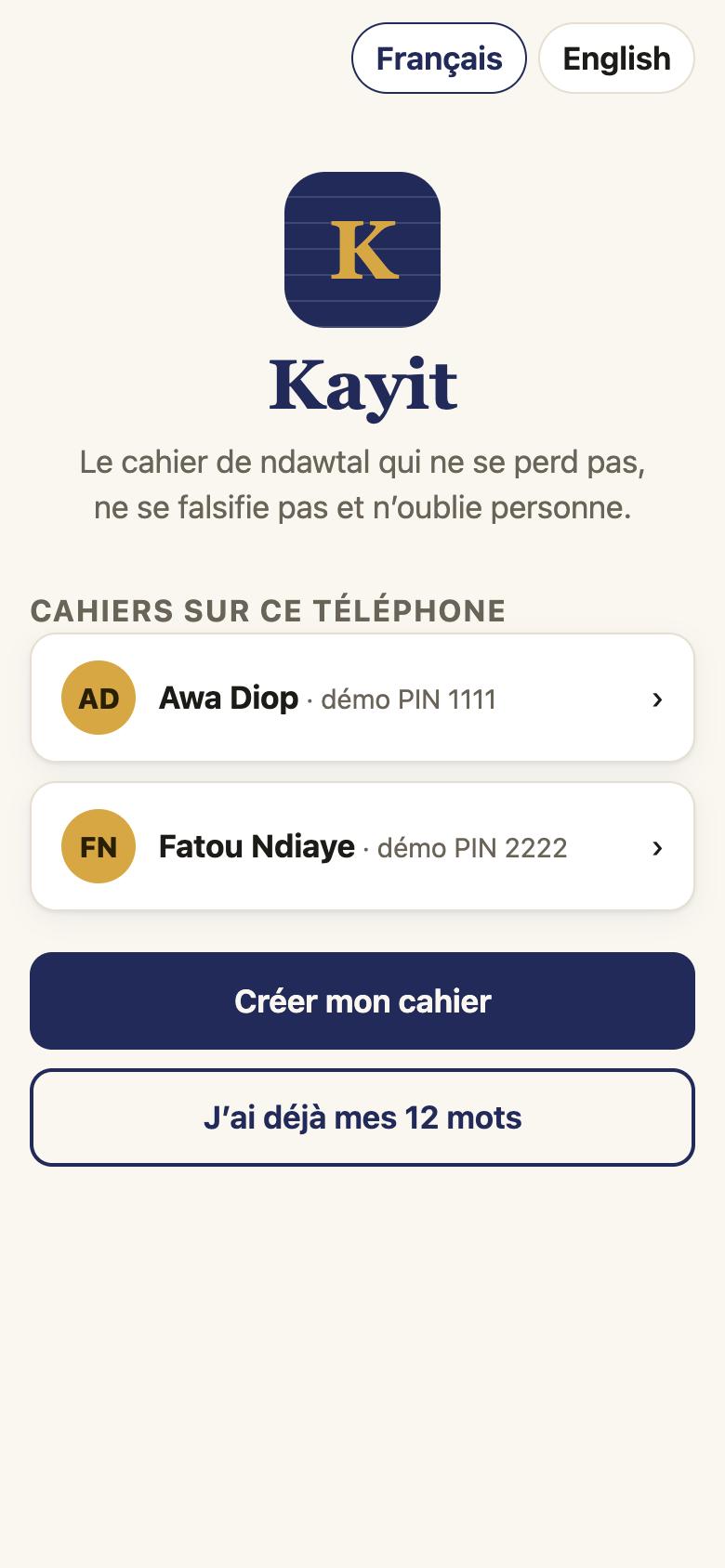
- Live MVP: https://ashank-crazy.github.io/kayit/ — tap Essayer la démo, PINs 1111 (Awa, host) and 2222 (Fatou, guest)
- Video (2:35): https://youtu.be/6YKSals4J0w
Built with
bitcoin, lightning, cashu, ecash, nostr, typescript, preact, vite, node.js, websockets, pwa, webcrypto, qr-code, docker
Inspiration
At every ngénte (naming day), wedding or funeral in Senegal, guests bring a ndawtal: an envelope of money that someone writes down in a school exercise book. That book is a ledger of debts. Custom says you return a ndawtal at the giver's own ceremony, usually doubled: half repays, half is a new advance.
The book is lost, burned, or stays with one sister. Amounts get disputed. People forget who they owe, and returning too little is shaming. Relatives abroad can't hand over an envelope. And the griot calling out each gift puts pressure on guests to give more than they can.
We wanted to keep the custom exactly as it is and give it a notebook that survives.
What it does
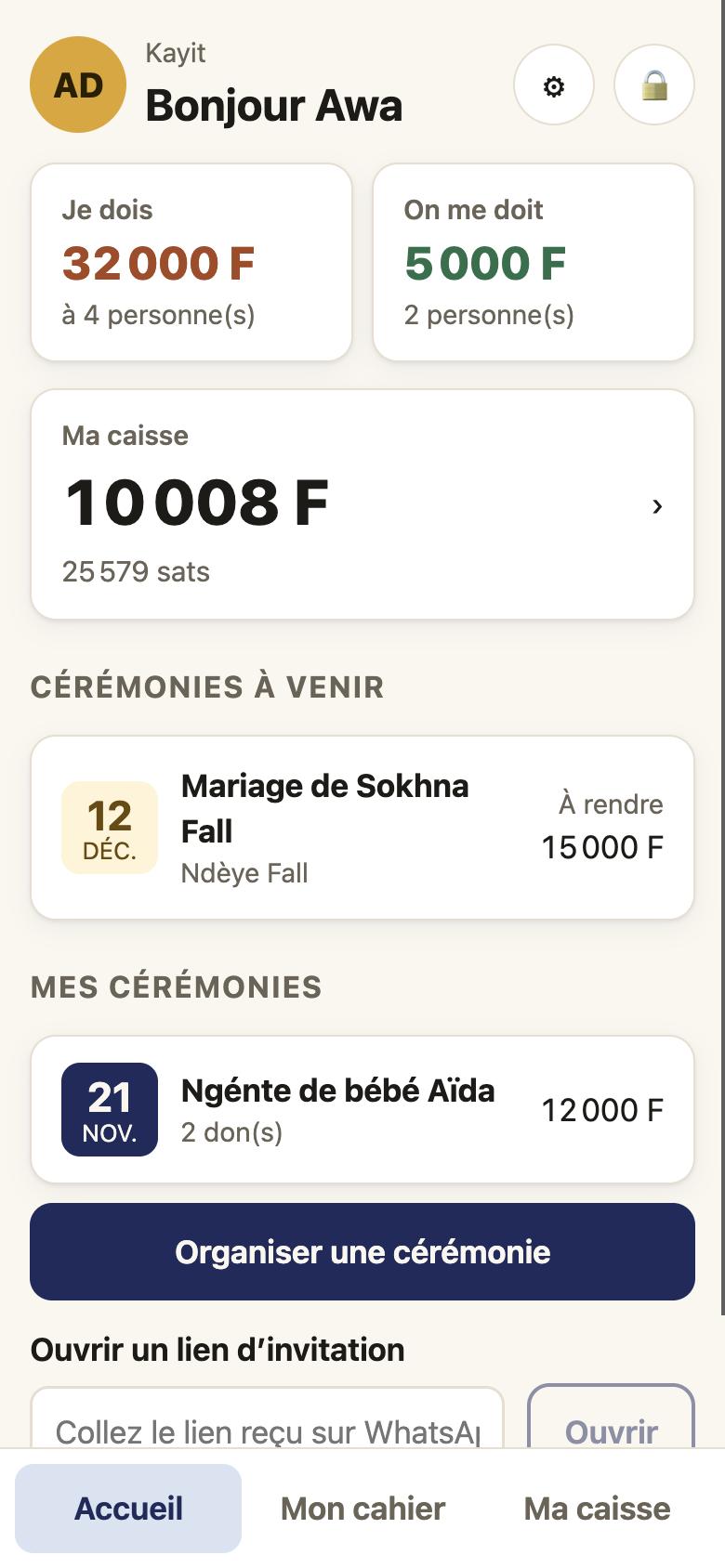
Kayit is a phone notebook with a built‑in Bitcoin wallet.
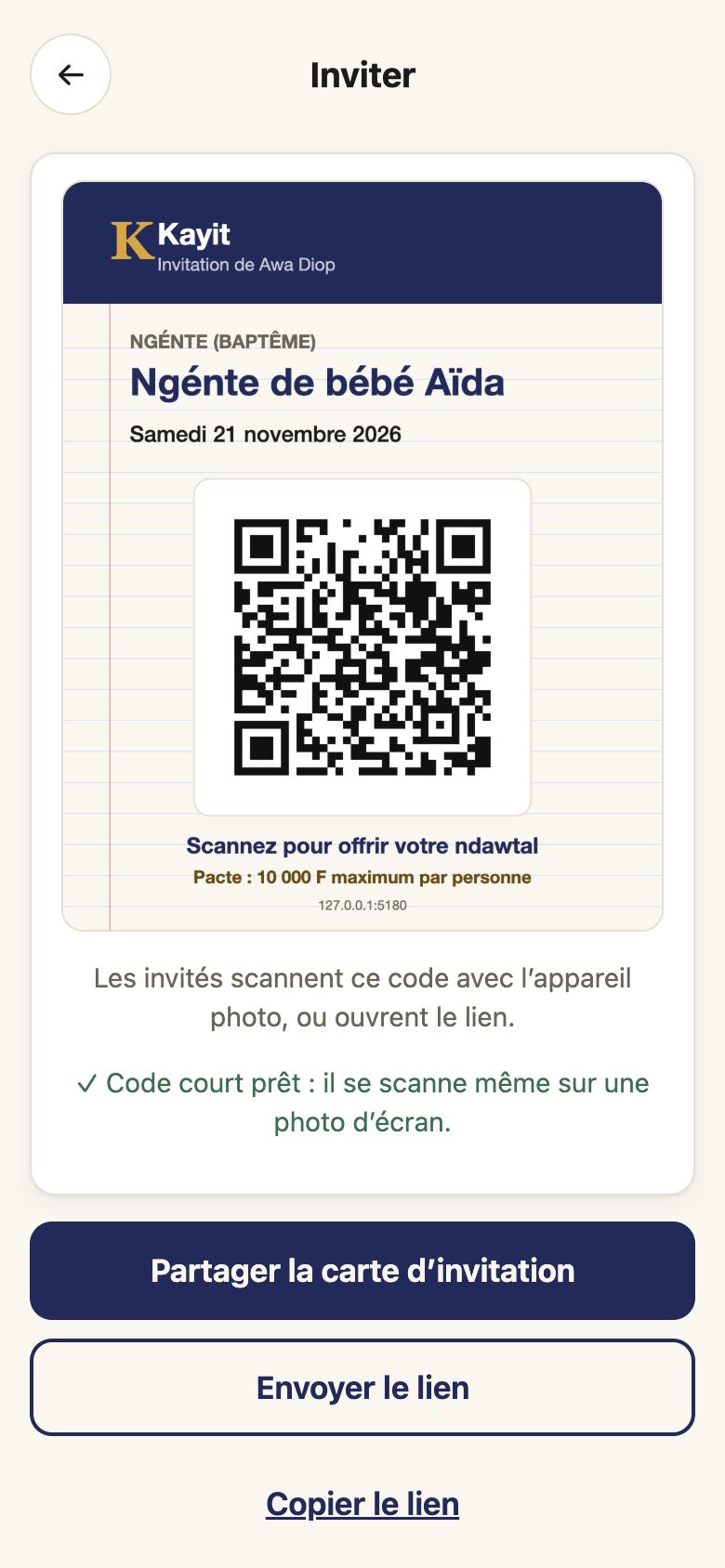
- The host creates the ceremony (with an optional pacte cap, e.g. "no gift above 10 000 F") and shares an invitation card on WhatsApp: one image with the title, date and a small QR that still scans from a heavily compressed photo.
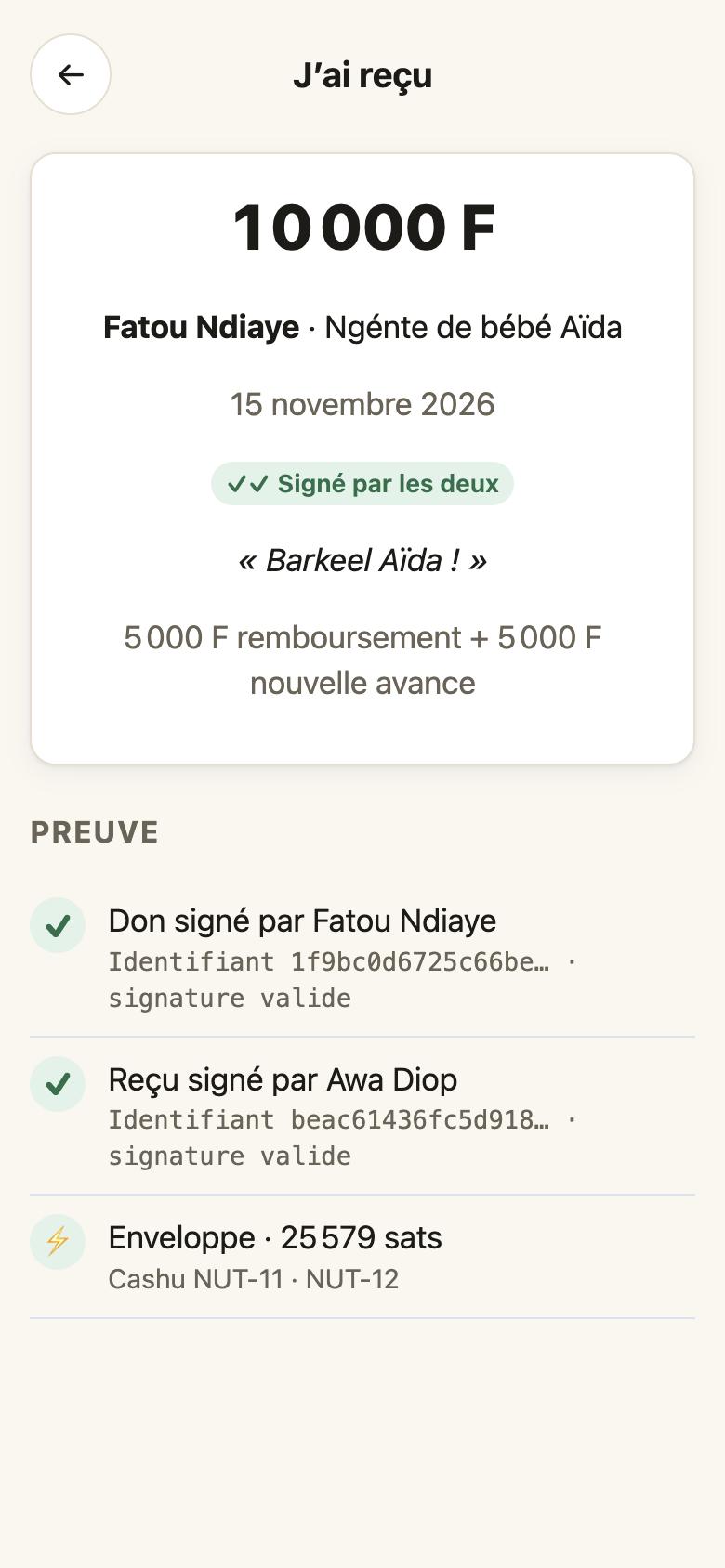
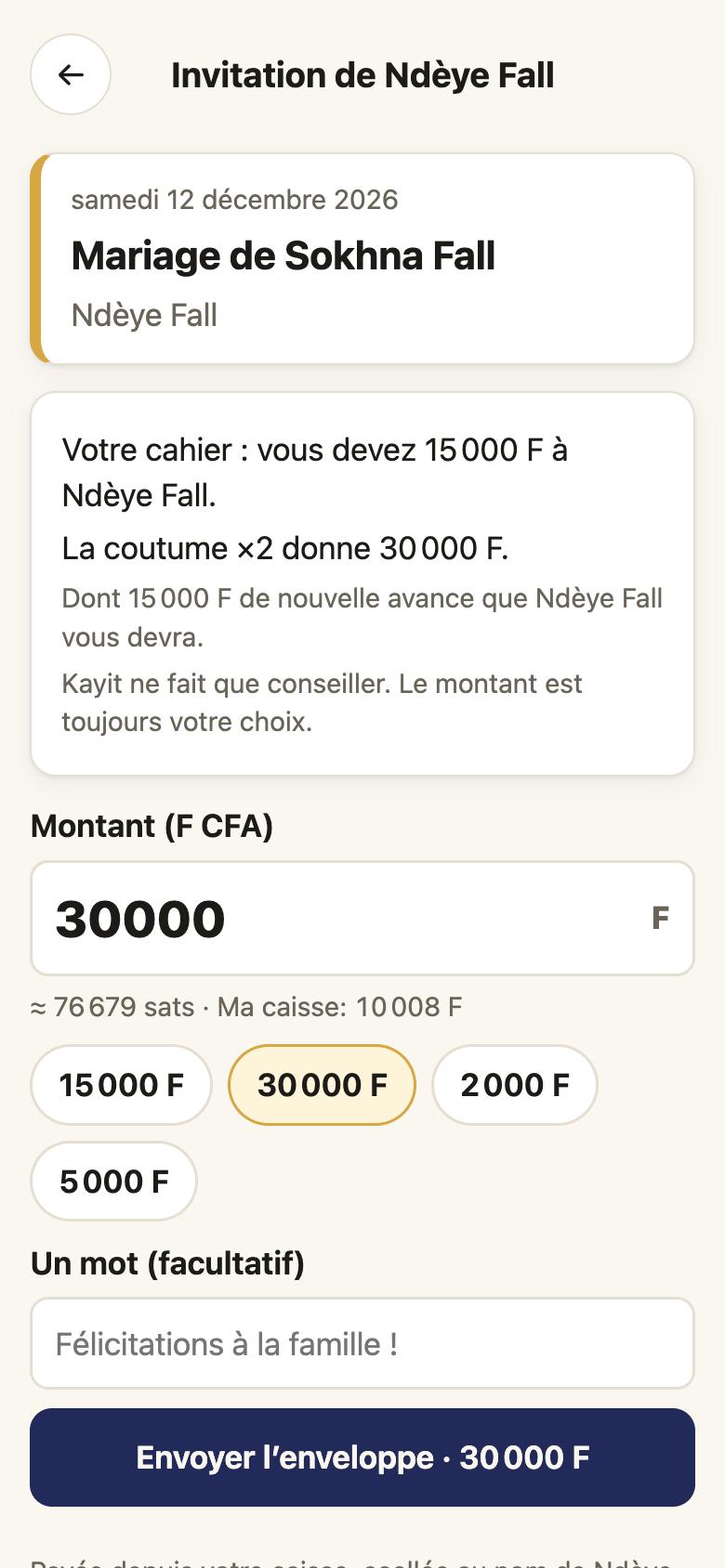
- The guest opens it. Kayit reads their notebook and suggests the custom amount: "You owe Awa 5 000 F. Return 10 000 F = 5 000 F repaid + 5 000 F new advance." They give by ecash envelope (sats locked so only the host can open them) or declare a cash gift the host confirms.
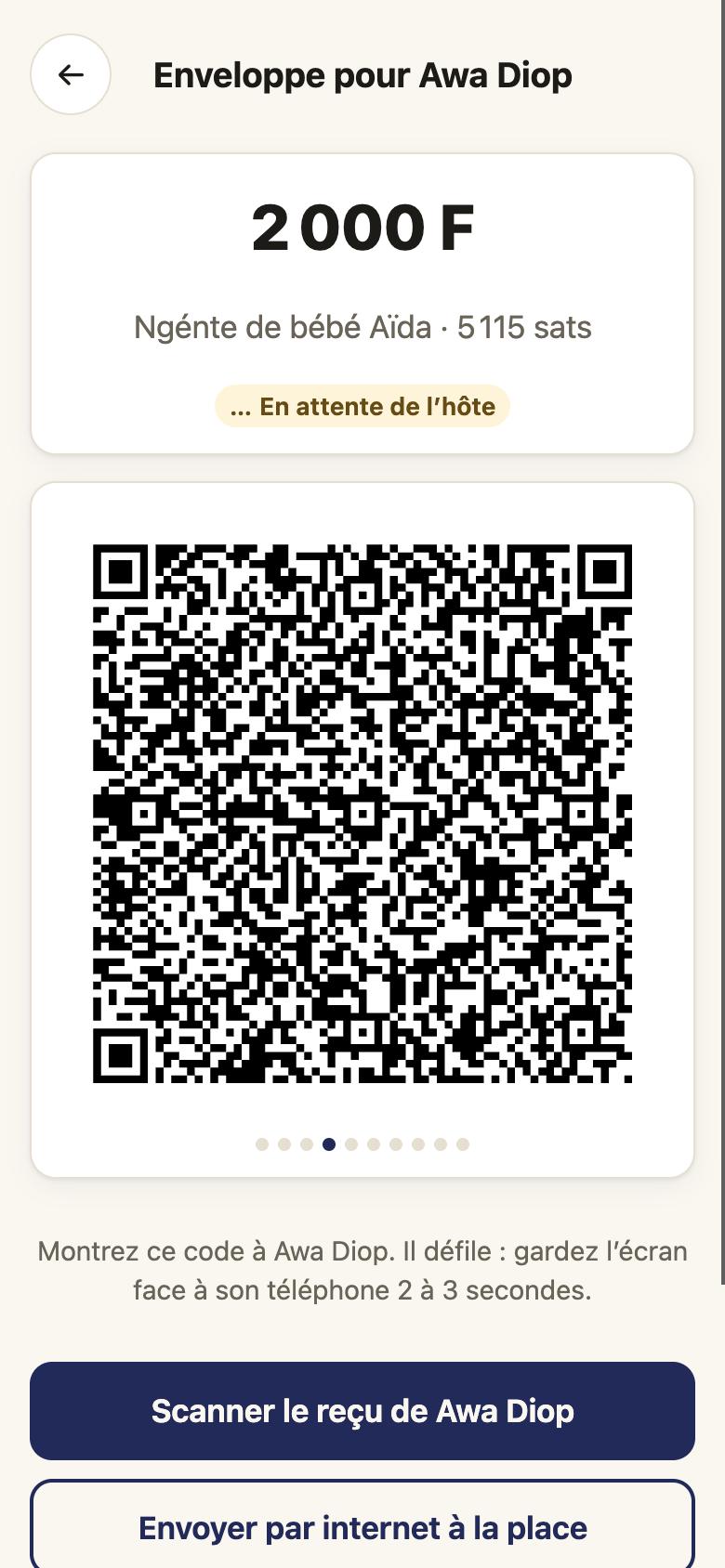
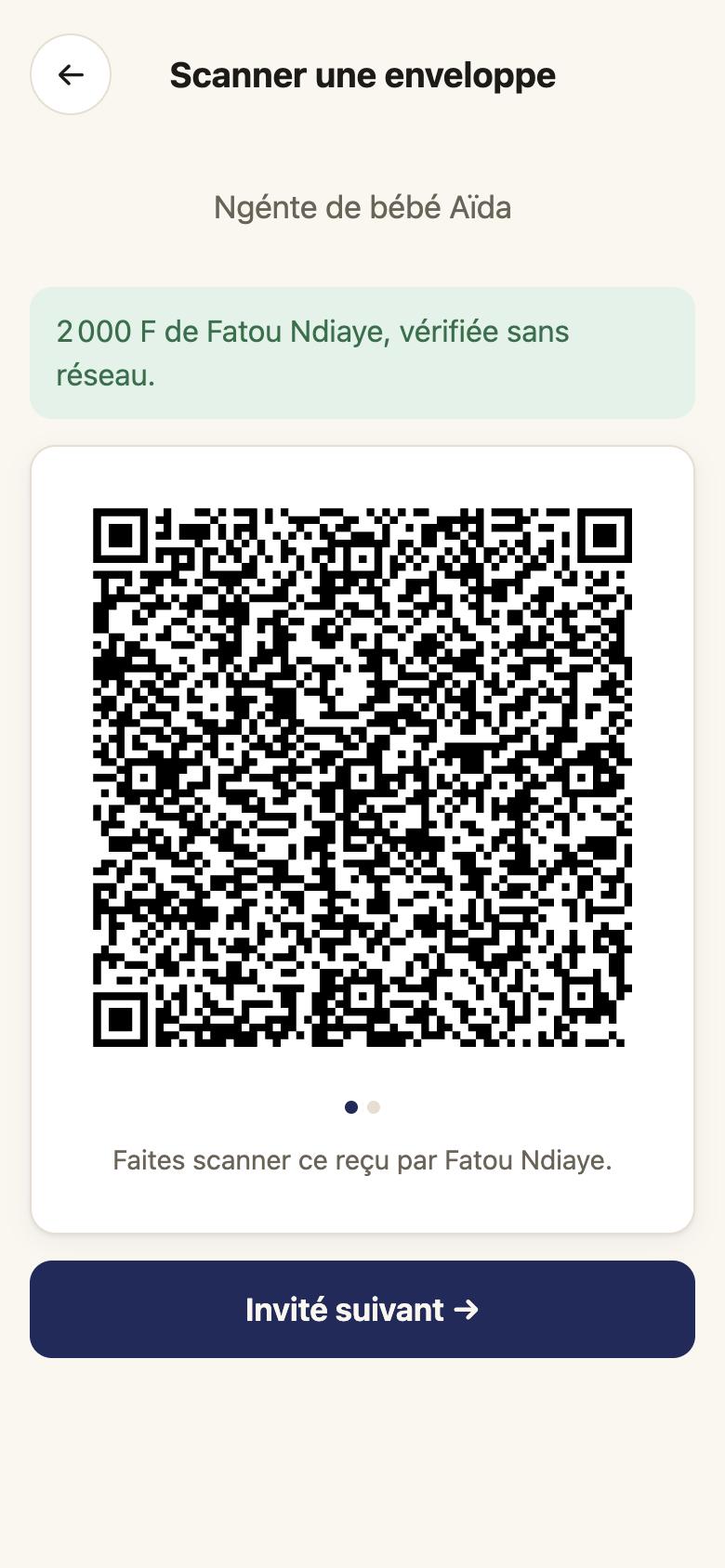
- No network at the ceremony? No problem. The guest prepares the envelope at home. In the courtyard, the host's phone scans it from the guest's screen as a short QR animation, checks it with no network (locked to her key, valid mint signatures, right amount), signs the receipt on the spot and cashes the sats later.
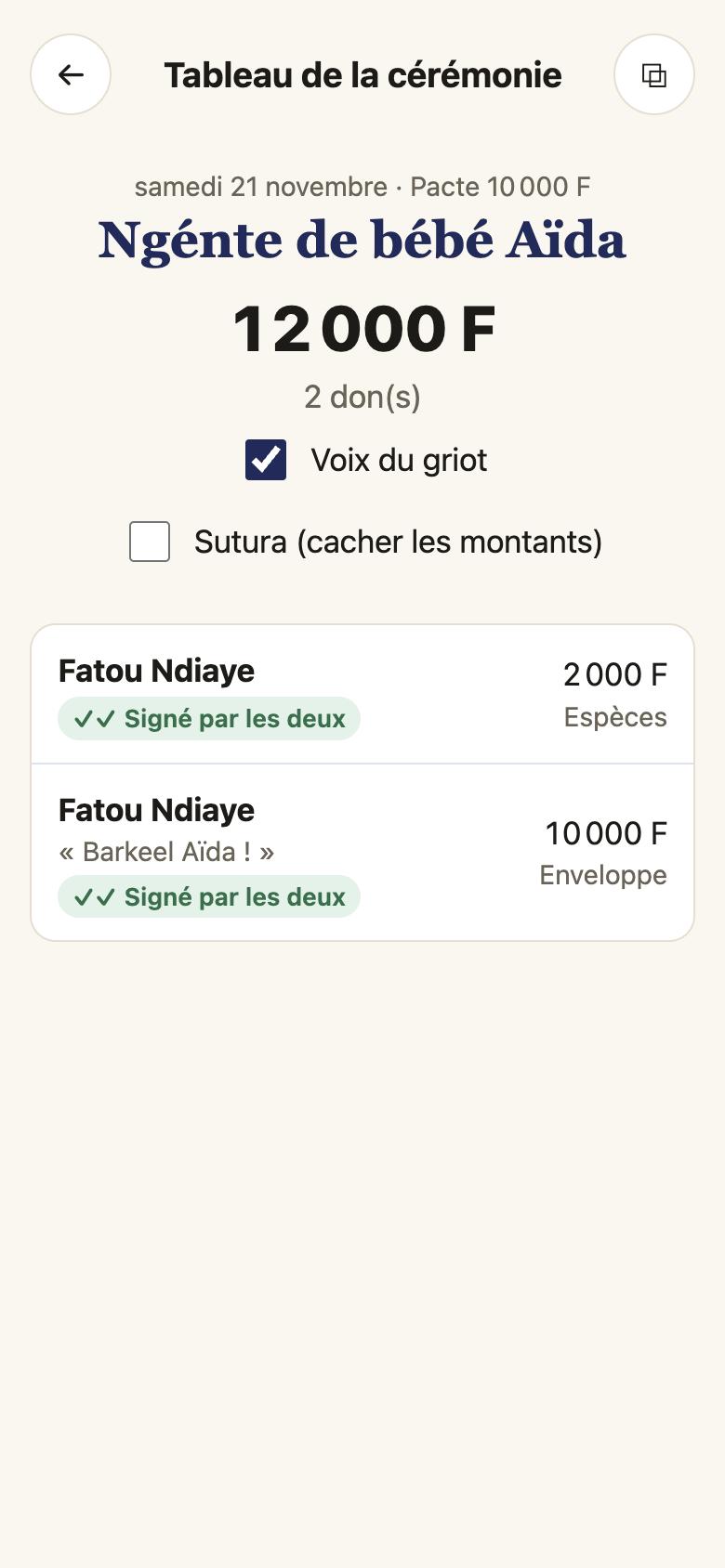
- The host's board lights up live. A griot mode reads names aloud; a sutura (discretion) mode hides amounts.
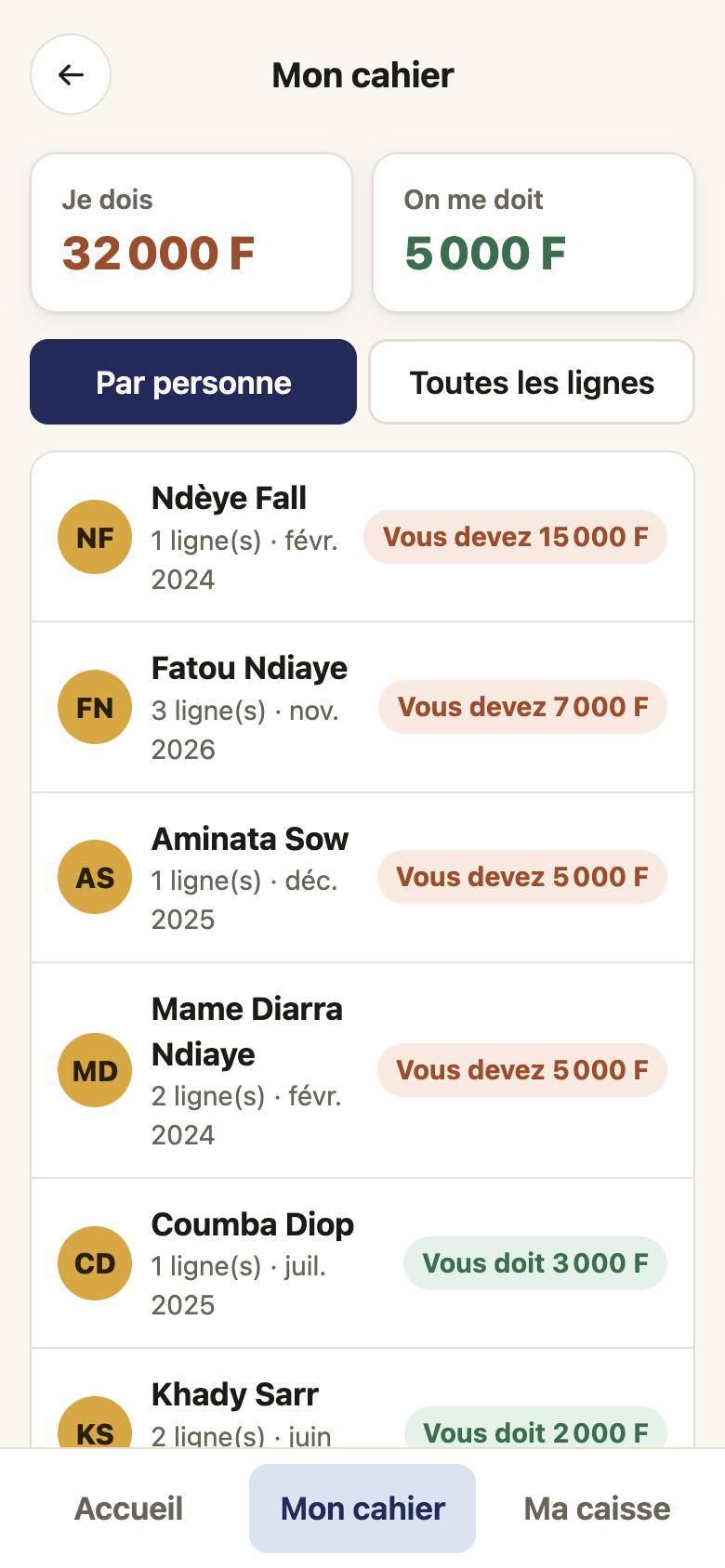
- The cahier shows who owes whom, person by person, with every return split into repayment and advance.
- Every line is co‑signed: the giver signs the gift, the host signs the receipt. Nobody can inflate, deny or invent a line later. The proof screen checks the signatures live.
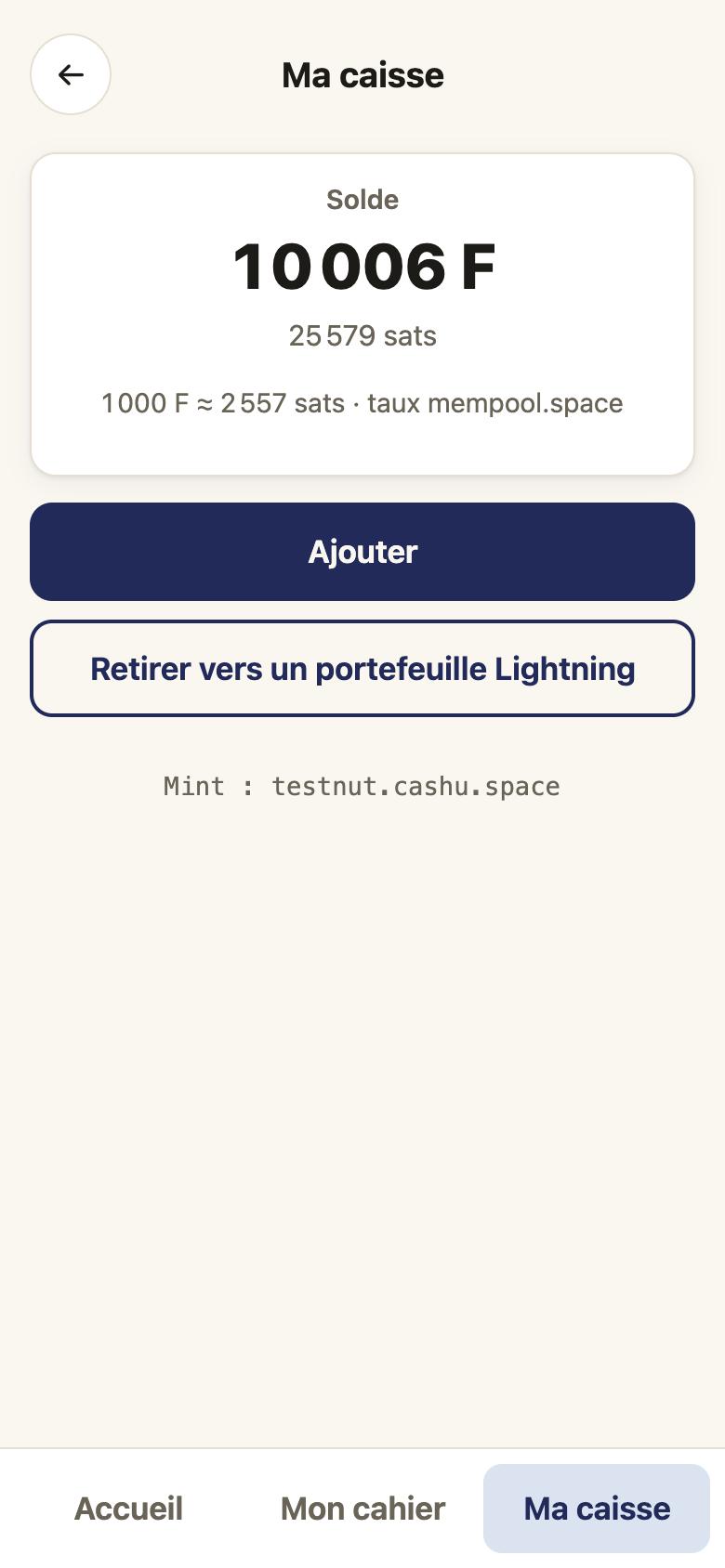
- Ma caisse is a real wallet: top up over Lightning, withdraw to any Lightning wallet, reclaim an envelope the host never opened.
- 12 words restore everything on a new phone, from Nostr relays, encrypted.
French first, English available, amounts in francs CFA with sats second.
Who it's for. The host — usually the mother, or the aunt who keeps the cahier — on a mid‑range Android with WhatsApp and patchy data. Senegal has about 540 000 births a year, so about as many naming ceremonies (World Bank crude birth rate 29.4 ‰). If 30–80 guests each bring a ndawtal (our assumption, the first thing a pilot measures), that is 16–44 million gift lines a year before weddings and funerals. 11.3 million Senegalese are online (DataReportal 2025), and WhatsApp is their most‑used platform.
How we built it
- Wallet: Cashu ecash with
cashu-ts. Envelopes are P2PK‑locked (NUT‑11) to the host's key, with the giver as refund key 30 days after the ceremony, and checked with DLEQ proofs (NUT‑12). Top‑up and withdrawal go over Lightning (mint and melt quotes). - Proof and transport: Nostr. Three event kinds — a signed ceremony (NIP‑52 calendar kind 31923), a gift signed by the giver (9330) and a receipt signed by the host (9331). They travel inside NIP‑59 gift wraps, so relays see neither names nor amounts.
- Compact invitations: the short link carries a 16‑byte secret and 8 bytes of the host's key. The signed ceremony waits on relays, NIP‑44 encrypted with a key derived from the secret; the guest checks the host key prefix, so a forged carrier needs a 2⁶⁴ search. The QR shrinks from 121 × 121 to 37 × 37 modules.
- Hand‑over with no network: the envelope (signed gift + Cashu token as raw CBOR) is deflated and cut into 300‑byte QR frames that loop on screen; the host's camera collects them in any order. Her phone checks the gift signature, token hash, a 1‑of‑1 P2PK lock with ≥ 2 days left and the DLEQ proofs against mint keys it cached while online, then shows a signed receipt back the same way.
- Keys: one NIP‑06 seed. Account 0 is the Nostr identity, account 1 the ecash lock key.
- At rest: PIN → PBKDF2‑SHA256 (310k) → AES‑256‑GCM over the seed and the whole state.
- App: Preact + Vite PWA, 171 KiB first load. Lighthouse mobile (slow 4G, 4× CPU): Performance 98, Accessibility 100, Best Practices 100; first paint 1.8 s.
- Server: one Node process that serves the app, runs a small Nostr relay at
/relay, and tells the app which mint to use.docker compose upadds a local Cashu mint (nutshell, FakeWallet). - Backups: the notebook is compressed and split into encrypted parts in two alternating slots, so it outgrows NIP‑44's 64 KB limit safely and a save cut off half‑way never damages the last good backup.
- Tests: unit tests for money, keys, vault, ledger, tamper checks, forged invite carriers, QR frames decoded by a real QR reader and a decompression bomb, plus a live end‑to‑end test that runs a real Lightning top‑up, envelope, receipt, cash gift, an in‑person hand‑over with every mint request blocked, and a 12‑word restore, against a relay and a Cashu mint.
Challenges we ran into
- A tampered event passed verification. nostr‑tools caches a "verified" flag on the event object, and a spread copy carries it over, so an edited amount still looked valid. We now verify a clean copy everywhere and have a test that edits amounts and signatures.
- Getting the maths of reciprocity right. A return is not one number: it is part repayment and part new debt, and the split has to follow the running balance across years of lines.
- Unreliable relays. One popular relay was unreachable from our network and stalled every send. Sends now complete on the first relay that accepts.
- An ecash envelope is too big for one QR. Every proof carries its lock, signature and DLEQ proof: 4–6 KB of text. Raw CBOR plus deflate brings it to ~2–3 KB, and a looping animation of 300‑byte frames makes it readable by a mid‑range camera.
- Backups outgrew Nostr. After about 30 signed gifts the encrypted notebook passed NIP‑44's 64 KB limit. It is now compressed and split into parts.
- Making a Bitcoin wallet feel like an envelope, in French, in francs, for someone who has never heard of sats.
Accomplishments that we're proud of
- A real, verifiable gift flow end to end: Lightning in, locked ecash envelope, signed gift, signed receipt, co‑signed line on both phones, restore from 12 words.
- Features that come from the custom, not from crypto: the 5 000 + 5 000 split, the pacte cap, sutura mode, the griot voice, cash gifts that still get a receipt.
- An envelope that changes hands in a courtyard with no signal, and still ends up as a line signed by both.
- Relays and servers never see who gave what.
What we learned
Cashu's spending conditions (P2PK with refund keys) map almost perfectly onto a physical envelope: it is addressed to one person, and it comes back if nobody opens it. Nostr gives us signatures and delivery for free. The hard part was never the cryptography; it was the words on the screen.
What's next for Kayit
- A Wolof interface and a Wolof griot voice.
- Printed envelopes for guests without a smartphone (safe on paper: only the host's key opens them).
- Seed‑based ecash recovery (NUT‑13 / NIP‑60).
- A CFA on/off ramp with a local Lightning exchange and mobile money.
- A shared family notebook for co‑hosts.
- A pilot with one neighbourhood association, measuring co‑signed gifts, disputes and restores.
Built With
- bitcoin
- cashu
- cashu-ts
- docker
- ecash
- jsqr
- lightning
- node.js
- nostr
- nostr-tools
- nutshell
- preact
- pwa
- qr-code
- service-worker
- typescript
- vite
- vitest
- webcrypto
- websockets
