Inspiration
In 2025, Indians lost ₹22,495 crore (about $2.7 billion) to cyber fraud across 2.81 million complaints, up 24% year over year. The attacker's tools keep getting sharper: cloning a voice now takes as little as 3 to 30 seconds of sampled audio (CERT-In advisory CIAD-2024-0084), and in June 2026 the Five Eyes alliance warned that voice confirmation alone can no longer verify who is on a call.
What makes the "digital arrest" scam so effective is not technical sophistication. It is that a fake police officer, real fear, and an artificial countdown are enough to stop someone from pausing to think, and the script explicitly instructs the victim not to consult their family. Existing defenses never reach that moment. Carrier blocklists and caller ID apps only flag numbers after someone has already been defrauded, which says nothing about a fresh number running a new script. Nothing protects you during the call itself, while the manipulation is actually happening. That gap is what Kavach closes.
What it does
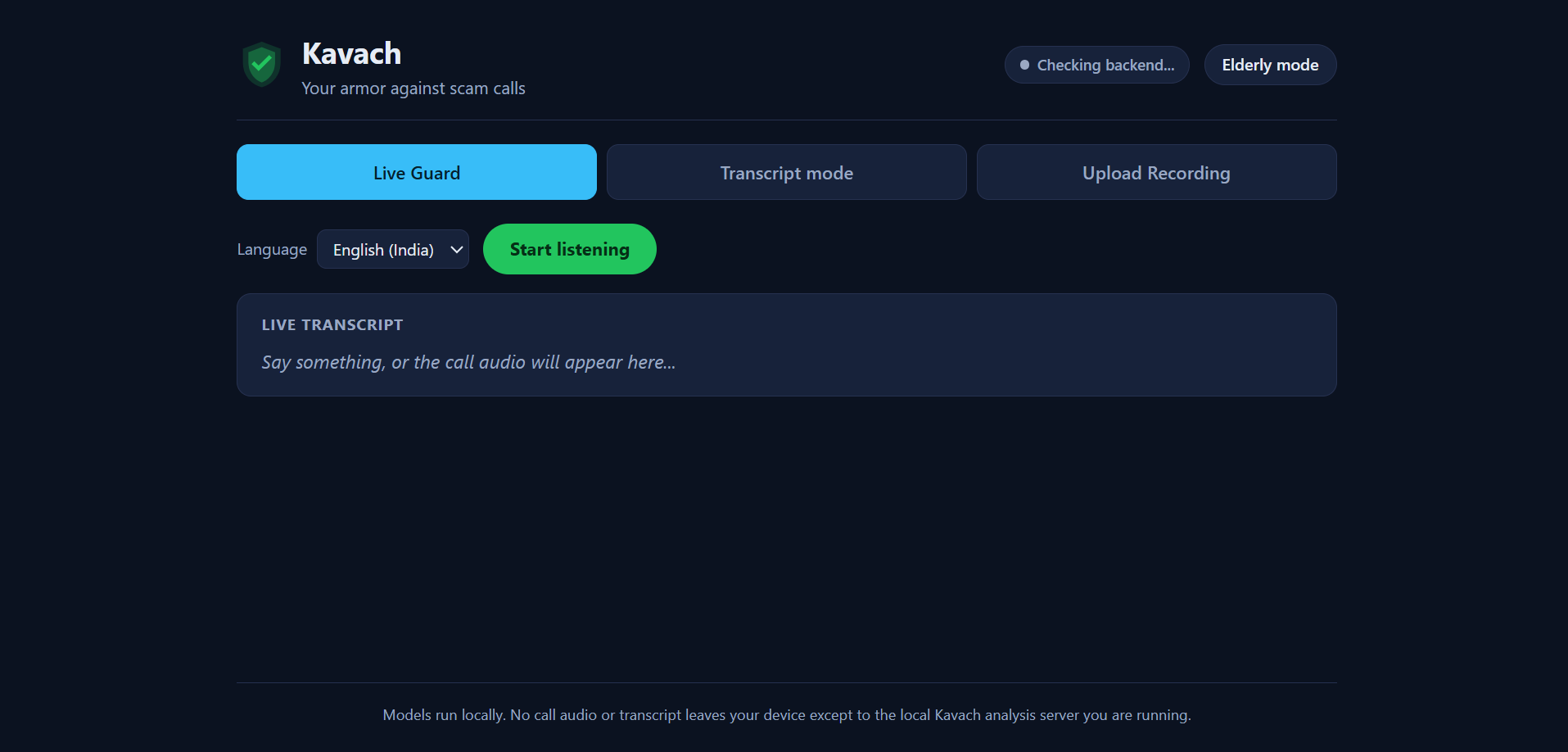
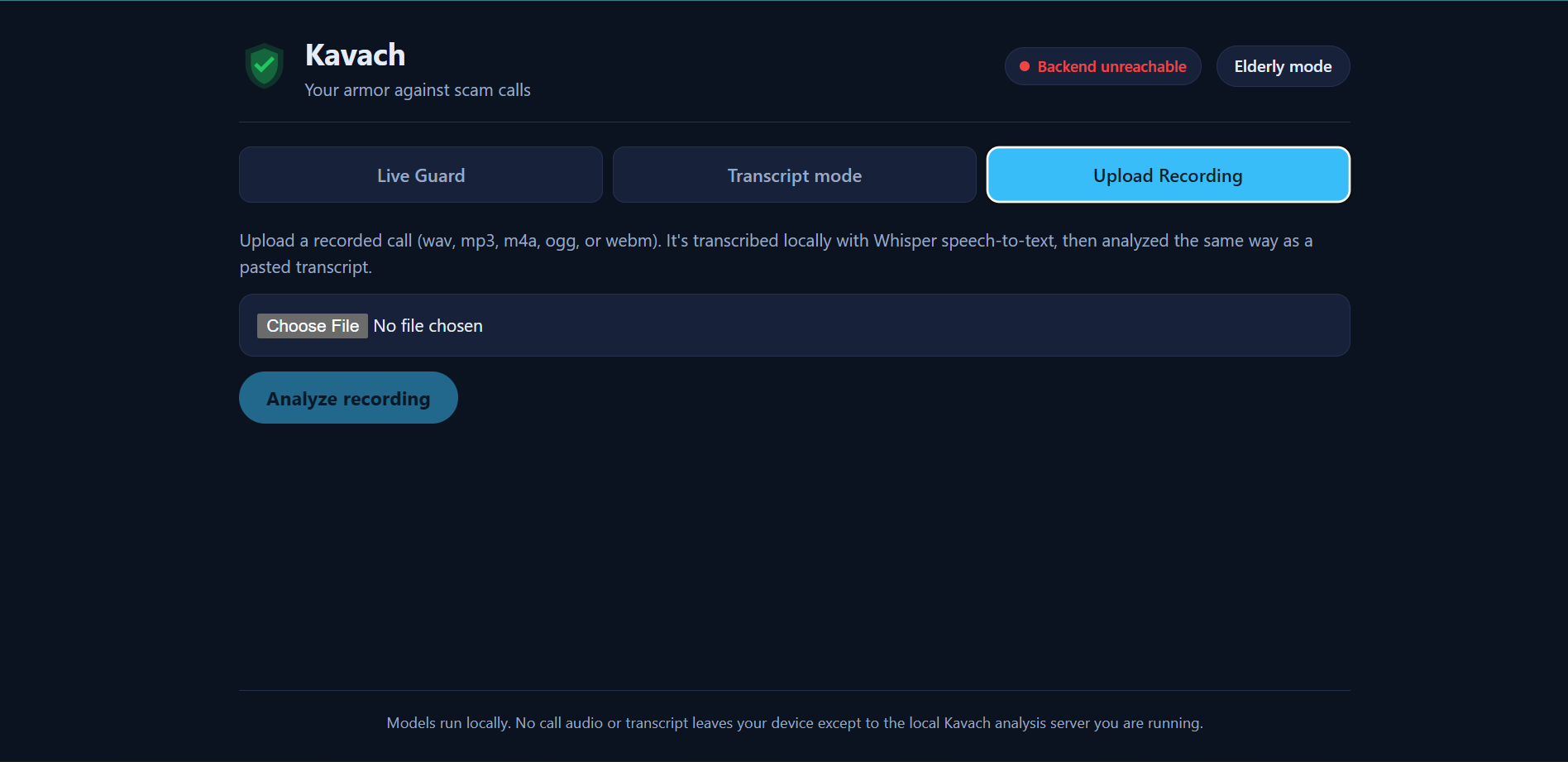
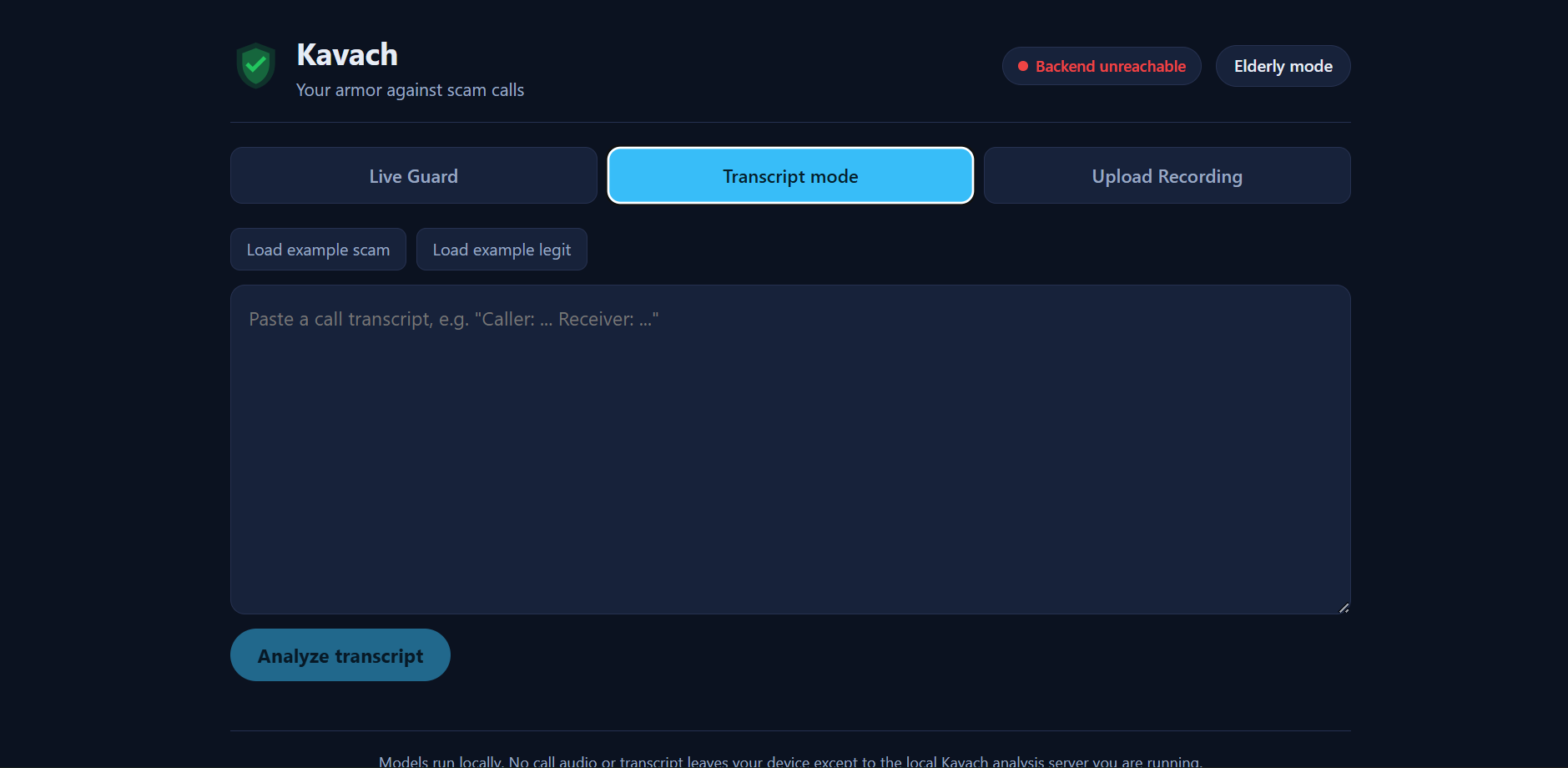
Kavach listens to a phone call, live through your microphone, pasted as a transcript, or uploaded as a recording, and returns a real-time, explainable verdict built from three independent AI signals:
- A fine-tuned DistilBERT model that reads the conversation for social-engineering language.
- A knowledge base of 12 India-specific scam signatures (OTP requests, "digital arrest" threats, remote-access app installs, UPI collect-request tricks, secrecy demands and more), each carrying a plain-language explanation.
- A fine-tuned wav2vec2 model that detects AI-cloned or synthetic speech from the audio itself.
The three signals combine through noisy-OR fusion into a single risk score, with hysteresis so the on-screen meter climbs smoothly instead of flickering. When risk crosses into "high", the app speaks a warning once and shows exactly why, quoting the line from the transcript that triggered each matched scam sign instead of presenting a black-box number. Elderly Mode strips the interface down to one gauge, one verdict and one line of advice, for the people scam callers target hardest. Detection runs entirely on the device. No external API is required.
How we built it
We assembled a corpus of 5,943 call transcripts from five open BothBosu HuggingFace datasets plus 25 India-specific synthetic scenario families we wrote ourselves: digital arrest, fake KYC, UPI refund traps, courier customs, KBC lottery, army/OLX marketplace fraud, loan-app extortion, investment fraud, and job, hostel and dating-app advance fees. Each scam family is paired with a matched benign look-alike call, so the model has to learn the manipulation pattern rather than scam-adjacent vocabulary. Twenty real scam call recordings were held out from training entirely, as an honest real-world probe.
We fine-tuned distilbert-base-uncased on that corpus, using a sliding 256-token window so
a signal buried in a long call still drives the score, and facebook/wav2vec2-base as a
bonafide-versus-spoof classifier on ASVspoof 2019 LA, cross-evaluated on the independently
sourced In-the-Wild dataset. Both were trained entirely on free Kaggle T4 GPU time and
exported to ONNX for fast local inference. A FastAPI backend fuses the text, signature and
voice scores, and a React frontend offers three ways in: live microphone capture via the
Web Speech API, paste-a-transcript, and upload-a-recording transcribed locally with
faster-whisper.
We wrote the end-to-end evaluation harness on day one, covering 30 fresh hand-written scenarios plus the 20 real held-out calls, and treated every result it produced as something to react to rather than a formality to pass.
Challenges we ran into
Four problems cost us the most time, and all four were found by our own testing.
The fusion math was quietly broken. An earlier weighted-average combiner renormalized over whichever signals were active, and because no audio model existed yet, every request renormalized to effective weights of text 0.588 and signature 0.412. A maximally confident text score of 1.0 therefore capped at 0.588, structurally below our 0.65 "high" threshold, no matter how obvious the scam. Full fusion was catching fewer real scam calls than the text model alone, 6 out of 20 against the text model's 12, before we found it. Rewriting it as a noisy-OR combination that excludes absent signals instead of diluting present ones took full-fusion real-call catch rate from 6/20 to 20/20 in that run.
The audio dataset ate two training days for a boring reason. The public Kaggle mirror of
In-the-Wild ships the audio without the meta.csv label file the official release
includes, and a second mirror sorted the same files into real/ and fake/ folders
instead. Our script assumed the documented layout and crashed at the evaluation step. We
tracked down and shipped a verified copy of the 31,779-row label file into our own repo,
and taught the loader to fall back to folder-name labels. Only then did the 19.5%
cross-dataset EER we report mean anything.
We lost a completed 94-minute training run. The wav2vec2 model finished training on Kaggle and then the process crashed during post-training evaluation, before the weights were ever written to disk. We changed the script to save the model artifact immediately after training and before any evaluation, so an eval-time crash can never again destroy a finished run.
The last one surfaced with barely a day left, while preparing the demo video. We uploaded a recording of an entirely benign clinic appointment reminder that happened to use a text-to-speech voice, and Kavach called it a scam with 0.92 confidence. The text model had scored it correctly and no signature had fired, but the voice-forensics signal alone carried enough weight to force a "high" verdict, and the explanation beneath it claimed "strong scam signs" while listing none. It was the right bug to find late, because it exposed a wrong assumption rather than a wrong line of code. A synthetic voice is not evidence of fraud. Bank IVRs, clinic reminders and delivery notifications are all synthetic speech, and an app that shrieks at every one of them teaches the elderly users we built it for to ignore it. We reweighted the voice signal so that on its own it can only reach "suspicious", corroborating context rather than proof, while a synthetic voice combined with scam content still fires "high" immediately.
Accomplishments that we're proud of
Our own testing found five real bugs before any judge could: a fusion-math dilution bug, an overfitting text model, a training pipeline that could silently lose a finished run, a baseline number that looked too good to be true, and a voice signal that flagged legitimate robocalls as fraud. We fixed all five and kept the honest before-and-after numbers in the report rather than quietly overwriting them.
On results, our text ensemble catches 19 of 20 real, never-before-seen scam call recordings, against a TF-IDF baseline that catches 11 of 20 on the same corpus. Our voice model reaches a 0.87% equal error rate on same-distribution data, and we published its much harder 19.5% cross-dataset number rather than hiding it. The entire detection pipeline, transcription, text scoring and voice forensics, runs offline with zero required external API calls, which matters for a tool meant to serve people who may neither trust nor afford a cloud service listening to their phone calls.
What we learned
The most valuable thing we built was not a model. It was the habit of writing the evaluation harness before trusting any result, and of treating a suspiciously perfect number as a warning rather than a win. Our TF-IDF baseline scored 100% on the synthetic test set and then caught barely half of the real calls.
We learned that fusing weak signals is harder than it looks. "Just average them" is an easy way to build a system that performs worse than its own best component, and we only caught that because we measured text-alone performance as a baseline to beat instead of treating it as one configuration among many.
We also learned how differently India-targeted scams work from the tech-support scams most detection tools were built around. "Digital arrest" scripts use isolation and video-call pressure specifically to stop a victim from consulting anyone, and loan-app blackmail and army/OLX marketplace fraud pull on entirely different psychological levers.
What's next for Kavach
Recalibrating the text ensemble's confidence, through temperature scaling or a lower fusion weight, to close the three benign false positives at "high" that our evaluation report documents openly. Adding speaker diarization to the recording endpoint so caller and receiver turns are separated instead of merged into one block. Expanding voice-forensics training across more TTS and vocoder families and more languages, to bring the cross-dataset error rate down. And building an on-device mobile version, so Kavach can sit on the actual call path rather than in a browser tab.
Built With
- distilbert
- fastapi
- faster-whisper
- huggingface-transformers
- onnx-runtime
- python
- pytorch
- react
- scikit-learn
- vite
- wav2vec2
- web-speech-api


Log in or sign up for Devpost to join the conversation.