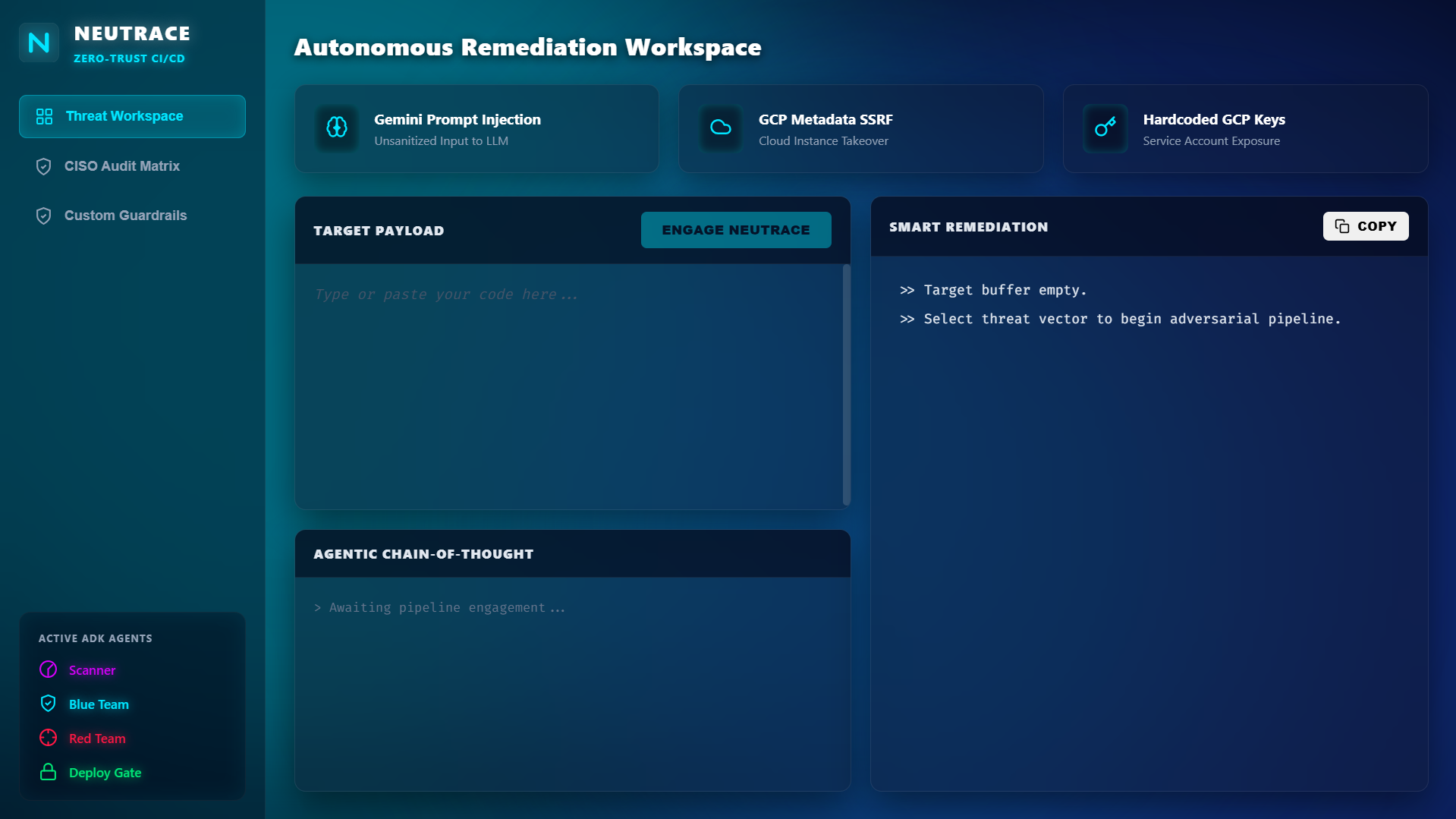
💡 Inspiration: The Agentic Security Crisis As enterprise AI adoption explodes, the speed of software development has fundamentally outpaced traditional security. We are entering the "Agentic Era," where AI generates and deploys code at unprecedented velocity. Yet, CI/CD security remains archaic—relying on static rules and manual human review.
The inspiration for NeuTrace was simple but urgent: 'We must use AI to secure AI'. To protect the next generation of cloud infrastructure, we needed an autonomous, zero-trust security perimeter that operates at the speed of generative pipelines.
⚙️ What it does: The Multi-Agent Security Forge NeuTrace is an autonomous, multi-agent CI/CD security forge that intercepts, analyzes, and remediates code before it ever touches production. Instead of a single LLM trying to guess vulnerabilities, NeuTrace deploys an entire "virtual cybersecurity team" powered by the Google Agent Development Kit.
Our matrix consists of four distinct agents:
- The AST Scanner: Deep-scans the Abstract Syntax Tree (AST) to isolate vulnerabilities in execution contexts.
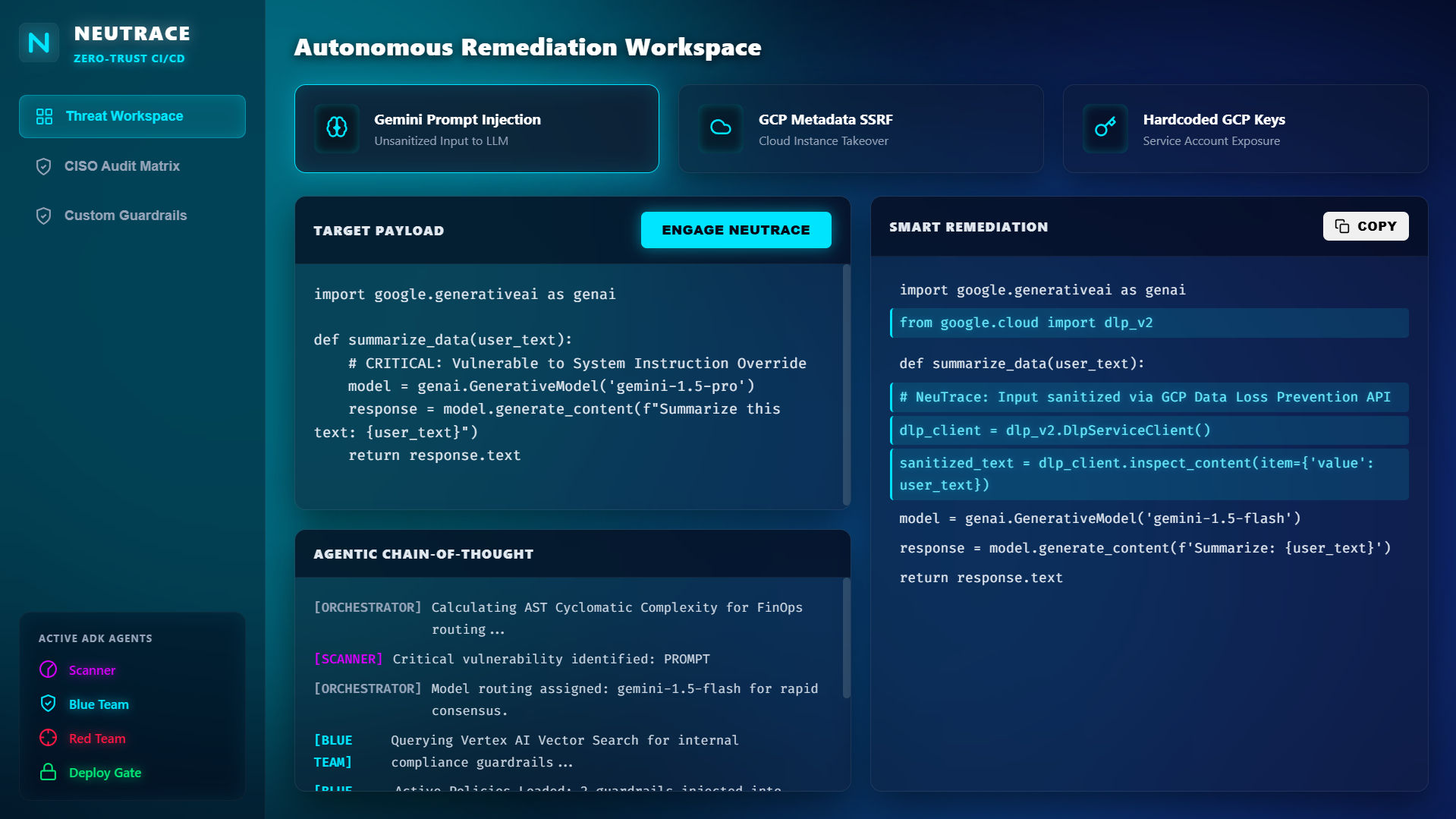
- The Blue Team Synthesizes cryptographic, deterministic patches (e.g., dynamically querying Google Cloud DLP or Secret Manager APIs).
- The Red Team: Acts as the adversary, executing a rigorous 3-pass bypass simulation to attack the Blue Team's patch.
- The Deploy Gate: The zero-trust arbiter that evaluates the Red Team's report and grants final cryptographic approval.
Key Capabilities Displayed:
- Threat Neutralization: Live remediation of Gemini Prompt Injections, Google Cloud SSRF takeovers, and Hardcoded GCP Service Keys.
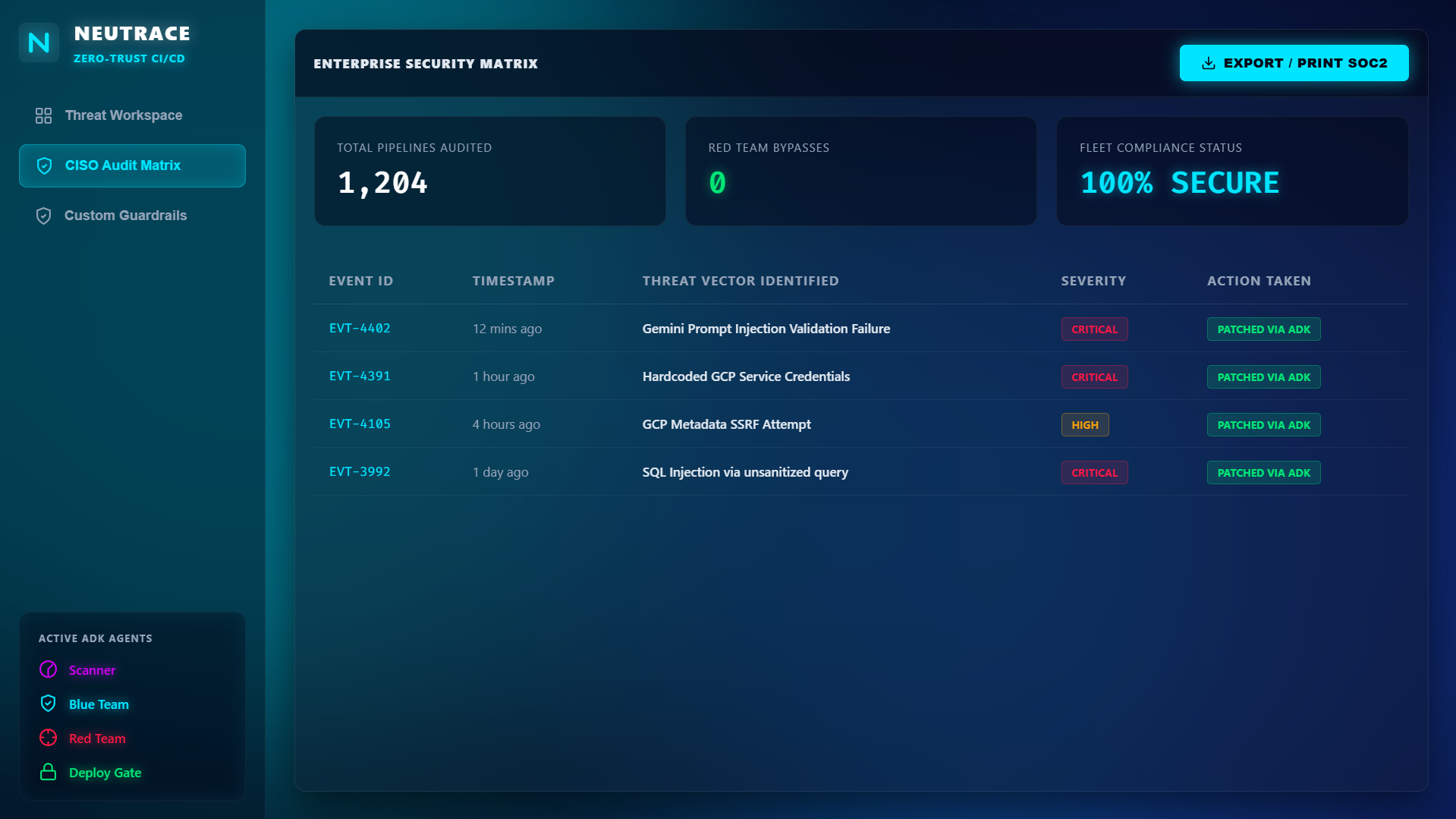
- CISO Audit Matrix: Fleet-wide threat telemetry that generates one-click, print-ready SOC 2 Type II compliance reports.
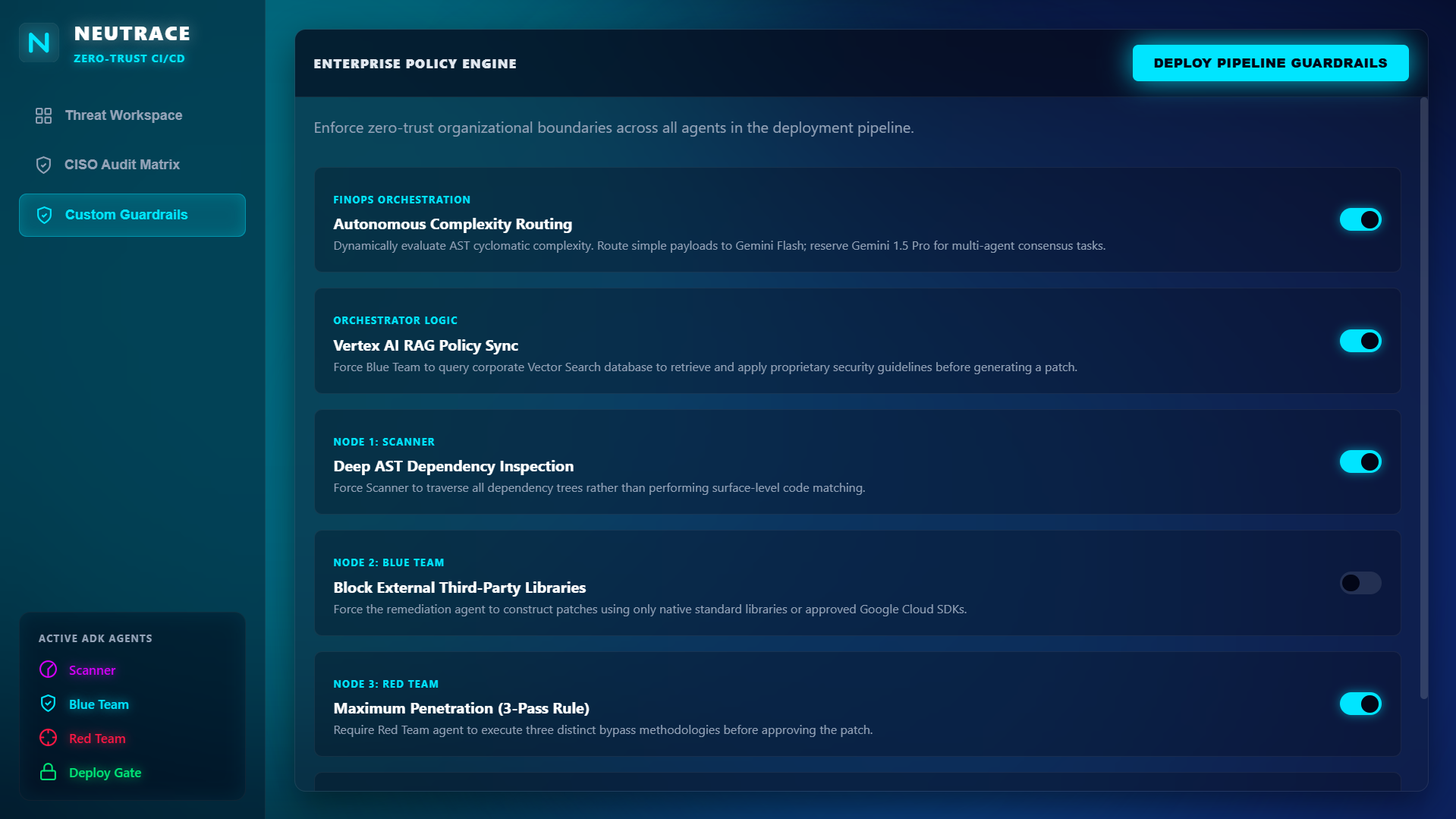
- Enterprise Policy Engine: Granular guardrails allowing security teams to enforce FinOps model routing and third-party dependency bans.
🏗️ How we built it: The Tech Stack
- Orchestration Engine: We utilized the "Google Agent Development Kit" and "Gemini 1.5 Pro/Flash" to power our multi-agent consensus architecture.
- The UI/UX: We built a custom React frontend utilizing a pure glass morphism aesthetic over a cinematic, CSS-driven ambient engine. We completely abandoned static image assets, engineering a custom scalable SVG logo inline to guarantee zero-latency rendering and pixel-perfect enterprise scaling.
- Security Integration: The agentic prompts were heavily grounded in Google Cloud security best practices (GCP Secret Manager, DLP APIs, Metadata security).
⚠️ Challenges we ran into The biggest challenge in building agentic cybersecurity is "LLM hallucination". A security patch cannot just "look" right; it must be deterministic and safe.
We solved this by engineering the "Red Team / Blue Team adversarial loop". If we relied on a single agent, it might approve a flawed patch. By forcing the Red Team agent to actively try to bypass the Blue Team's code, we mathematically reduced false positives and ensured enterprise-grade reliability.
🏆 Accomplishments that we're proud of: We successfully built a product that doesn't look or feel like a weekend hackathon project—it looks and acts like a multi-million-dollar SaaS enterprise platform.
We are incredibly proud of the 'Enterprise Policy Engine', which proves that agentic workflows can be strictly governed by human-defined guardrails, addressing the number one concern CISOs have regarding AI integration.
📚 What we learned We learned that the true power of Large Language Models isn't just in code 'generation', but in code 'validation'. By structuring Gemini models into distinct personas with conflicting goals (Attacker vs. Defender), the resulting output is exponentially more secure and reliable than a standard zero-shot prompt.
🚀 What's next for NeuTrace This is just the genesis. The immediate roadmap for NeuTrace includes:
- Native CI/CD Integration: Direct webhooks for GitHub Actions and GitLab CI to make NeuTrace an invisible, automated step in the PR merge process.
- RAG Policy Sync: Integrating Vertex AI Vector Search so the Blue Team agent dynamically queries a company's internal, proprietary security wikis before writing patches.
- Agentic FinOps: Dynamic token optimization to ensure the security forge remains highly cost-effective at enterprise scale.

Log in or sign up for Devpost to join the conversation.