Katibe AI — From Documents to Action
Inspiration
Katibe started with a simple idea: make administrative and document preparation easier for people in Algeria.
Many people know what they want to accomplish, but they do not always know which procedure to follow, which documents they need, or how to write the appropriate request. This inspired us to go beyond a traditional document generator.
For this hackathon, we transformed Katibe into an agentic administrative assistant designed to understand the user's goal and guide them from intention to action.
Instead of asking users:
"Which document do you need?"
Katibe asks:
"What do you want to accomplish?"
What We Built
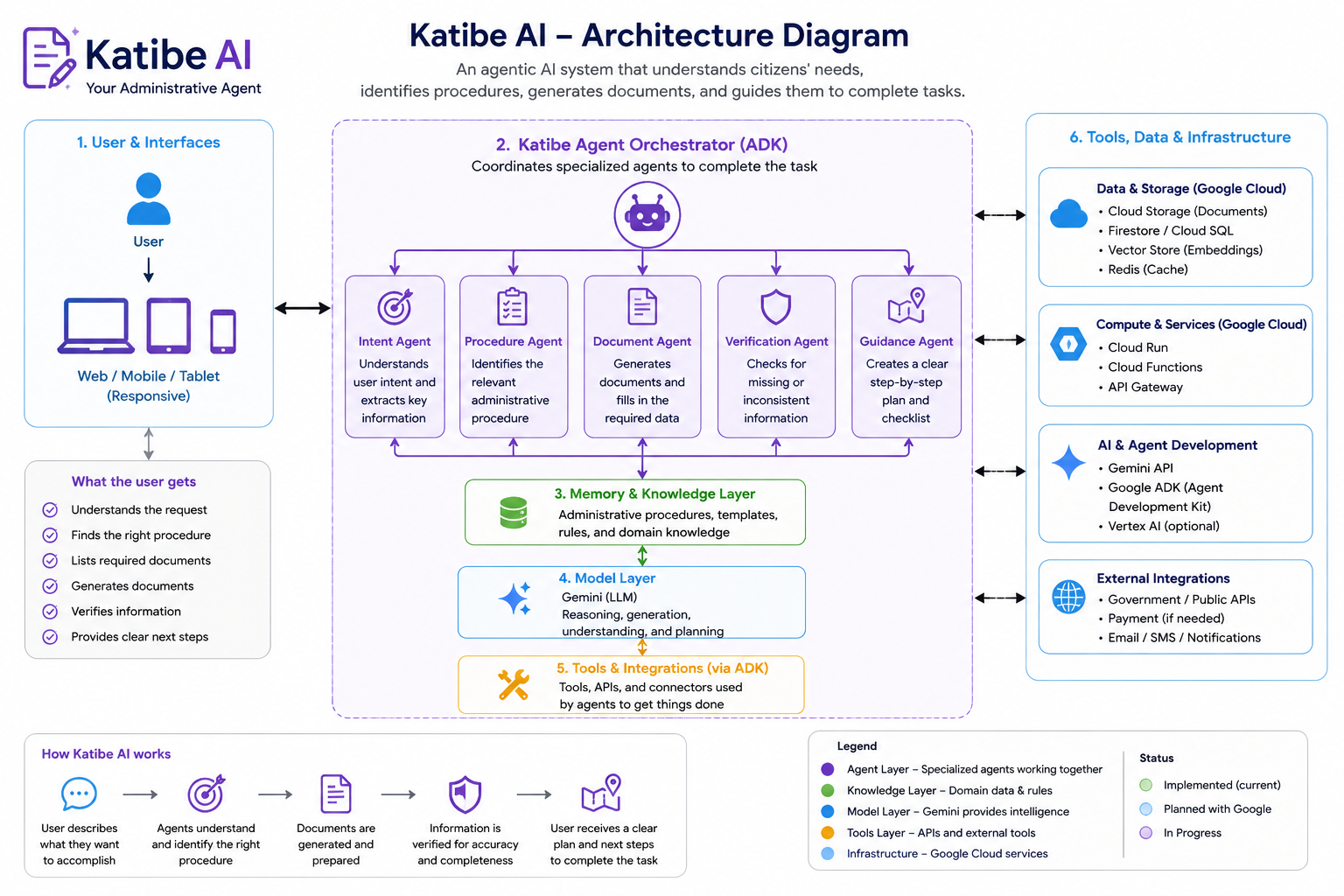
Katibe AI is designed to understand a user's request, identify the relevant administrative procedure, determine the required information and documents, generate the appropriate paperwork, verify the result, and provide a clear step-by-step action plan.
The experience is built around an agentic workflow:
User Intent → Understanding → Procedure → Documents → Verification → Guidance
The goal is not to create another chatbot that simply generates text. Katibe is designed as an action-oriented AI Agent that can coordinate multiple tasks to help users complete real administrative workflows.
How We Built It
We built the experience on top of the existing Katibe platform and redesigned the user journey around the AI Agent.
The architecture is designed to support specialized agent capabilities such as:
- Intent Agent — understands what the user wants to accomplish.
- Procedure Agent — identifies the relevant administrative workflow.
- Document Agent — prepares the required documents.
- Verification Agent — checks for missing or inconsistent information.
- Guidance Agent — turns the result into a clear checklist and next steps.
The system is designed to integrate with Gemini, Google Agent Development Kit (ADK), and Google Cloud, while keeping the AI layer separate from the frontend so the platform can evolve into a scalable agentic system.
What We Learned
One of the biggest lessons was that an AI Agent should not be treated as just a conversational interface.
A useful agent needs to understand context, decide what information is missing, use the right tools, verify its output, and keep the user moving toward a real-world goal.
We also learned that good agent design requires a balance between autonomy and user control. Katibe should automate repetitive work while keeping the user informed about what it is doing and why.
Challenges
The biggest challenge was turning a document-generation concept into a complete agentic workflow.
Administrative requests can be ambiguous. Two users may ask similar questions but require different procedures depending on their location, situation, or the purpose of the request.
Another challenge is reliability. Administrative information should not simply be invented by an AI model. Katibe therefore needs a structured knowledge layer and reliable sources, with the ability to indicate when information requires verification.
We also focused on making the experience accessible on mobile phones, tablets, and desktop computers, because administrative assistance should be available regardless of the user's device.
Why Katibe Matters
Katibe is built around a simple principle:
People should not need to understand the bureaucracy before they can ask for help with it.
By combining an existing administrative document platform with agentic AI, our goal is to make complex administrative workflows easier to understand, easier to prepare, and easier to complete.
Katibe AI turns "What document do I need?" into "Tell me what you want to accomplish, and let's get it done."
Built With
- administrative
- agent
- agentic
- ai
- app
- arabic
- artificial
- automation
- design
- document
- generation
- generative
- intelligence
- javascript
- language
- lovable
- natural
- react
- responsive
- rtl
- technology
- web

Log in or sign up for Devpost to join the conversation.