Inspiration
In townships, taxis are the most used form of transport, yet commuters rely on guesswork and word-of-mouth to know wait times, fares, and peak hours. Inspired by how Where Is My Train uses community data to reduce uncertainty, I wanted to build a similar information layer for kasi taxis.
What it does
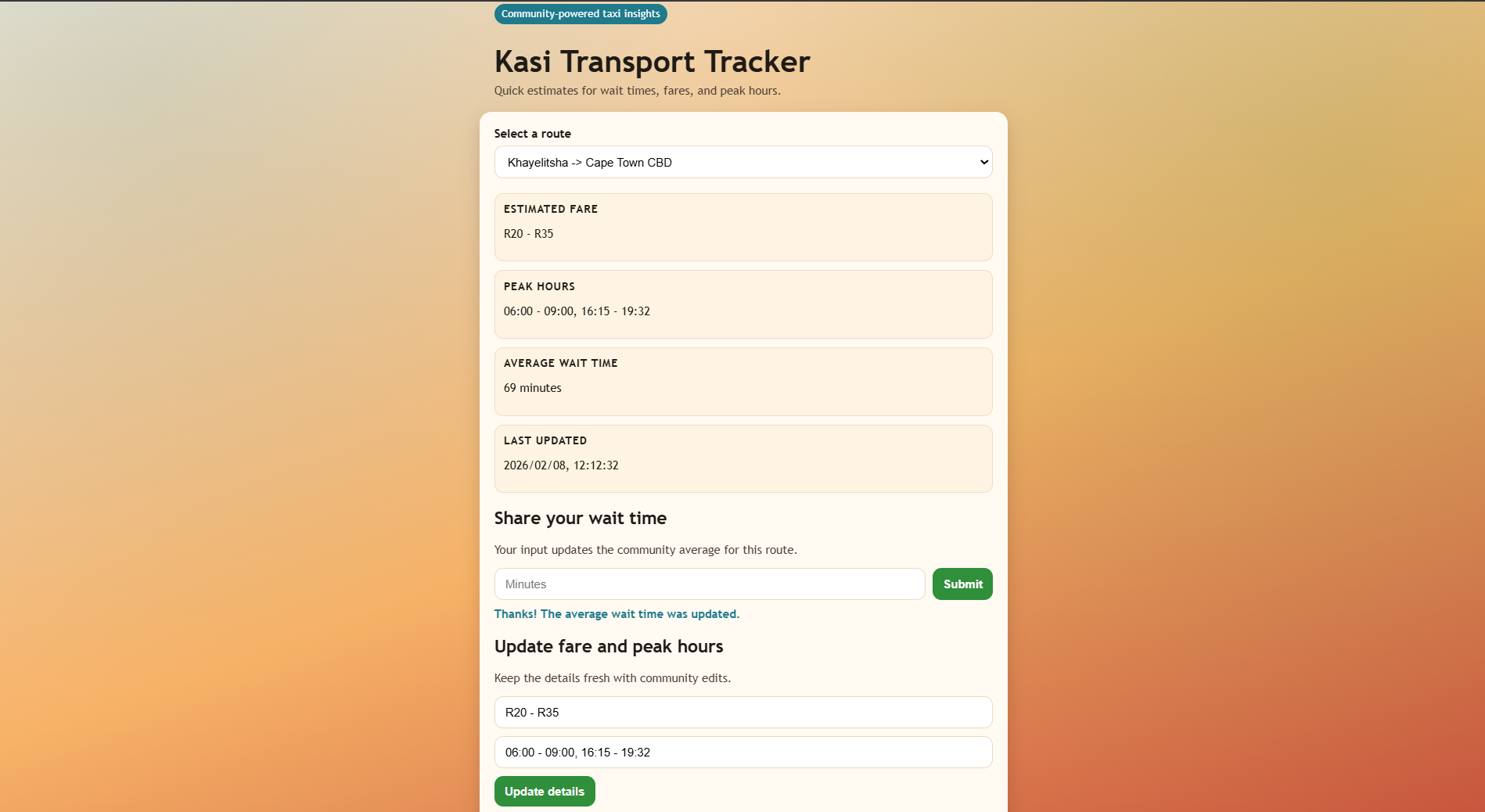
Kasi Transport Tracker is a community-powered web app that shows estimated taxi fares, peak hours, and average wait times for selected routes. Users can also submit their own wait time, helping other commuters plan better.
How we built it
The project was built as a lightweight frontend-only prototype using HTML, CSS, and vanilla JavaScript. Route data is stored as mock data in JavaScript objects, and user-submitted wait times are used to update averages in real time.
Challenges we ran into
The main challenge was designing a useful solution without access to live taxi APIs or GPS data. Another challenge was keeping the app simple and beginner-friendly while still solving a real problem.
Accomplishments that we're proud of
We successfully built a clear proof of concept that demonstrates how informal commuter knowledge can be digitized. The app is easy to use, mobile-friendly, and clearly communicates its purpose and impact.
What we learned
We learned how to turn a real community problem into a practical prototype, how to design with constraints, and how community-driven data can be powerful even without complex technology.
What's next for Kasi Transport Tracker
Future improvements include GPS-based updates, safety alerts, rank-level heat maps, offline support, and broader community participation to make the data more accurate and real-time.

Log in or sign up for Devpost to join the conversation.