Inspiration
AI agents can already search, compare and check out. But most people won't let one spend their money. A Checkout.com survey (December 2025) found that 52% of shoppers aren't comfortable letting an AI agent buy for them. Their top fear is losing control, and what would change their mind is spending limits and easy refunds.
So I didn't build another shopping chatbot. I built the part that's missing: the trust layer between any AI agent and your PayPal account.
What it does
Kart lets any AI agent shop for you without handing it your wallet.
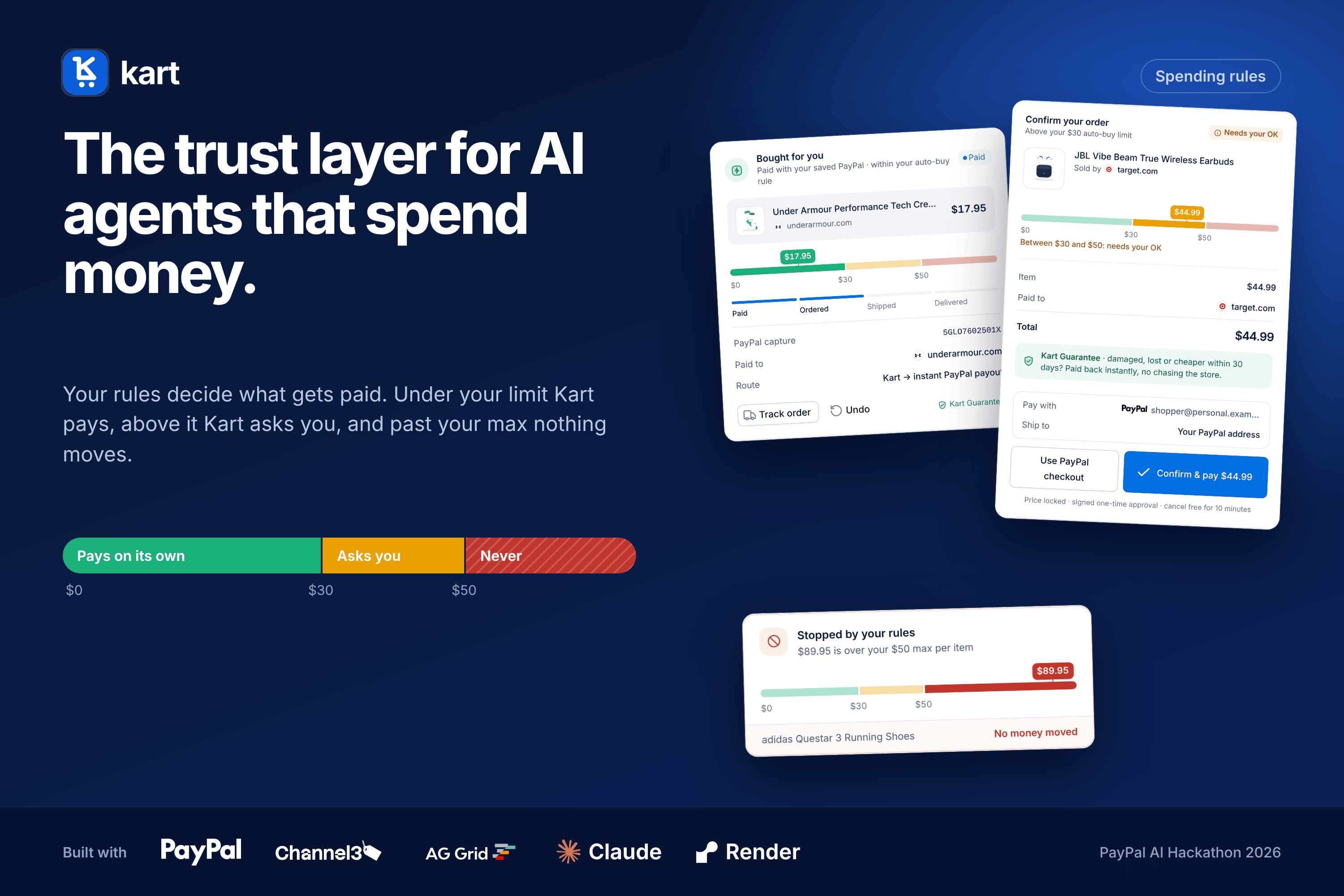
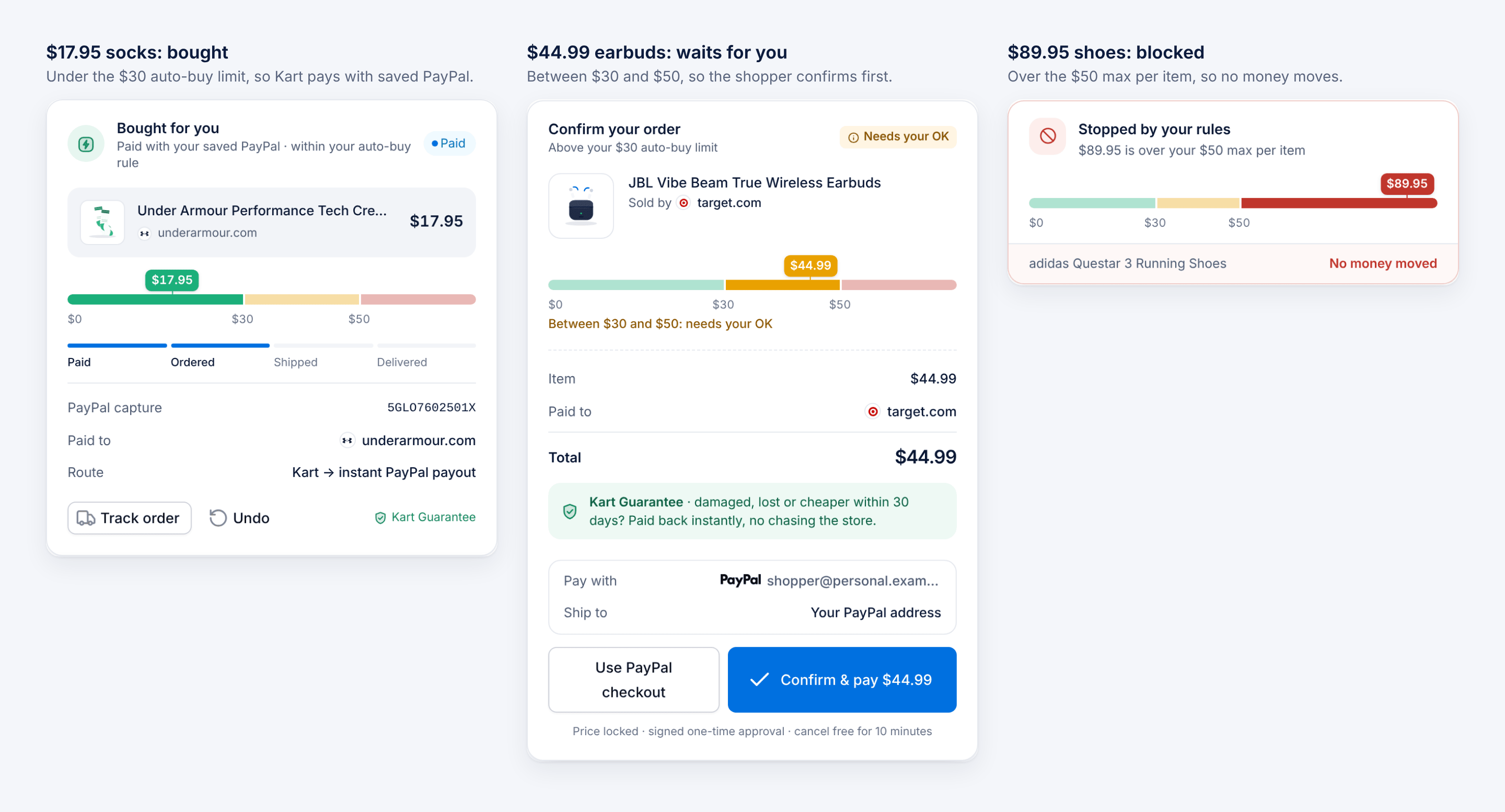
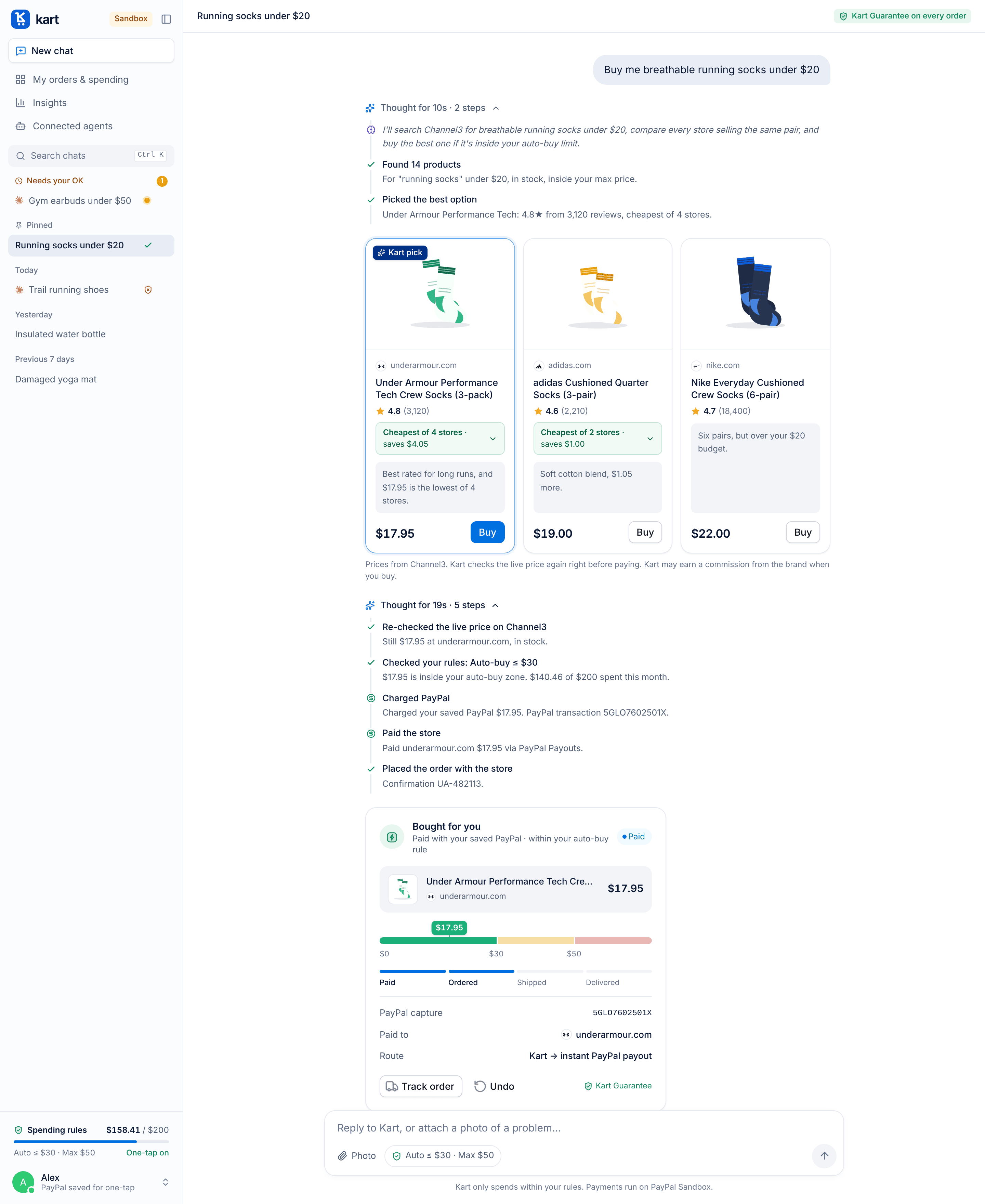
Before the purchase: your rules. You set an auto-buy limit, a max per item and a monthly cap. Every price ends one of three ways:
- Under your auto-buy limit: Kart pays on its own.
- Between the limit and your max: Kart asks you first.
- Over your max: blocked, and no money moves.
During the purchase: PayPal. PayPal pays the store. Agents never see your PayPal details.
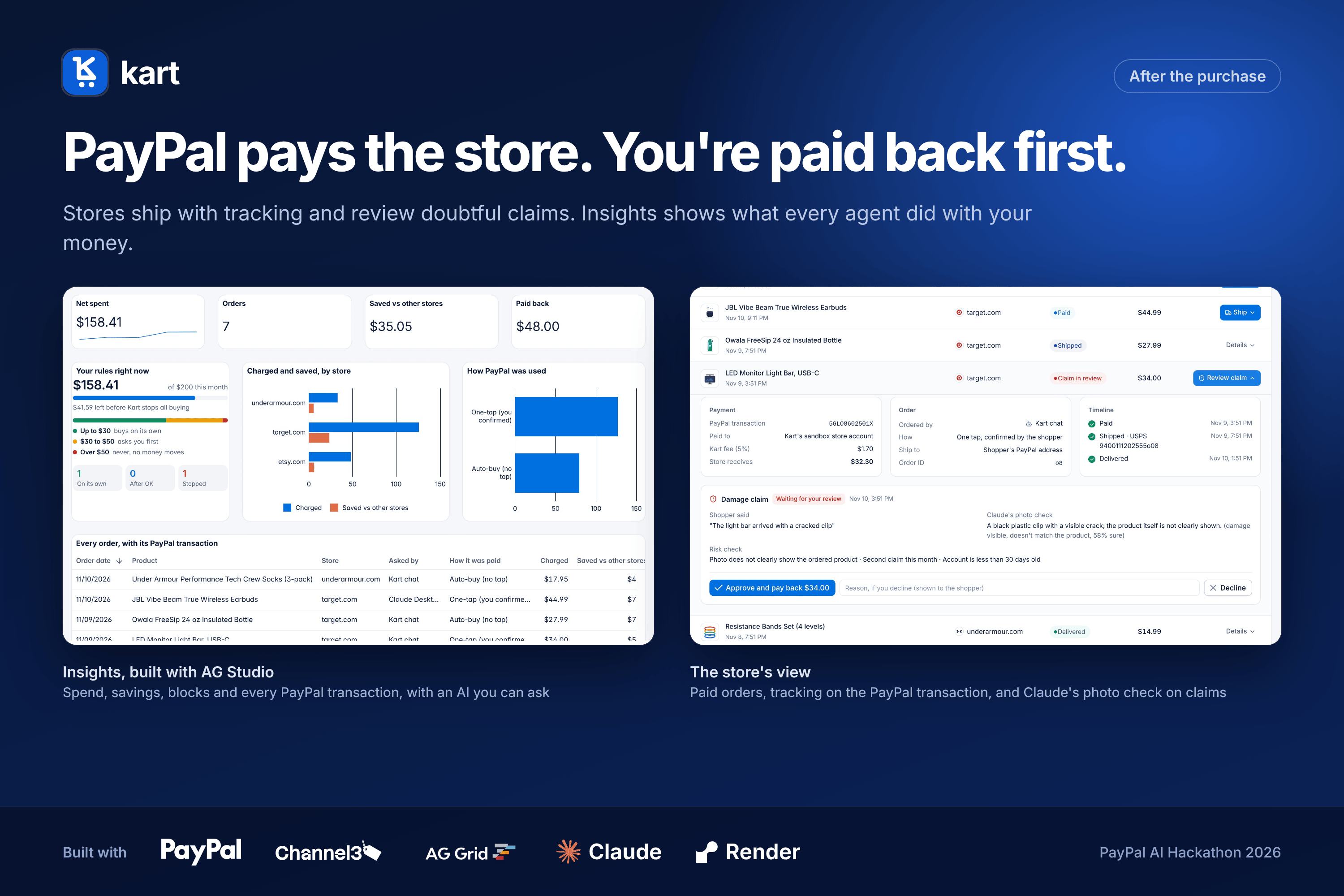
After the purchase: the Kart Guarantee. Damaged, lost or cheaper later? You send a photo, Claude checks it, and you're paid back first through PayPal. Kart settles with the store.
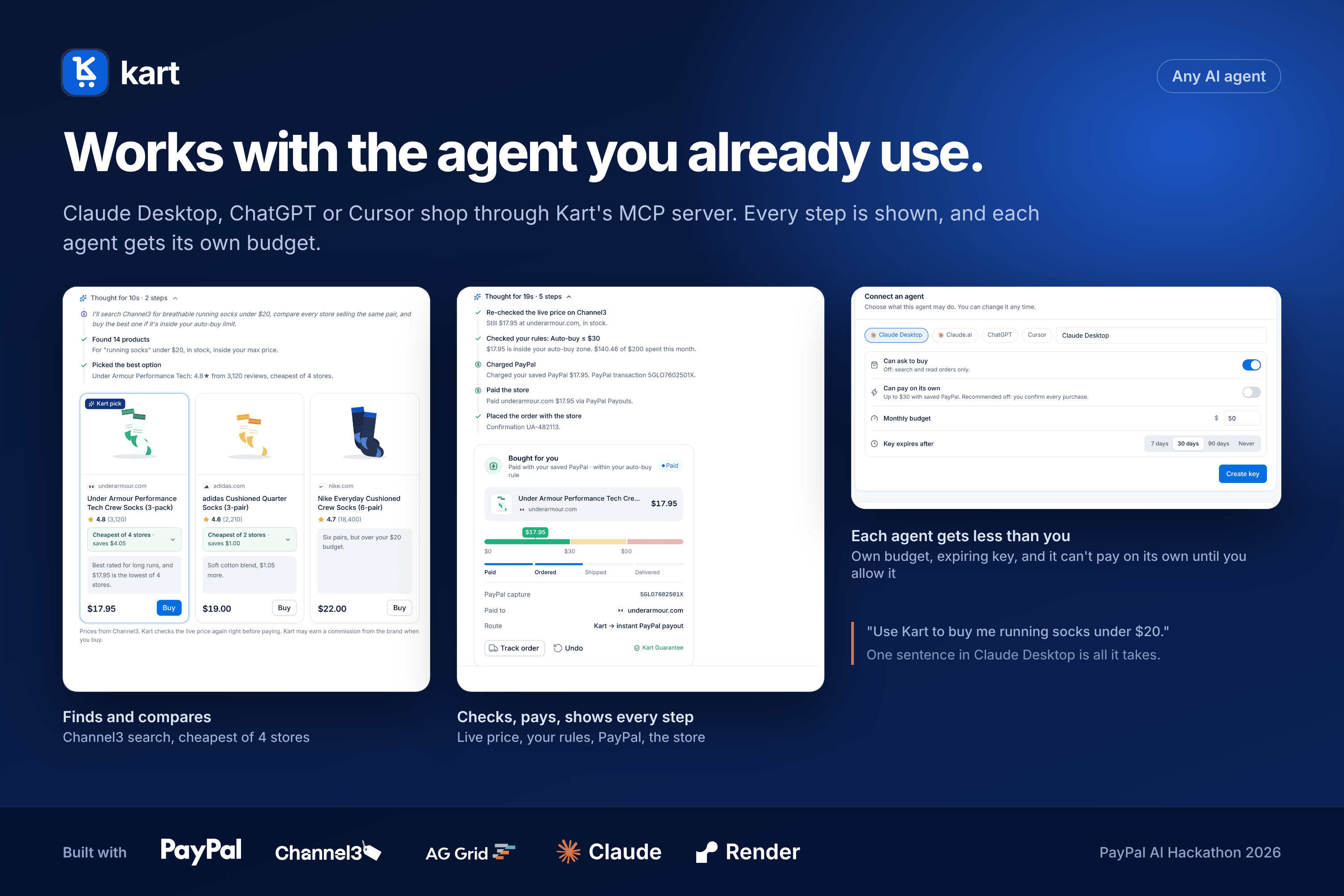
It works with Kart's own chat agent and with the agent you already use. Kart is an MCP server, so Claude Desktop, ChatGPT or Cursor can shop through the same rules. Each agent gets its own smaller budget, an expiring key, and no permission to pay on its own until you allow it.
Stores get a dashboard where orders arrive already paid. They ship, add tracking, and review doubtful claims.
How we built it
- PayPal (sandbox): Orders v2 and the JS SDK for checkout in the chat, Vault for one-tap and auto-buy, Payouts and Refunds for the Guarantee, Partner Referrals for store onboarding, the Agent Toolkit for shipment tracking, and signature-verified webhooks.
- Claude (Anthropic): the shopping agent with tool use, vision checks on damage photos, and the assistant inside the dashboard.
- Channel3: product search across stores, every store's price for the same product, and a live price re-check right before PayPal charges.
- AG Studio (AG Grid): the Insights dashboard, a custom guardrail widget, and "Ask Kart AI" on the Studio Agent Framework, running on Claude through my own adapter.
- Render and Neon Postgres for hosting and storage, with Next.js and TypeScript for the app.
The key design choice: the rules live in server code, not in the prompt. The AI can ask to buy, but only Kart's server can move money, after checking the limits, the agent's budget and the live price.
Challenges we ran into
- PayPal Vault failed silently. Saving a PayPal account didn't work when the order also paid another merchant, and nothing reported an error. I had to restructure who captures the payment before one-tap worked.
- Making the "thinking" view honest. I wanted users to see what the agent is doing, but not a fake animation. Every step in the trace is built from an event Kart actually logged.
- Deployment surprises. Data vanished on restart until I moved everything, including photos, into Postgres. Sign-in redirected to localhost behind the host's proxy.
- Real stores, sandbox money. Sandbox money can't buy real goods, and Channel3's checkout API isn't open yet. So the payment, tracking and refunds are real PayPal sandbox flows, and the order on the store's own site is simulated. I say so openly in the app and the README.
Accomplishments that we're proud of
- One request, three outcomes, shown on a single "Rule Lane" that appears everywhere money is decided.
- An outside agent (Claude Desktop) buying through Kart and getting stopped at $90 with no money moved.
- Seven PayPal capabilities working together in one flow.
- A security pass built for a payments app: signed one-time confirmations, hashed agent keys, rate limits and verified webhooks.
What we learned
- Trust in agentic commerce is mostly a product problem: limits people can see, and a way back when things go wrong.
- Guardrails have to sit outside the model. A prompt is not a spending limit.
- MCP makes "works with any agent" real with very little code.
- PayPal's sandbox is powerful, but its settings (Payouts, Vault) and error messages take time to learn.
What's next for Kart: The Trust Layer for AI Agents
- Placing the order at the cheapest store automatically once checkout APIs open up.
- Spending categories per agent, such as a work agent that can only buy office supplies.
- A "Pay Later above $X" rule.
- Letting stores publish catalogs and return policies directly to agents.


