Inspiration
We were inspired by the "Billion-Dollar Copy-Paste Problem." In the enterprise world, highly paid sales engineers spend 30-40% of their time manually searching for answers to technical questions in Request for Proposal (RFP) documents. We realized this wasn't just a "documentation" problem; it was an "intelligence" problem. We wanted to build a tool that didn't just help them search, but actually did the work for them.
What it does
BidWiz is an autonomous proposal architect. It functions as a "Robot Secretary" for sales teams:
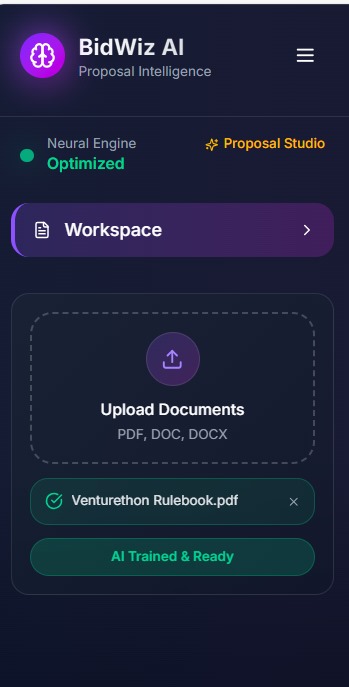
- Ingestion: It reads a company's internal knowledge base (PDFs, security policies, past bids) using local embedding models.
- Cognition: It uses Groq's LPU to run Llama 3.3 70B at lightning speeds, using Retrieval Augmented Generation (RAG) to find exact answers.
- Agentic Verification: A specialized "Critic Agent" reviews every answer for accuracy and tone compliance.
- Execution: It automatically compiles the answers into a professional PDF report and dispatches it via email to stakeholders.
How we built it
We prioritized a high-performance, Full-Stack architecture:
- Frontend: Built with React and TypeScript to ensure a responsive, type-safe, and enterprise-grade user interface.
- Backend API: We used FastAPI (Python) to create a robust REST API that handles document processing and logic.
- The Intelligence: We leveraged the Groq LPU Inference Engine running Llama 3.3 70B. This allowed us to achieve near-instant token generation, making the "Agentic Loop" feel real-time.
- Memory: Utilized FAISS vector stores for local, privacy-centric context retrieval.
- Automation: Integrated ReportLab for programmatic PDF generation and SMTP for email dispatch.
Challenges we ran into
- Full-Stack Integration: Connecting a modern React frontend with a Python AI backend presented CORS and data serialization challenges. We had to carefully design our API endpoints to handle file uploads and streaming responses efficiently.
- Hallucination Control: The biggest risk in B2B is the AI inventing facts. We solved this by implementing a "Critic Agent" Loop. Instead of showing the first draft, our system has a secondary agent that "proofreads" the output against the source PDF.
- The "Physical" Artifact: Most AI demos just output text. We struggled to make the output "real." We engineered a Python pipeline that converts AI text into a formatted, timestamped PDF document that looks like it came from a human consultant.
Accomplishments that we're proud of
We are proud that we moved beyond a simple "Streamlit Wrapper." BidWiz is a fully decoupled Client-Server application. We successfully integrated Groq, which allowed our complex RAG pipeline to run incredibly fast. Seeing the system autonomous draft, verify, format, and email a physical PDF without human intervention was our "Moonshot" moment.
What we learned
We learned that Latency Matters. By switching to Groq, the user experience improved dramatically compared to standard APIs. We also learned that User Experience (UX) in AI isn't just about the chat window, it's about the "Status Updates" (Drafting... Reviewing... Approved) in the React UI that build user trust in the system's logic.
What's next for BidWiz
We plan to evolve BidWiz from "Drafting" to "Dealing."
- CRM Integration: Connecting directly to Salesforce to pull customer context.
- Autonomous Negotiation: We are exploring "Agent Swarms" where our AI can interact with Procurement Bots to negotiate pricing and terms autonomously in real-time.
Built With
- faiss
- fastapi
- groq
- langchain
- llama-3
- python
- react
- reportlab
- rest-api
- typescript

Log in or sign up for Devpost to join the conversation.