-
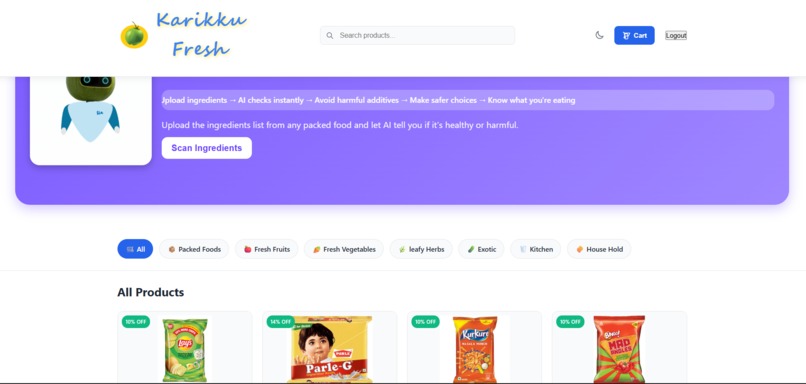
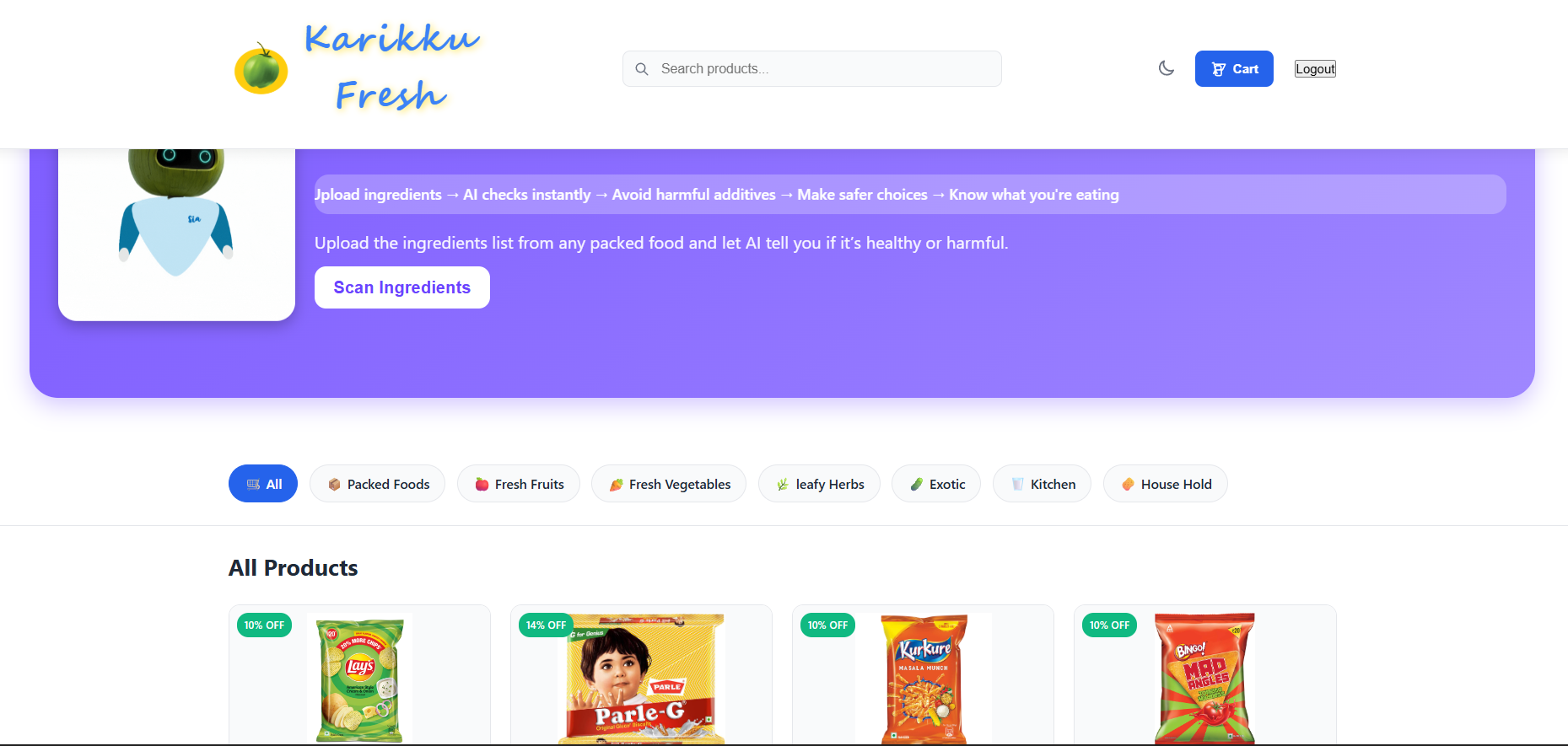
Karikku fresh front page
-
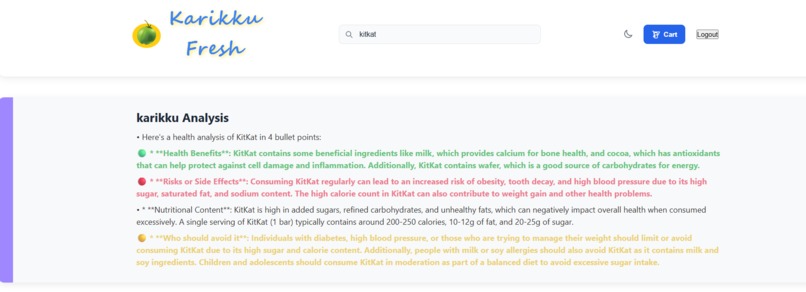
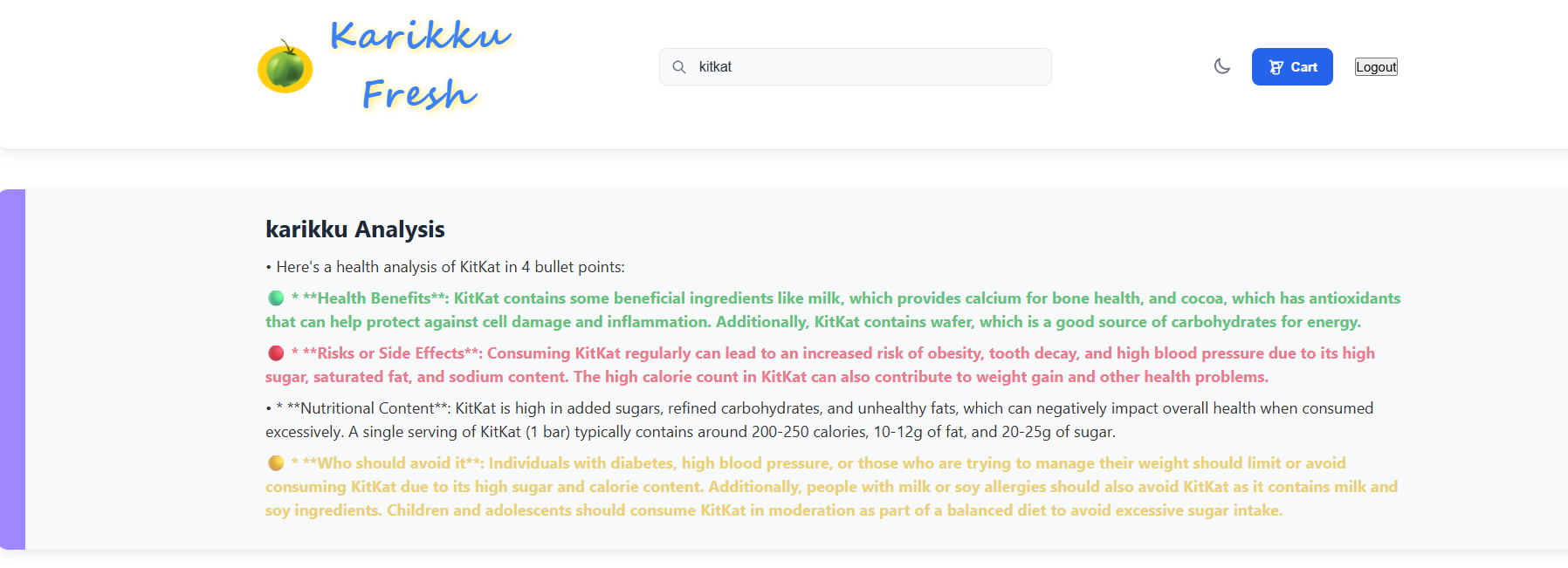
karikku fresh analysis
Karikku Fresh: Project Story
1. Inspiration
The idea for Karikku Fresh emerged from a simple everyday problem—while purchasing packaged food, most consumers struggle to understand ingredient labels. Many products contain preservatives, additives, and artificial substances, but the information is often complex and difficult to interpret.
This gap between available information and user understanding inspired the development of a system that not only allows users to shop online but also helps them make health-aware decisions. The goal was to combine e-commerce with artificial intelligence to create a smarter grocery platform.
2. What I Learned
Through the development of this project, I gained both technical and practical knowledge:
Full-Stack Development
Learned how to build and integrate frontend and backend systems using modern web technologies.API Integration
Understood how to work with external AI services for OCR and data analysis.Database Management
Gained experience in designing schemas and managing data using MongoDB.AI Application in Real Systems
Learned how OCR and NLP can be applied to solve real-world problems.System Design & Architecture
Understood how to structure applications using modular and scalable design patterns.
3. How the Project Was Built
The project was developed in a structured, phase-wise manner:
Step 1: Requirement Analysis
- Identified key features such as product browsing, cart management, and ingredient scanning.
Step 2: System Design
- Designed the architecture using a client-server model.
- Planned modules like authentication, product catalog, and AI scanner.
Step 3: Development
- Frontend built using HTML, CSS, and JavaScript.
- Backend developed using Node.js and Express.
- MongoDB used for storing user data.
Step 4: AI Integration
- OCR used to extract ingredient text from images.
- AI model used to analyze ingredients and generate health insights.
Step 5: Testing & Optimization
- Tested system accuracy, response time, and performance.
- Improved reliability and user experience.
4. Mathematical Representation
The system can be modeled as a multi-stage pipeline:
[ U = f_{\text{decision}} \big( f_{\text{AI}} ( f_{\text{token}} ( f_{\text{OCR}} (I) ) ) \big) ]
Where:
- ( I ) = Input image
- ( f_{\text{OCR}} ) = Text extraction function
- ( f_{\text{token}} ) = Text processing/tokenization
- ( f_{\text{AI}} ) = Ingredient analysis model
- ( f_{\text{decision}} ) = Final output (health insights)
5. Challenges Faced
1. OCR Accuracy Issues
- Difficulty in extracting text from low-quality or blurred images
- Variations in packaging design affected accuracy
2. AI Interpretation
- Handling complex ingredient names and generating meaningful insights
- Ensuring consistency in AI responses
3. API Integration
- Managing communication between backend and external AI services
- Handling delays and errors in API responses
4. System Performance
- AI processing increased response time
- Needed to optimize backend for multiple users
5. State Management
- Managing cart and user session using LocalStorage
- Ensuring synchronization between UI and stored data
6. Conclusion
This project successfully demonstrates how artificial intelligence can be integrated with e-commerce to solve real-world problems. It not only provides a functional shopping platform but also empowers users with knowledge about the products they consume.
Karikku Fresh represents a step toward smart, health-aware digital systems, showing the potential of combining AI with everyday applications.

Log in or sign up for Devpost to join the conversation.