KareMate AI
02:07, Saturday
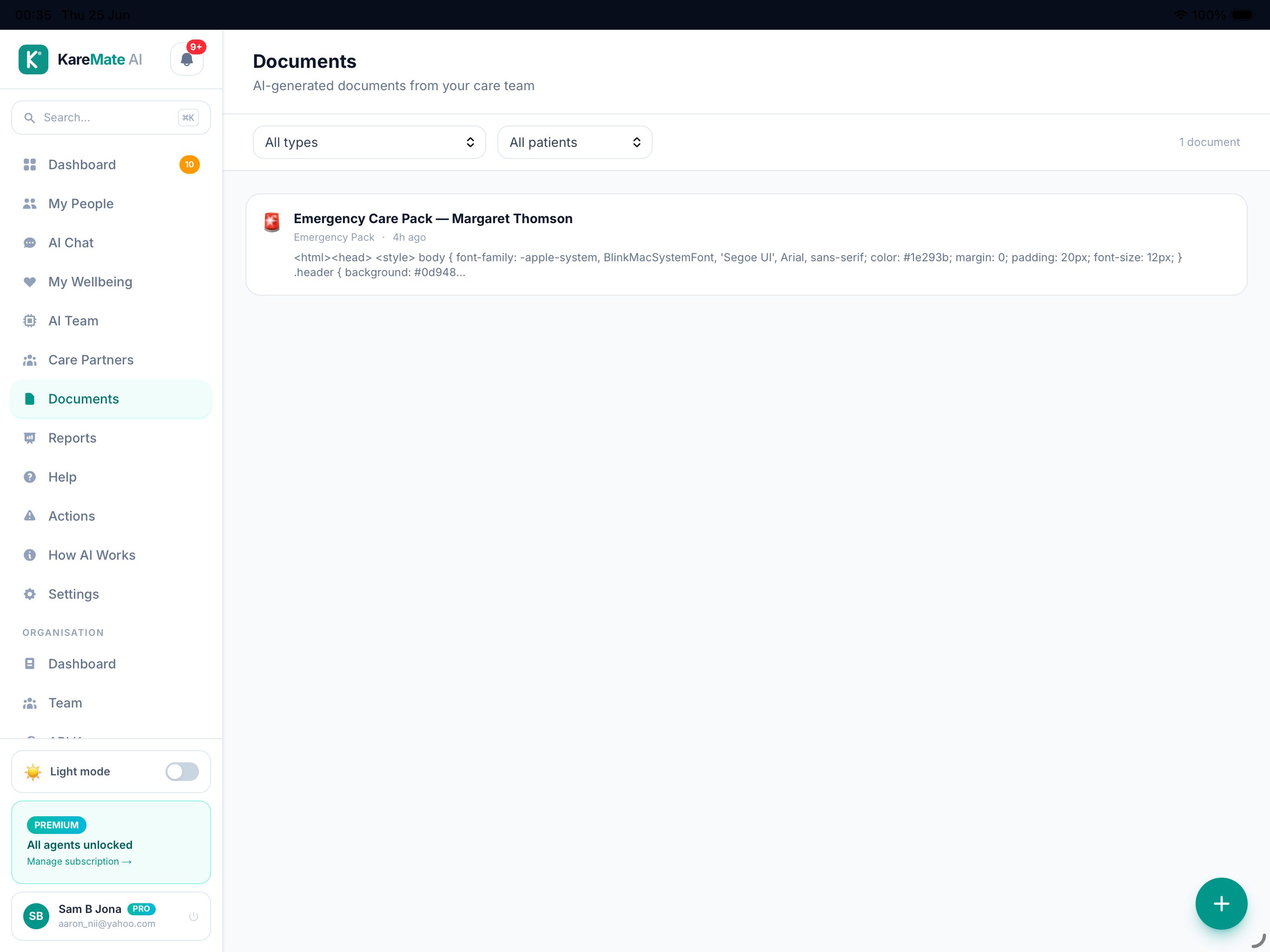
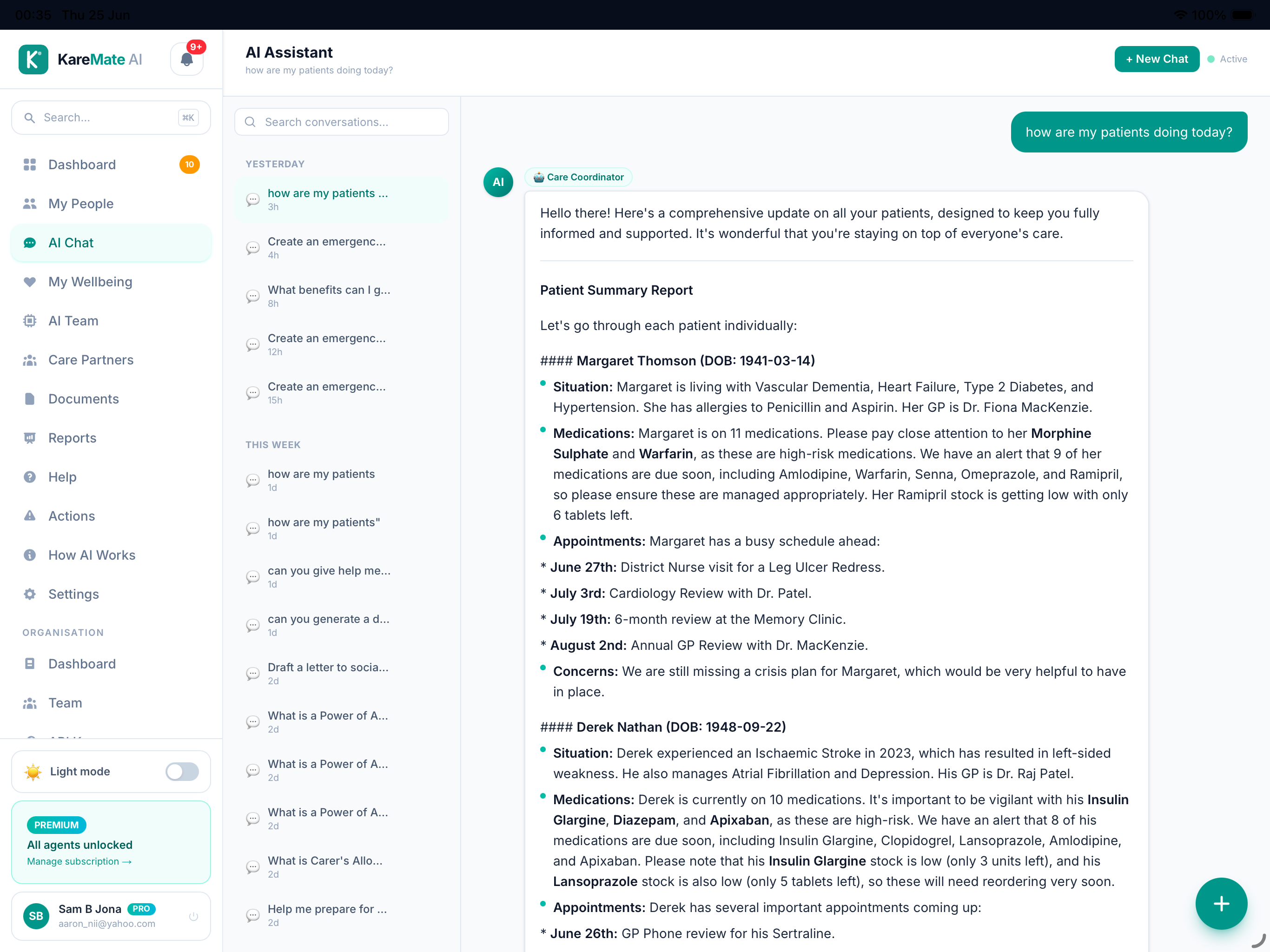
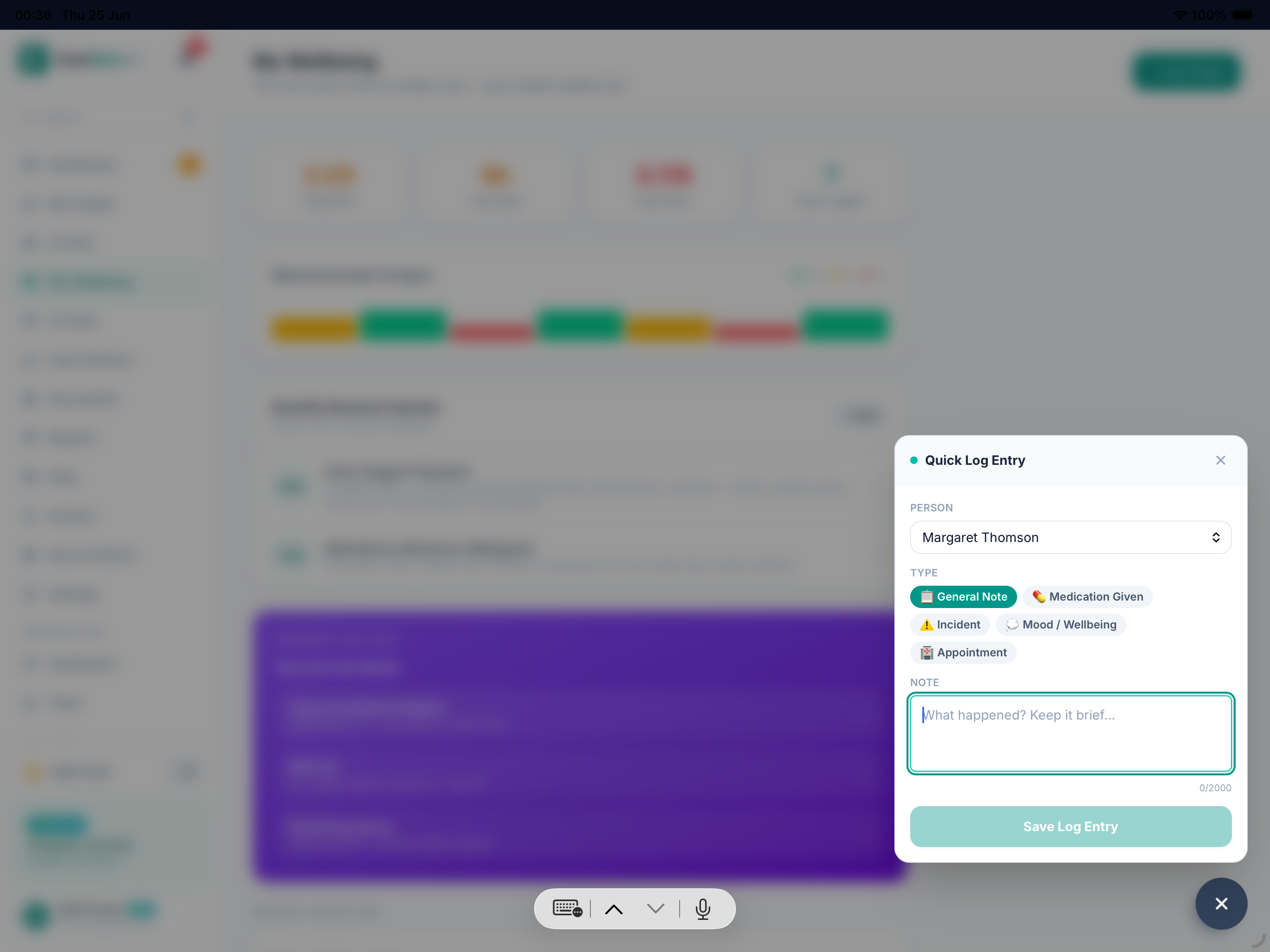
At seven minutes past two on a Saturday morning in July, someone in Scotland asked KareMate for an emergency pack: one page containing their mother's medications, conditions, allergies and GP details, ready to hand to A&E.
The Documentation Officer produced it. The request is in our production logs.
That moment captures why we built KareMate.
Professional care coordination, including welfare-rights support, social-work navigation, discharge planning and clinical documentation, is constrained by the number of qualified people available. When professional capacity runs out, the coordination does not disappear. It falls to families.
In Scotland, an estimated 694,000 people provide unpaid care. They manage medications, appointments, benefits, hospital transitions, records and deteriorations, often without training and while dealing with the emotional reality of caring for someone they love. The estimated economic value of unpaid care in Scotland is £15.9 billion per year.
We were inspired by a simple question: what if AI could increase access to the professional coordination surrounding care, rather than simply give carers another chatbot to talk to?
So we built the service itself and staffed it with AI agents.
What we built
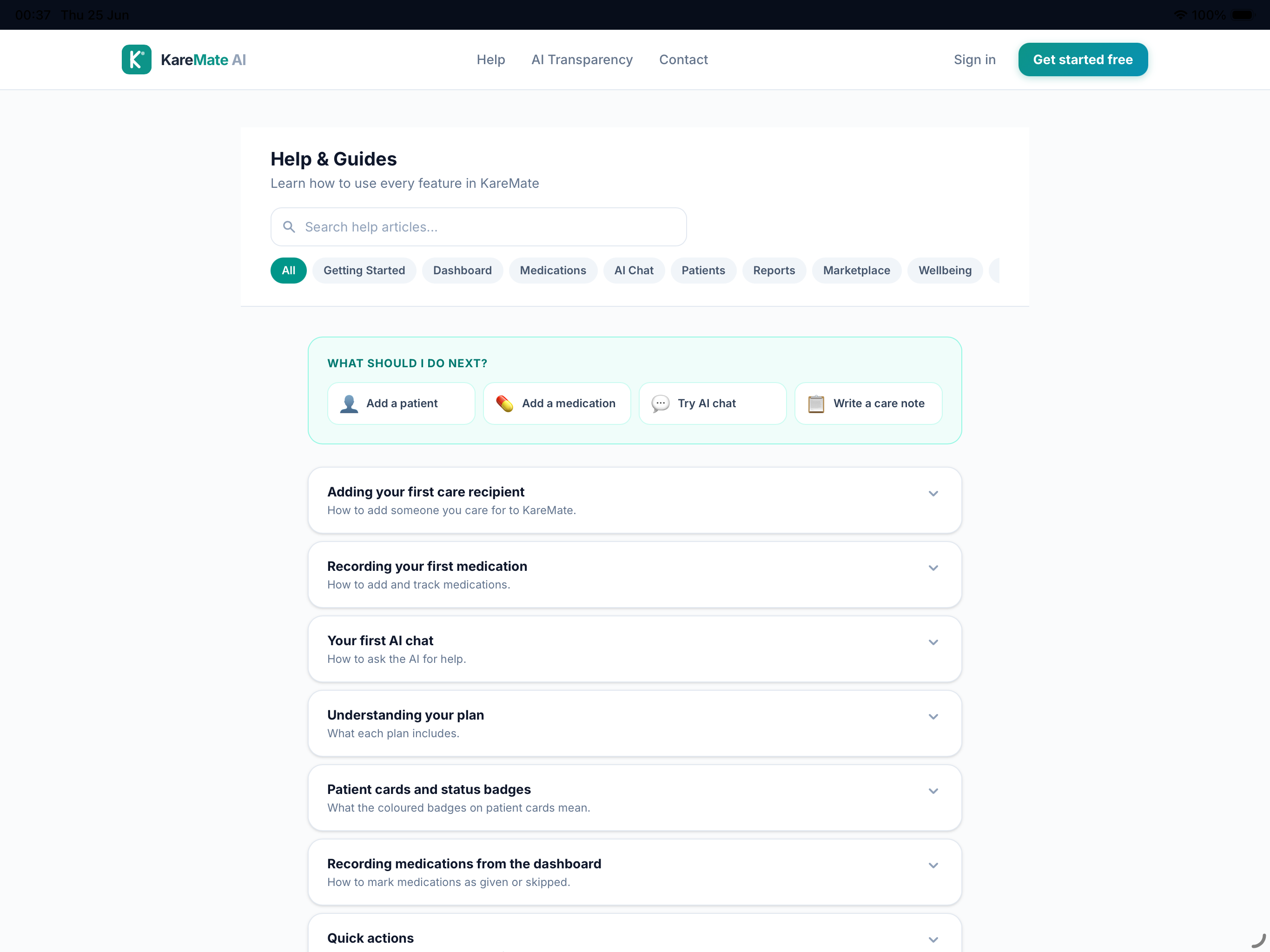
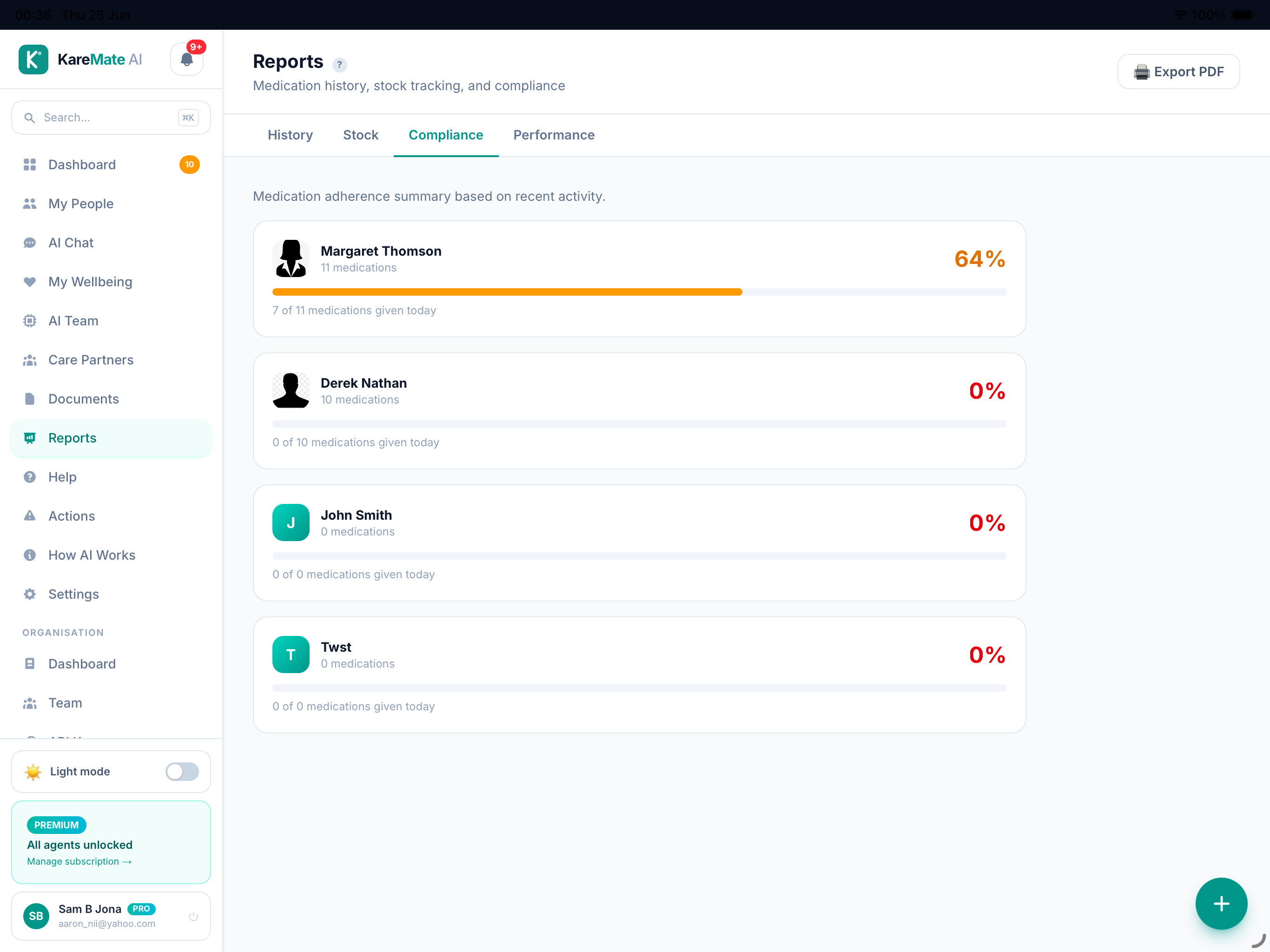
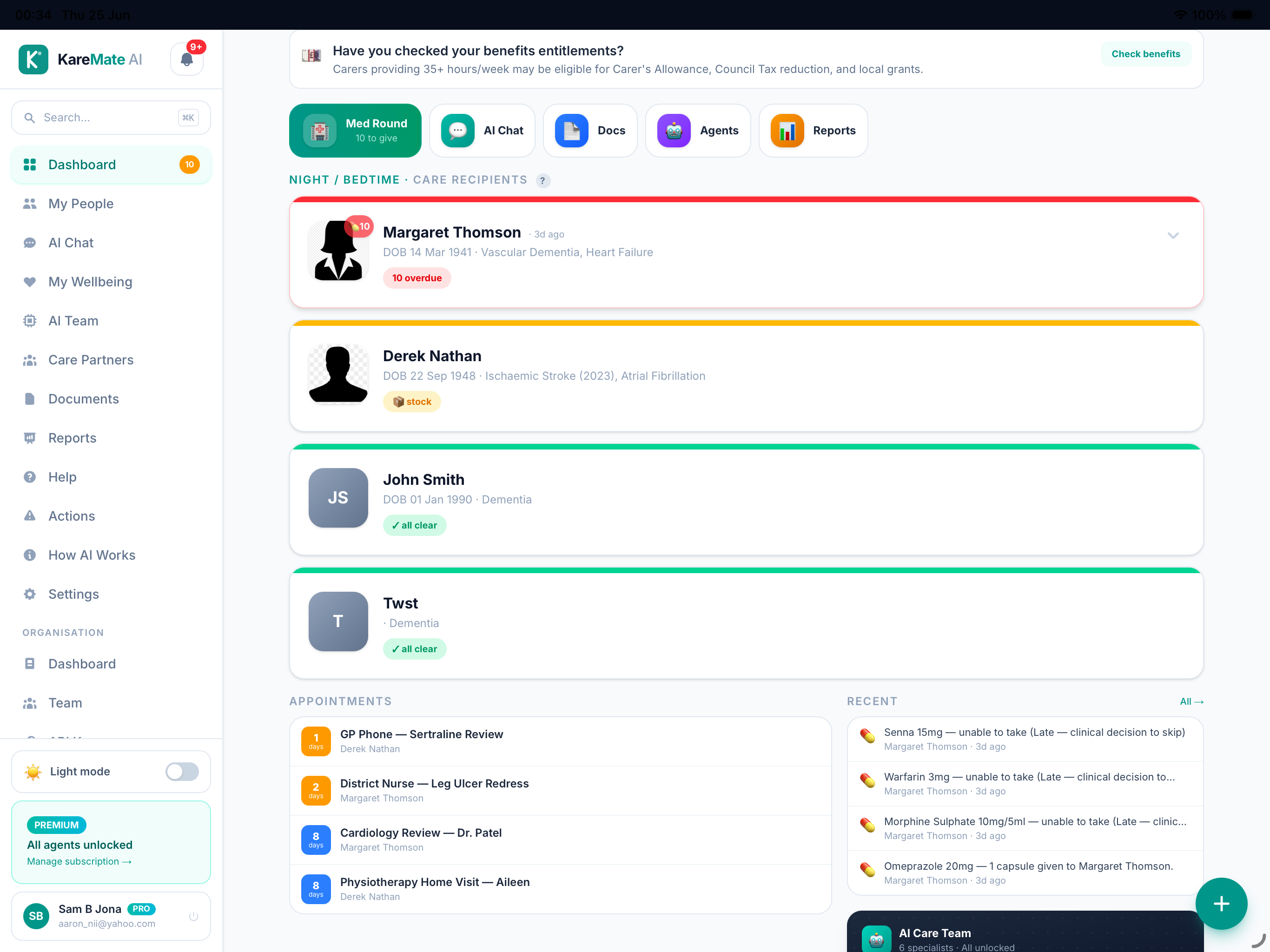
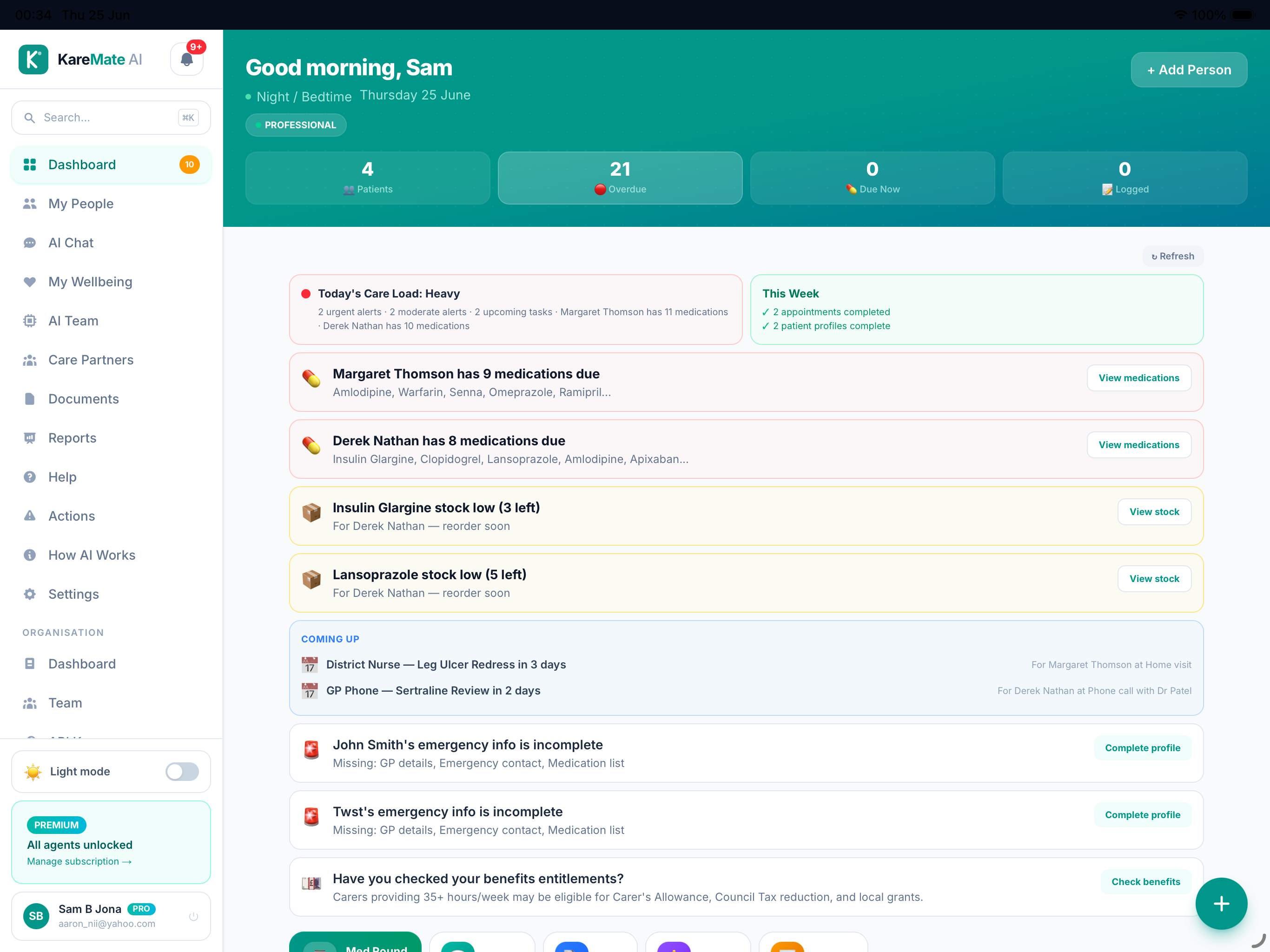
KareMate is an AI-native care coordination platform powered by Gemini 2.5 Pro through Vertex AI.
Fourteen specialised agents form the workforce.
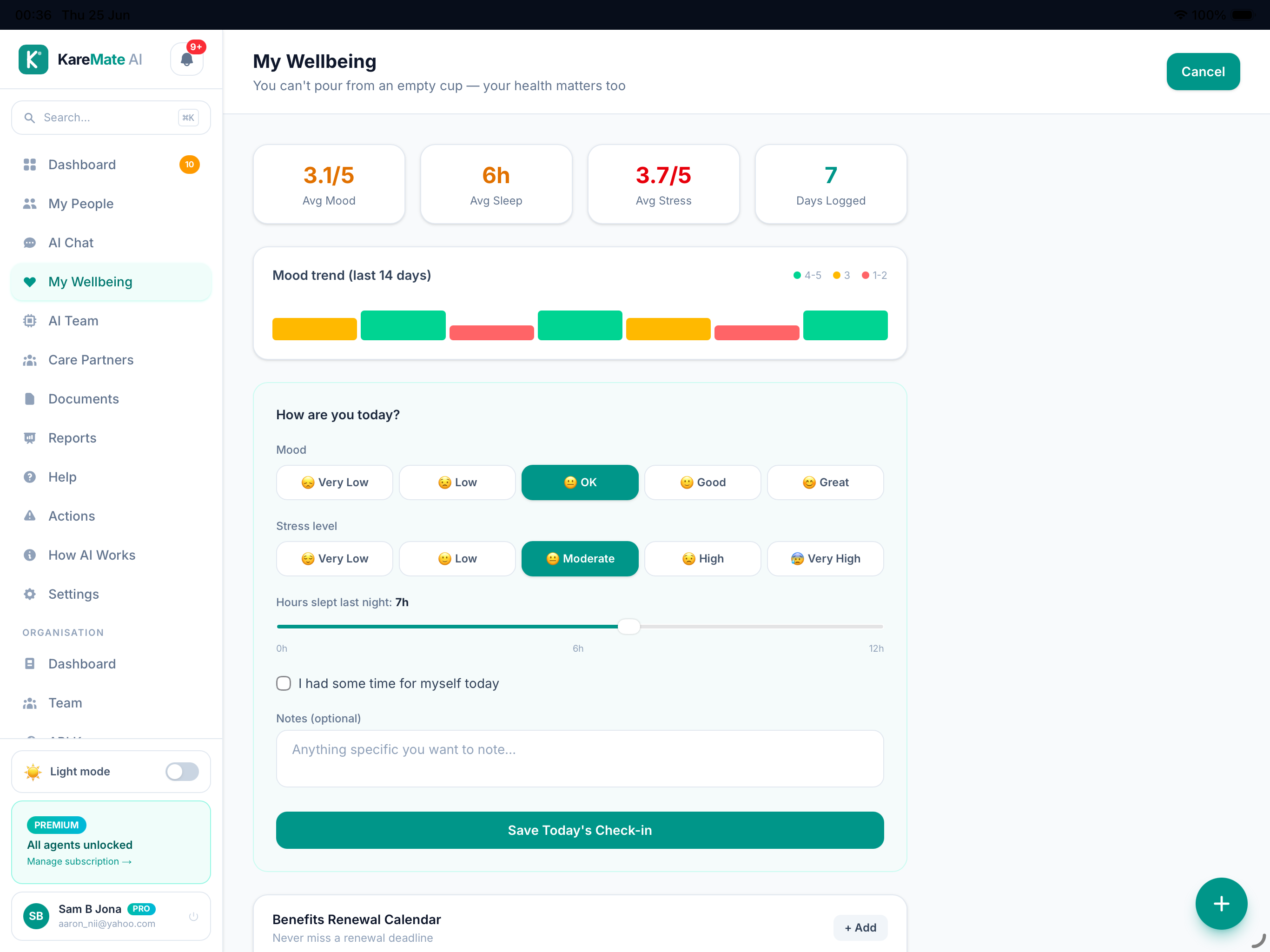
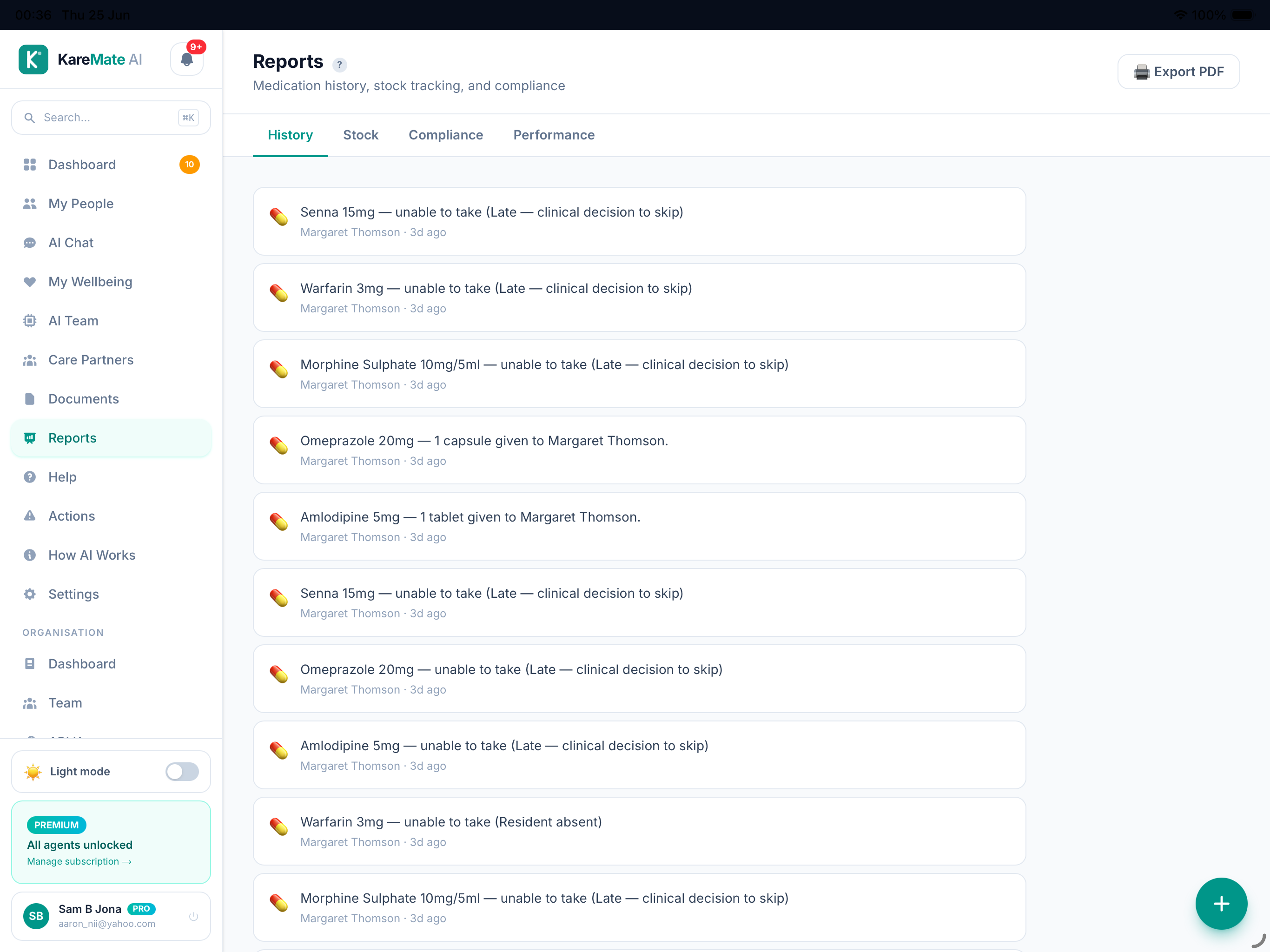
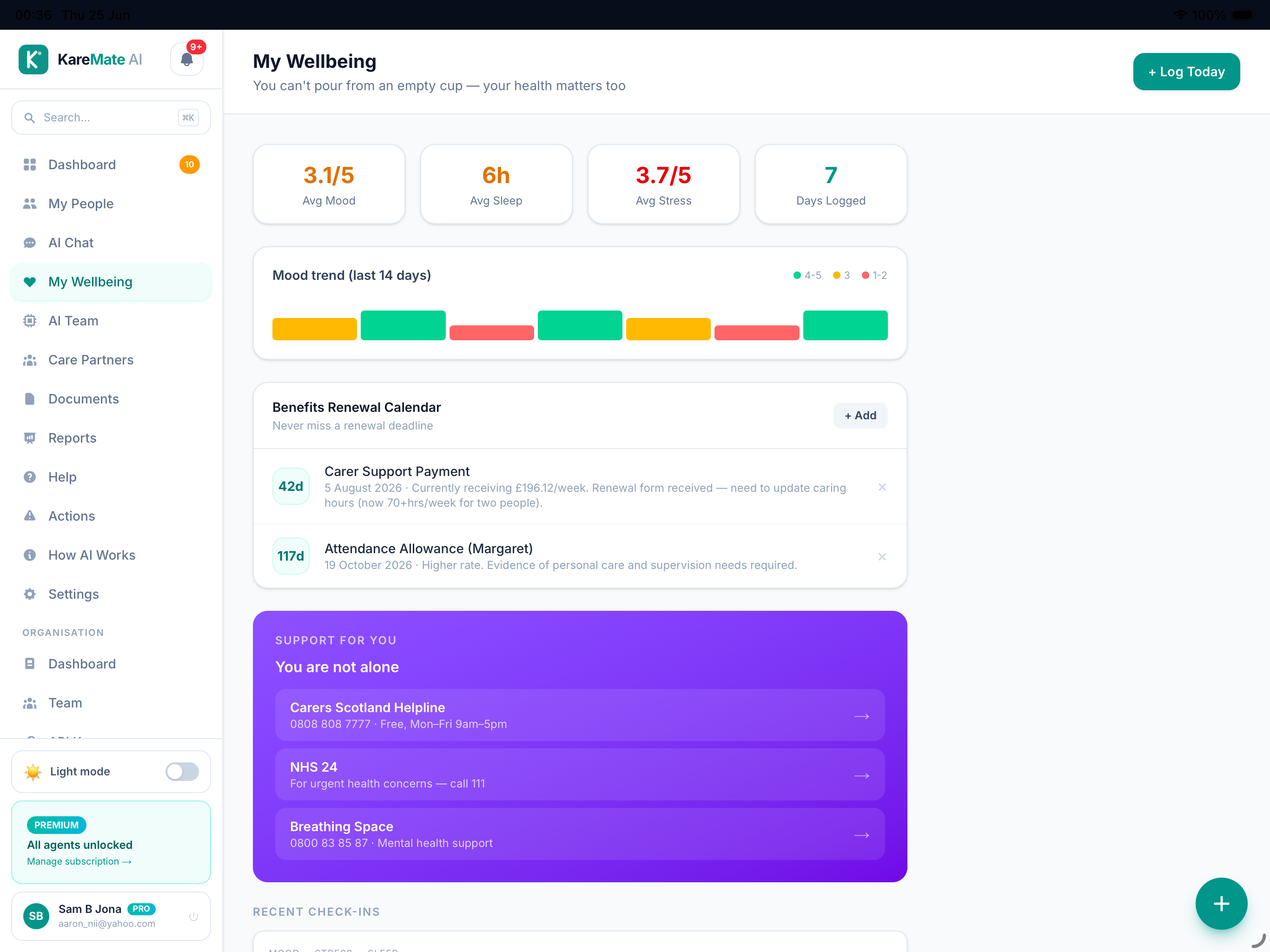
Ten are focused on care. A Supervisor interprets requests and routes them to the appropriate specialists. A Benefits Caseworker works with retrieved Scottish social-security information. A Documentation Officer turns fragmented care records into structured handovers and emergency packs. Other agents specialise in navigation, discharge, crisis support, wellbeing, care-partner coordination, family coordination and feedback.
Four additional agents help operate the business itself. The Growth Officer researches potential partners and prepares outreach. The Customer Success Officer evaluates account health and churn risk. The Revenue Officer analyses subscription data and prepares business briefings. The Marketing Officer develops content and imagery.
This became one of the most important lessons of the project: AI did not have to exist only inside the product. It could become part of the operating model of the company delivering it.
What humans still do
Building an autonomous service also forced us to decide what AI should not control.
Humans set the safety boundaries, approve consequential external actions and retain accountability where professional judgement is required.
Critical safety decisions are therefore not delegated to Gemini.
Every relevant message passes through a deterministic risk engine. When an emergency threshold is reached, escalation executes unconditionally in code. The LLM cannot override it. In our evaluation suite, all 221 emergency scenarios escalated, with zero false escalations from lower-risk scenarios in that test set.
A separate confidence gate provides another layer of protection. Approximately 16% of evaluated interactions reach a human-review threshold by design, while approximately 13% of inputs are refused by guardrails.
We learned that the most useful question was not "How autonomous can we make this?" It was "Where should autonomy stop?"
A day inside an AI-native business
KareMate runs on Google Cloud.
Cloud Scheduler activates autonomous workflows using Google-issued OIDC authentication. Cloud Run executes them, Cloud SQL maintains persistent state, and Gemini provides the reasoning layer.
The Revenue Officer can retrieve subscription information, calculate business metrics and generate an executive briefing without the founder initiating the workflow.
The Growth Officer researches prospective carers' centres, councils, NHS networks and care providers, scores their partnership potential and drafts personalised approaches that wait for human approval.
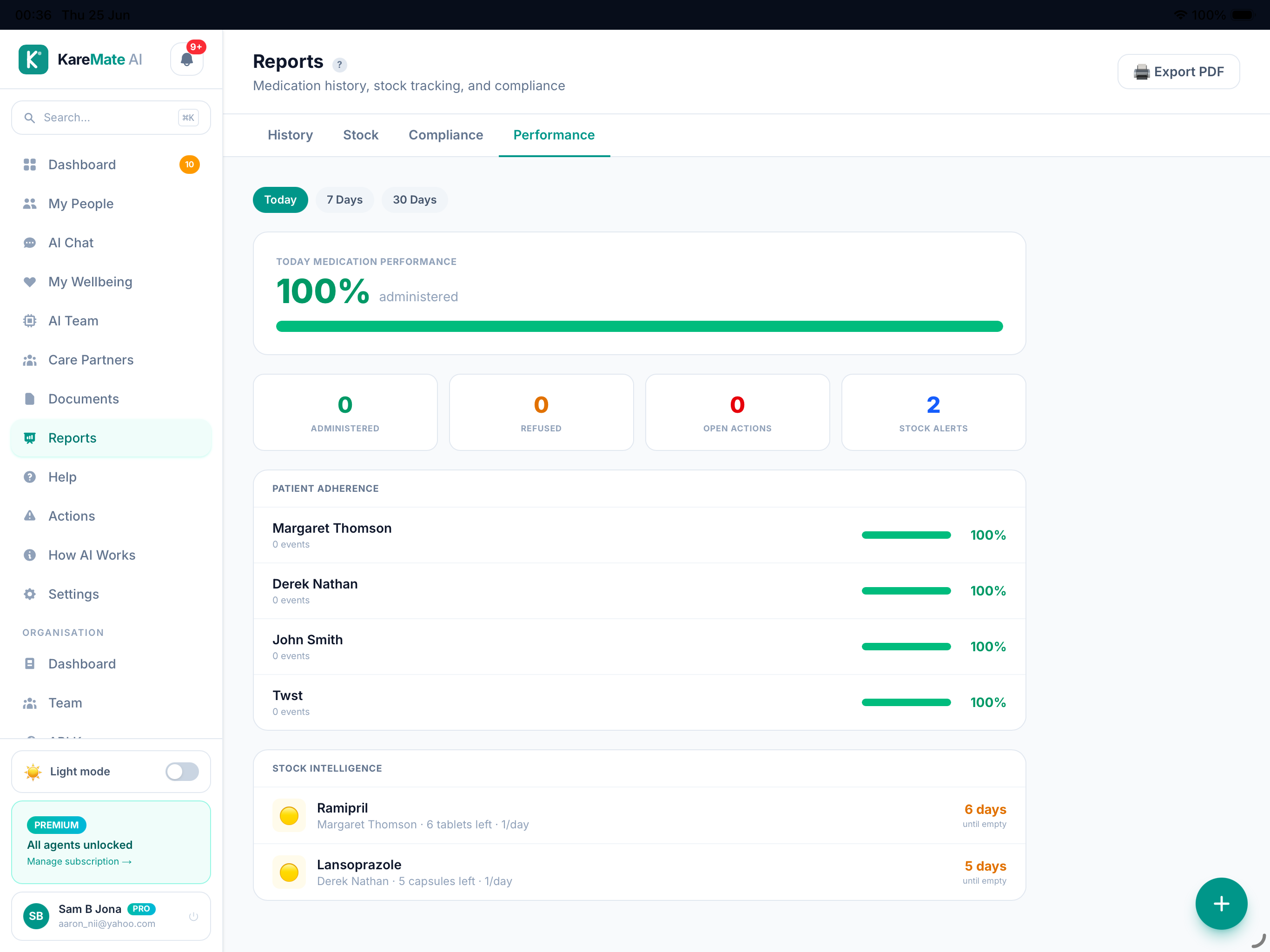
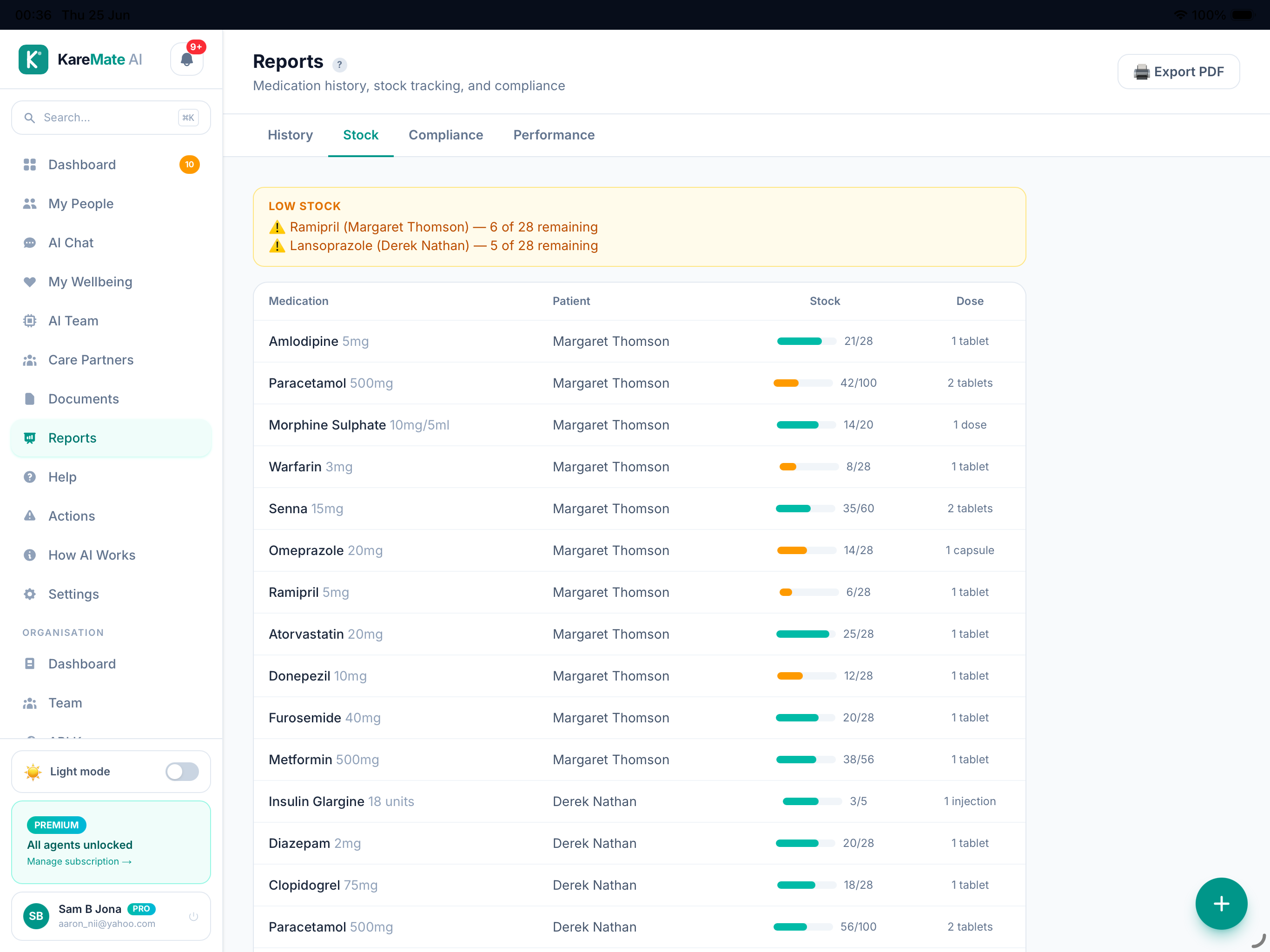
Medication-reminder workflows process 96 scheduled reminders per day.
When a carer asks for help, the Supervisor determines which specialist should respond, sometimes coordinating multiple agents when a situation crosses professional boundaries.
Across 56 active production days, our operational audit trail recorded 481 agent actions. 467, or 97.1%, were performed by agents and 14, or 2.9%, by a human. Every recorded human action was an approval. The scheduler recorded 56 complete autonomous daily cycles.
The Growth Officer identified and scored 100 prospective organisations and prepared 50 outreach drafts.
This changed the founder's role from executing every operational task to supervising the systems that execute them.
What was difficult
The most valuable lessons came from things that failed.
We discovered that our agent execution logger had been writing to a relative path on Cloud Run's ephemeral filesystem. Deployments destroyed those records. The agents had executed, but much of the evidence had disappeared.
We rebuilt the instrumentation around durable structured logging and an append-only operational audit trail.
We also discovered that a daily briefing had silently fallen back to a template for 30 consecutive days because it called a method that did not exist. Hundreds of automated tests had not exposed the problem. Production observation did.
During the hackathon we also identified an outdated Vertex AI SDK dependency and migrated the application to the supported Google Gen AI SDK.
Those failures changed how we think about AI-native systems. A passing test suite does not prove that autonomous agents are doing what their designers believe they are doing. Observability, auditability and production evidence have to be treated as product features.
What AI makes possible
The constraint in Professional Services Access is often human capacity.
A professional can only manage a finite caseload. Traditional service businesses therefore increase capacity primarily by adding people.
KareMate changes that relationship. Once the infrastructure exists, serving another carer primarily requires additional inference and compute rather than a proportional increase in professional headcount.
That does not mean replacing professionals.
Our goal is to automate the coordination and administrative work around them so scarce professional time can be concentrated on cases requiring human expertise, judgement and accountability.
We have also built the foundations of a Care Partner Marketplace where professionals and providers could receive AI-matched referrals, manage families and record services. The hypothesis is that reducing the administrative burden around each case could allow professionals to support more families.
That remains a hypothesis. No provider has yet earned income through the marketplace.
What we can prove
We can prove that the software is deployed.
We can prove that autonomous agents execute in production.
We can point to 481 recorded operational actions, 56 complete autonomous daily cycles, 100 organisations researched and scored, 50 outreach drafts, production safety evaluations and the emergency pack generated at 02:07.
We can also regenerate our principal operational evidence from the underlying records.
But this project taught us to be equally precise about what we cannot prove.
We currently have ten friends-and-family accounts using complimentary access. They are not arms-length customers and generated $0 revenue during the hackathon. We therefore do not claim product-market fit.
We do not have a control group demonstrating that KareMate improves carers' long-term outcomes. We cannot yet say that someone experienced less burnout because of KareMate, or that an intervention prevented a hospital admission.
Those are outcomes we need to measure, not infer.
What comes next
The next phase is about turning technical capability into measured impact.
We will instrument carer outcomes and establish baselines so that claims about time saved, coordination burden and wellbeing can be supported by observed evidence.
We will test whether the partnership pipeline created during the hackathon can acquire carers with no relationship to the founder.
We will measure whether those users remain engaged and eventually pay for the service.
And as the organisation grows, we will add human clinical and safety accountability rather than pretending agents can replace it.
The biggest thing we learned during this project is that building autonomous AI is not primarily about giving a model more authority.
It is about deciding precisely where AI should act, where deterministic systems should take control, where humans must remain accountable, and then recording enough evidence to know whether those boundaries actually worked.
At 02:07 on a Saturday, someone needed a page they could take to A&E.
KareMate produced it.
We have proved that the system can be there at 02:07.
The next challenge is proving what that availability changes in someone's life.
¹ Scottish Government, Scotland's Carers Update Release, 12 March 2025. Estimated 694,000 unpaid carers in Scotland based on Scottish Health Survey 2019–2023 data.
² Carers Scotland and Centre for Care, Valuing Carers 2022: Scotland, published 21 November 2024. Estimated annual value of unpaid care in Scotland: £15.9 billion.
Built With
- ai-agents
- capacitor
- chromadb
- cloud-run
- cloud-scheduler
- cloud-sql
- fastapi
- firebase
- gemini
- gemini-api
- google-cloud
- imagen
- ios
- multi-agent
- next.js
- postgresql
- python
- rag
- react
- sqlalchemy
- stripe
- tailwindcss
- typescript
- vertex-ai


Log in or sign up for Devpost to join the conversation.