-

Home
-
Screens

Inspiration
In California, a mother loses her life to pregnancy-related complications every 5 days. Cardiovascular disease is the leading cause of these deaths, yet 80% of them are preventable. Furthermore, developing high blood pressure during pregnancy translates to a 63% increased risk of future cardiovascular issues.
We built Kardia for the "Heart Health at Warp Speed" track to directly answer the Office of the California Surgeon General's call to use pregnancy and postpartum care as critical intervention windows for long-term heart health. While there are countless generic fitness trackers, very few are built strictly around clinical maternal standards (ACOG guidelines). We wanted to give expecting mothers a tool that provides premium, high-fidelity data visualization purpose-built to track vital maternal health metrics and identify clinical red flags before they become emergencies, bridging the gap between home-monitoring and medical visits.
What it does
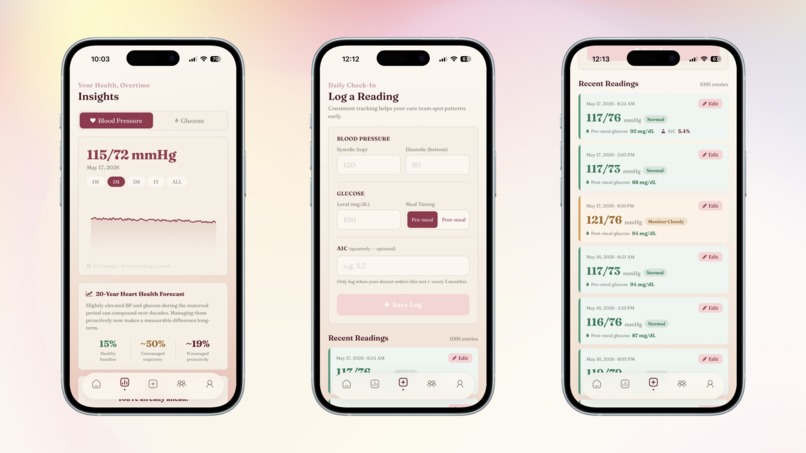
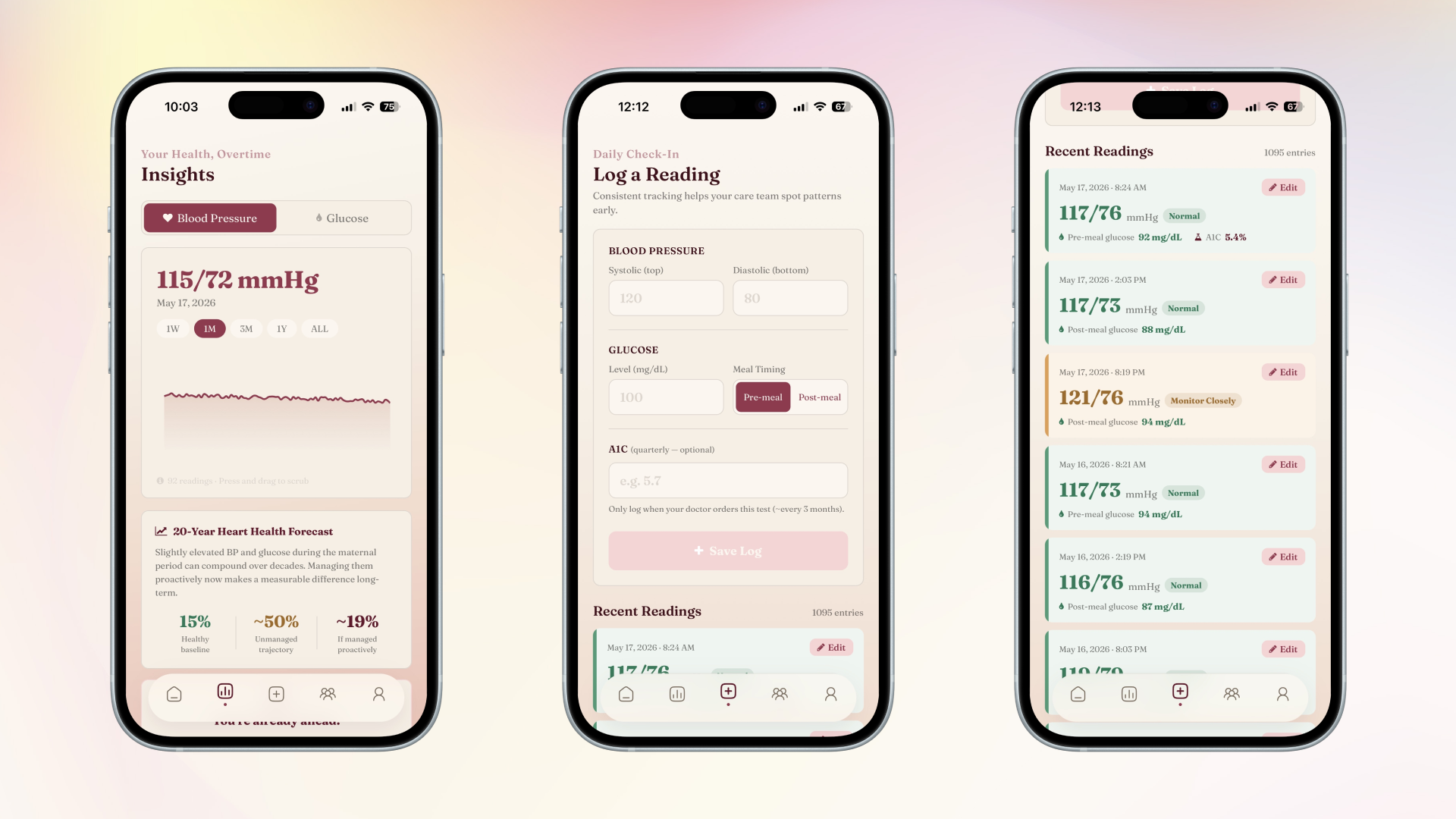
Kardia is a comprehensive maternal health monitoring application designed to track short-term vital metrics and project long-term cardiovascular health.
- The Translation Engine: Kardia doesn't just log numbers; it interprets your latest blood pressure and glucose readings, explaining exactly what they mean based on ACOG guidelines to remove the anxiety and confusion from medical data.
- Long-Term Insights Dashboard: Using logged trends (BP, glucose, A1C), the app features a visualizer that projects 10-to-20-year cardiovascular risks, treating maternal health as a predictor for lifelong heart health.
- Automated Advocacy Scripts: The app automatically generates custom, doctor-ready scripts based on the user's recent health readings, ensuring mothers are equipped to effectively communicate symptoms and advocate for themselves in clinical settings.
- Advanced Data Visualization & Pro Metrics: A deeply interactive line chart allows users to smoothly scrub through their dense health data across multiple timeframes (1W, 1M, 3M, 1Y, ALL) to spot long-term physiological trends. Users can tap BP readings to instantly toggle to Mean Arterial Pressure (MAP)—the precise metric clinicians use to assess organ perfusion.
How we built it
We built the frontend in React Native utilizing the Expo SDK 54 framework and Expo Router for file-based routing.
- Authentication: We integrated Clerk (
@clerk/clerk-expo) to handle secure user sessions. - State Management: To ensure the Home, Log, and Insights tabs all share real-time synchronized data, we centralized our health arrays using the React Context API (
HealthContext). - UI & Data Viz: The core visual experience was engineered using
react-native-gifted-chartsfor sweeping data curves, combined withexpo-blurto achieve authentic iOS-style glassmorphism and@hugeicons/reactfor our minimalist, calming iconography.
Challenges we ran into
- Time-Series Data Mapping: Building the interactive chart filters (1W, 1M, etc.) was incredibly tough. We ran into silent failures with
NaNdate parsing and chronological sorting issues. We had to build a robust data pipeline that mathematically calculated Unix timestamp cutoffs to safely filter and map complex, multi-metric data objects without crashing the charting library. - Maternal Physiological Accuracy: We realized early on that "normal" adult blood pressure is completely different from a pregnant woman's baseline. We had to engineer a custom data generation algorithm that accurately simulated how a mother's BP naturally drops in the second trimester before potentially spiking in the third, ensuring our app's logic matched clinical realities.
- Custom UI Engineering: Getting the floating "liquid glass" navigation bar to look and behave like a native iOS component required deep-diving into absolute positioning, z-indexes, and dynamic padding to ensure the scrollable health data perfectly blurred underneath it without clipping.
Accomplishments that we're proud of
- Successfully addressing the core mission of the "Heart Health at Warp Speed" track by connecting immediate pregnancy vitals to long-term cardiovascular prevention.
- Nailing the continuous, sweeping data visualization. We successfully transformed sparse, jagged data points into beautiful, smooth Bezier curves that feel incredible to interact with.
- Engineering the Advocacy Script feature. It's one thing to show users their data, but providing them with the exact medical phrasing to take to their OB/GYN empowers them to demand a higher standard of care.
What we learned
- The devastating reality of maternal mortality statistics and how highly preventable cardiovascular issues are when caught early during the pregnancy window.
- How to manage, parse, and synchronize complex chronological data streams across multiple tabs using React Context in React Native.
- Deep domain knowledge regarding maternal health standards (ACOG), gestational hypertension, and how different medical metrics like MAP are utilized by doctors.
What's next for Kardia
- PDF Data Export: Finalizing a feature in the Profile tab to compile the user's historical charts into a clean PDF or CSV report that can be handed directly to an OB/GYN during clinical checkups.
- Expanding the Community Hub: Launching the Reddit-style forum where expecting mothers can connect over specific conditions (e.g., "Postpartum BP", "Gestational Diabetes") and share anonymized health charts to find solidarity.
- Bluetooth Integration: Adding BLE (Bluetooth Low Energy) support to automatically ingest readings from modern smart blood pressure cuffs, eliminating manual data entry.


Log in or sign up for Devpost to join the conversation.