
Inspiration
Companies want AI agents to pay contractors, move treasury funds and run recurring payments. Today there are two bad options. You hand the agent a hot wallet key, or a human signs every transaction and the automation is pointless.
There is a quieter problem too. Agents are software, and software ships updates. When version 2 asks for more spending power than version 1, most setups just let it inherit the old wallet access. Nobody reviews the change, because nothing forces a review.
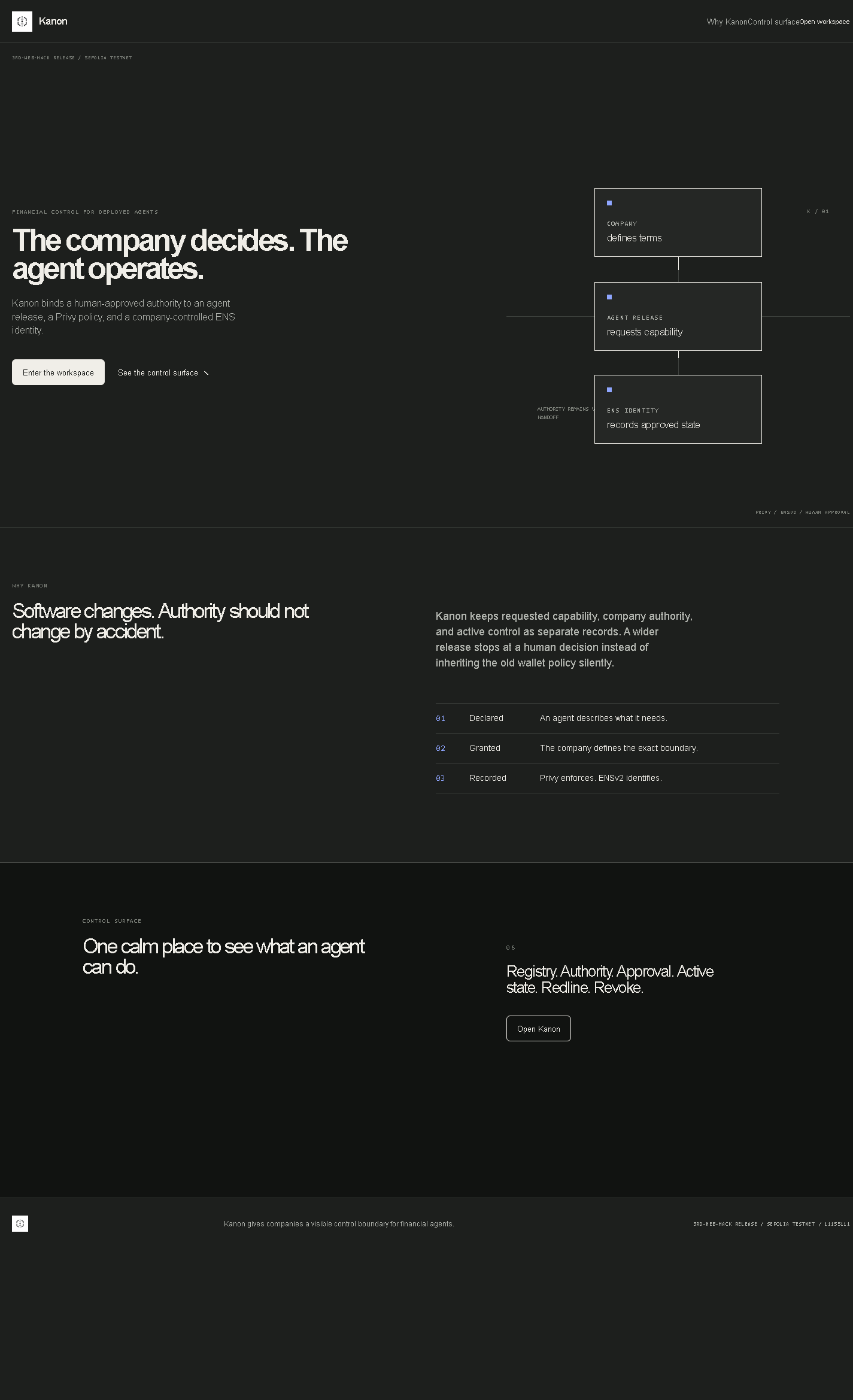
We wanted a control layer where a human approves an exact authority boundary once, the agent works freely inside it, and any broader release stops until a human looks at the difference
Problem
A financial agent needs real wallet authority to be useful. That creates three unsolved problems for the business running it:
- Unbounded keys. Backend hot wallets give an agent far more authority than its task needs, and application-level checks can be bypassed by a bug or a prompt injection.
- Silent escalation. A new agent release can request broader authority than the one the company approved, and nothing ties the approval to a specific release.
- No public, company-controlled identity. Outsiders cannot check which agent is acting for a company, which release was approved, or whether its authority has been revoked.
Solution
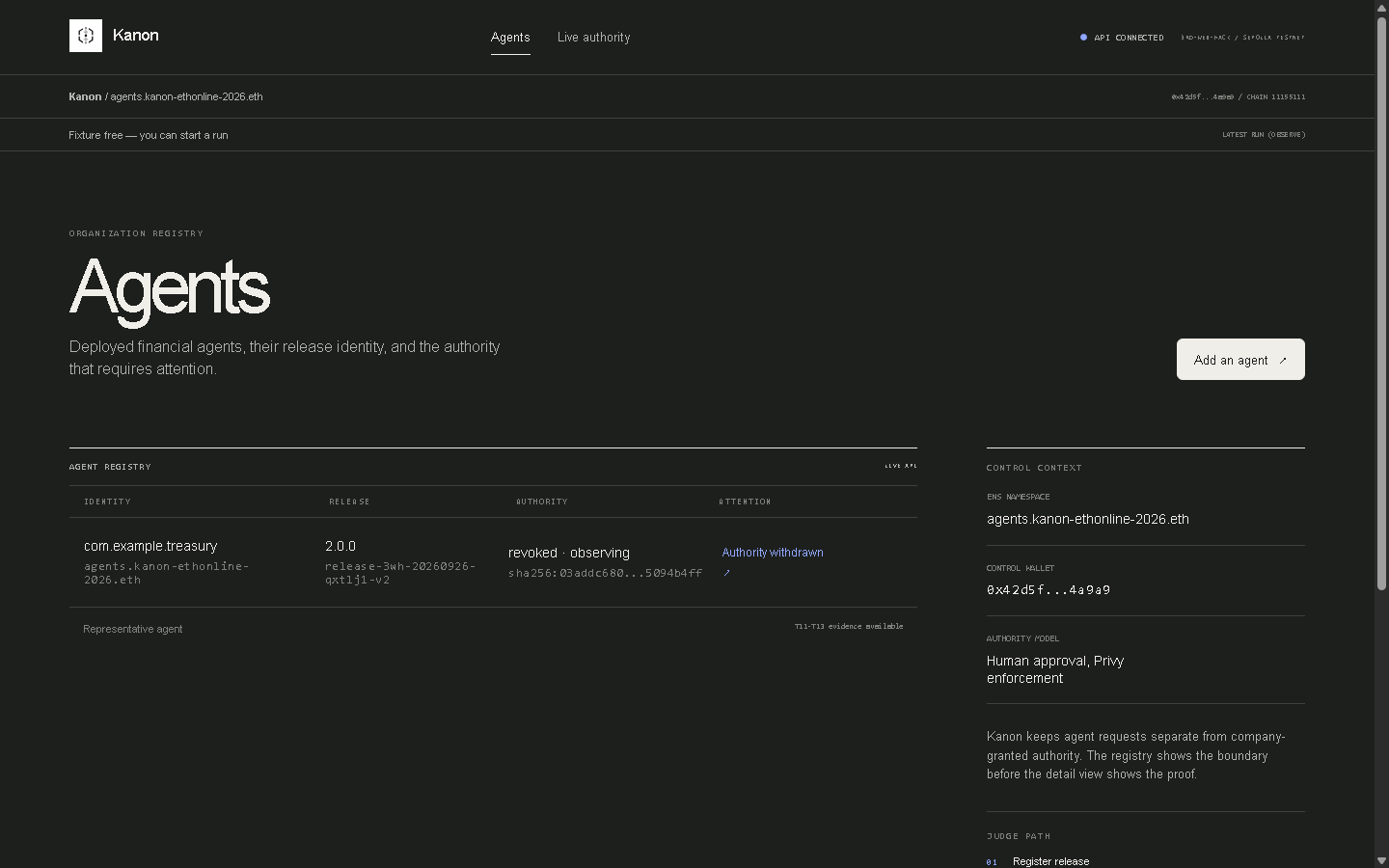
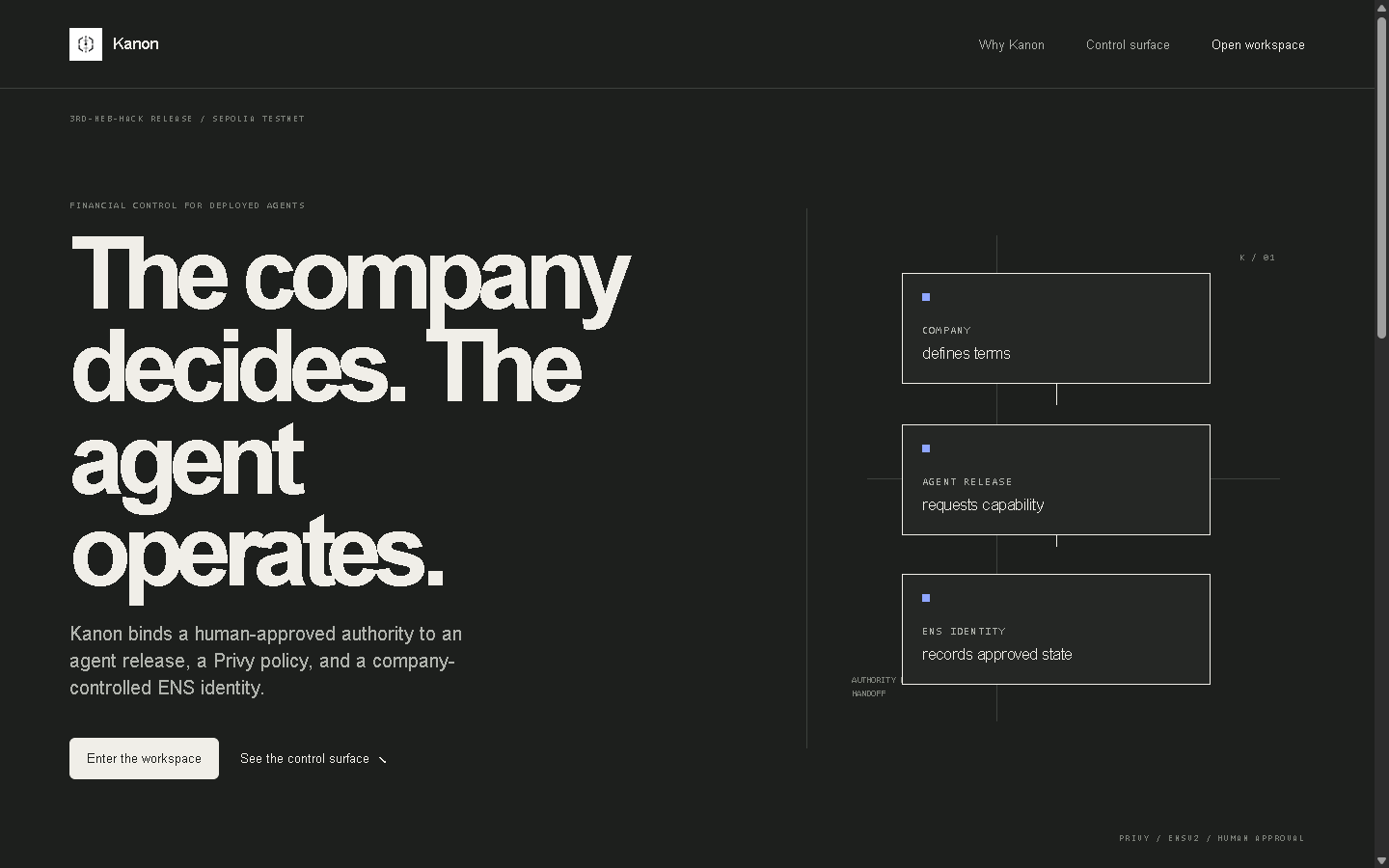
Kanon is a business agent-control runtime. It sits between the company, the agent release, a Privy wallet and an ENSv2 identity.
- The agent release declares the capabilities it wants. That declaration never grants anything.
- The company defines the terms it is willing to grant: recipient, per-action ceiling, rolling spend ceiling.
- Kanon normalizes those terms and computes a deterministic
permissionHash. - A human approves that exact hash, bound to the release, package and manifest hashes.
- Kanon compiles the approved terms into a Privy signer-specific policy and attaches a dedicated delegated signer. The company keeps wallet ownership. Privy enforces the boundary on every transaction.
- Kanon writes the approved release,
permissionHashand status to the agent's ENSv2 name under the company namespace, where only the company's writer role can change them. - When a new release asks for more, Kanon classifies the change as
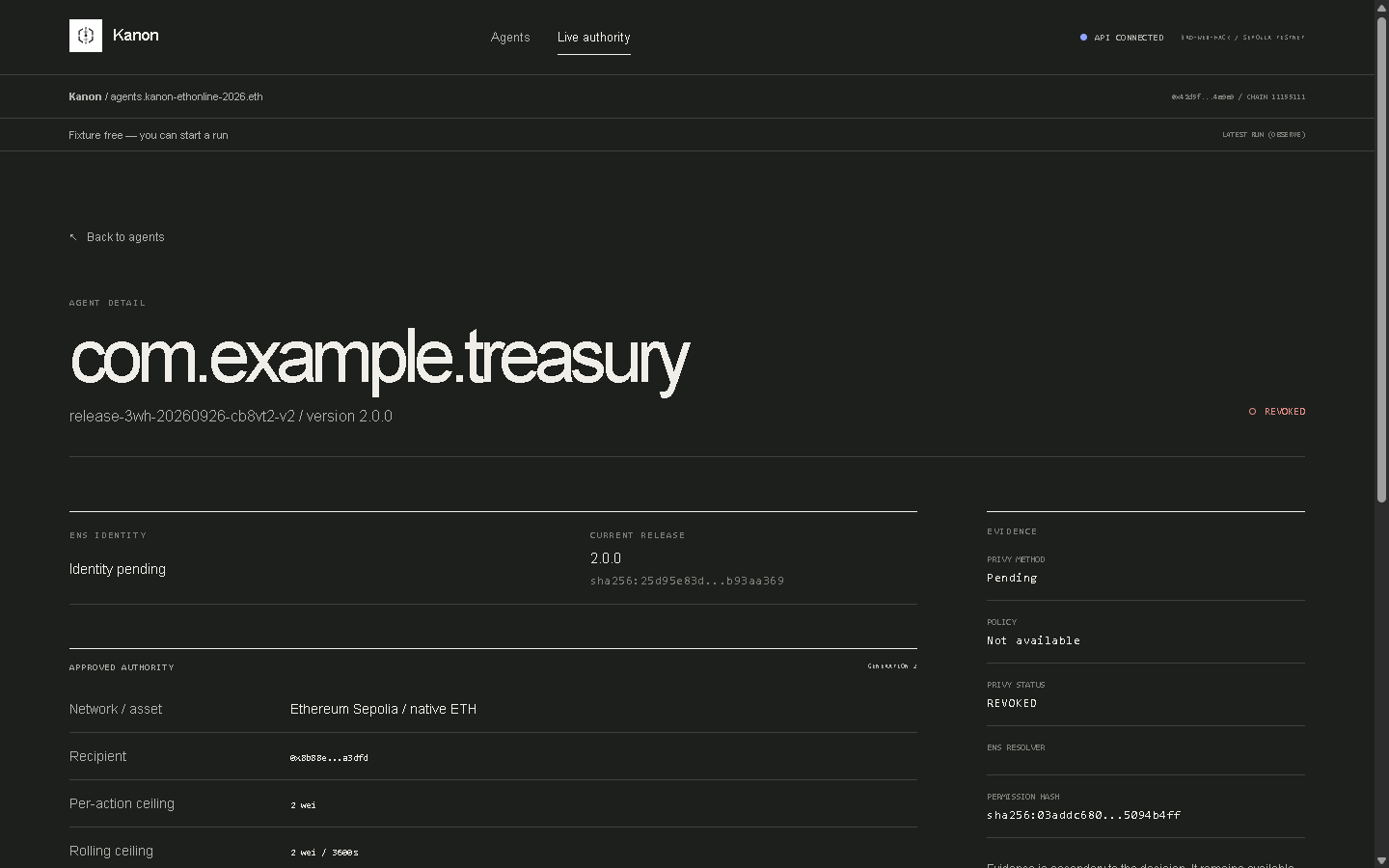
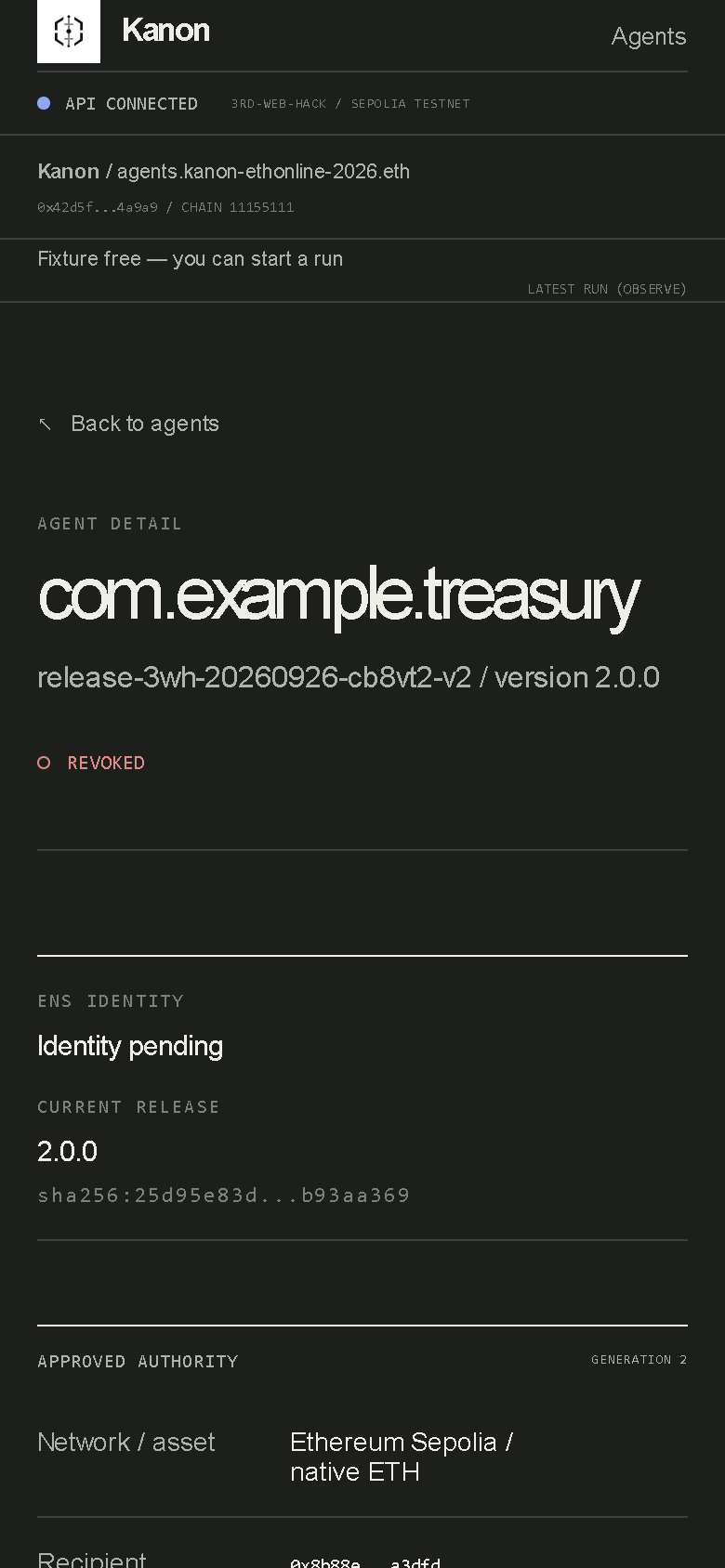
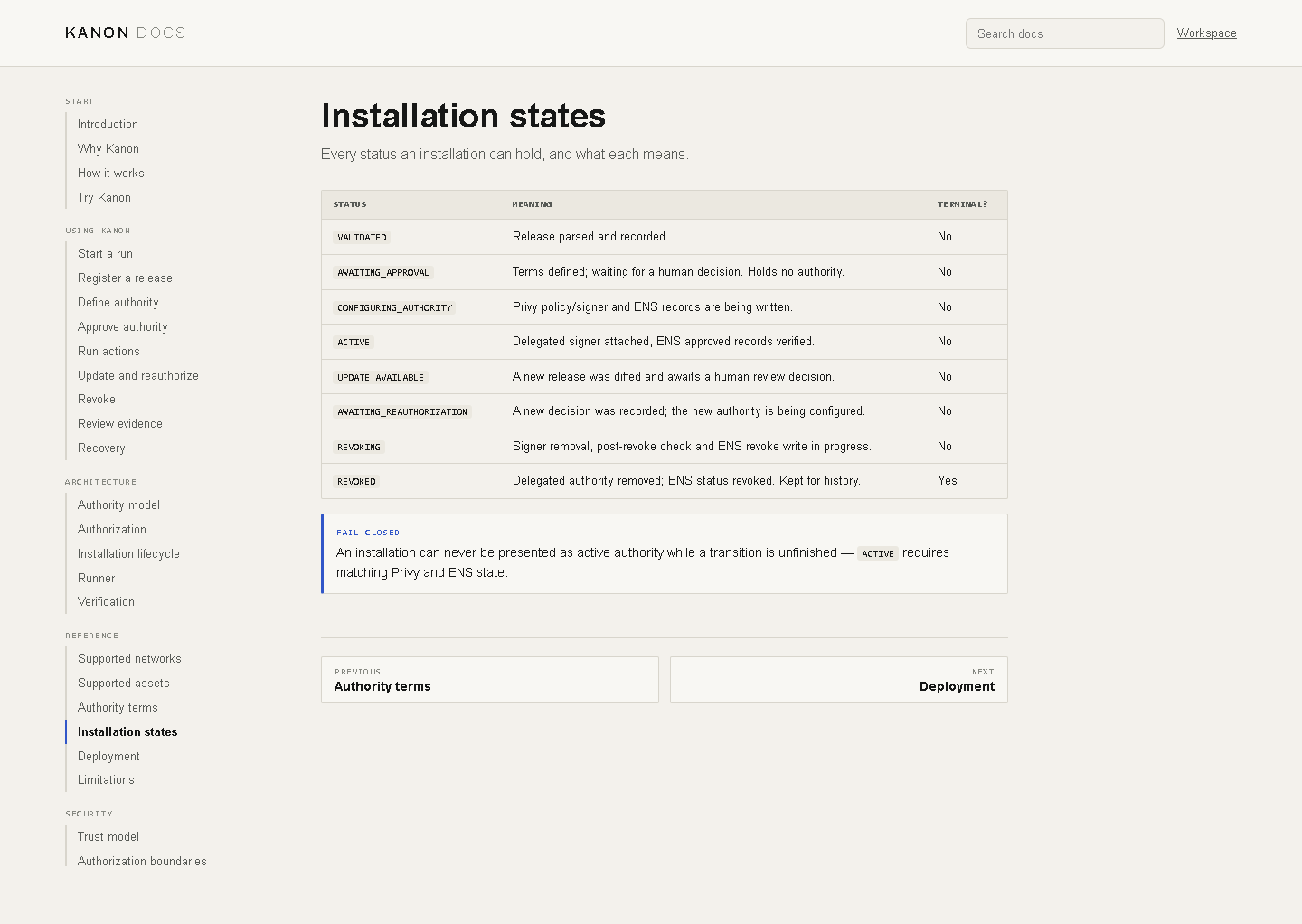
EXPANDED, blocks it and requires a fresh human decision. Privy is updated first; the ENS record only moves after Privy confirms. - Revocation removes the delegated signer, then marks the ENS identity
revoked. Later execution attempts fail.
The rule is simple: humans approve authority boundaries, agents operate inside them.
How it works
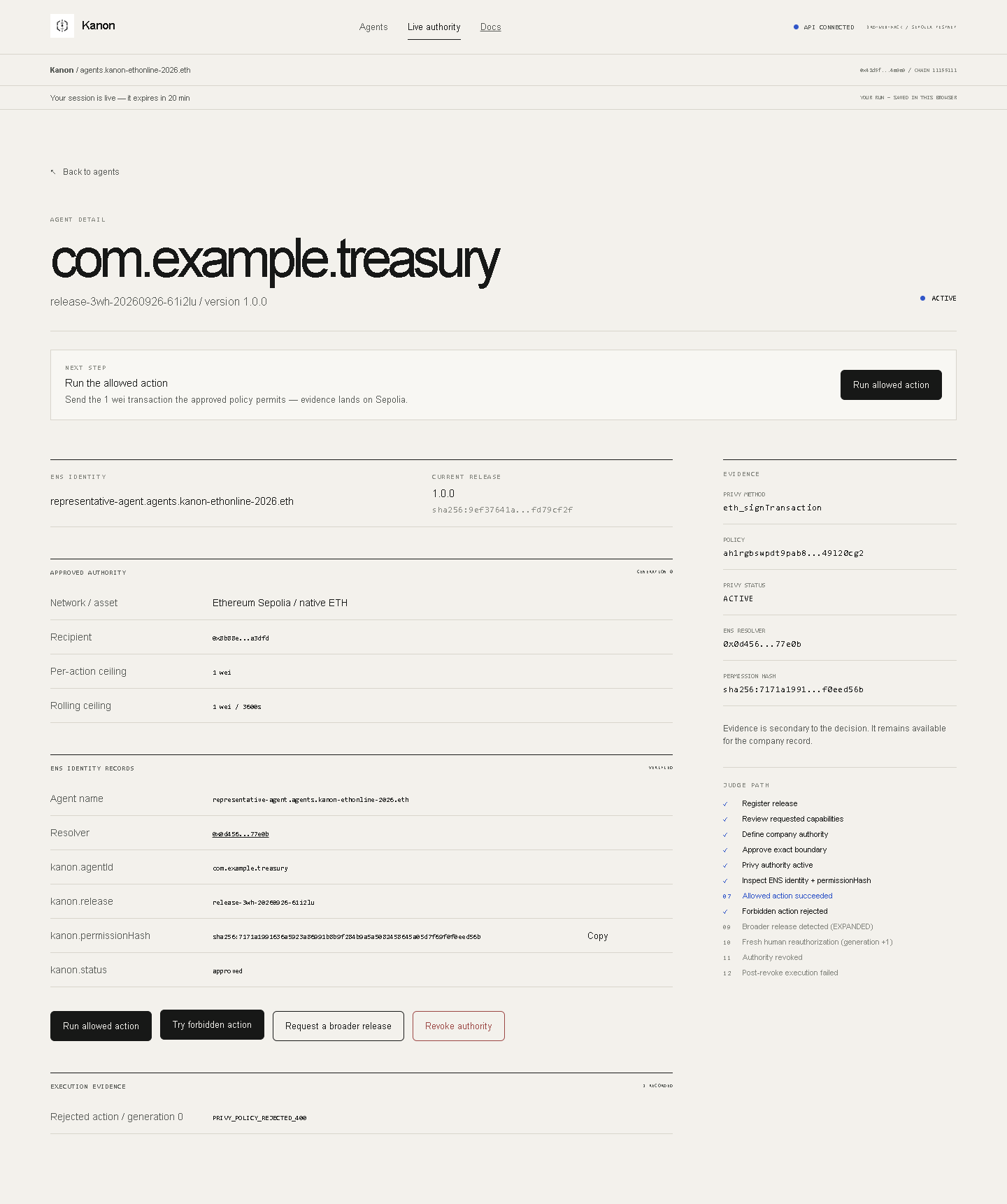
The live demo walks through the whole lifecycle on Sepolia:
- Register an agent release. The release gets a package hash and manifest hash.
- Review requested capabilities. The request is shown separately from anything granted.
- Define company authority. One exact recipient, a per-action ceiling in wei, and a rolling ceiling per time window.
- Approve the exact boundary. The review screen shows the normalized terms and
permissionHashthe human is signing off on. - Activate Privy-enforced authority. The API creates the Privy policy and aggregation, attaches the agent signer, then writes and reads back the ENS records.
- Inspect the ENS identity.
kanon.agentId,kanon.release,kanon.permissionHashandkanon.statusresolve from the Permissioned Resolver. - Run an allowed action. The isolated runner signs through Privy with only the agent's key and broadcasts a real Sepolia transaction.
- Reject a forbidden action. A transfer to an unapproved recipient is refused by the Privy policy, not by a UI check.
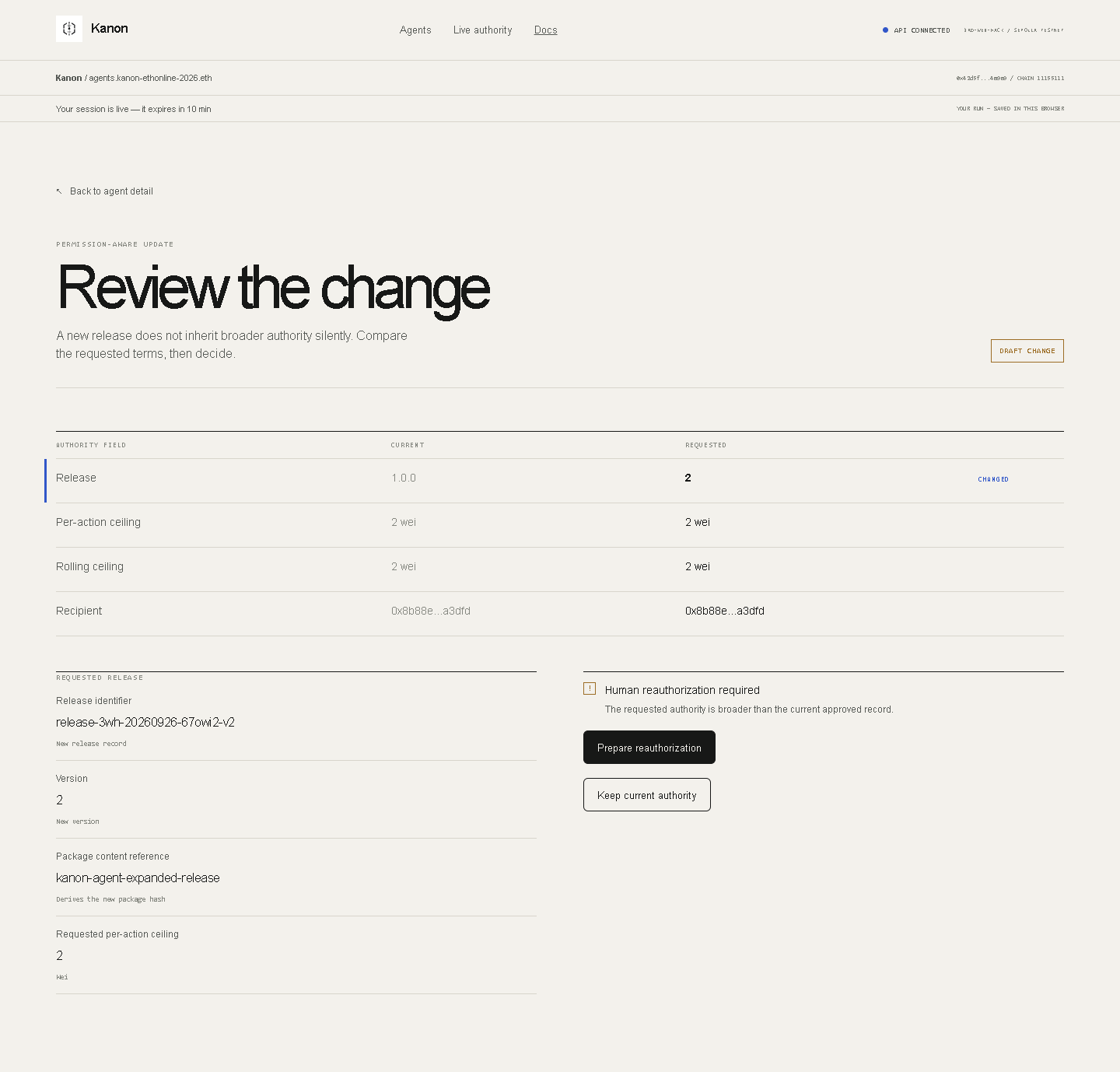
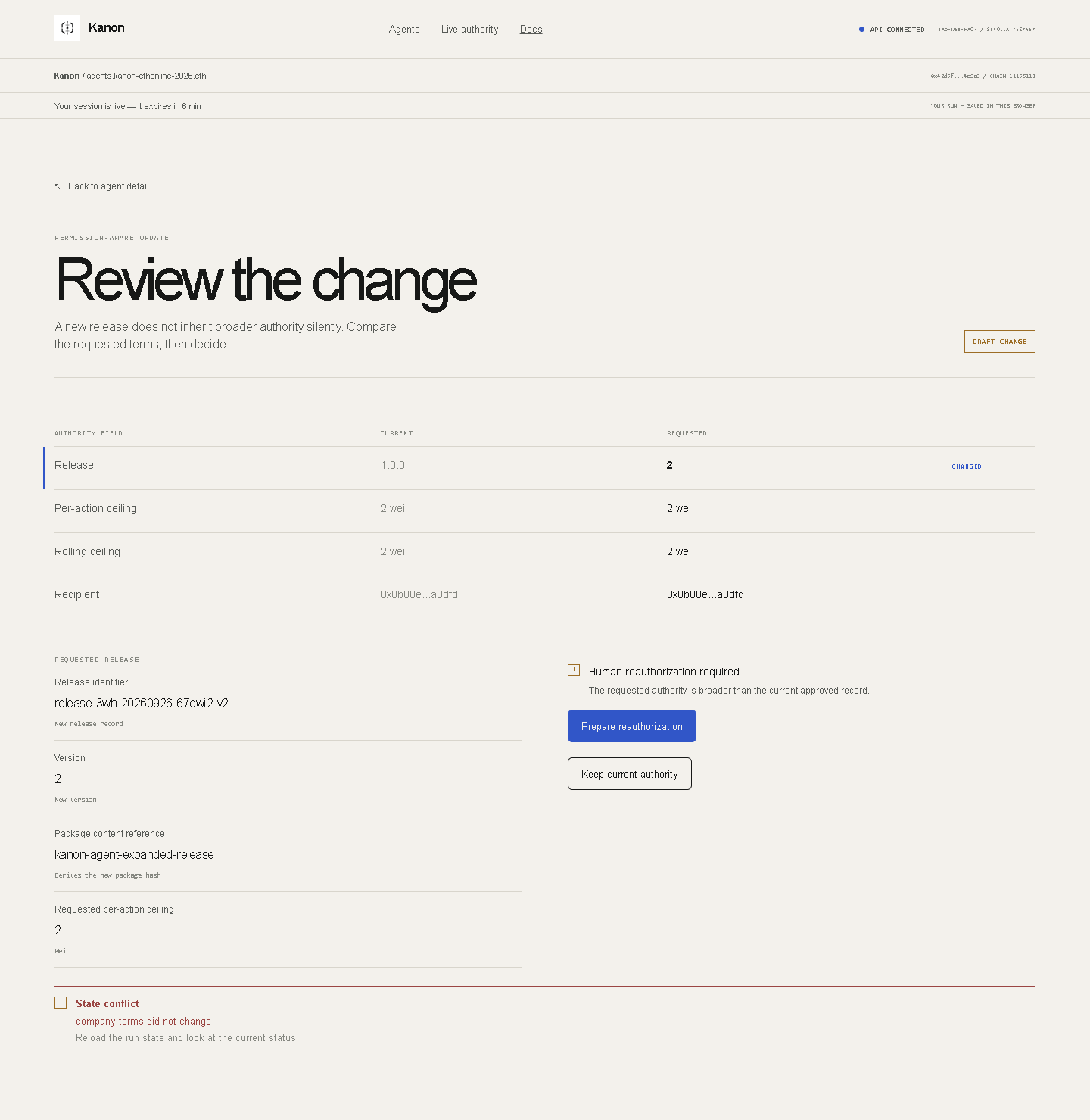
- Detect a broader release. Version 2 asks for a higher ceiling. Kanon's permission diff returns
EXPANDEDwith the changed paths. - Require fresh human authorization. The old authority stays in force until a human approves the new hash. Then the generation increments.
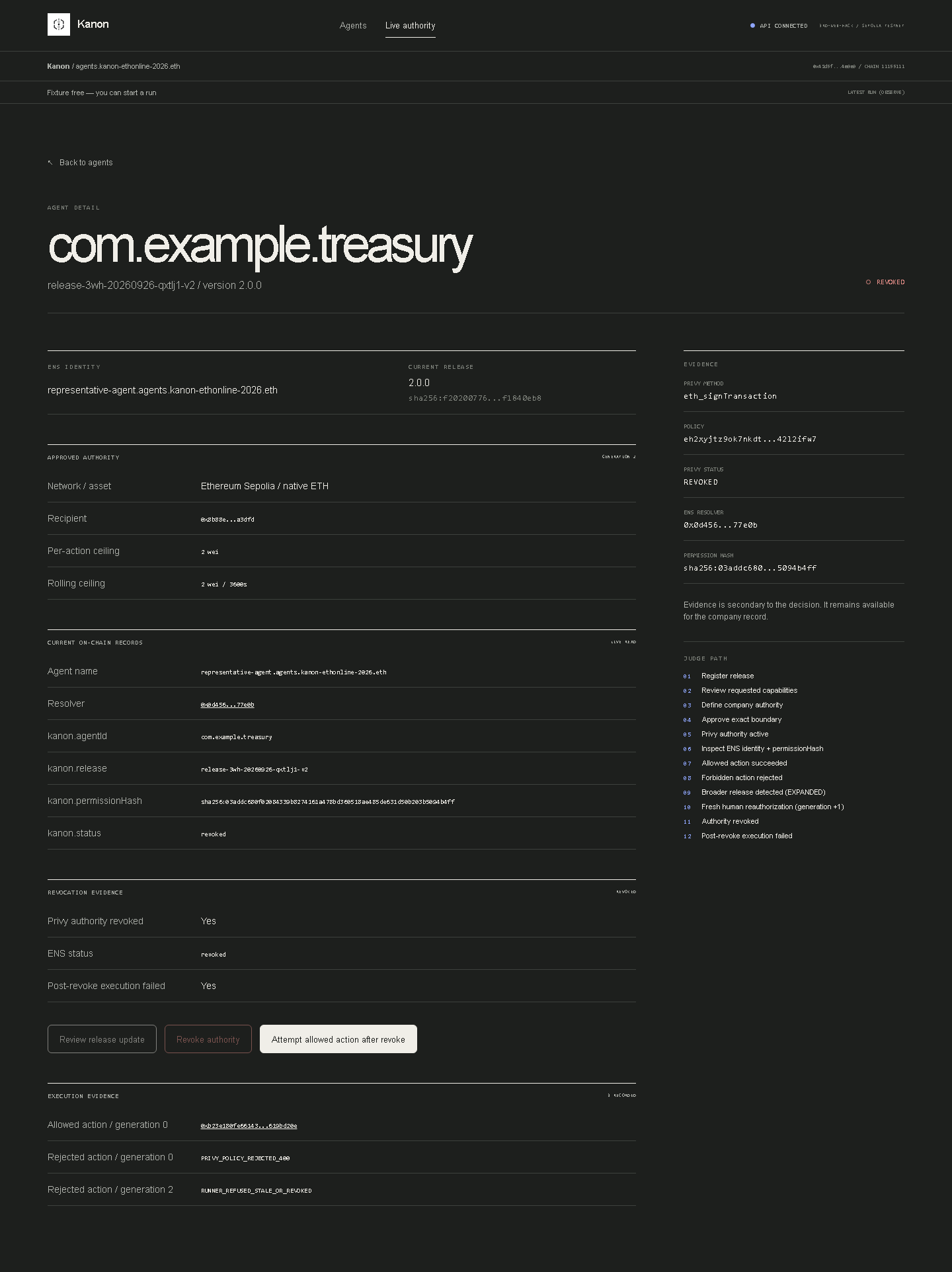
- Revoke authority. The Privy signer is removed and ENS status becomes
revoked. - Prove post-revocation execution fails. The next delegated attempt is rejected and recorded as evidence.
Innovation
- Release-bound authority. Approval attaches to a specific release, package hash, manifest hash and
permissionHash. A new release cannot reuse an old approval if its authority changes. - Permission diffing for agent updates. Every release is classified as
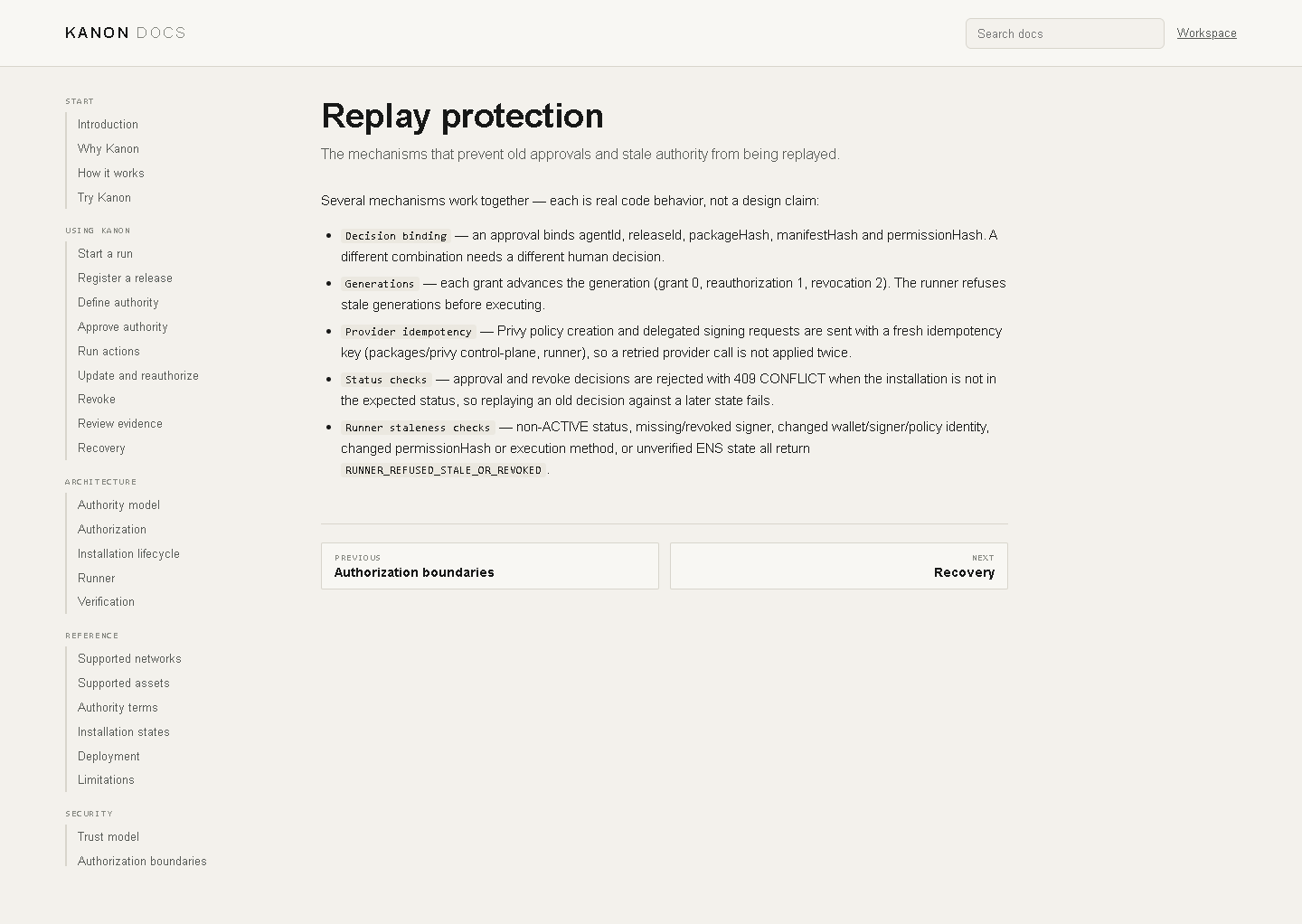
NO_CHANGE,NARROWER,EXPANDED,SUBSTITUTEDorUNKNOWN. Anything that is not provably equal or narrower fails closed and waits for a human. - Two planes with a strict order. Privy enforces money movement; ENSv2 publishes company-controlled identity and approved state. ENS never claims authority Privy does not hold, because ENS is only written after Privy confirms.
- Fail-closed compilation. If a company term cannot be enforced by the selected Privy execution method, Kanon refuses to compile a policy instead of silently approximating it.
Uniqueness
Most agent-wallet tools answer "how does an agent get a wallet?" Kanon answers a different question: "what exactly did the company approve, for which release, and can anyone prove it is still true?" It is not a wallet provider, an agent launcher or a trading bot. It is the authority record and enforcement lifecycle around an agent a company already wants to run.
Technical implementation
- Monorepo (pnpm, TypeScript):
packages/manifest(release and manifest hashing),packages/permissions(normalization,permissionHash, diff classification),packages/privy(method-aware policy compiler and Privy adapter),packages/ens(ENSv2 identity binding, protected record writes and readback),packages/shared(installation state machine and versioned API contracts). - API (Render, Node.js 22, Neon PostgreSQL): installation lifecycle, human decisions, asynchronous authority configuration with polling, Privy-first update ordering, revocation.
- Isolated runner (separate Render service): holds only the agent's delegated signing key, re-reads the installation before every execution and refuses stale, revoked or mismatched authority. It never receives owner credentials.
- Frontend (Vercel, React + Vite): the judge-facing workspace. Browser code never sees a provider secret or the company API token.
- Public demo boundary (new in this release): the Vercel proxy sends a restricted demo credential instead of the company token. The API limits that role to the guided flow, caps terms to the organization's own wallet and small wei values, rate-limits mutations, and blocks operator routes.
- Tests: Vitest suites cover manifest hashing, permission normalization and diffing, policy compilation, ENS binding, lifecycle gates, the runner, API contracts, and the new demo guard and session lease.
What's new in the 3rd-Web-Hack release
Origin and timeline. Before September 11, 2026, Kanon was only written product notes. All of its code was written between September 12 and September 26, 2026, which falls inside this hackathon's submission period (August 22 to September 27). The same build was also created for ETHOnline 2026. The public Git history is unchanged and shows every commit date.
Work from September 25 to 26 made it a dependable prototype that judges can repeat:
- Reliable hosted backend. The workspace no longer sticks on "API pending". It retries with timeouts, explains free-tier wake-ups, and offers a manual retry. Services start faster and a scheduled job keeps them warm during judging.
- Safe public demo. Visitor requests no longer carry the company API token. A restricted demo role, a terms ceiling, rate limits and a proxy route allowlist stop visitors from damaging the shared Sepolia state or draining the demo wallet.
- Repeatable flow without manual fixture resets. A session lease gives one visitor the shared Privy signer and ENS name at a time. Abandoned sessions expire through the real revocation path, so the next judge always starts clean. The operator proof now restores its ENS baseline itself, after Privy authority is attached.
- Allowed, forbidden and post-revoke execution in the UI. Judges can trigger each one and see the Sepolia transaction or the policy rejection recorded as evidence.
- Judge path. A twelve-step checklist tracks the run, and the ENS panel shows the live records and full
permissionHash. - Reject-update path. A human can reject a broader release and keep the current authority.
Impact
Kanon targets small crypto-native teams, DAOs, and startups paying contributors in stablecoins: groups that want agents to do financial work but cannot afford to trust an agent with an unrestricted key. It gives them a way to say "this agent, this release, this much, to this recipient", have a wallet enforce it, and let anyone check the company-controlled identity record. The same pattern applies to payroll, treasury rebalancing, vendor payments or a company's own custom agent.
Challenges we ran into
- Matching company terms to what Privy actually enforces. Rolling spend limits only work with Privy aggregations on the
eth_signTransactionpath, so the compiler became execution-method aware and refuses unsupported combinations instead of faking them. - Keeping two systems consistent. Privy and ENS can fail independently. We made Privy the source of truth, update it first, and roll back to the previous policy and ENS state when a step fails.
- ENSv2 is beta on Sepolia. We verified registry, resolver and role behavior against the live deployment before relying on it.
- A shared testnet fixture. One Privy signer and one ENS name meant an abandoned session could block everyone. The session lease and expiry-through-revocation solved that without weakening any rule.
- Free-tier hosting. Cold starts caused the stuck connection state. Retries, faster startup and a keep-warm job fixed the judge experience.
Accomplishments that we're proud of
- The full lifecycle runs end to end on Sepolia with real Privy policy enforcement and real ENSv2 records: activation, allowed transaction, policy rejection, expanded update, reauthorization, revocation and post-revoke failure.
- An unauthorized account cannot rewrite the agent's protected ENS records; the proof checks this.
- The public demo is open to anyone without giving anyone operator power.
What we learned
- Policy enforcement is only as honest as the compiler in front of it. Refusing to compile is better than approximating a limit.
- Ordering matters. "Privy first, then ENS" is what keeps the public record from overstating authority.
- A demo shared by many strangers needs the same care as a product: least-privilege credentials, bounded inputs and automatic cleanup.
What's next
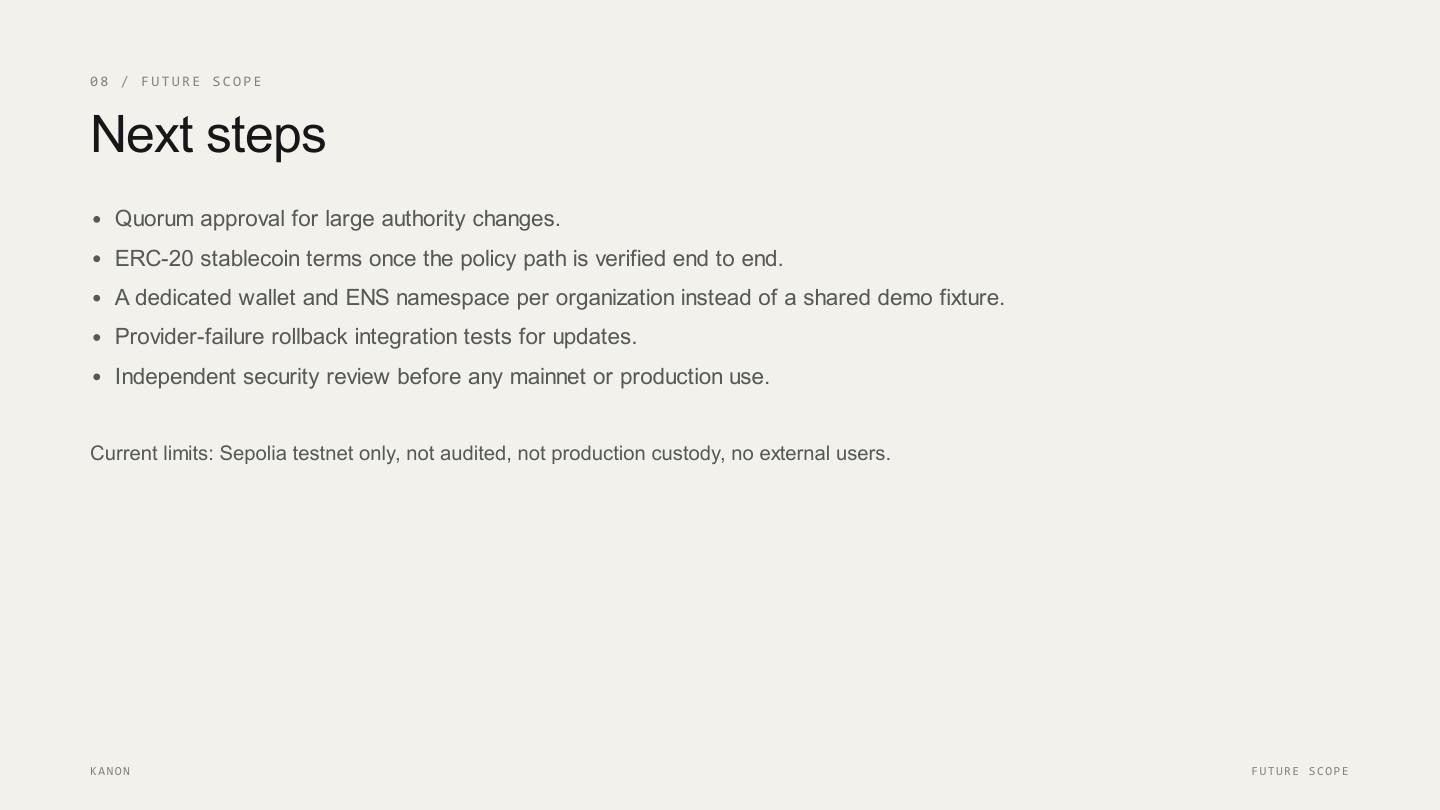
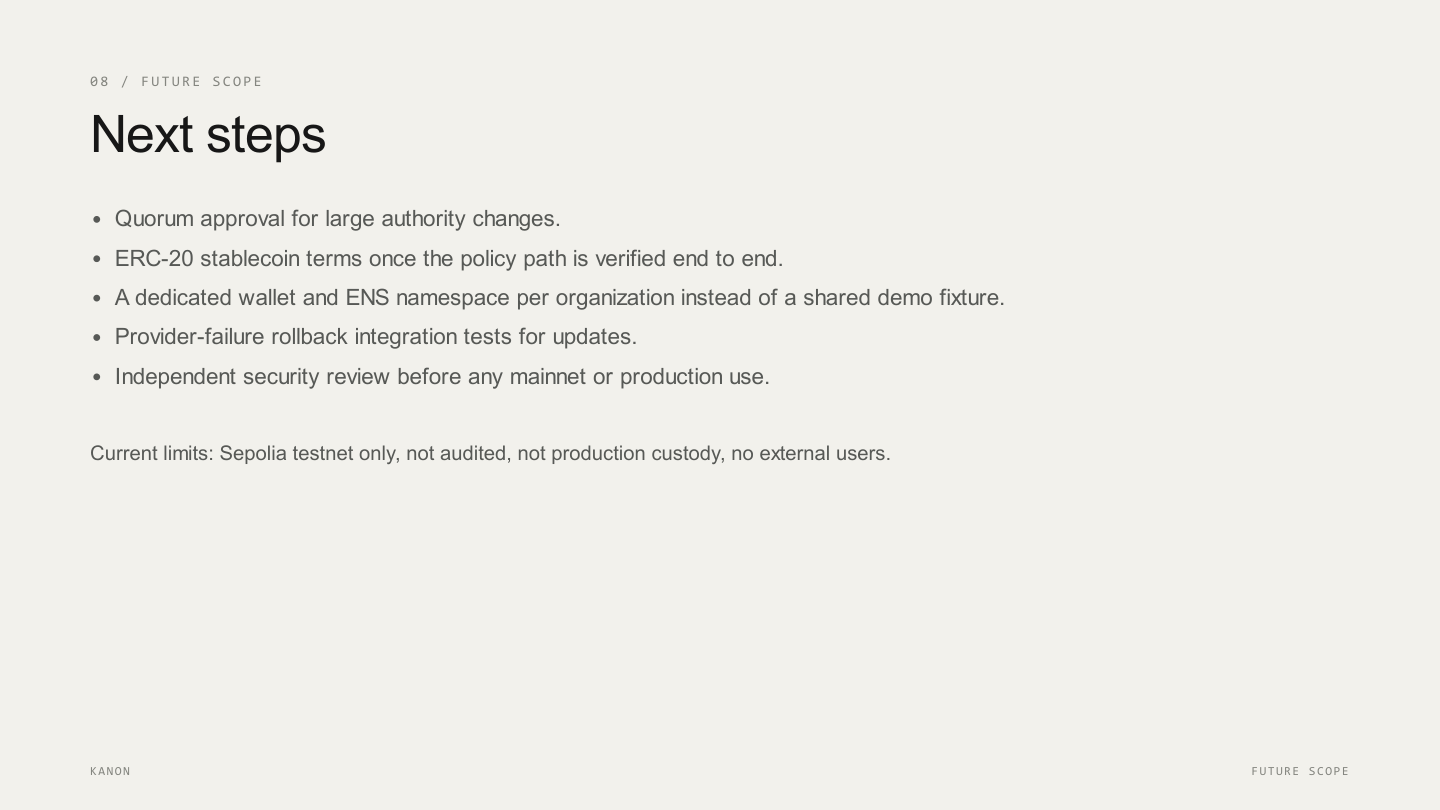
- Multi-party (quorum) approval for large authority changes.
- ERC-20 stablecoin terms once the policy path is verified end to end.
- A per-company fixture so each organization gets its own wallet and ENS namespace instead of a shared demo.
- An integration test for provider-failure rollback during updates.
- Independent security review before any mainnet or production use.
Limitations (please read)
- Sepolia testnet only. No mainnet deployment, no real funds.
- Not audited. Not production custody. No external users yet.
- The ENS namespace
kanon-ethonline-2026.ethwas registered during the original build and is reused so the verified records stay valid. - The hosted demo shares one Privy signer and one ENS name. If another person is mid-run, the UI shows when the fixture becomes free (at most 20 minutes).
- Render free services can take up to a minute to wake after idle.
Built With
- enhanced-access-control)
- ensv2-on-sepolia-(permissioned-registry
- node.js-22
- permissioned-resolver
- pnpm
- postgresql-(neon)
- privy-server-wallets-and-policies
- react
- render
- typescript
- vercel
- viem
- vite
- vitest

Log in or sign up for Devpost to join the conversation.