📋 Table of Contents
- Overview
- Key Highlights
- Features
- Architecture Overview
- Tech Stack
- System Design
- Database & Backend
- Real-Time Collaboration
- Security
- API Design
- Screenshots
- Getting Started
- Future Improvements
Overview
Kanban Core is a full-stack collaborative project management platform built for real-world team workflows. Inspired by tools like Trello and Linear, it enables teams to organize tasks on live-synced Kanban boards, manage workspace permissions, invite members via email, and track granular project activity - all in real time.
The platform was architected with production-grade concerns in mind: persistent task ordering, role-based access control, WebSocket-powered collaboration, optimistic UI updates, and a clean RESTful API with proper rate limiting, pagination, and validation.
Key Highlights
| Capability | Implementation |
|---|---|
| Real-Time Sync | Django Channels (WebSocket) - live board updates across all connected clients |
| Role-Based Access | Owner / Admin / Member roles enforced at both API and UI layers |
| Persistent Ordering | Task position stored in DB; drag-and-drop order survives page refresh |
| Optimistic Updates | UI reflects changes instantly before server confirmation |
| Token Invitations | Secure email-based invite system with signed tokens |
| Activity Feed | Human-readable audit log: "Mokshy added John to the Board" |
| Media Uploads | Cloudinary-backed avatar storage with CDN delivery |
| Secure API | JWT auth, throttling, rate limiting, input validation, proper HTTP status codes |
Features
Authentication & Security
- JWT-based login and registration with secure token refresh
- Protected API endpoints - unauthenticated requests rejected with
401 Unauthorized - Rate limiting and request throttling to prevent abuse
- Input validation with descriptive error responses
- Proper HTTP status codes throughout (
200,201,400,401,403,404,422)
Authorization & Permissions
- Three-tier role system: Owner, Admin, Member
- Workspace access is strictly scoped - users can only interact with boards they belong to
- Board modification (member management, settings) restricted to Owners and Admins
- Resource-level authorization checks on every mutating API operation
Board & Task Management
- Full CRUD for boards, lists, and tasks
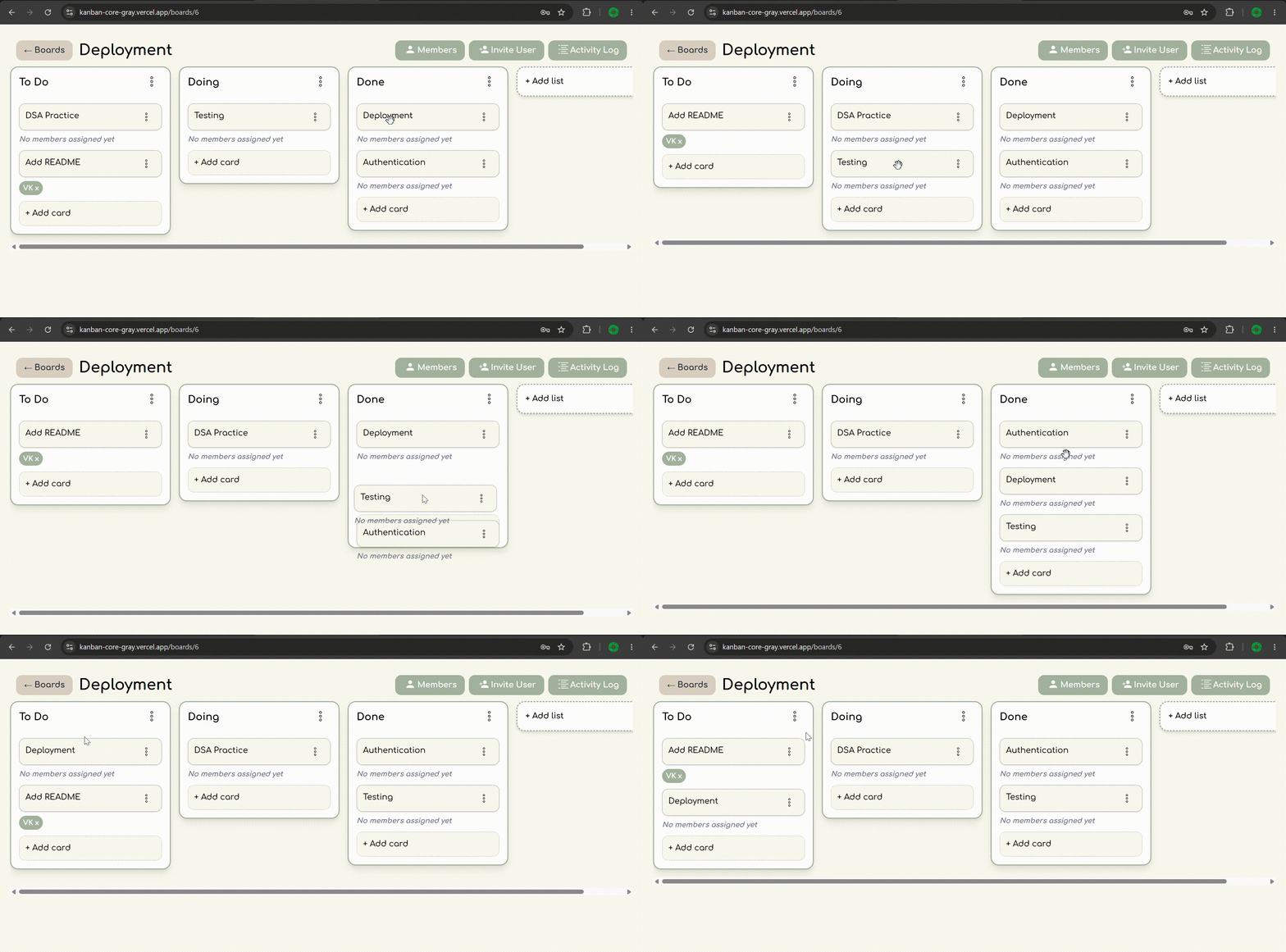
- Drag-and-drop task movement between lists with persisted order in the database
- Task assignment to workspace members
- Filter tasks by assignee
- Full-text task search
- Soft state management, no unnecessary full-page reloads
Collaboration & Invitations
- Invite members by email via a signed token-based invitation system
- Workspace membership management (promote, demote, remove)
- Real-time board updates pushed instantly to all active collaborators via WebSocket
Activity Tracking
Every significant action is recorded and surfaced in a human-readable activity feed:
* Mokshy added John to the Board
* Alex joined the board
* Task "User Auth" was created
* Mike updated "Fix login bug"
User Experience
- Fully responsive, mobile-friendly layout built with Tailwind CSS
- Skeleton loading states and empty state illustrations
- Error boundary handling with user-friendly fallbacks
- Optimistic UI updates changes appear instantly, with rollback on failure
- Member avatars powered by Cloudinary CDN
Architecture Overview
┌─────────────────────────────────────────────────────────┐
│                        CLIENT                           │
│           React + React Router + Axios                  │
│         Tailwind CSS · Optimistic Updates               │
└──────────────────────┬──────────────────────────────────┘
                       │  HTTP (REST) + WebSocket
┌──────────────────────▼──────────────────────────────────┐
│                       SERVER                            │
│         Django + Django REST Framework                  │
│      Django Channels (ASGI) · JWT Auth Layer            │
│         Rate Limiting · Input Validation                │
└────────────┬──────────────────────┬─────────────────────┘
             │                      │
┌────────────▼──────────┐  ┌────────▼────────────────────┐
│      PostgreSQL        │  │        Cloudinary           │
│   Relational Data      │  │     Media / Avatars         │
│   Task Order Persist   │  │     CDN Delivery            │
└────────────────────────┘  └─────────────────────────────┘
Tech Stack
Backend
- Django
- Django REST Framework
- Django Channels
- PostgreSQL
- JWT Authentication
Frontend
- React
- Tailwind CSS
- Axios
Infrastructure
- Render
- Vercel
- Cloudinary
System Design
Backend Design Decisions
Django Channels over polling: WebSocket connections are maintained per board session. When a task is mutated, the server publishes to a channel group (board_{id}), and all active subscribers receive the event enabling true real-time collaboration without polling overhead.
Task ordering via position field: Each task stores an integer position value within its list. On drag-and-drop reorder, the backend recalculates and batch-updates affected positions atomically, ensuring order consistency across concurrent users.
Role enforcement at the view layer: Permission classes are composed per endpoint. A custom IsBoardAdminOrOwner permission class is applied to destructive operations. Member-only endpoints use IsBoardMember. This keeps authorization logic centralized and testable.
Token-based invitations: Invitations generate a signed, time-limited token (expiry) stored against a pending invite record. On acceptance, the user is added to the workspace and the token is invalidated.
Frontend Design Decisions
Optimistic updates with rollback: Task mutations are applied to local state immediately. If the server returns an error, the previous state is restored and an error toast is shown. This eliminates perceived latency.
WebSocket state reconciliation: The React app maintains a WebSocket connection per active board. Incoming server events are diffed against local state and merged-preventing flicker or duplicate updates.
Database & Backend
Core Data Models
### Key Model Design

**Task** — Stores `position` (int), `assigned_to` (FK), `list` (FK), `created_by` (FK), `title`, `description`, `created_at`, `updated_at`

**WorkspaceMembership** — Junction table with `role` field (`owner` / `admin` / `member`), `joined_at`

**Invitation** — Stores `token` (hashed), `email`, `workspace`, `invited_by`, `expires_at`, `accepted`

**ActivityLog** — Stores `action`, `username`, `actor`, `board`, `metadata` (JSON), `created_at`
Backend Capabilities
- Pagination on all list endpoints (cursor-based where applicable)
- Filtering via
django-filter- assignee, list, board, status - Full-text search on task titles
Real-Time Collaboration
Kanban Core uses Django Channels (ASGI) to power WebSocket connections for live board synchronization.
Event Types
| Event | Payload | Trigger |
|---|---|---|
task.created |
{ task } |
New task |
task.updated |
{ task_id, changes } |
Task edit |
task.deleted |
{ task_id } |
Task deletion |
member.joined |
{ user } |
Invite accepted |
Connection Flow
Client connects → WebSocket handshake → Auth token validated → Joined to channel group board_{id} → Receives all future board events until disconnect
Security
| Layer | Implementation |
|---|---|
| Authentication | JWT access + refresh tokens (short-lived access, rotated refresh) |
| Authorization | Role-based permission classes on every endpoint |
| Throttling | Per-user and per-IP rate limits via DRF throttling classes |
| Input Validation | DRF serializers validate all input; malformed requests return 400 |
| CORS | Whitelist-only CORS configuration |
| Invitation Tokens | HMAC-signed, time-limited, single-use |
| Media Security | Cloudinary-hosted — no media served directly from application server |
API Design
Base URL: https://api.kanban-core.onrender.com/api/
Screenshots
Getting Started
Prerequisites
- Python 3.11+
- Node.js 18+
- PostgreSQL 15+
Backend Setup
# Clone the repository
git clone https://github.com/Mokshy46/Kanban-Core.git
cd kanban/backend

# Create and activate a virtual environment
python -m venv venv
# Windows: venv\Scripts\activate

# Install dependencies
pip install -r requirements.txt


# Apply migrations
python manage.py migrate


# Start the development server
python manage.py runserver
Frontend Setup
cd ../frontend

# Install dependencies
npm install

# Copy and configure environment variables
cp .env.example .env.local
# Set VITE_API_BASE_URL and VITE_WS_BASE_URL

# Start the development server
npm run dev
Frontend — Vercel
The React frontend is deployed to Vercel via GitHub integration. Every push to main triggers an automatic deployment.
# Build command
npm run build

# Output directory
dist
Future Improvements
- [ ] Due dates & calendar view — task deadlines with calendar integration
- [ ] Notification center — in-app notifications with read/unread state
- [ ] Subtasks — nested task hierarchy within cards
- [ ] Labels & tagging — color-coded labels with multi-label filtering
- [ ] Board templates — predefined board layouts for common workflows
- [ ] Audit log export — downloadable CSV activity reports
- [ ] OAuth login — Google and GitHub social authentication
- [ ] Slack integration — activity notifications via Slack webhook
- [ ] Offline support — service worker caching for read operations
- Engineered a real-time WebSocket collaboration layer using Django Channels, enabling instant, bi-directional board synchronization across concurrent users — no polling, no page refresh
- Designed a composable role-based permission system with three access tiers enforced at the API layer, preventing unauthorized resource access and privilege escalation
- Architected a secure, token-based invitation system with time-limited, single-use tokens delivered via transactional email
- Delivered a production-deployed full-stack application across Render (Django/ASGI) and Vercel (React), with environment-specific configuration and static file handling
- Developed a human-readable activity feed powered by Django signals, generating structured audit logs from model events without coupling business logic to logging
Built With
- django
- django-channels
- drf
- jwt
- postgresql
- python
- react
- tailwindcss
- websockets

Log in or sign up for Devpost to join the conversation.