-
-
Home Page
Inspiration
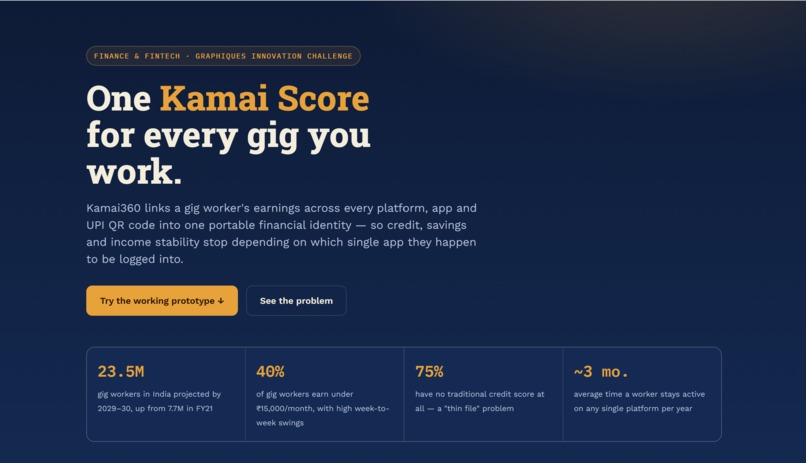
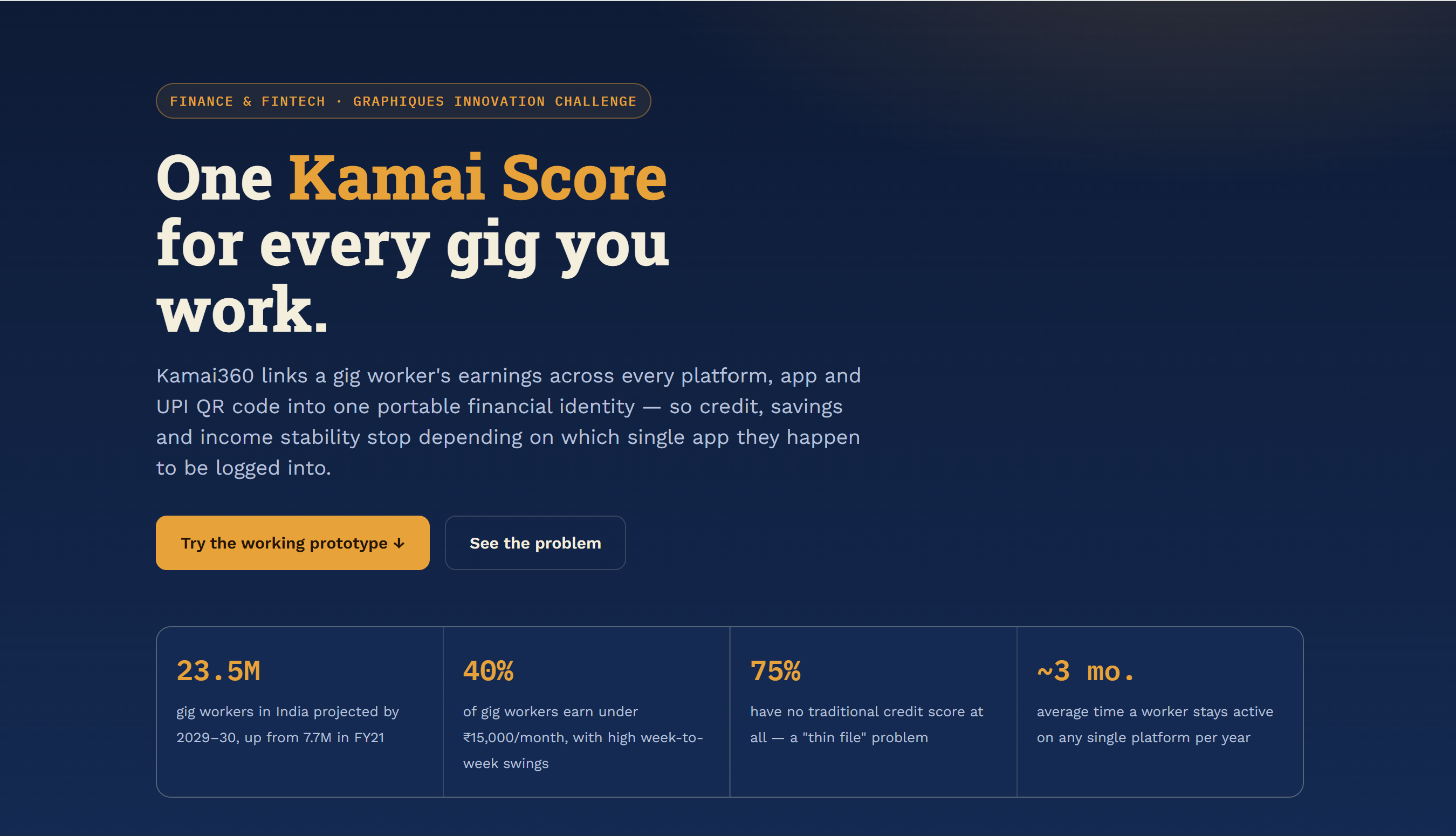
India's gig economy crossed 12 million workers this year and is projected to triple by 2030 — but the financial system built for salaried employees hasn't caught up. What struck me digging into the research wasn't that gig workers lack income; it's that 40% earn under ₹15,000/month with heavy week-to-week swings, and roughly 75% still have no traditional credit score at all, despite being financially active every single day.
The deeper I looked, the more I realized the real gap wasn't data — India already has UPI clearing 21+ billion transactions a month and an RBI-regulated Account Aggregator framework with 250M+ linked accounts. The gap was that every existing tool (even strong ones like KarmaLife) only sees a worker's earnings on one platform, because they're switched on by an employer or platform partnership. But most gig workers aren't loyal to one app — the average worker stays active on any single platform for only about three months a year. So even a reliable, steadily-earning worker looks like a thin, unconvincing file to every lender they approach.
That mismatch — real income, fragmented across apps, invisible as a whole — became the project.
What it does
Kamai360 is a worker-owned financial identity app for gig workers. Instead of requiring a platform partnership, a worker gives one-time consent (via UPI + India's Account Aggregator rails) to link every income source they have — delivery apps, ride-hail, home services, and even off-platform UPI-QR payments from cash customers.
That combined picture becomes one portable Kamai Score, which powers three things:
- Income smoothing — auto-parks surplus from big-earning days and tops up slow ones, turning lumpy daily pay into a steady weekly draw
- A lender marketplace — partner NBFCs and banks bid for the worker's business using their Kamai Score, so the worker compares and picks, instead of being locked into one captive lender
- Goal-based savings — automatic round-ups on every payment build toward something concrete, like a delivery e-bike
Because the score belongs to the worker, not a platform or a lender, it follows them across gig changes, cities, and eventually into salaried work.
How I built it
I started with research, not design — pulling current data from the Economic Survey 2025–26, NITI Aayog, and the Redseer Gig Internet Workforce Report to make sure the problem was real and current, and to map the competitive landscape (KarmaLife's employer-linked model, CARD91's B2B scoring engine) so I could be precise about what was actually missing.
From there I built a working, interactive prototype as a single self-contained HTML/CSS/JavaScript app — a phone-frame simulation of the full worker journey: consent screen, an animated Kamai Score gauge, a live income-smoothing toggle with before/after bar charts, a clickable lender marketplace, and a savings goal with a live-updating projection slider. No frameworks, so it opens instantly in any browser and is easy for judges to click through without setup.
Alongside it, I wrote up the full concept — problem statement, solution, differentiation, phased go-to-market, and an illustrative business model — as a formal submission document, and scripted a 75-second walkthrough for a screen-recorded demo video.
Challenges I ran into
The hardest part wasn't the interface — it was resisting the obvious idea. "Alternative credit scoring from UPI data" already exists as a product category (CARD91 sells exactly that to banks). The real work was figuring out why that category still leaves most workers behind, which came down to the single-platform dependency baked into how those tools are distributed. Once I found that gap in the data itself — the "~3 months per platform" stat — the differentiation became obvious and defensible rather than cosmetic.
Designing the smoothing and marketplace interactions to feel real (not just static mockup screens) inside a plain HTML/JS file, without a framework, also took some care — getting the SVG gauge to animate cleanly and the bar charts to transition between states without library support.
Accomplishments that I'm proud of
Grounding every claim in the project — the market size, the credit gap, the "thin file" problem, the infrastructure that already exists — in real, current sources, rather than assumptions. And building something judges can actually click through end-to-end in under two minutes, not just read about.
What I learned
That in a well-covered problem space like gig-worker fintech, the differentiated idea is rarely a new mechanism — it's usually a more accurate read of who the user actually is. The workforce data (transient, multi-platform, part-time) was the whole insight; the product just had to take it seriously.
What's next for Kamai360
Pilot in one or two cities through gig-worker unions and Common Service Centres, integrate with two to three licensed Account Aggregators, and bring on two to three NBFC/bank partners for the marketplace under RBI's Digital Lending Guidelines sandbox — validating real approval-rate and pricing improvements before scaling city coverage.
Built With
- competitiveanalysis
- css3
- financialmodelling
- fonts
- html5
- javascript
- marketresearch
- rbiaccountaggregatorframework
- upi

Log in or sign up for Devpost to join the conversation.