-
-
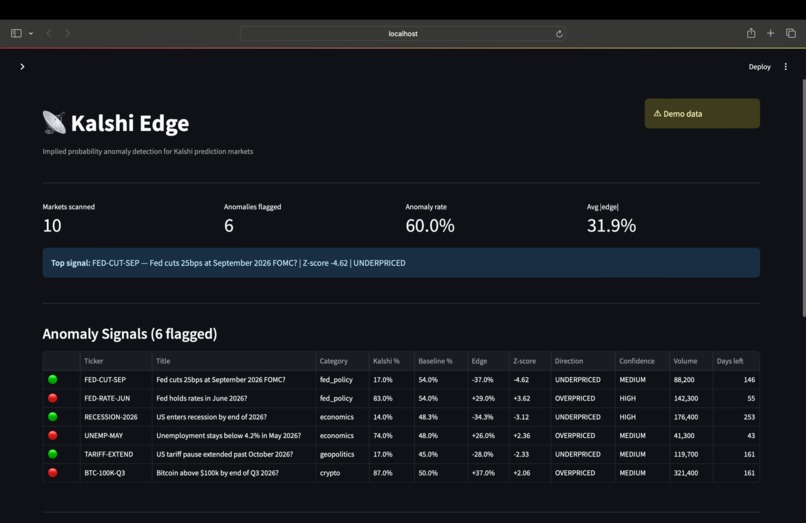
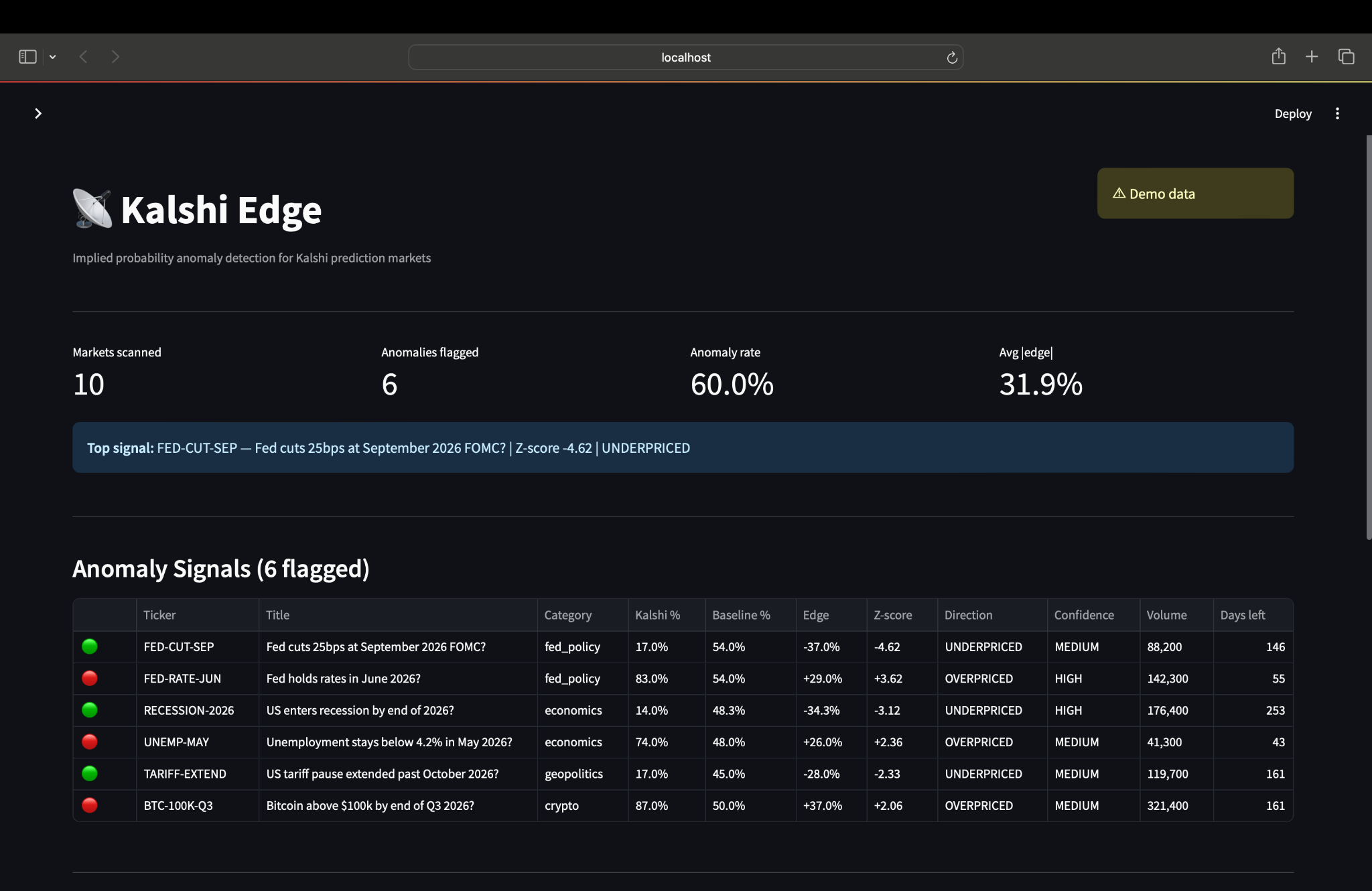
Kalshi Edge dashboard: scans markets, flags unusual pricing with Z-scores, and ranks the strongest anomalies in real time.
-
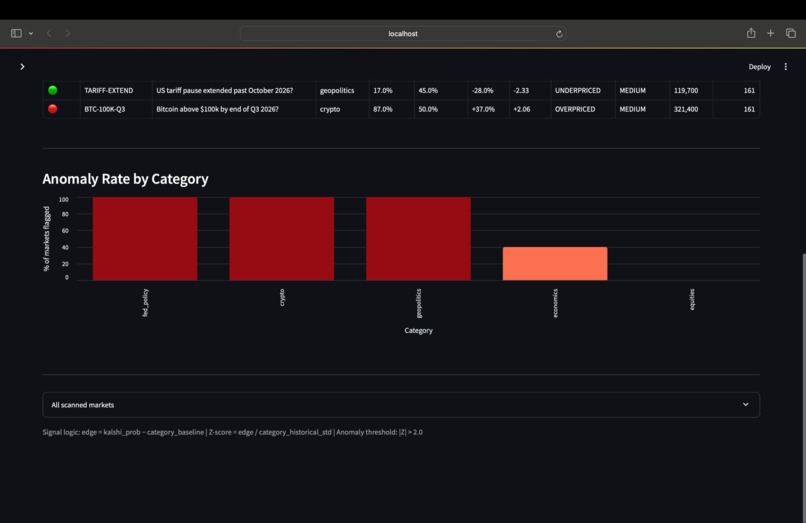
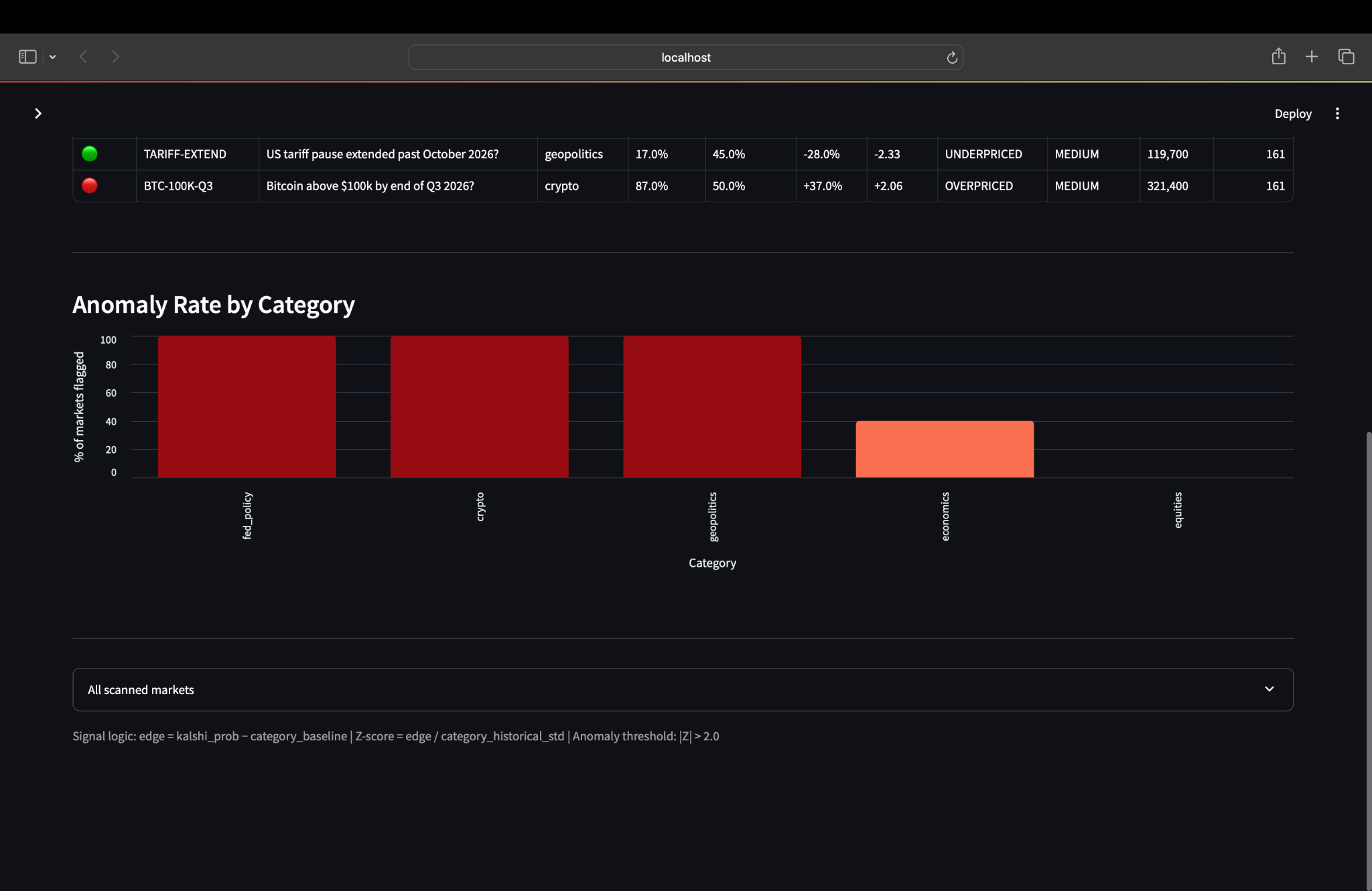
Kalshi Edge analytics: anomaly rates by category reveal where pricing dislocations appear most across major market themes.
Inspiration
What it does
How we built it
Challenges we ran into
Kalshi Edge
Inspiration
Prediction markets are one of the most interesting real-time sources of crowd intelligence. Prices move instantly as new information enters the market, but market prices are not always perfectly efficient. I wanted to explore whether those probabilities could be analyzed more systematically and transformed into actionable signals rather than just raw numbers on a screen.
What it does
Kalshi Edge scans active prediction markets and compares live implied probabilities against category baselines across areas such as Fed policy, economics, crypto, and geopolitics. It calculates the probability gap, standardizes the deviation using Z-scores, and ranks the strongest anomalies as potential opportunities.
Markets are labeled as:
- Underpriced
- Overpriced
The result is a clean dashboard plus an API that surfaces structured signals instead of forcing users to manually interpret dozens of markets.
How I built it
I built the project in Python using a modular architecture:
- FastAPI for backend endpoints and signal generation
- Streamlit for the interactive dashboard
- Pandas for data handling and analytics
- Modular Python files for data ingestion, analytics logic, and frontend display
The system also includes fallback demo data so the application remains fully functional even if external APIs are unavailable during demos.
Challenges I ran into
One challenge was handling inconsistent market pricing formats and making sure probabilities were parsed correctly before analysis. Another challenge was designing a scoring system that was statistically meaningful while still simple enough to explain clearly in a demo setting. I also focused on making the UI readable and intuitive so the output felt like a real product rather than just a script.
What I learned
I learned how to turn a finance research idea into a full product with both backend and frontend components. I also improved my understanding of API design, data pipelines, statistical anomaly detection, and how strong presentation can make technical work more impactful.
What's next
Future versions could use live streaming data, historical backtesting, user watchlists, alerts, and machine learning models for adaptive baselines.

Log in or sign up for Devpost to join the conversation.