-
-
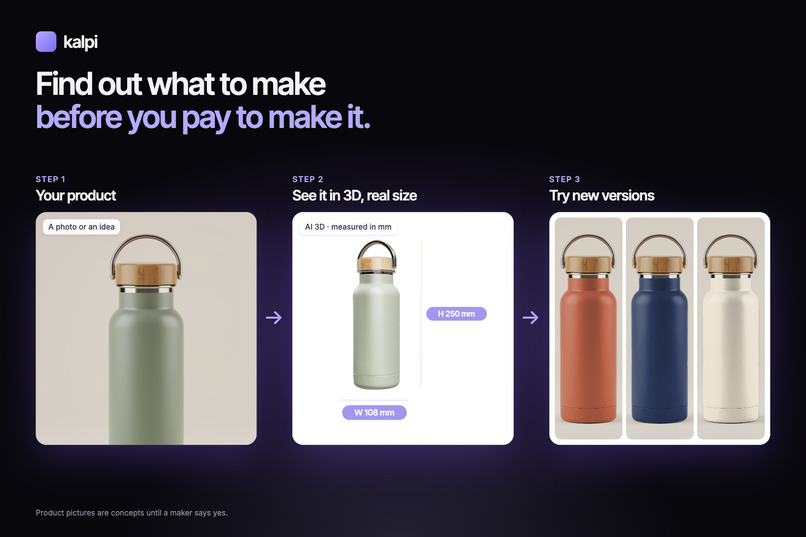
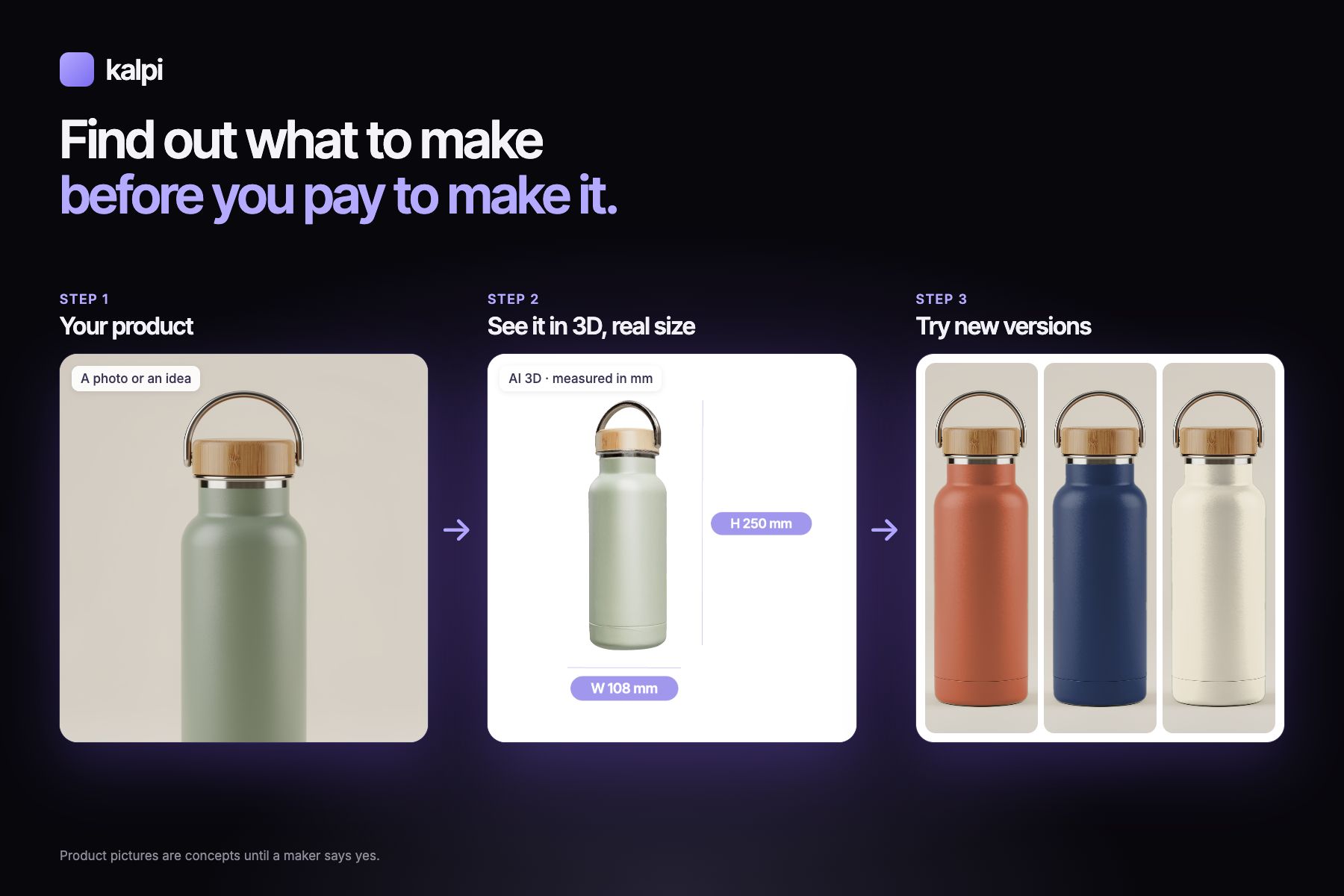
Your product → 3D at real size → new versions.
- INSPIRATION
Your product idea takes seconds to imagine, minutes to visualize, and weeks to manufacture. And after all that, you might still get it wrong.
Imagine launching your first physical product. You find a manufacturer, communicate your vision, pay for a sample, cover shipping costs, and wait for the product to arrive.
Then you open the package. The proportions aren't right. The material looks different. The packaging doesn't match what you envisioned.
Another sample. Another shipment. Another round of waiting.
And even when the product is finally exactly how you want it, there's one question you still haven't answered: Will anyone actually buy it?
For entrepreneurs and small brands, bringing a product to market means navigating manufacturing costs, international shipping, repeated physical samples, and minimum order quantities. A single incorrect decision can mean wasted time, money, and inventory.
We realized the real problem wasn't a shortage of AI image generators or design tools. It was the enormous disconnect between imagining a product, visualizing it accurately, and knowing whether it deserves to be manufactured.
That's why we built Kalpi. We wanted to give creators the ability to experiment digitally, explore product variations, and understand customer preferences before spending money on physical production.
- WHAT IT DOES
Kalpi connects product design, 3D prototyping, and customer validation in one product-development workflow. We built two complementary experiences.
Kalpi for Figma: From 2D Design to 3D Prototype
We chose Figma because it provides a structured design environment where creators can intentionally define a product's shapes, proportions, colors, typography, and branding. Unlike a standalone image generator, a design file provides meaningful information about the intended product.
Our Figma plugin extends that workflow into 3D. Creators can extrude vector shapes, add bevels and depth, inflate flat designs into rounded objects, and use AI-assisted reconstruction to create 3D models from product imagery. They can rotate and inspect objects, explore lighting and materials, and export supported models as GLB files.
Our goal is to make 3D prototyping accessible without requiring every product creator to learn specialized modeling software.
Kalpi Studio: From Prototype to Proof of Demand
Visualizing a product is only the beginning. Kalpi Studio helps creators explore which versions of their products customers may prefer.
A creator can start with a product concept or reference image, develop variations, and compare alternatives. Imagine launching a reusable water bottle. Should it be navy, terracotta, or cream?
Rather than immediately ordering physical samples, a creator can explore those alternatives digitally and present them to potential customers.
Our Studio follows four stages: Your Product, Try a Change, Ask Your People, and Decide.
The experience brings product concepts, variations, customer voting, and deposit-oriented purchase-intent flows into one place. The goal is to gather evidence about what customers might buy before committing to inventory.
One Connected Vision
Kalpi for Figma helps creators define and visualize products. Kalpi Studio helps them evaluate variations and explore demand.
Together, they form a connected journey from design to 3D prototyping, product variations, demand validation, and production decisions.
Manufacturing integration is our longer-term goal. Today, we're focused on helping creators make better decisions before that expensive stage begins.
- HOW WE BUILT IT
Kalpi combines traditional computer graphics, AI-assisted 3D reconstruction, and a web-based product experimentation platform.
We used the Figma Plugin API to work with design elements, vector information, and images from existing Figma files. For interactive 3D rendering, we used Three.js and WebGL, including vector extrusion, beveling, surface inflation, and rotational geometry for objects such as bottles and containers.
For more complex products, we integrated image-to-3D reconstruction through fal.ai, using models including Tripo and TRELLIS. We also developed GLB export functionality for supported models.
Kalpi Studio was built as a web interface where creators can organize product concepts, experiment with variations, compare designs, and explore customer-validation workflows.
Our technology stack includes JavaScript, TypeScript, React, Vite, Python, Three.js, WebGL, and the Figma Plugin API.
The biggest architectural challenge was combining deterministic geometry with generative AI. Extruding a vector drawing requires preserving explicit geometric information, while reconstructing a complex product from an image requires estimating depth and surfaces that may not be visible. We designed Kalpi to use both approaches.
- CHALLENGES WE RAN INTO
Making 3D useful, not just visually impressive.
A photorealistic render doesn't necessarily represent an accurate physical prototype. We had to consider geometry, proportions, design fidelity, materials, and performance.
Preserving the designer's intent.
AI can generate convincing objects but may change important details. We explored how to use existing design geometry and imagery as the foundation for reconstruction.
Connecting different environments.
Figma plugins, Three.js rendering, AI inference services, and web applications have different constraints. Integrating them required significant debugging.
Making the experience accessible.
Our users aren't necessarily 3D artists. We wanted the workflow to feel intuitive for someone starting with a product concept, photograph, or familiar design tool.
Balancing ambition with hackathon constraints.
Our original vision extended from idea to manufacturing. We focused on two essential stages: creating 3D prototypes and exploring customer demand.
- ACCOMPLISHMENTS WE'RE PROUD OF
We're proud of building Kalpi around a problem that extends beyond creating attractive 3D images.
We developed a Figma-based workflow combining traditional geometric transformations with AI-assisted reconstruction. We also built Kalpi Studio to help creators organize product concepts, explore variations, and compare possible outcomes.
One of our favorite examples is the reusable water bottle workflow: starting with a product, exploring multiple colors, and showing how customer preferences can guide the next decision.
We're not building 3D models simply because we can. We're building them to help creators make better decisions before committing money to physical production.
- WHAT WE LEARNED
Generating a realistic-looking product and creating the right product are two different problems.
AI can infer three-dimensional structure, but the original design contains information that matters: shapes, proportions, branding, and intentional details. We learned that traditional geometry and generative AI are complementary rather than competing approaches.
We also learned that digital prototyping is only one part of product development. A product may look exactly as intended and still fail to attract customers. That's why demand validation became central to Kalpi's vision.
Our biggest lesson was that technology creates value when it helps people make better real-world decisions.
A rotating 3D model is interesting. A rotating 3D model that helps someone avoid an unnecessary physical prototype or decide what to produce is far more meaningful.
- WHAT'S NEXT FOR KALPI
Our long-term goal is to connect the journey from product ideation to manufacturing preparation.
Manufacturing-aware 3D models: Improve dimensional precision, geometry validation, and production-oriented file formats.
Better design preservation: Carry labels, artwork, typography, and branding more accurately into 3D.
Stronger customer validation: Measure genuine purchase intent rather than relying only on visual preferences.
Supplier connections: Help creators move from validated designs toward manufacturing quotes and production planning.
Augmented reality: Allow creators to inspect products at their intended physical scale.
Unified product development: Reduce the need to move between disconnected tools when designing, prototyping, validating, and preparing products for manufacture.
Digital models cannot replace every physical sample. Materials, fit, safety, and production quality still require real-world testing. But creators should be able to make far more informed decisions before reaching that stage.
Kalpi helps you find out what to make before you pay to make it.
Built With
- api
- fal.ai
- figma
- javascript
- plugin
- python
- react
- three.js
- trellis
- tripo
- typescript
- vite
- webgl

Log in or sign up for Devpost to join the conversation.