-
-
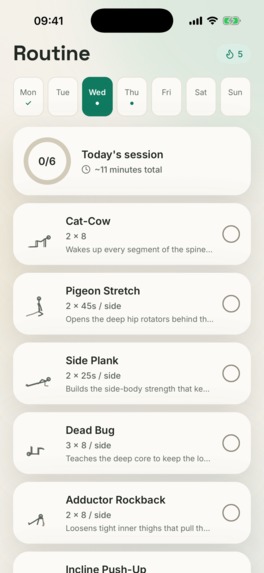
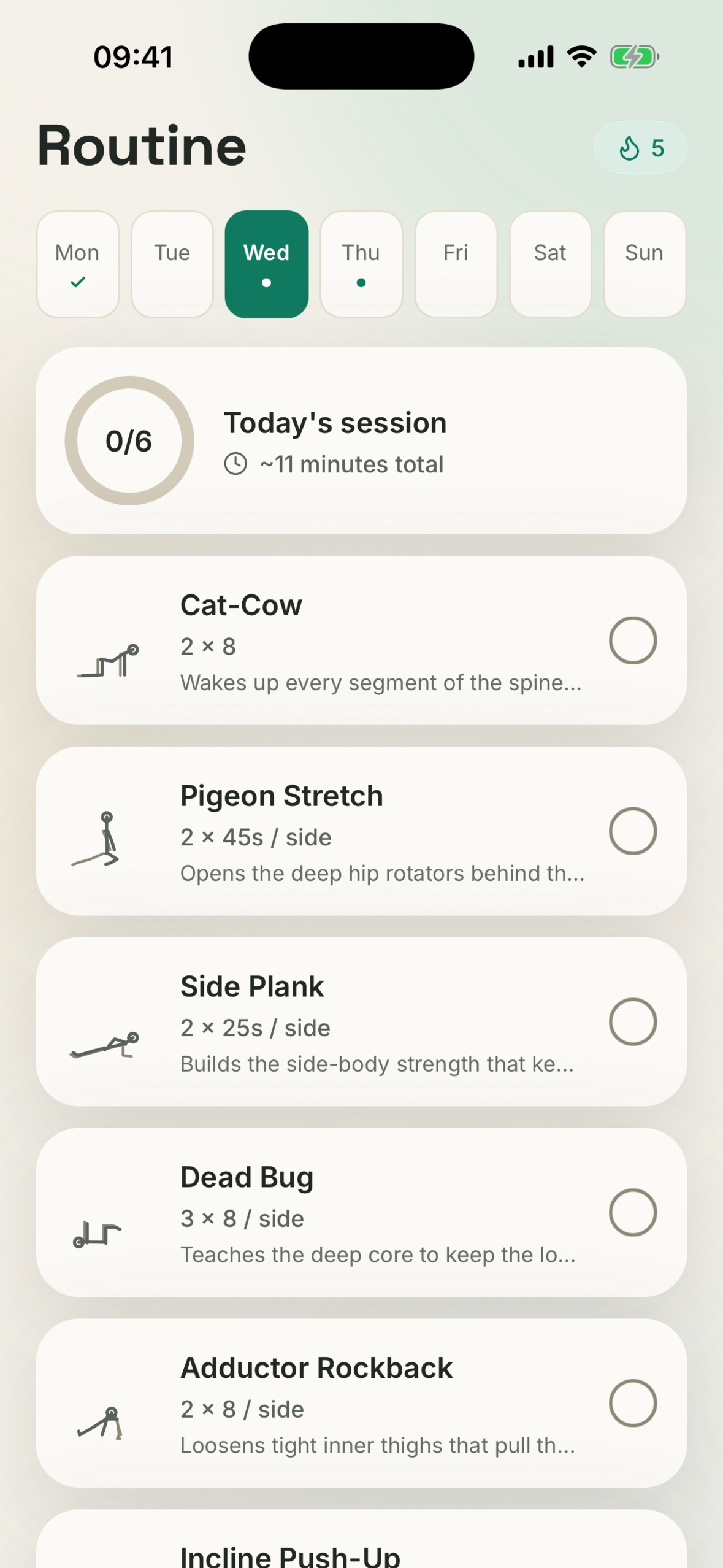
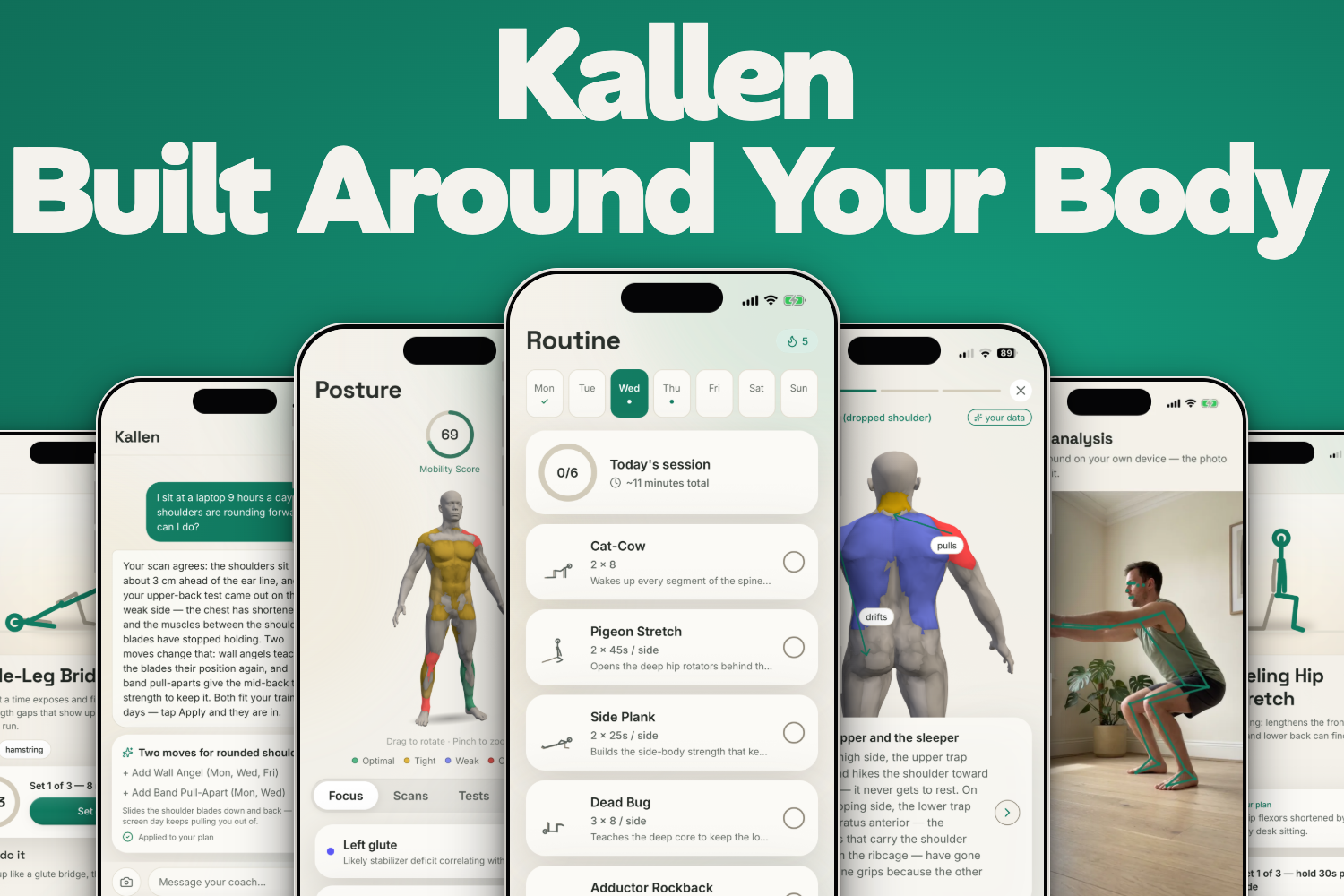
Routine tab: today's plan of 6 exercises (~11 min), chosen from the user's measurements. One plan per day instead of a library.
-
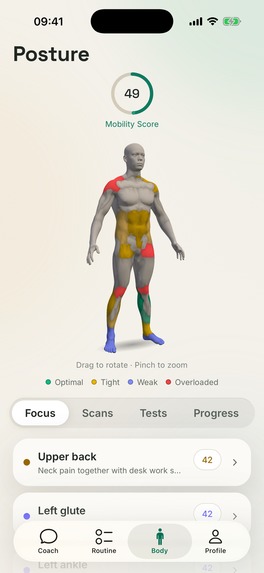
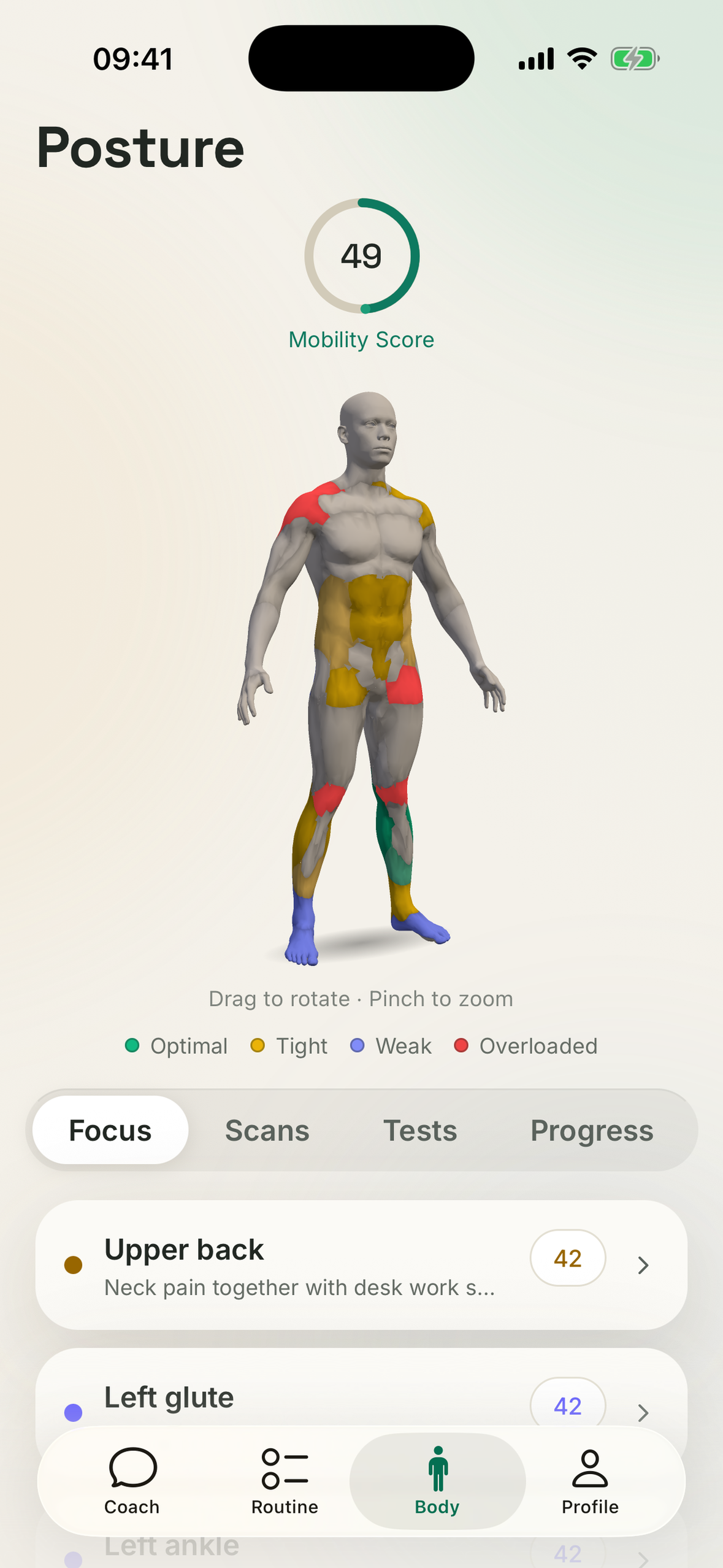
3D body twin: each muscle coloured by the user's test and scan results (optimal, tight, weak, overloaded).
-
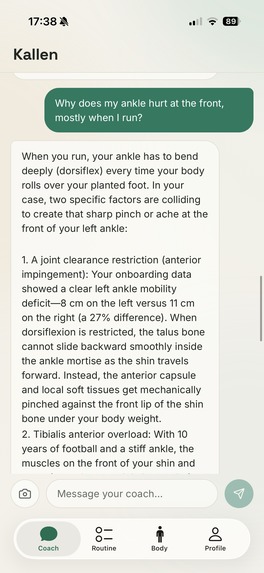
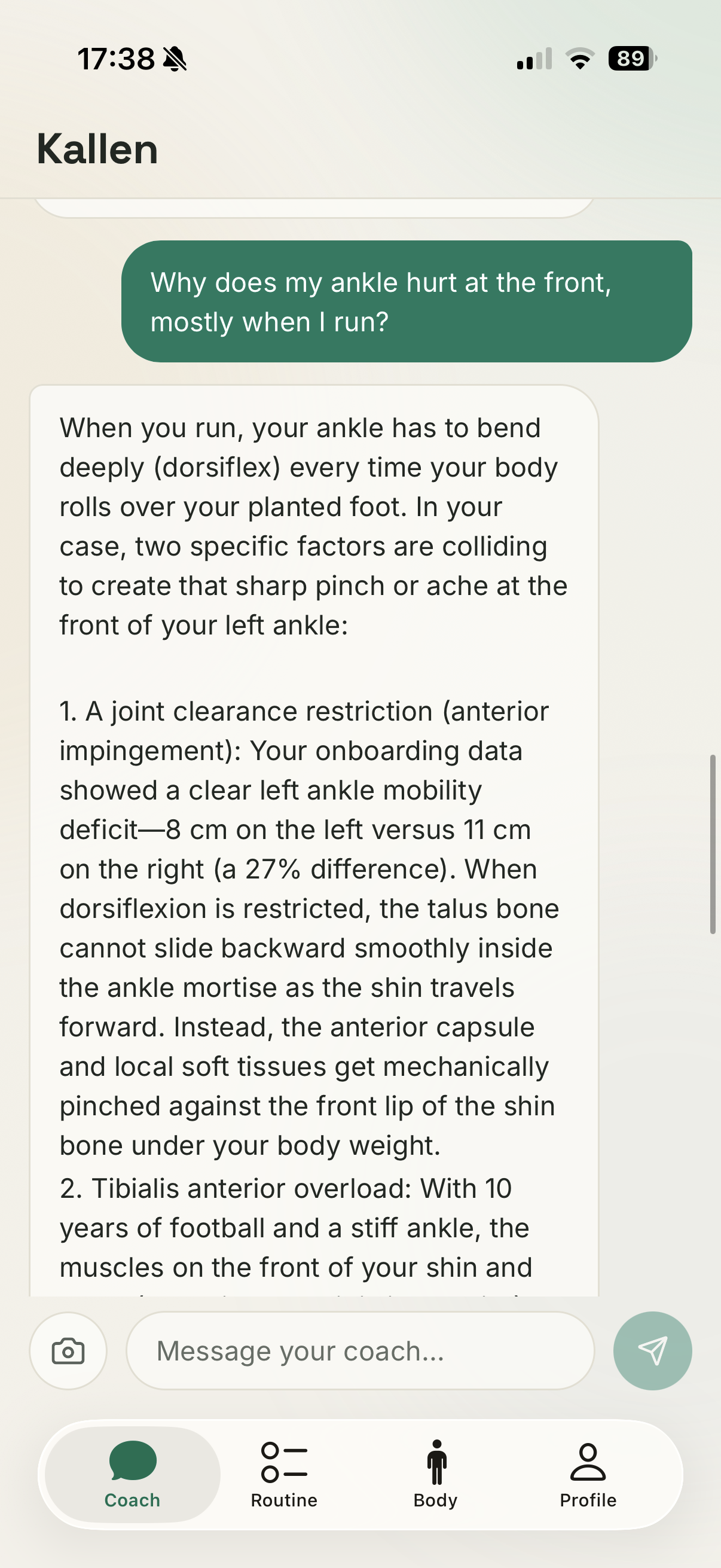
AI coach chat: the answer draws on the user's recorded data, e.g. a 27% left–right difference in ankle mobility.
-
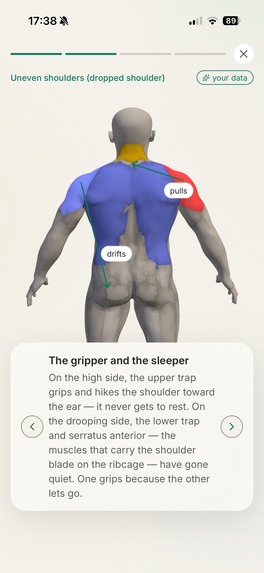
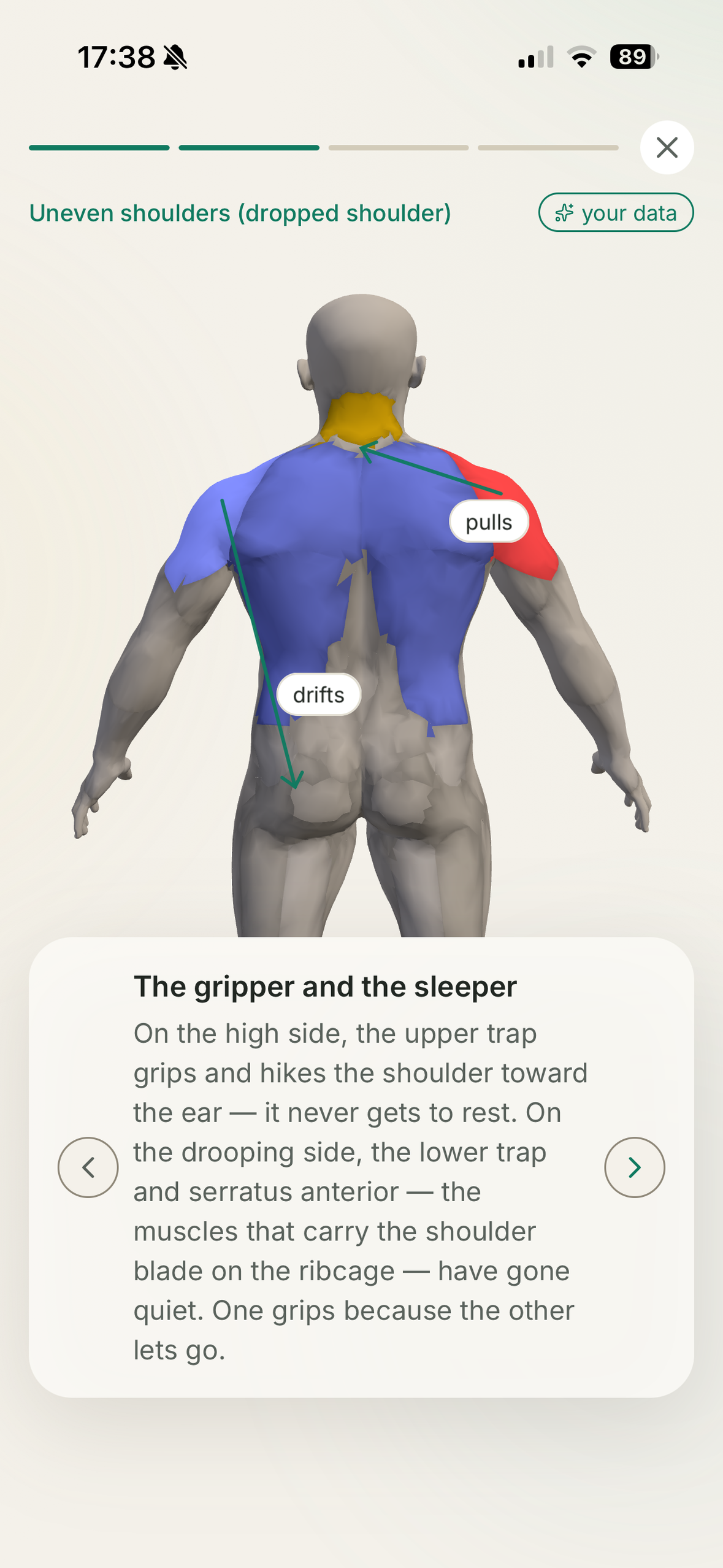
Posture Story "uneven shoulders": the 3D twin morphs into the pattern and explains which muscles grip and which drift.
-
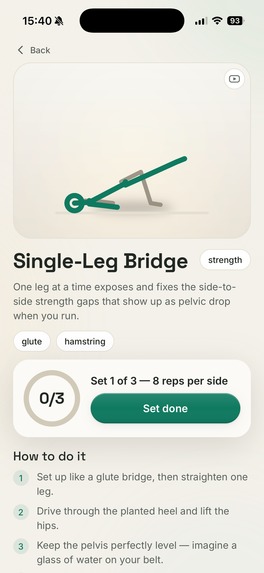
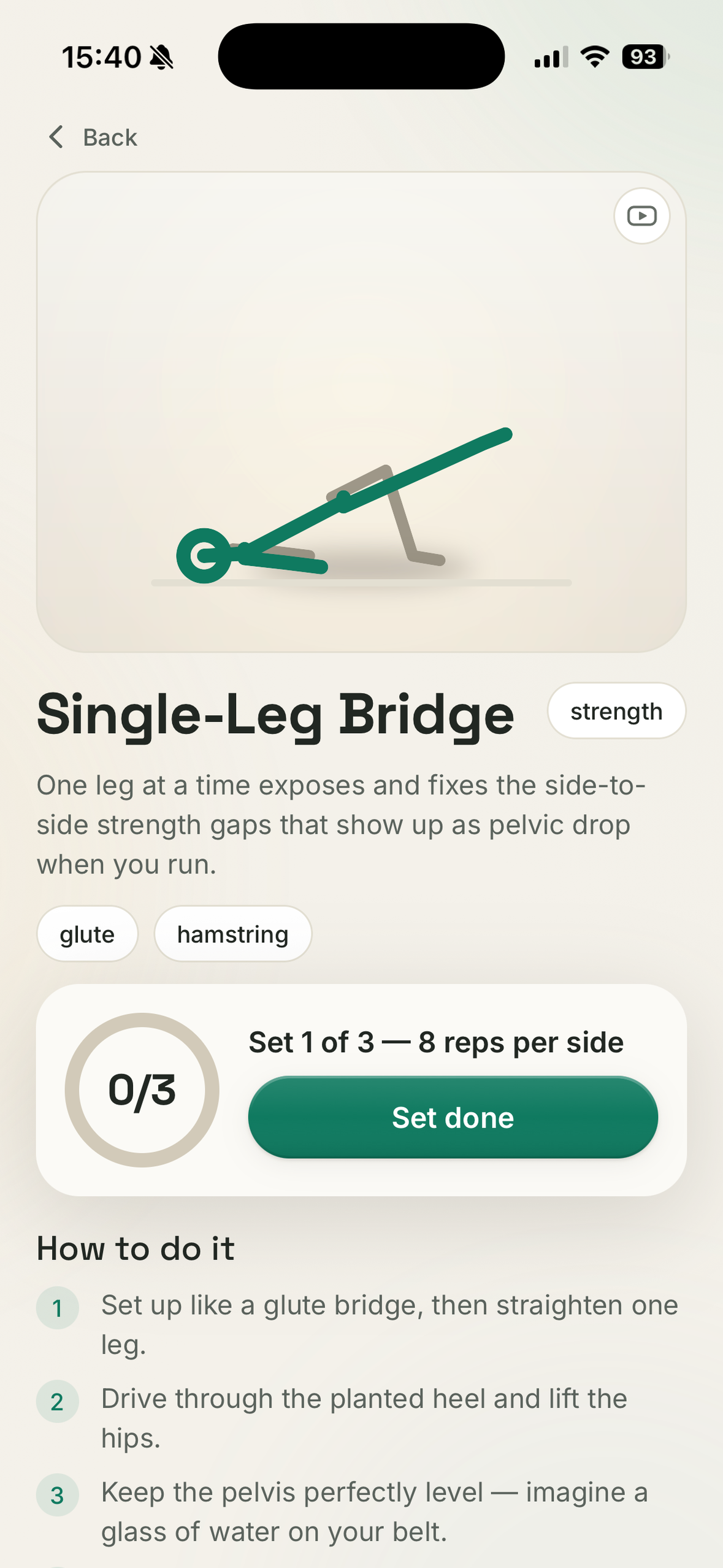
Guided exercise: set counter, "Set done" button and step-by-step instructions, with a dedicated animation for every exercise.
-
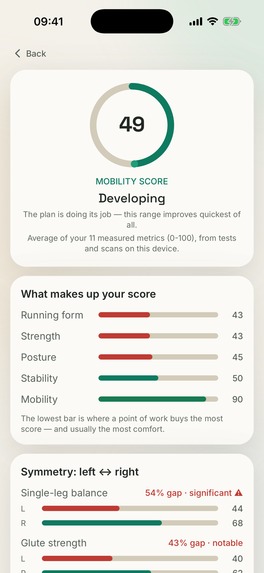
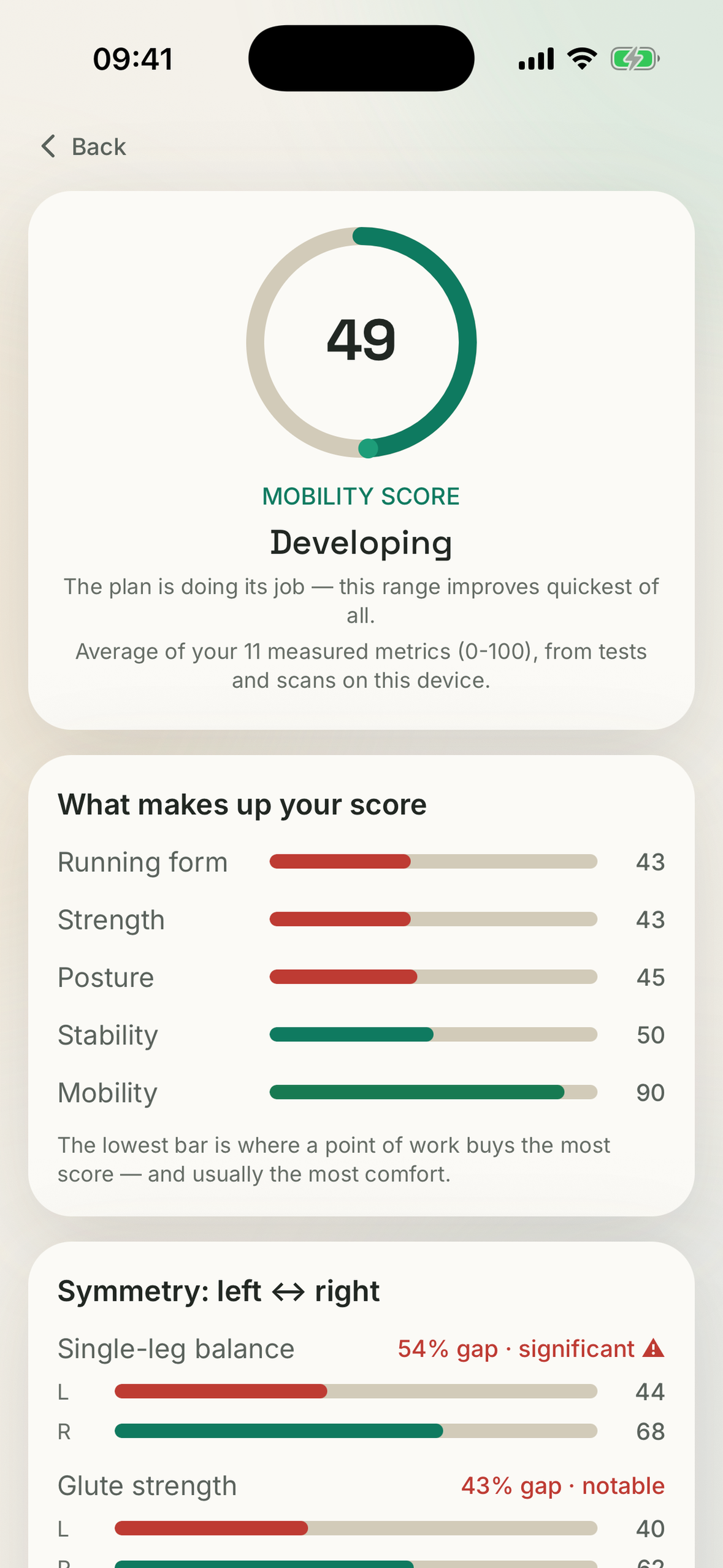
Mobility Score: an average of the user's measured metrics, broken down by area, plus a left–right symmetry check.
-
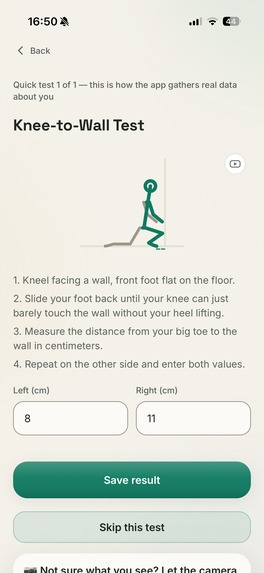
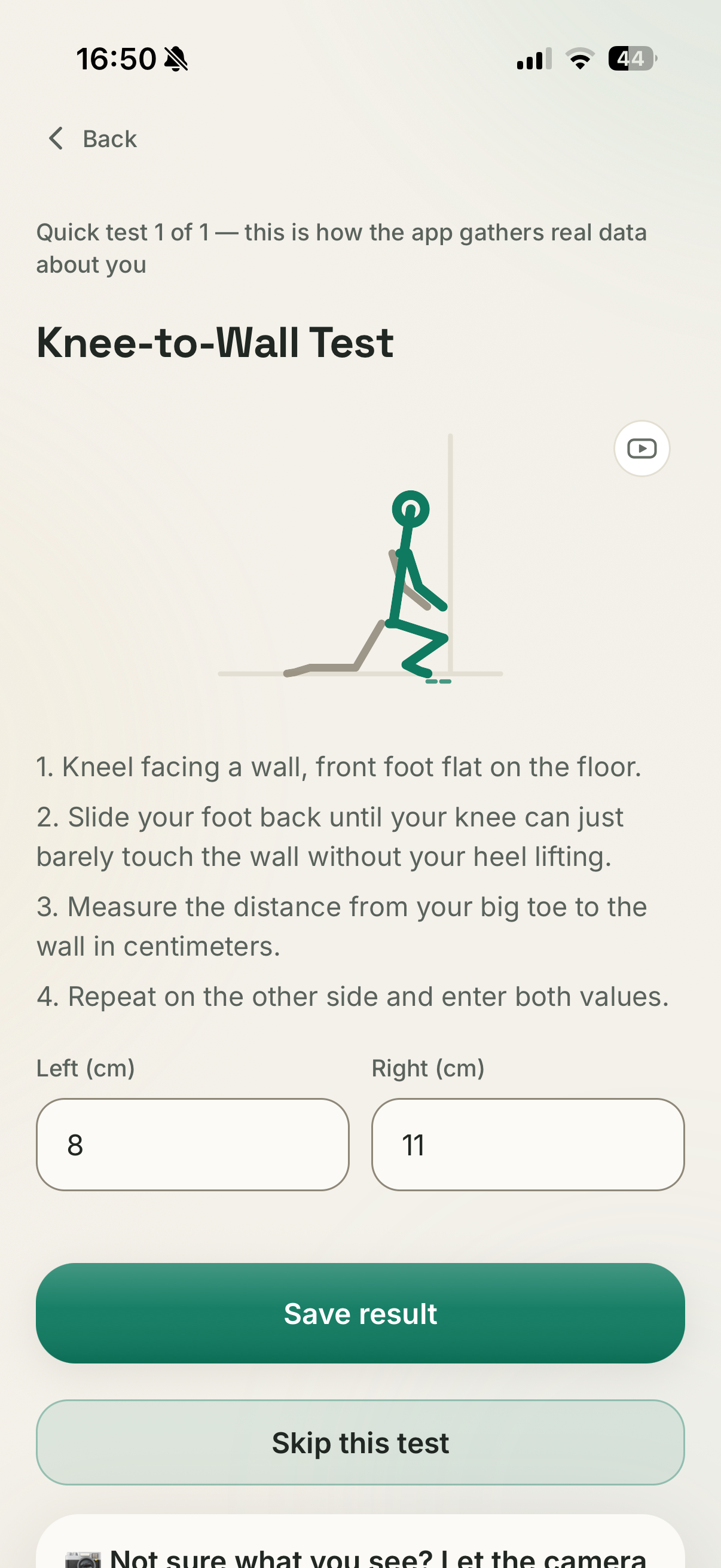
Knee-to-Wall, one of 34 movement tests: illustrated steps and a per-side result in centimetres.
-
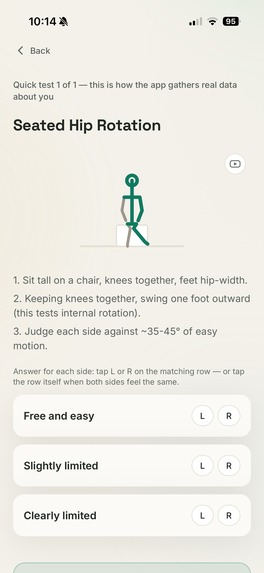
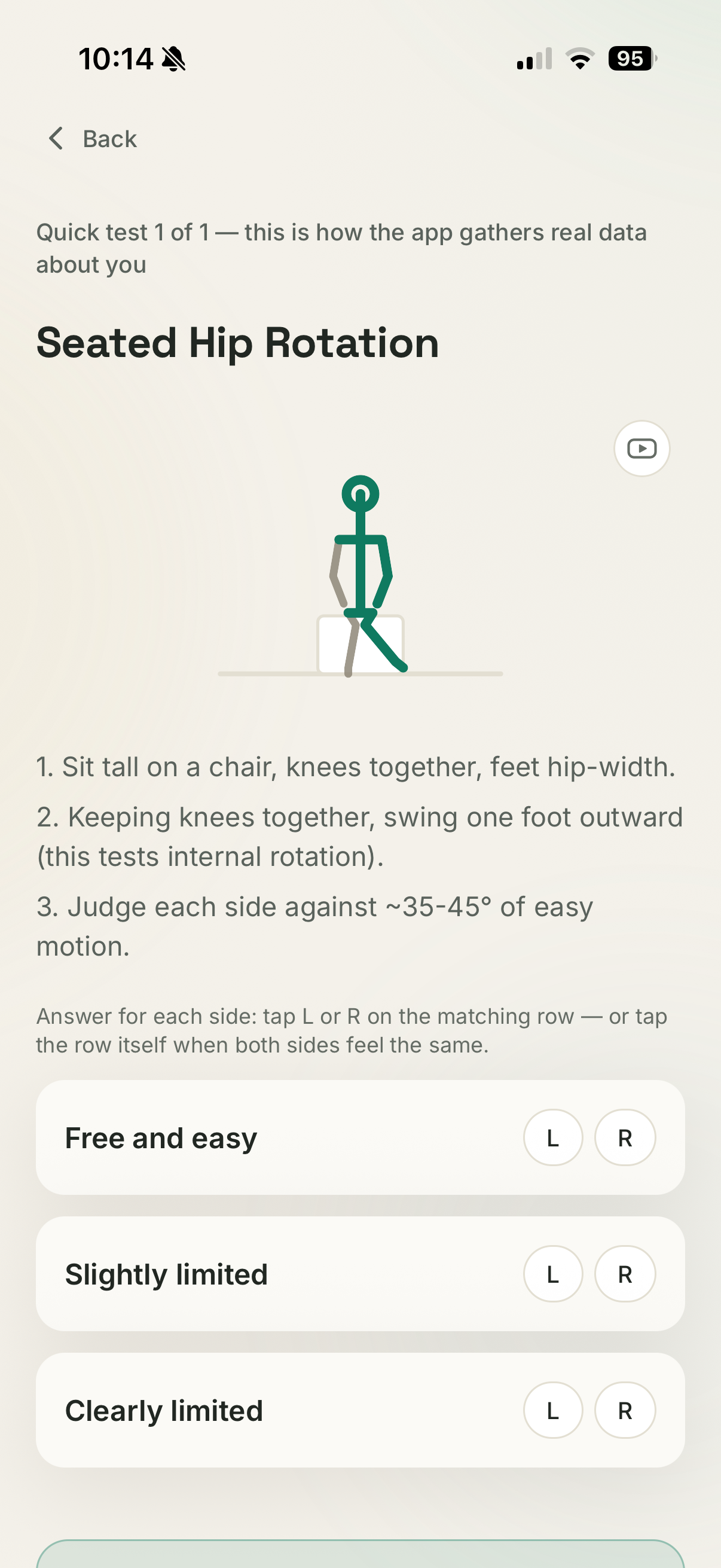
Seated Hip Rotation test: each side rated in a few taps, no equipment needed.
-
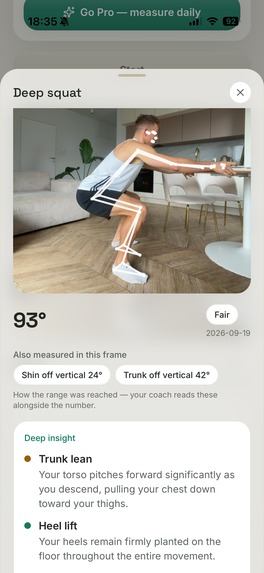
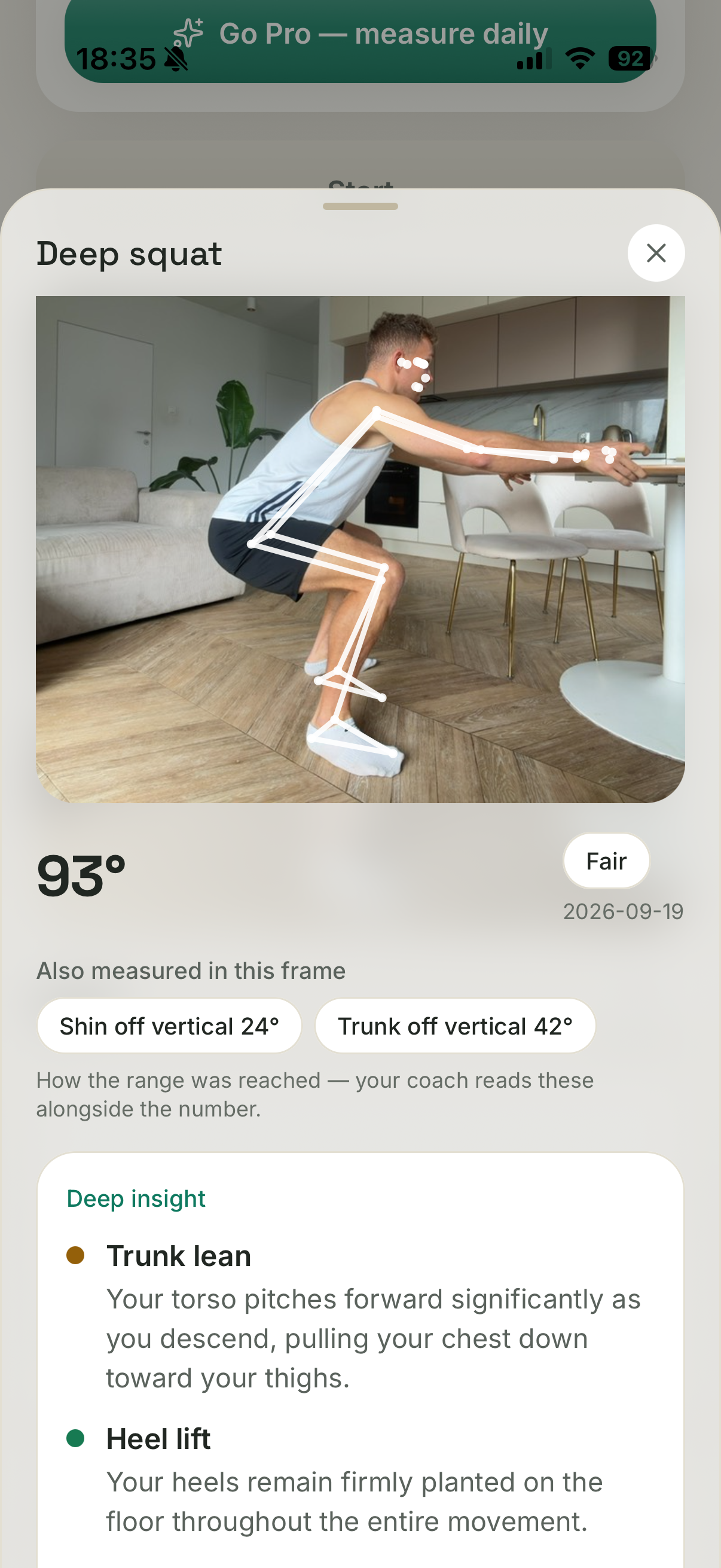
Camera range-of-motion test: 93° deep squat measured on-device, with compensations detected (trunk lean) and a Fair rating.
-
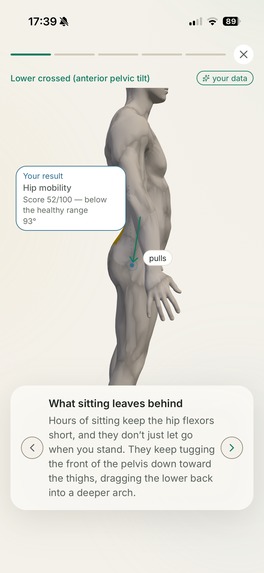
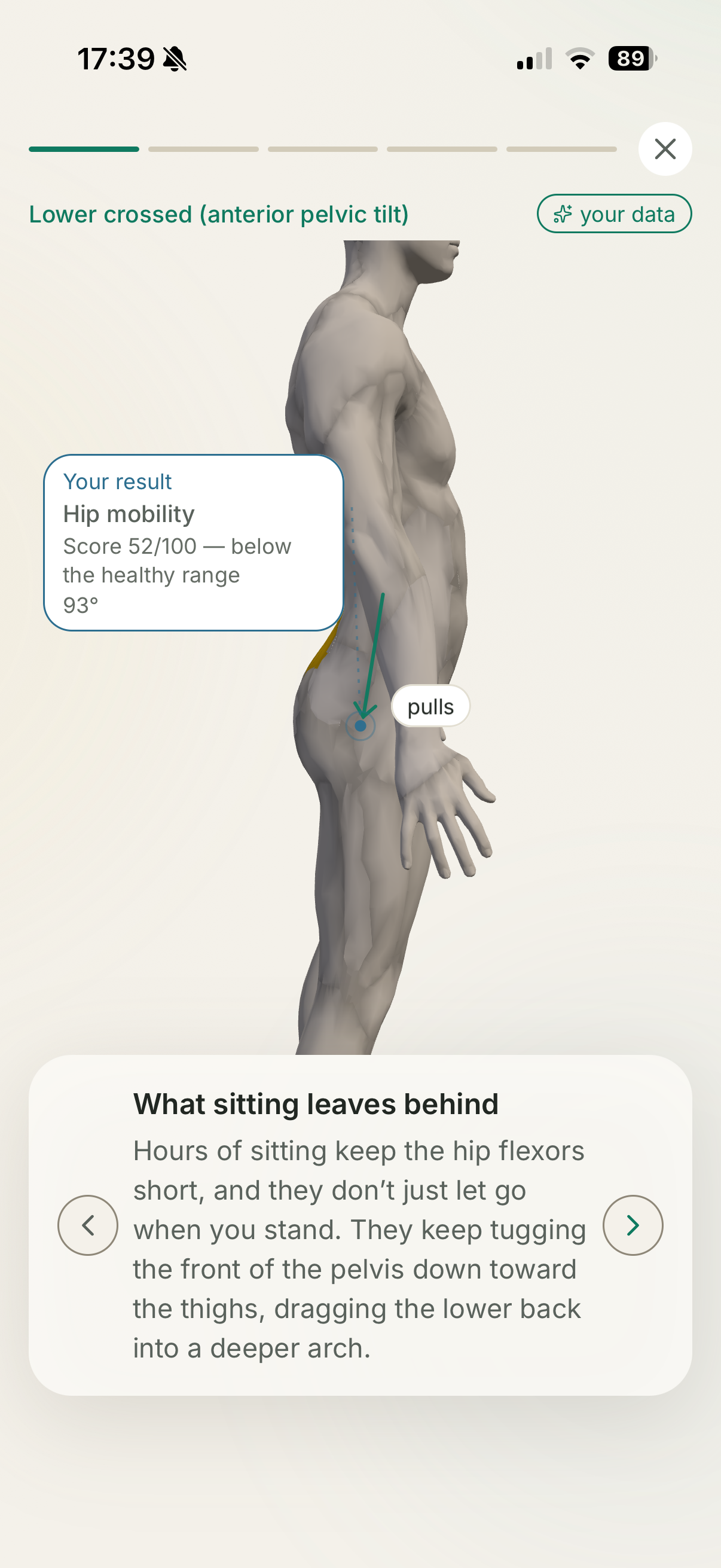
Posture Story "lower crossed": the user's hip mobility result (52/100) is pinned to the 3D body where the story explains it.
-
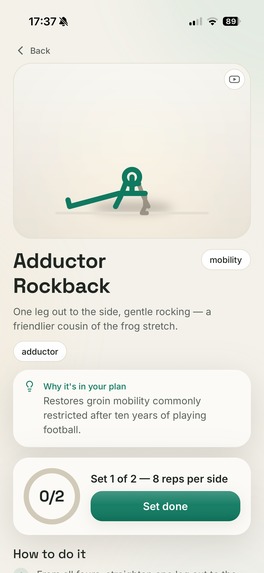
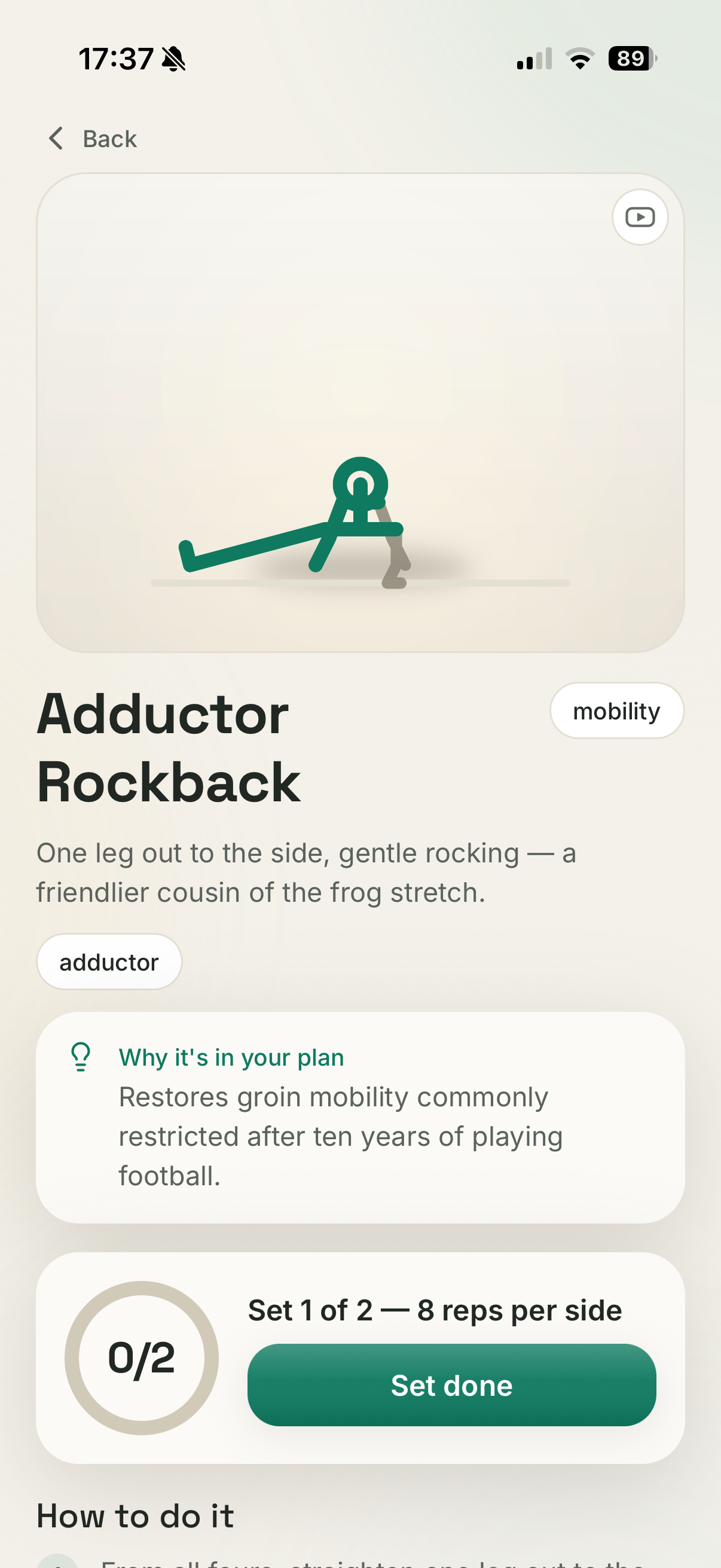
Exercise screen: every exercise states why it is in this user's plan, here linked to ten years of playing football.
-
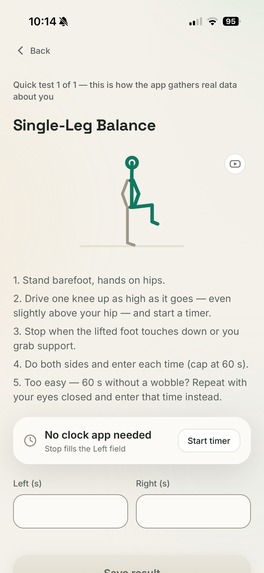
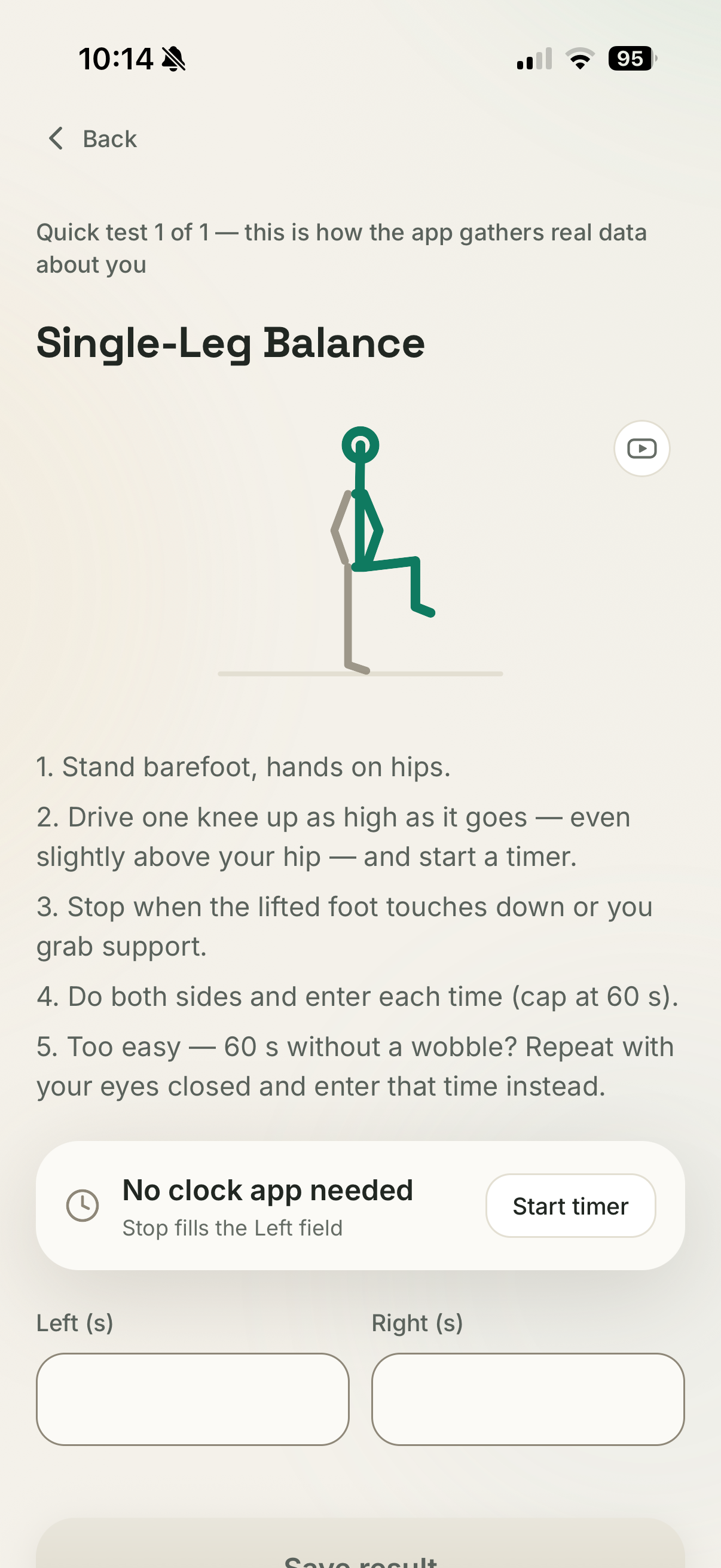
Single-Leg Balance test with a built-in timer and a per-side result in seconds.
-
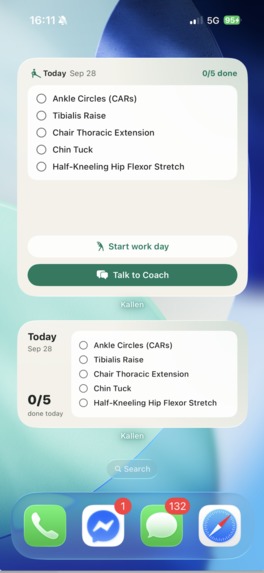
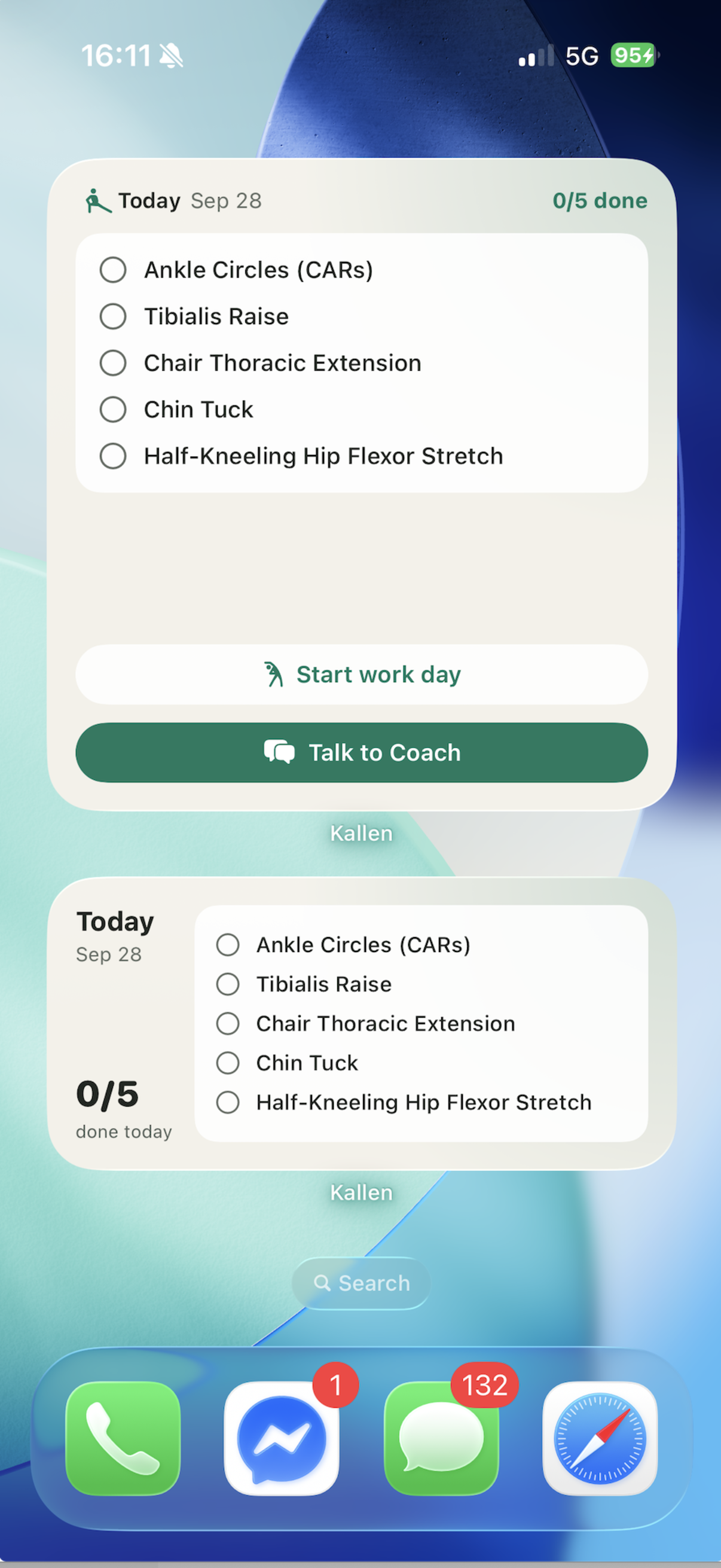
Home-screen widgets (large and medium): today's exercises, progress, "Start work day" and "Talk to Coach".
-
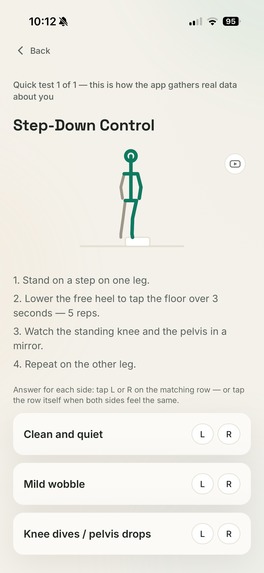
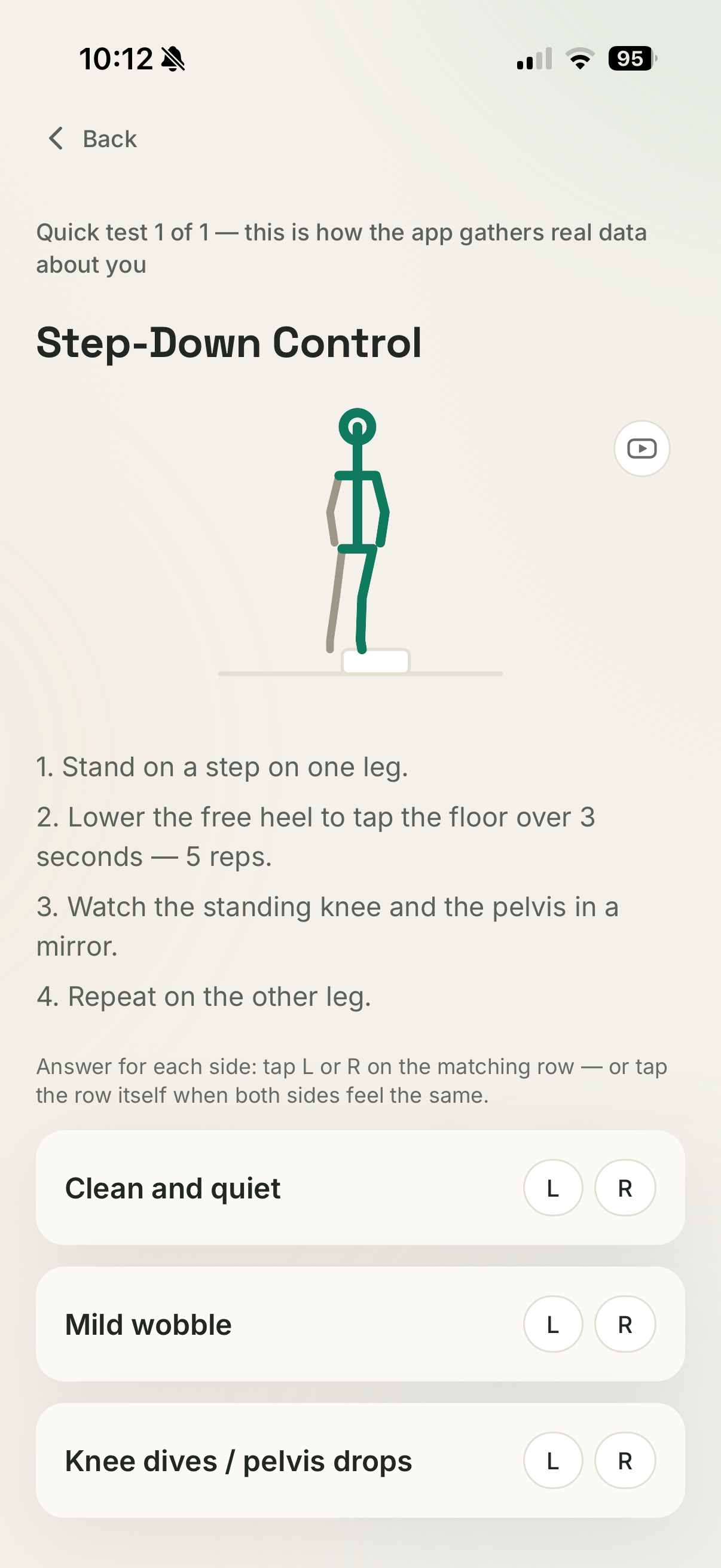
Step-Down Control test: knee and pelvis control rated per side; the result feeds into plan generation.
-

Icon

Inspiration
The Personal Struggle
Kallen grew out of my own mobility problems. I played soccer competitively for almost 10 years, and over the last few years I've been to more than a dozen physical therapists with the issues that left me with. None of them could fix anything for good. Back and knee pain kept me from walking comfortably, and at some point I couldn't play any sport at all, not even for fun. My desk job as a software developer only made my posture worse. The advice I got from the "specialists" was all about managing symptoms: "stretch your right upper trap," that kind of thing. What I needed was to understand why that muscle was tight in the first place, what it was doing to the rest of my body, and how to actually fix it.
So I decided to figure it out myself. It turned out that very long conversations with an LLM got me closer to a real diagnosis than all of those physical therapists combined. Years of soccer had locked in a whole set of asymmetries and muscle imbalances that only started showing their cost much later. My pelvis was tilted in two different planes, and my right ankle, basically set in concrete from years of kicking a ball, wouldn't let my foot roll through a step properly. After many weeks of mobility work aimed specifically at those asymmetries, my body slowly started working together again. The back pain I had been fighting for years began to fade, and I could finally get a proper night's sleep.
Since then I've been using AI to build my gym program around prehab work that targets my weak points, instead of running the same bodybuilding split as everyone else. I used it to put together my running plan, with warm-ups and running-specific mobility, and not long ago I ran a marathon in under 4 hours.
AI also helped me put together a home routine that turned around a posture years of desk work had wrecked. A handful of targeted exercises plus short mobility breaks during the workday, and my neck pain and the pain in my right wrist were gone.
The second push to build Kallen came from my mom. Her problem was unfortunately much bigger than mine: a frozen shoulder that caused her severe pain every single day and made normal life impossible. Using AI grounded in the latest research, I helped her get the pain under control and start mobilizing her arm step by step, much sooner than her doctor had suggested.
Why Generic AI Isn't Enough
That's when it clicked for me how much AI can help with problems like these: how good it is at suggesting exercises, tests, and things worth checking in your posture. But for that help to actually work, the AI needs a lot of context about the person, and it has to be genuinely inquisitive, asking questions instead of guessing. A plain conversation with ChatGPT gives you very general information and not much else. And knee pain, for example, can have hundreds of different causes, so generic advice often doesn't help at all. Sometimes it makes things worse.
But take that written context about your problems, your goals and your lifestyle, and add photos of your posture, measured body angles, results from physical therapy and fitness tests, and range-of-motion numbers, and you get something that can really help a lot of people around the world. That's how Kallen came to be.
The Global Problem: Health Inequity & Fitness Overwhelm
One-on-one physical therapy is expensive and often hard to get, so most people only react once a more serious injury shows up. In some countries, more than half of the people who need rehabilitation never receive it (WHO). Everyone else gets generic advice from the internet: hundreds of exercise lists, contradictory tips, and no way of knowing which of it applies to them.
The fitness world isn't much different. It buries us in thousands of generic plans and complicated exercises, and instead of helping, it causes decision paralysis, the "wellness overwhelm." Most busy people don't need another video library. They need one simple answer: "what exactly should my body do today?"
The Kallen Vision
Most fitness apps start from a library of exercises and plans instead of from the person. Two people can have the same goal and a completely different range of motion, posture, limitations and abilities. I wanted to build something different: an app that first understands how you move, and only then tells you what to do. I also wanted healthy movement to fit into a normal life, including for people who are parents, run their own businesses, are busy building a career, or spend most of the day at a desk. Until now, only professional athletes could afford a personal strength and conditioning coach. Kallen changes that. It gives you one clear plan for today, whether you want to lose weight, get stronger, look better, fix your posture, speed up your rehab, have more energy after work, or hit a specific athletic goal.
What it does
Kallen works in five steps: Measure → Understand → Personalize → Act → Adapt.
Measure
Kallen starts by measuring how you actually move.
- 34 movement tests covering mobility, balance, control, asymmetries and more.
- Camera-based range-of-motion measurements with real results in degrees: toe touch, overhead reach, deep squat, hip extension, side split, side bend, ankle bend and straight-leg raise.
- Posture scans that analyze how the body is aligned, with dedicated scans of the lower body, feet and arches.
- Together, the photos and test results form your individual movement profile.
Understand
Kallen combines those measurements with the wider context of your life to understand your individual movement patterns.
- Test results, ROM and posture are analyzed together, not in isolation.
- Kallen also takes into account your goals, lifestyle, training, problems and history.
- The 3D body twin shows your body and the areas that need attention most.
- The AI looks at how different results relate to each other instead of reacting to a single symptom or question. At any moment you can ask Kallen about your movement, results, exercises, training or a specific problem, and it answers in the context of your own measurements, tests, goals and history.
- Personalized education: Kallen explains your results and the possible connections between them using your own data. Educational scenes and visualizations show, on the 3D model, where a specific problem may be coming from, and the model can be filled in with your actual measurements and results. So you don't just see what Kallen found, you also understand why it might be happening and how the different parts of your body are connected.
Personalize
Based on that profile, Kallen builds a plan for you specifically.
- Kallen picks exercises based on your actual results, not just your goal.
- Every exercise in the plan has a specific purpose that comes from an earlier measurement or test.
- The plan can combine mobility, stretching, strength and movement work, depending on what you need.
Act
Kallen turns all of that context into a simple answer to one question: "What should I do today?"
- You get one simple, personalized plan for the day instead of hundreds of exercises to choose from.
- Guided sets walk you through each exercise.
- The plan is designed to fit into a normal life, without organizing the whole day around a workout. A mom of two rarely has an hour and a half to get to a group Pilates class. With Kallen she can do her session at home in about fifteen minutes, and she doesn't have to figure out which exercises she actually needs. Kallen already did.
- Reverse Sitting turns time at the desk into regular short movement breaks. Mobility Snacks are quick exercises you can do during the day, for example while working.
- Reminders at the time you choose, a home-screen widget with today's plan, a Mobility Score and badges keep you moving.
Adapt
Kallen doesn't stop at the first plan. It learns from new results and your feedback.
- Measurement history lets you track changes over time.
- The AI remembers earlier context and can carry a conversation based on your whole history, not just the last message.
- Feedback from workouts, new scans and retests can lead to a plan change with a single tap.
- Repeat measurements show whether the earlier work actually made a difference.
- As a result, the plan evolves along with you instead of staying a static program.
How I built it
I built Kallen to combine advanced biomechanical diagnostics with a simplicity that keeps all of that technology out of sight. I wanted the complexity of the data analysis to stay in the background, while the user gets a clear picture of their body, explanations they can understand, concrete guidance tailored to their needs, and the feeling that someone is genuinely looking after them.
Architecture
- The app is built on React Native and Expo.
- Data is stored on the user's device in a SQLite database.
- Computer vision & ROM measurements: I integrated MediaPipe for real-time visual analysis, so the phone camera can precisely measure joint angles (range of motion) and detect posture asymmetries.
- Contextual AI engine: I designed my own context and prompt architecture. With every message, the app assembles a complete picture of the user: muscle statuses, left/right asymmetries, angles from the camera tests, the pain journal, the symptom interview, the current plan and goals. The coach acts on that data through more than 20 tools, for example logging a pain or proposing a plan change. A single chat question triggers several model calls: the main coach answers, and smaller "judge" models check its work.
UX & Interface Design
- Zero-overwhelm UX: To kill decision paralysis ("wellness overwhelm"), I deliberately dropped complicated menus and bloated video libraries. The whole interface is built around a single question: "What exercises should I do today?"
- Interactive 3D body twin: Instead of dry reports, I built an interactive 3D model of the body. You can literally see your tightness and asymmetries: if one shoulder sits higher than the other, the difference shows on the model, and with lumbar hyperlordosis, for example, the deepened curve of the spine is reproduced precisely. It builds instant body awareness in a form that's beautiful and modern.
- In Posture Stories, the 3D model smoothly morphs into your own posture with your measured angles, the camera flies between shots, and the annotations stay pinned to the moving anatomy.
- 147 exercise and test animations, each designed from scratch and matched to the exercise's description.
- Light and dark themes, smooth animations, a Live Activity and home-screen widgets.
Challenges I ran into
The challenge was making the best possible use of data from many sources without letting Kallen jump to conclusions or take everything at face value. It had to be inquisitive, ask about the non-obvious things, and look for the connections that matter when building a personalized plan, one that works just as well for a busy mom who wants a bit of movement after work as for an athlete dealing with serious anatomical problems.
I also didn't want the education to be generic. Kallen was supposed to explain your own results, using your data and 3D visualizations. Which meant building a believable, interactive 3D model, and that was a challenge of its own.
I built a pipeline that takes an anatomical mesh (CC0, about 34,000 triangles), fits invisible anatomical volumes to it using body landmarks, and splits it into close to 80 parts, including more than 60 muscle and joint zones, with smooth borders cut along triangle bisectors. Every zone is tappable, confirmed by automated tests generated from an offline-rendered hit map. The biggest obstacle: on an iPhone, every new shader costs a few seconds of freeze, so Posture Stories deform the body on the CPU inside the existing buffers, without a single new GPU program.
Accomplishments that I'm proud of
Safety validation and a multi-layered AI architecture
I'm proud of the rigor I brought to Kallen's AI engine. The architecture underneath is a lot more advanced than it looks at first glance. To make sure the app is safe and precise, I ran thousands of automated simulations. I used a multi-model verification setup where different kinds of AI models checked, graded and refined each other's answers and exercise plan proposals. I simulated an extremely wide range of cases, from tough conditions and overuse injuries (for example: shin splints, tennis elbow, sciatica) through performance optimization in sport, all the way to everyday questions (for example, a woman looking for an easy way into Pilates). I measured the repeatability and accuracy of the answers over and over, so that Kallen supports people safely and precisely, whatever their movement challenge is.
Launch, Growth & First Users
- I only started marketing Kallen a few days ago, and the RevenueCat dashboard already shows almost 100 people using Kallen in the last 28 days. It makes me happy that Kallen is already helping real people ❤️ and I know this is just the beginning.
- A Google Ads campaign for iOS.
- Apple Ads: ads in App Store search results, right at the moment someone types "posture," "back pain," "stretching" or "mobility."
- The website, kallen.app: a long-term investment in SEO and GEO, with guides that answer the questions people type into Google. The content is also optimized so that AI search engines like ChatGPT, Perplexity and Google AI Overviews can cite it.
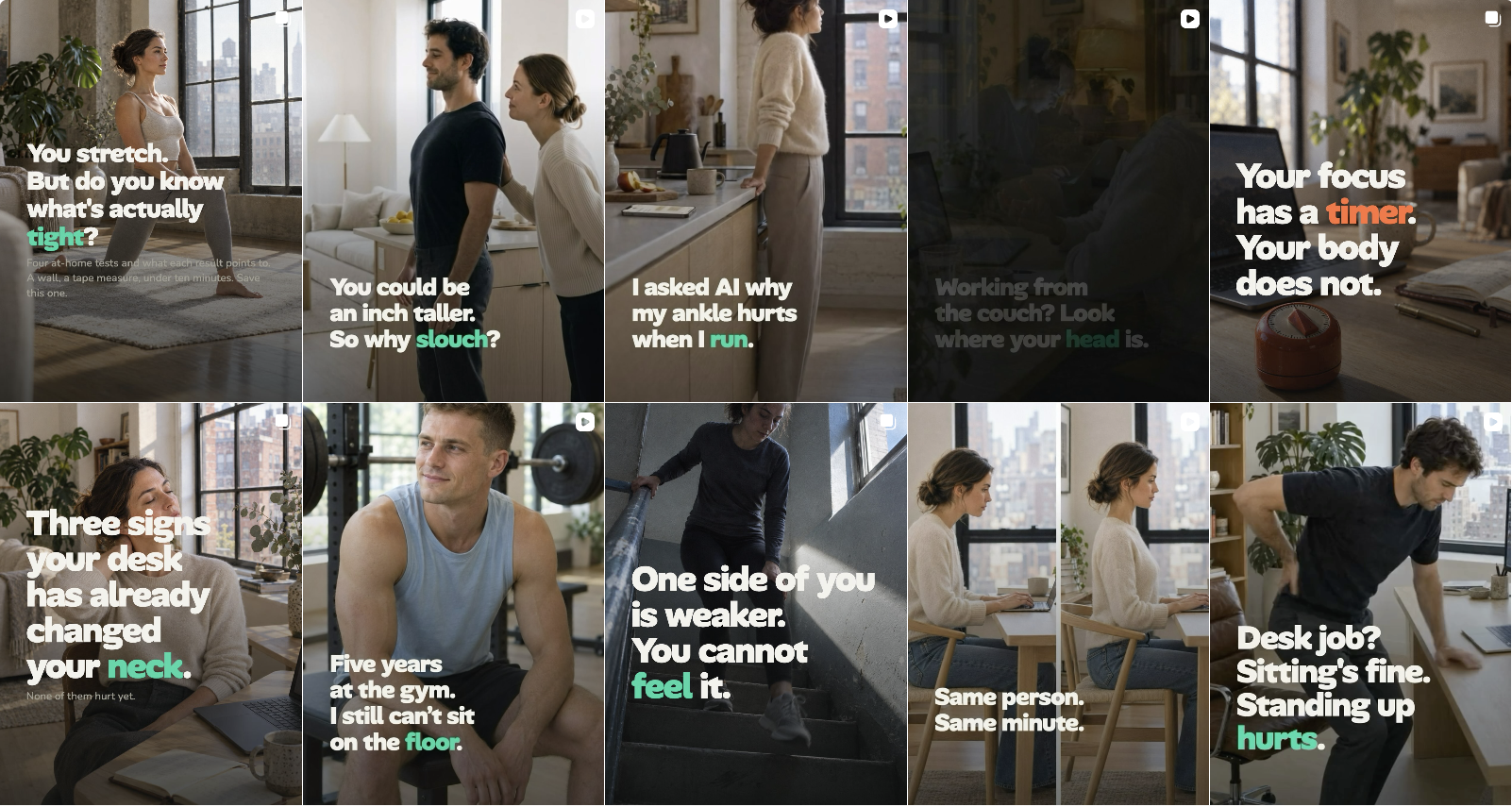
- Kallen on TikTok and Instagram.
A dedicated partner platform and a custom RevenueCat integration
To build a scalable growth loop, I created a dedicated tool for running partner programs for mobile apps as part of my platform, Polyreach. I built a custom, direct integration with RevenueCat that lets online creators earn a steady monthly income (a subscription commission) for bringing in new users.
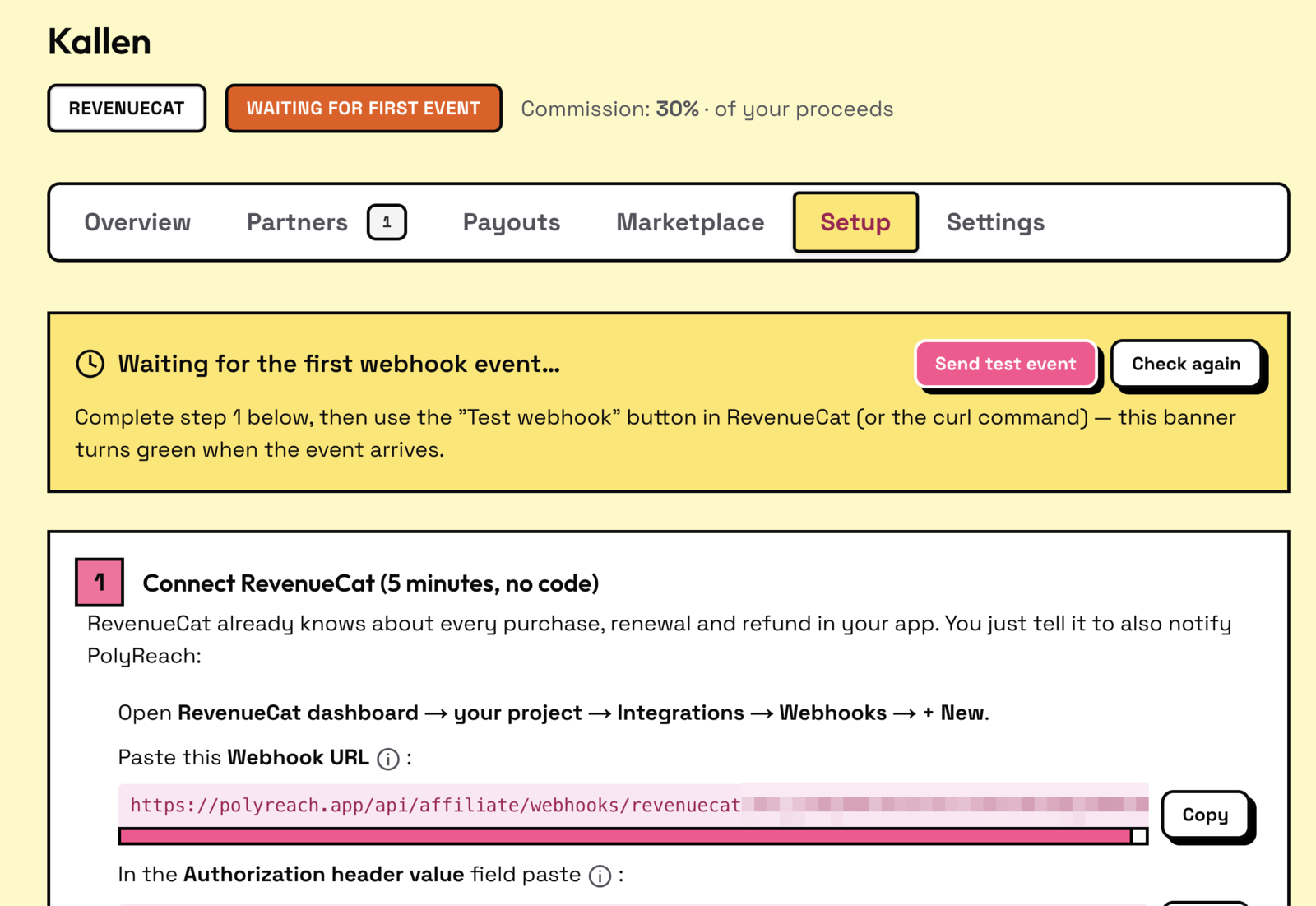 Through the Kallen Partner Program I'm partnering directly with creators in health, fitness, physical therapy, office ergonomics and productivity. The first creators are already lined up to promote Kallen as brand ambassadors!
What I learned
Working on Kallen showed me that a shallow, conversational chat with an LLM isn't enough where human health, sport and fitness are at stake. The deeper and more structured the context you give the AI, from precisely measured movement angles and posture scans to a detailed history of habits and how the person feels, the more targeted, safe and genuinely helpful the answer becomes. Fitness and injury prevention don't have to run on averaged-out, generic advice. With a well-thought-out architecture, we can take advanced biomechanics knowledge to a completely new level and deliver it in a precise, safe form.
What's next for Kallen
- An Android version. Kallen is built in React Native and already runs on Android; after a few adjustments it will be available for download soon.
- Global expansion: translating Kallen into many more languages.
- Apple Health and Apple Watch integration, so Kallen can take an even wider context of daily activity into account, including movement, training and recovery. Two-way sync with Apple Health and Android Health Connect: Kallen won't just read daily activity data, it will also write completed mobility sessions, calories burned and flexibility metrics straight into Apple Health, becoming a consistent part of the user's digital health profile.
- A compact Apple Watch app, so Kallen can be with you even when the phone isn't. Mobility Snacks and Reverse Sitting will run right from the wrist, with a countdown, instructions and haptic cues, no need to reach for the phone. That will make it even easier to fit purposeful movement into every single day.
- The next and most important step after the hackathon is to focus on growth marketing and distribution.
Built With
- expo.io
- react-native
- sqlite
- typescipt


Log in or sign up for Devpost to join the conversation.