-
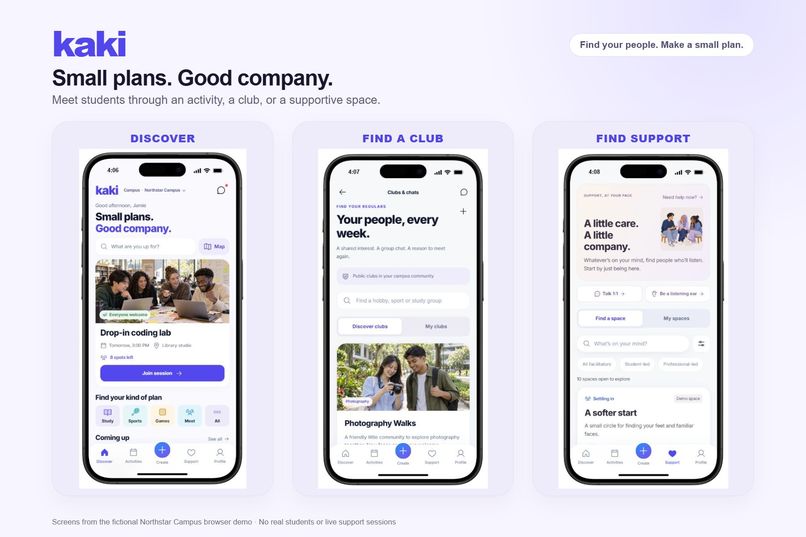
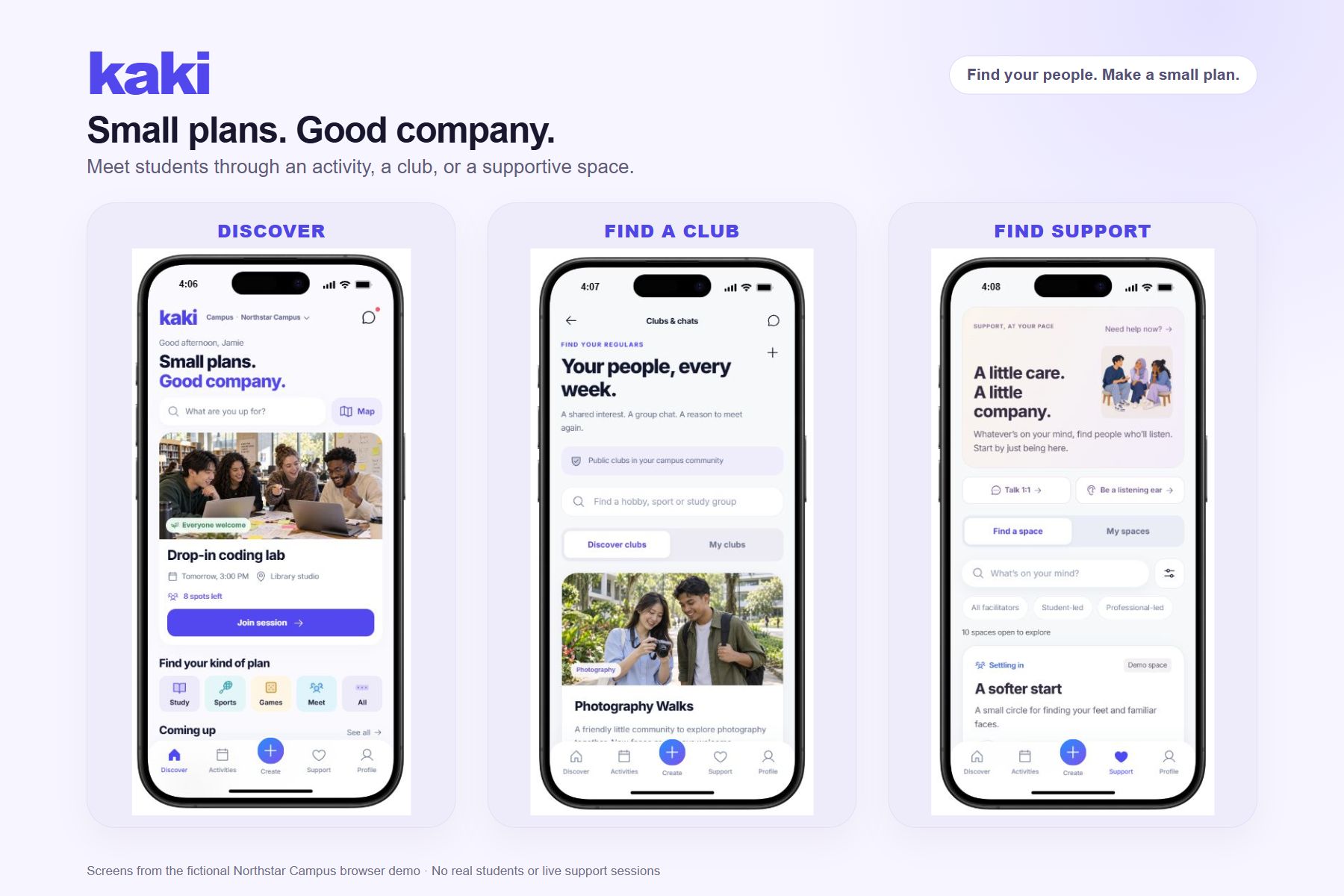
Discover activities, clubs and support at fictional Northstar Campus
-
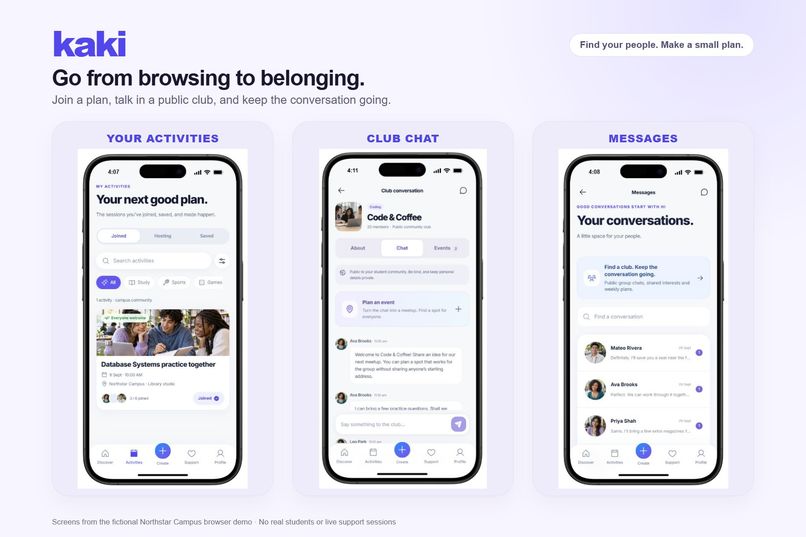
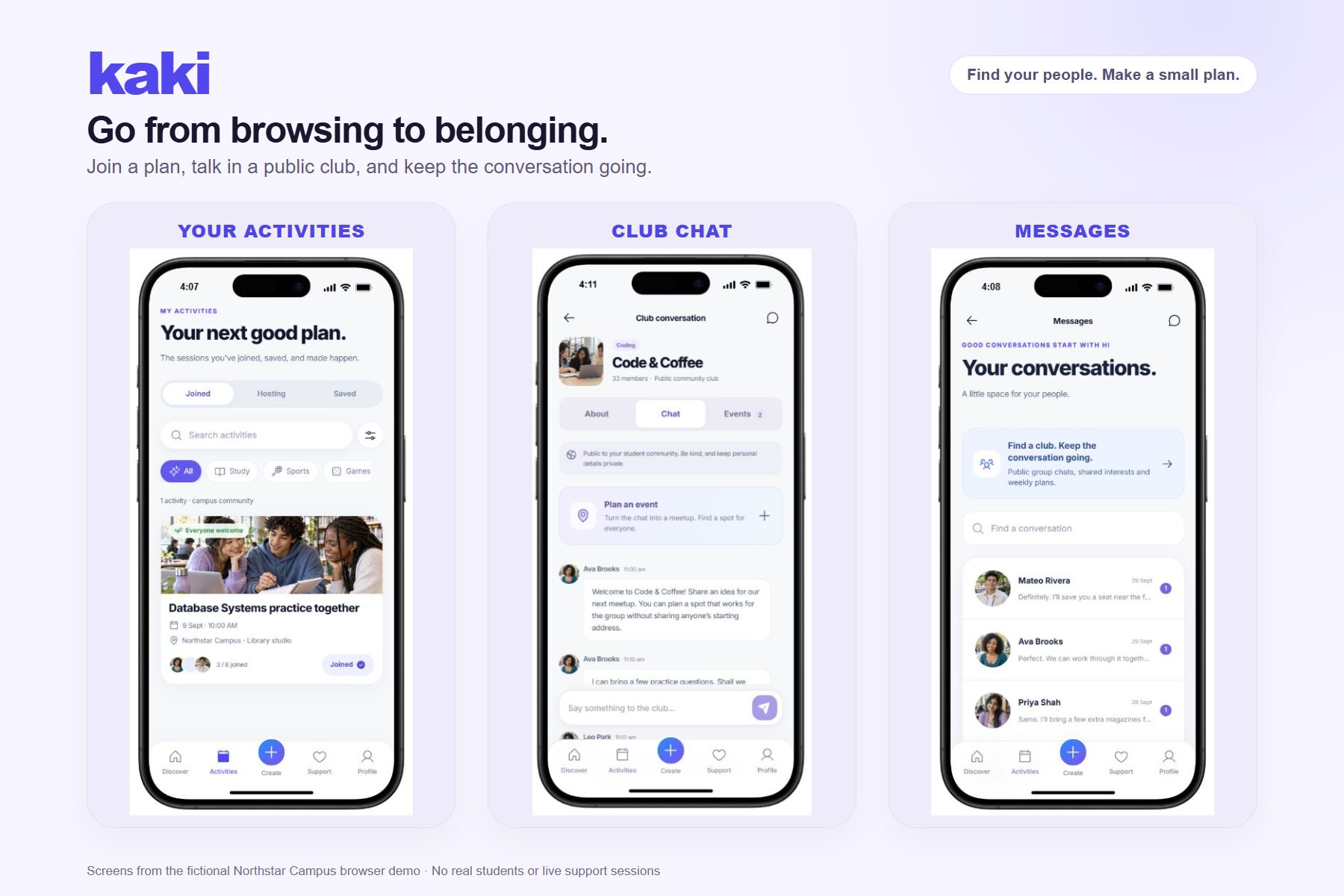
Join activities, plan in club chat and keep up with friends
-
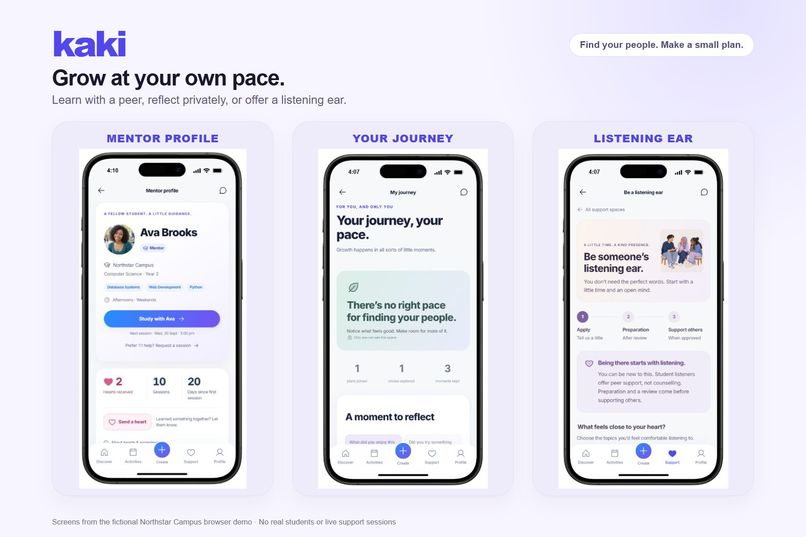
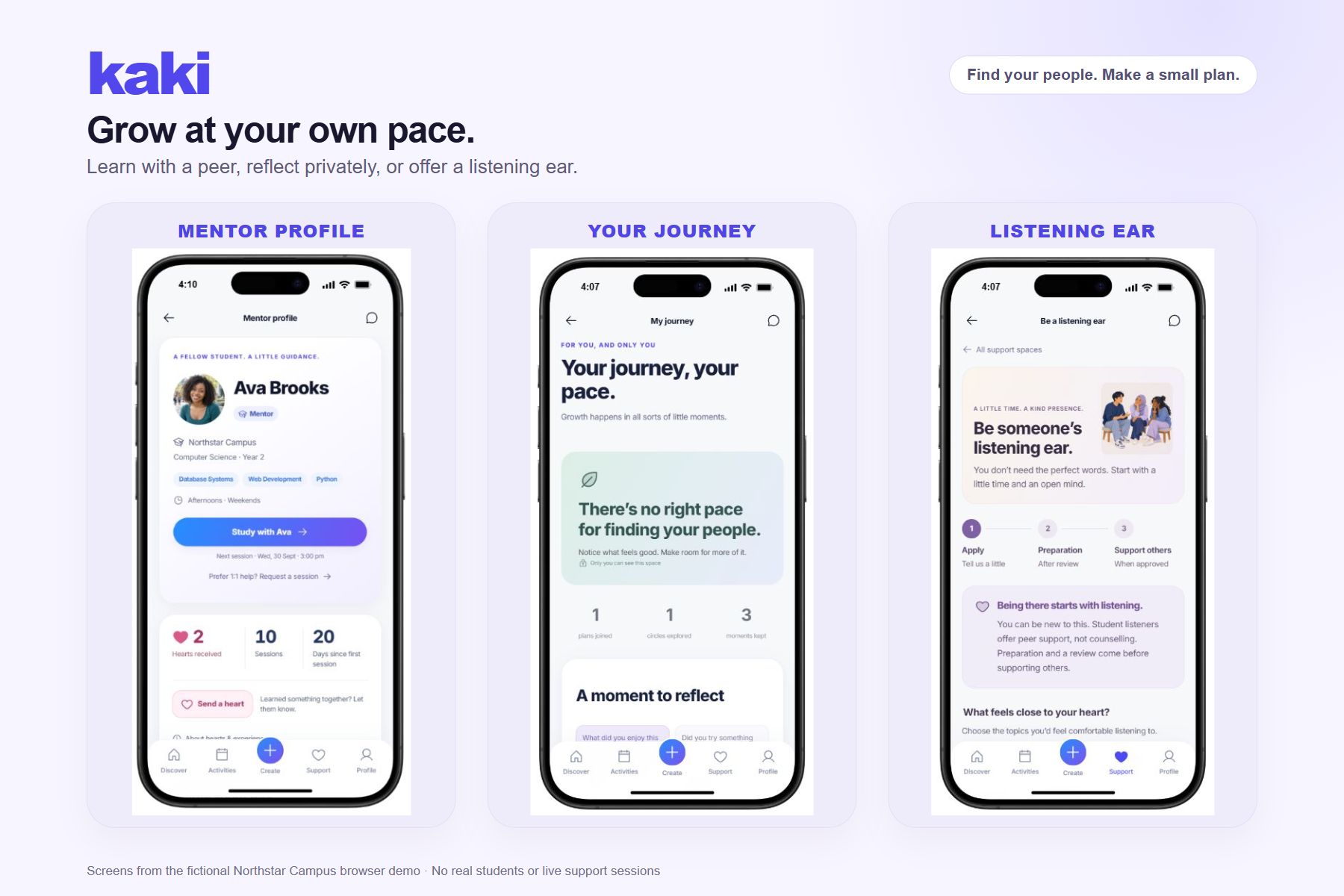
Mentor hearts and experience, private reflections and peer listening
Inspiration
Many students want to make friends or ask for support, but the first step can feel surprisingly big. Opportunities are scattered across feeds and chats, and showing up alone to a large event is not easy. kaki starts with a smaller invitation: a shared plan with a clear activity, time, place and host.
What kaki does
kaki is a mobile-first student community app that helps students find people through doing something together. Discover study tables, sports, games, lunches and creative sessions; join as a peer or mentor; see where a plan meets; and continue the conversation through clubs and messages. Clubs can host recurring meetups and suggest a convenient public venue from members' privately submitted starting postal codes.
Support is part of campus life too. Students can explore small or larger support groups, request a one-to-one conversation, or apply to be a student listening ear. Students can also write private Journey reflections after participating. The prototype separates ordinary public activity from private support participation. Peer listening is not presented as counselling.
Who it is for
Students building a new circle at school, especially newcomers and anyone who finds it easier to connect around a low-pressure activity than through a cold introduction. The experience also gives student hosts, peer mentors and listeners clear ways to contribute. Community and age-band access rules keep student spaces relevant to eligible members.
What makes it different
- A small plan is the entry point. Instead of starting with swipes or an empty chat, students can say yes to a concrete activity with a time, place, capacity and host.
- One encounter can become a community. Discovery, joining, club discussion, weekly planning, mentorship and messages form a connected path from first meeting to repeat participation.
- Mentorship uses appreciation, not rankings. Public mentor profiles show days mentoring, completed sessions and hearts from eligible past study peers. New mentors get a New tag; there are no star ratings or invented credentials.
- Meeting-place planning respects privacy. Members enter starting postal codes privately; the group sees suggested public venues rather than everyone's individual starting point.
- Support belongs in the same student journey. Peer-led spaces and illustrative facilitated options are easy to find, while membership, applications and conversations stay separate from public profiles and activity feeds.
- Growth stays personal. Private Journey reflections let students notice what helped and what they want to try next, without turning self-development into a public score.
These are prototype features and hypotheses to validate with students, not claims of proven wellbeing outcomes.
How we built it
React, TypeScript and Vite power the interface. The local developer version uses a Node.js API and SQLite to persist activities, memberships, messages and privacy rules. Leaflet powers map views. The live demo opens directly into fictional Northstar Campus; its students, mentors, conversations and support groups are sample data stored in each visitor's browser. Map pins there are illustrative, not directions. The GitHub repository includes the code, setup guide and tests.
Challenges and learning
Making social features useful means handling the details behind the cards: capacity, community and age boundaries, consent, support privacy, waitlists and repeat events. We implemented and tested these flows. We also learned to make the first step specific and approachable, then test whether it leads to a meaningful return visit.
What's next
Interview students, run a supervised campus pilot, and measure whether people move from browsing to a first plan and from a first plan to repeat participation. Real-world use would also require enrolment checks, facilitator review, staffed moderation and local support-service integrations.
AI and outside resources
OpenAI Codex assisted with coding, testing, copy and design iteration; OpenAI ImageGen created fictional student photos for the demo. I reviewed and integrated the output. Open-source dependencies and third-party event sources are credited in the repository. Sample people, credentials and conversations do not represent real users or adoption.
Built With
- leaflet.js
- node.js
- openai-codex
- openai-imagegen
- react
- sqlite
- typescript
- vercel
- vite

Log in or sign up for Devpost to join the conversation.