-
-
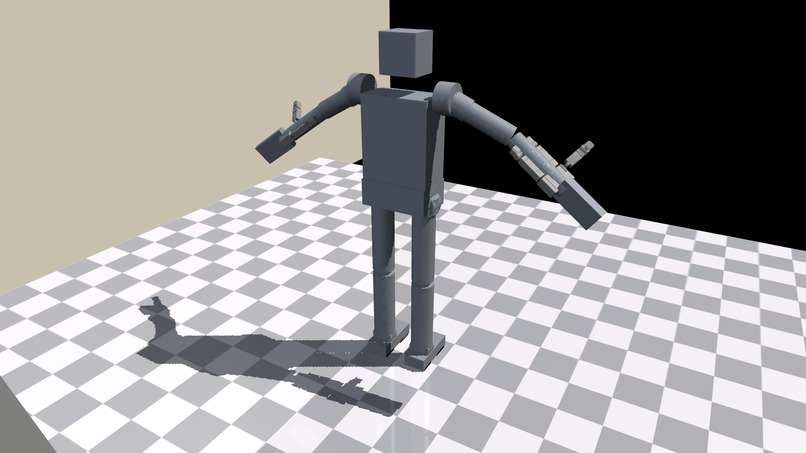
A single robot shot from a diagonal angle
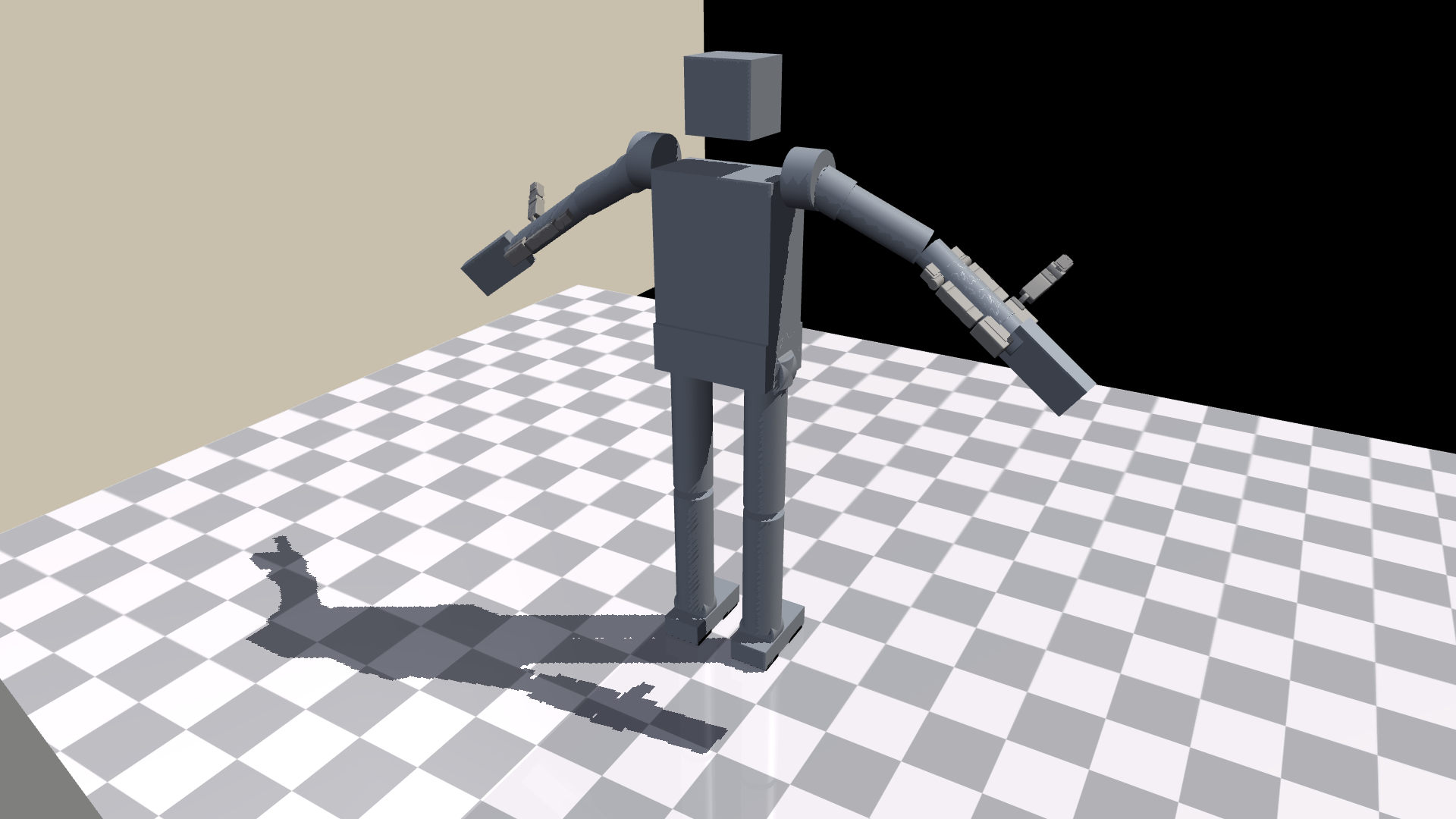
Kaji-Suru Moto
AI assistance disclosure: I wrote the original content in Japanese and remain responsible for all project details, technical claims, and conclusions. ChatGPT was used to translate, organize, and polish the English text.
Inspiration
My family name is Kajimoto. In Japanese, “kaji” means housework, which makes it ironic that I have never been particularly good at it.
That joke led to a serious question: could I build another “Moto” that actually does housework?
Kaji-Suru Moto means “Moto who does housework.” What began as a wordplay became a from-scratch project to design a household humanoid, along with the simulation, training, and evaluation infrastructure needed to eventually operate it in a real home.
What it does
Kaji-Suru Moto is an end-to-end development and evaluation platform for a household humanoid robot.
The current robot is designed to be 1.35 meters tall, weigh approximately 28 kilograms, and have 29 actuated degrees of freedom. Its first practical target is to move dishes from a dining table to a kitchen sink.
The project can:
・import a real room from captured images; ・calibrate and evaluate the reconstructed scene; ・procedurally generate varied household environments; ・export environments to MJCF and USD; ・generate synchronized full-body robot and hand models; ・run standing, contact, grasping, and household-interaction evaluations; ・record metrics, diagnostic logs, audit data, and demonstration videos.
The project does not yet autonomously perform complete household tasks. The current result is the simulation and evaluation foundation needed to train those behaviors reliably.
How we built it
The robot model is generated from structured parameter tables containing dimensions, masses, inertias, joint ranges, actuator limits, friction estimates, and controller parameters. From this shared source, the project generates URDF, MJCF, and USD assets through a controlled pipeline rather than maintaining each format manually.
During Build Week, I developed five major areas.
For scene ingestion, I implemented frame extraction, COLMAP reconstruction, ArUco-based calibration, manifest generation and validation, ground-truth evaluation, and automated report generation. I also added a registered example scene based on EV-REPLICA-ROOM0.
For environment generation, I created a procedural household and furniture generator with object catalogs, collision meshes, material and mass rules, MJCF and USD export, scene validation, and evaluation-level checks. I ran 100 generation probes, a 500-case robustness test, a 30-scene benchmark, throughput measurements, gallery export tests, and audit logging.
For the full-body robot, I maintained synchronized robot assets, configuration data, hashes, standing tests, and model-consistency tests. The existing design contains 29 movable joints and automated checks for mass, joint limits, symmetry, and deterministic generation.
For the robot hand, I implemented URDF and mesh generation, CoACD collision decomposition, MJCF and USD conversion, self-collision analysis, grasp-scene generation, and grasp execution. The collision rules expand 112 logical body pairs into 282 MuJoCo geometry pairs across four MJCF configurations.
Finally, I added demonstration tooling for standing, furniture pushing, metrics collection, diagnostics, and showcase-video generation.
GPT assisted with project decomposition, technical planning, review, failure analysis, and supervision of the development process. Codex implemented constrained engineering tasks with explicit file scopes, input-output contracts, acceptance tests, definitions of done, and prohibited modifications.
Challenges we ran into
The largest challenge was that a simulation can look successful while being physically wrong.
An early standing test passed because unsupported damping had been added to the robot’s floating root joint. The test was green, but the artificial stabilization concealed a real instability. I removed it, treated the result as a failure, investigated the underlying dynamics, and corrected the ankle-controller parameters.
The hand exposed even harder problems. Self-collision tests exceeded the three-millimeter penetration limit, tactile-interference checks failed, and the official MuJoCo grasp evaluation currently succeeds on zero of twelve objects. Isaac validation also remains incomplete because the final USD asset has not yet been generated.
These are not results I want to hide. They identify the specific engineering problems that must be solved before claiming reliable manipulation.
Accomplishments that we're proud of
During Build Week, Kaji-Suru Moto progressed from a robot-model project into an integrated robotics development stack.
I built pipelines for real-scene reconstruction, procedural environment generation, full-body model generation, hand construction, collision analysis, evaluation, diagnostics, and demonstration production.
I am particularly proud that the system records failed evaluations as first-class results. The 500-case robustness test, grasp results for twelve objects, collision diagnostics, benchmark metrics, and audit logs provide reproducible evidence rather than relying only on visually convincing demonstrations.
The demo test suite currently passes four tests, and the corrected full-body model can maintain a standing pose in MuJoCo without unsupported root stabilization.
What we learned
I learned that passing a test is not the same as building a correct robot.
Robotics requires traceable physical assumptions, synchronized assets, measurable acceptance criteria, and a strict separation between demonstrations and validated capabilities. A visible failure with useful diagnostics is more valuable than a successful-looking result produced by an unrealistic workaround.
I also learned that AI coding agents perform best under explicit engineering governance. GPT and Codex accelerated the project, but only when tasks clearly defined what could be changed, what evidence was required, and which shortcuts were prohibited.
What's next for Kaji-Suru Moto
The immediate priority is to resolve the hand’s self-collision and tactile-interference failures and improve the official grasp result from zero of twelve objects.
I will then complete Isaac USD generation and validation, integrate the authoritative full-body and hand models with the demonstration environment, and replace scripted demonstrations with trained manipulation and whole-body policies.
In parallel, I plan to develop an open-source tactile-sensing system for contact force, pressure, and slip detection.
The long-term goal remains unchanged: manufacture Kaji-Suru Moto and have it safely perform useful household work in a real home—starting with carrying dishes from the dining table to the kitchen sink.
Built With
- humanoid
- issac

Log in or sign up for Devpost to join the conversation.