Inspiration
I often see AI tools that immediately rewrite SQL queries, acting as a black box that bypasses critical thinking. I wanted to build a tool that doesn't just "fix" code, but helps me understand database optimization principles deeply. For me, the true value of this project wasn't just getting to a finished binary, but enjoying the process of engineering a clean solution from scratch. Inspired by the Japanese philosophy of continuous improvement (Kaizen), I created KaizenSQL (kzql) to bridge AI inference with Socratic mentorship, delivering an ultra-fast, minimalist CLI that acts as a senior database mentor right in the terminal.
What it does
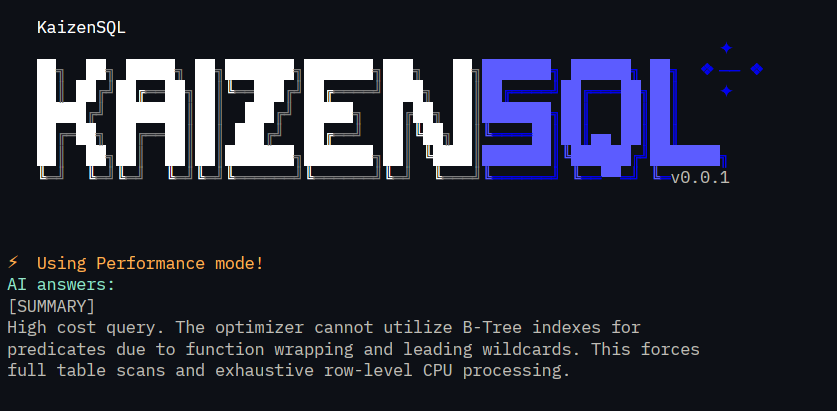
KaizenSQL is a lightweight, zero-dependency AI CLI I built in Go for SQL query analysis, performance profiling, and security review. Instead of returning raw rewritten queries, its primary Mentor Mode uses a Socratic approach to highlight performance bottlenecks (such as non-SARGable predicates, implicit type conversions, and missing index patterns) and guide developers toward understanding why a query is inefficient. It features an interactive TUI file picker, smooth ASCII branding, and standard Unix exit behaviors.
How I built it
- Language & TUI: I chose Go to keep execution instantaneous and the binary footprint minimal. I crafted the interactive file picker, terminal layout, and ASCII branding using the Charm ecosystem (
bubbletea,bubbles,lipgloss). - Inference Pipeline: I integrated Groq’s high-throughput API to run open-weight models (Qwen/Llama) with zero third-party SDK bloat.
Challenges I ran into
- Strict OTPM Rate Limits (HTTP 429): Working within free-tier API constraints, I ran into instant
429rate limit errors. I discovered that the root cause wasn't input volume (TPM), but the default SDK reservation for Output Tokens Per Minute (OTPM). I solved this by enforcing explicitMaxTokenscaps at the request level. - CLI UX Synchronization: Implementing an animated ASCII banner without locking the terminal required managing custom tick cycles (
tea.Tick) and state machines in Bubble Tea before gracefully transitioning into the file selection model.
Accomplishments that I'm proud of
- Embracing the Process: Turning every friction point—from rate limits to state management—into a deliberate learning experience rather than rushing to a quick fix.
- Zero-Dependency Core: Building a fully self-contained Go binary with embedded rule sets that runs out-of-the-box on Linux and macOS without needing external asset directories.
- Token Efficiency: Reducing System Prompt token footprint by up to 80% through dynamic heuristic injection.
- Craftsmanship-Driven DX: Creating an intuitive "first contact" experience with smooth keyboard navigation, clear error output on
os.Stderr, and standard Unix exit codes.
What I learned
- The Joy of Craftsmanship: Focusing on the journey of building taught me that wrestling with low-level details—like state machines or SDK behaviors—is where real growth happens as a software craftsman.
- API Constraints Drive Architecture: Understanding the subtle distinction between input TPM and output OTPM was essential for designing low-latency, free-tier-friendly LLM tools.
- State Machines in TUIs: Mastering the Elm architecture (Model-Update-View) through
bubbleteashowed me how to orchestrate terminal animations, keypresses, and program exits deterministically.
What's next for KaizenSQL
- AST SQL Parser: Adding a true SQL AST parser (such as
pingcap/parser) for deeper structural analysis. - Custom Local Rules (
.kzqlrules): Allowing developers to define custom project-level Markdown rules for specific database standards. - Documenting the Journey: Writing in-depth technical write-ups on Dev.to and sharing tactical posts on LinkedIn to break down everything I learned while building this project.
Built With
- ai
- cli
- go

Log in or sign up for Devpost to join the conversation.