[In person]
Inspiration
During our initial brainstorming, the topic of neurodivergence was brought up, and the project path was leading towards solving a technological problem that neurodivergent people struggled with. After some discussion, it was brought to our attention that one of our team members is actually neurodivergent. Our teammate brought up several challenges they faced in regards to staying focused while studying. This discussion was what led to figuring out our problem space: ADHD impacts attention, decision-making, and time management. Many existing productivity tools, while helpful in theory, overwhelm ADHD users in practice. They bombard neurodivergents with cluttered UIs, lack visual clarity, and fail to account for cognitive fatigue/overload, decision paralysis, and distraction spirals.
What it does
Lockin is a personalized AI study tool designed to support neurodivergent users with Attention-Deficit Hyperactivity Disorder in navigating uncertainty, focus, and productivity. The app is a hybrid Pomodoro and planning AI-app specifically designed around the cognitive patterns of ADHD. Some of the key features include:
To ensure minimal decision-making, we made:
- A default Pomodoro study preset based on the questionnaire answered in the onboarding process, which is generated by our AI Mascot, Lockie.
- Study setting customization
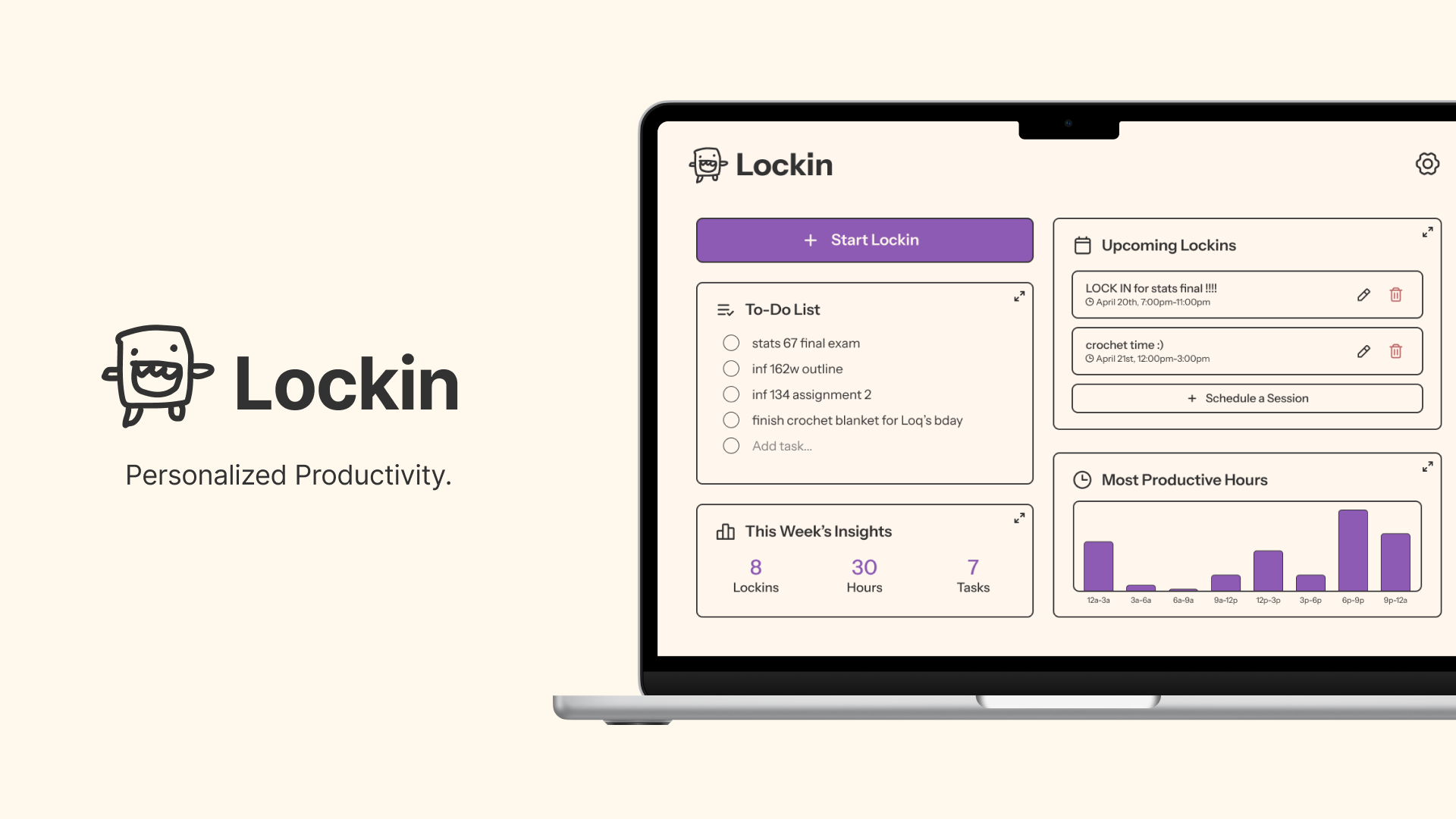
Users can schedule study sessions with our calendar planner feature, which is set to a 3-day view by default.
Light “pop-up” check-ins, which are to assess current energy, focus, and mood right before breaks to help users self-regulate and reflect, all without judgment.
Cute, Emotionally Intelligent Sprite: Our mascot, Lockie reacts subtly to progress and distraction (detected by our eye tracking and motion-detecting technology), not to shame, but to gently nudge.
Saving Presets: Users can adjust over time by saving the settings they like as a preset, as familiarity has great synergy with the neurodivergent.
At the end of a new study session, Lockie analyzes the productivity behind it and if it meets Lockie’s standards, it will ask the user if they would like to save their settings as a new preset.
To-do lists: One for specific study sessions, and one general to-do list for everything.
How we built it
With the proper amount of primary and secondary research, we were able to find the correct design decisions to meet our audience’s needs. We designed Lockin using Nielsen’s Usability Heuristics and cognitive accessibility principles, which were informed by lived ADHD experiences, like our teammate and the community of r/ADHD. Psychology was also a big help for us when making our decisions. Now, let us explain some of the “whys” behind some of our most important design decisions:
Onboarding light questionnaire:
- Accommodates first-time users’ attention deficits with just 4 short questions that are set in place to determine a default study preset.
- This was to combat how long onboarding processes take and how quickly they lose the interest of ADHD users, according to Redditors of r/ADHD.
- Our AI mascot, Lockie, automatically creates a default preset based on the questionnaire so our users won’t have to go through an even longer setup–they can just go straight into using our app!
Calendar Planner:
- Because ADHD tends to mess with ADHDers’ memories, scheduling study sessions was a must-have in our app. Users can see right on the landing page what study sessions they have coming up, which reduces the chances of forgetting to study for that day significantly.
- Our calendar is set to a 3-day view by default, as some ADHDers from our community, as well as our own teammate, have stated that a 7-day view is too cluttered when using a calendar app. Of course, the view is interchangeable between 1-day, 3-day, and 7-day settings. Our neurodivergent users require customization to their liking, however, not too much, as it will cause cognitive overload with a cluttered UI.
Customizing and Saving Presets:
- Familiarity has great synergy with those of neurodivergence.
- According to those in the education workforce, personalized learning is the best form of learning for all neurodivergent students. The reason for that is that every student with ADHD learns differently and at their own pace, as the disorder is considered a spectrum disorder.
- Allowing users to customize and save their preferred learning presets allows for ease of access and enables users to start with their desired learning environment.
- The app is based on the Pomodoro Technique, which has been proven to improve focus in ADHD users, and takes away its rigidity, allowing users to customize their learning environment to their liking.
- Our AI model, Lockie, allows users to discover what study conditions work best for them, unlike what Pomodoro prescribes.
Lastly and most importantly, the design acknowledges and supports decreasing distraction, instead of punishing it.
- Our Cute, Emotionally Intelligent Sprite: Lockie is here not to shame, but to gently nudge. We used the psychology of cuteness to keep users engaged.
- Those with ADHD already feel guilty enough for being distracted and hyperactive at times of important studying, so punishing users for being distracted was never an option. Instead, we chose a different route that stems from psychology itself: the fight-or-flight response. Using the element of surprise, we want to activate the sympathetic nervous system in our users in order to get that fight-or-flight response.
"This response enables an individual to either fight the threat or flee the situation. The rush of adrenaline and noradrenaline secreted from the adrenal medulla leads to a widespread discharge of almost all portions of the sympathetic system throughout the body. Physiological changes of this mass discharge effect include increased arterial pressure, more blood flow to active muscles, less blood flow to organs not needed for rapid motor activity, increased rate of blood coagulation, increased rates of cellular metabolism through the body, increased muscle strength, increased mental activity, increased blood glucose concentration, and increased glycolysis in the liver and muscle." (www.ncbi.nlm.nih.gov)
Reflections
Challenges:
- ADHD is a spectrum disorder, so we received a numerous amount of responses that varied a LOT.
- Deciding on the branding for our app, as all of us surprisingly had difficulty connecting neurodivergence with a study app.
- Narrowing down on the features we brainstormed.
- Struggling to understand the prompt which ultimately delayed our progress.
- 3 hours of sleep 💔🥀 (this entire weekend…)
Accomplishments:
- Taking an abnormally long amount of time to find the correct research and sources in order to meet our audience’s needs!
- Creating the silliest and cutest mascot we have ever seen!
- Successfully working with people that no one really understands, not even themselves (We are talking about our own teammate, who is the one writing this Devpost right now)!
- Our candle animation!
What we learned:
- We learned a lot about the world of neurodivergence! Designing for another world has its challenges and uniqueness, but nonetheless, it was the same exact design process as for any other audience. We also learned that any amount of user research requires an extensive amount of time in order to reach the correct conclusions and design decisions.
What's next for Lockin
- Ability to add "general to-do list" items to new study sessions.
- Real AI Development for Lockie so we can bring it to life!
- Live animations for Lockie.
- Gamification (e.g. rewards to unlock cosmetics for Lockie).
- More ADHD research-based features!
- Can you tell we love Lockie? No? We will make Lockie plushies in the future.
References
- Understanding Attention-Deficit/Hyperactivity Disorder From Childhood to Adulthood
- Overcoming Decision Fatigue in ADHD
- r/ADHD
- Nielsen’s 10 Usability Heuristics
- UX Principles that Include Cognitive Accessibility
- ADHD Symptomatology is Best Conceptualized as a Spectrum
- Personalized Learning ADHD Students
- Blog: Personlized Learning Techniques for Students with ADHD
- add.org: ADHD Paralysis
- Cuteness on the Brain
- The Psychology of Cuteness
- Physiology, Stress Reaction
- Pomodoro Technique
- add.org: Tips For Studying With ADHD
Built With
- figma
- procreate


Log in or sign up for Devpost to join the conversation.