-
-

Kairos logo
-
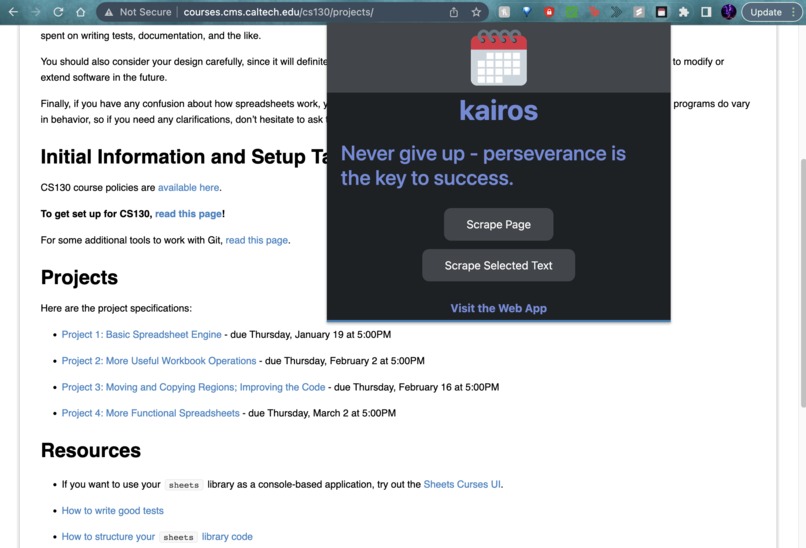
Kairos chrome extension to scrape assignment due dates off webpages or highlighted text.
-
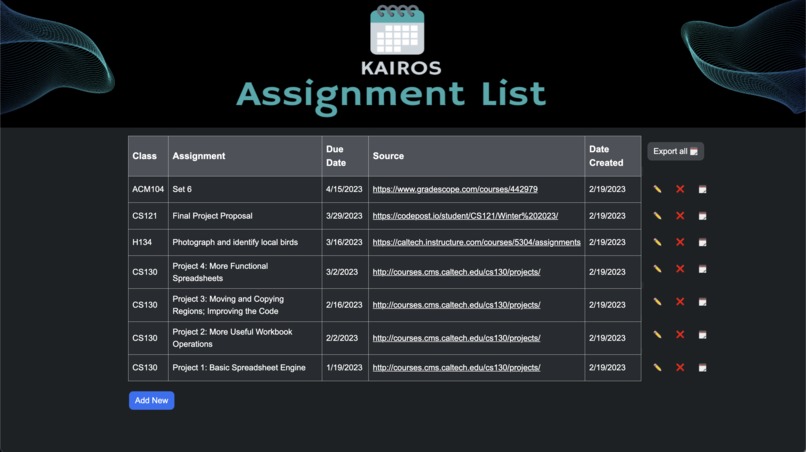
Kairos webpage where users can see, edit, and export their list of assignments to complete, sorted by due date.
-
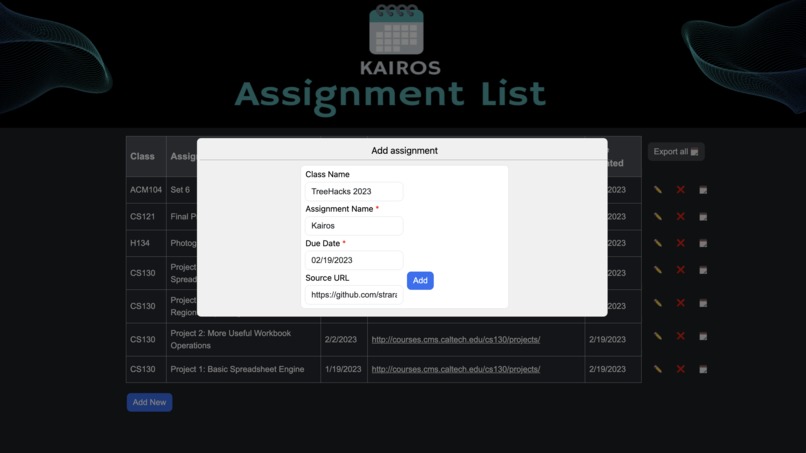
UI for users to manually add assignments.
-
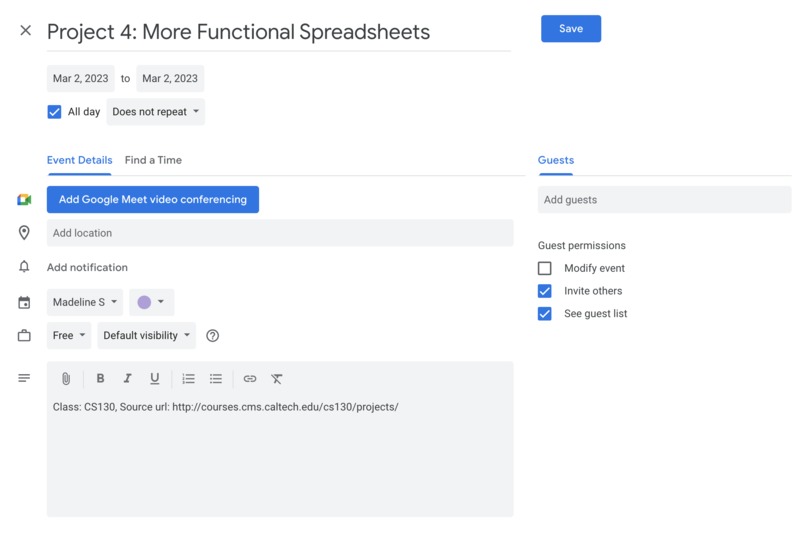
Users can export assignment due dates as calendar events.


💡Inspiration
First and foremost, we wanted to build a project that would solve real-world problems that we personally faced and would have a real impact on communities close to us. From our personal experiences with college life, our team found we all had one experience in common: the struggle of spending hours manually collecting and recording homework deadlines and exam dates from an excessive number of different sources such as Gradescope, codePost, Canvas, and school portals into calendar apps. Professors often have varying preferences as to what learning tools they use in their courses, and as a result, it can be difficult to keep track of everything when students have to search for five different pages just to figure out when their next assignment is due.
In addition, manually entering tasks can be error-prone and can lead to missing an important assignment or test. Furthermore, even when all the assignments have been recorded in a calendar, students often struggle on prioritizing tasks, resulting in procrastination and low-quality work, an issue that is exacerbated by the difficulty in determining the most pressing assignments.
The inconvenience and the resulting procrastination motivated us to develop a tool to consolidate and visualize deadlines across various sources, as well as add tasks automatically, in order to save time and boost the efficiency of all the students in our community and beyond.
📅 What it does
Kairos is composed of two parts: a chrome extension for scraping assignment information from webpages and a web application for visualizing assignment deadlines. Students and professionals can extract deadlines for tasks with the Kairos chrome extension using only the press of a button, choosing whether the extension parses the entire webpage or only the selected text. In the Kairos web app, the list of tasks are visualized and sorted by due date, and students and professionals are able to manually add, edit, and delete these tasks or export them into their personal calendar.
💻 How we built it
The first part of Kairos, the chrome extension, scans the page or selected text the user is currently on and utilizes the OpenAI API to query the Davinci Natural Language Processing model, employing a carefully engineered prompt that extracts deadlines by filtering out all irrelevant information and formatting the data appropriately. The data is then stored in a Convex-based backend where it can be retrieved and displayed in the second part of Kairos, the web application frontend, which was built in React.
🔥 Challenges we ran into
One of the most significant challenges of this project was integrating the chrome extension and web application to communicate in real time. We considered many options to accomplish this, such as Node.js-based middleware, but eventually decided to use Convex as a middleman between the extension and web application. As this was our first time using Convex, there was a bit of a learning curve, but ultimately the solution was effective.
✨ Accomplishments that we're proud of
We are proud of fully implementing a helpful, personally-motivated tool that can be used in the real world, executing all features we’ve brainstormed, and succeeding in integrating the chrome extension and web page as desired. From a rough idea to a complete, usable tool, we’ve accomplished a lot to enable Kairos to handle the process that has plagued us for so long, from start to end: visualizing and exporting the tasks from our many syllabi into our own Google calendars. As a team, we look forward to seeing the flexibility and convenience of Kairos help more people like ourselves improve their efficiency and optimize their time management.
📚 What we learned
In developing this project, we experimented with things that were new to the whole team and explored known tools to new lengths. All of us became familiar with the OpenAI API, as well as how to use Convex to abstract away the need of a complex backend. In addition, each member of our team learned specific skills, ranging from picking up new frameworks like React to building a chrome extension for the very first time.
In addition to these technical skills, we also developed our soft skills as well through the course of working together to plan and develop this project from scratch, including things like collaboration, communication, independence, creativity, and initiative.
Though the hackathon was only 36 hours long, we feel that our experiences here, however short, were not only fun and memorable, but were also invaluable in growing our talents and guiding us to become better hackers.
🚀 What's next for Kairos
In the future, we plan to further improve on the procrastination prevention portion of the app by adding a feature that suggests what to work on and when based on the user’s schedule and models predictions about each assignment’s difficulty and time commitment.
Overall, we are so excited about our product and we hope that it is helpful not only to students, but anyone in need of a deadline management tool.
Built With
- convex
- css
- html
- javascript
- node.js
- openai
- react


Log in or sign up for Devpost to join the conversation.