Inspiration
Modern life is overloaded with information, difficult tradeoffs, and constant mental switching[cite: 1]. Undergraduates and early professionals are expected to make high-stakes decisions with incomplete information[cite: 1]. When we analyzed the landscape of decision-making tools, we realized they fundamentally fail users in two ways: they either oversimplify complex choices into basic pros-and-cons lists, or they overwhelm the user with walls of conversational AI text[cite: 1].
We chose to build Kairós for Direction A: Life Decision Simulator to fill the gap for an AI system that helps people reason through structure, not just retrieve generated content[cite: 1]. We wanted to build a "Second Brain" that acts as a strict semantic friction engine—forcing users to confront hidden tradeoffs, long-term latencies, and asymmetrical risks rather than giving them a false "correct answer"[cite: 1].
What it does
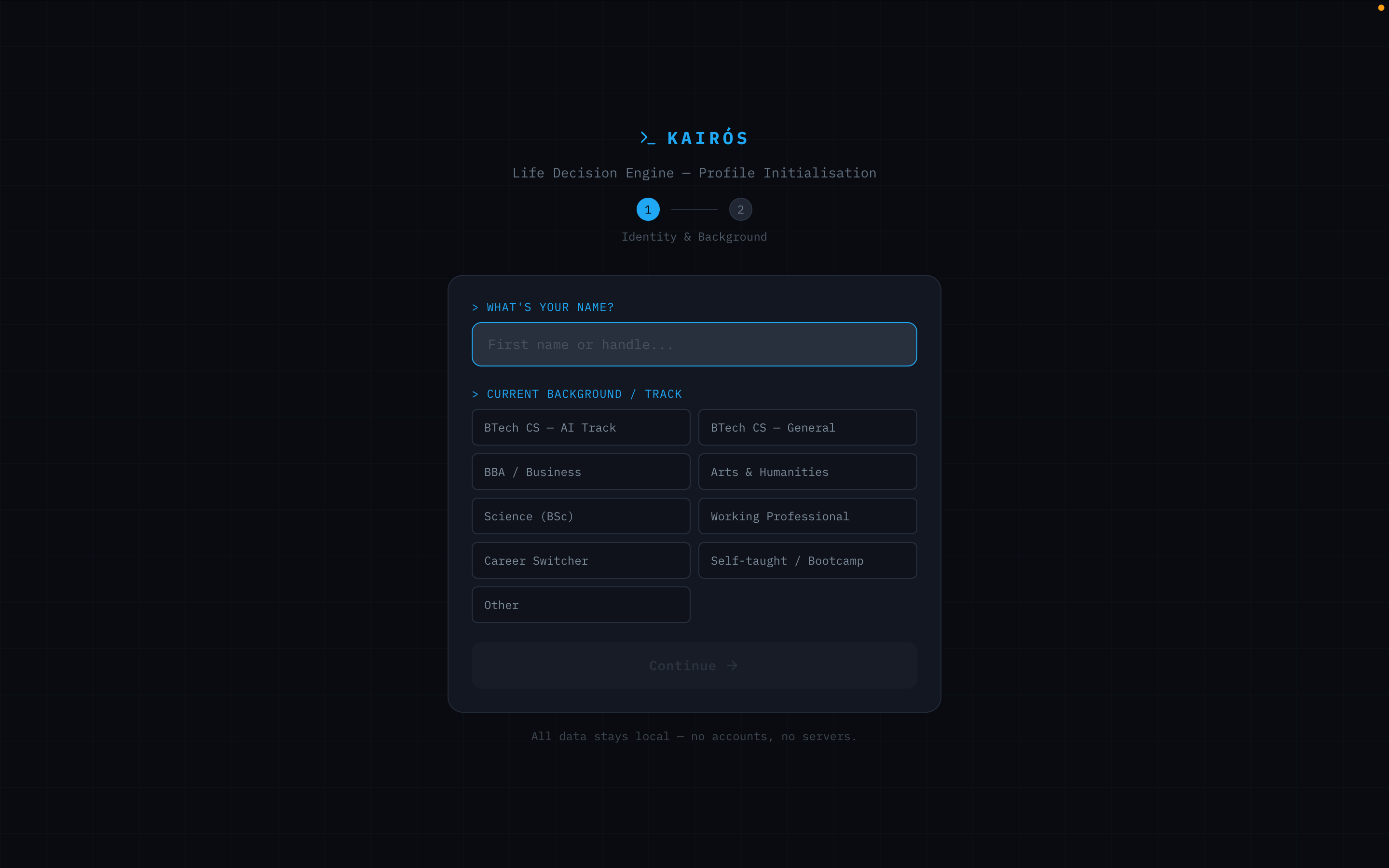
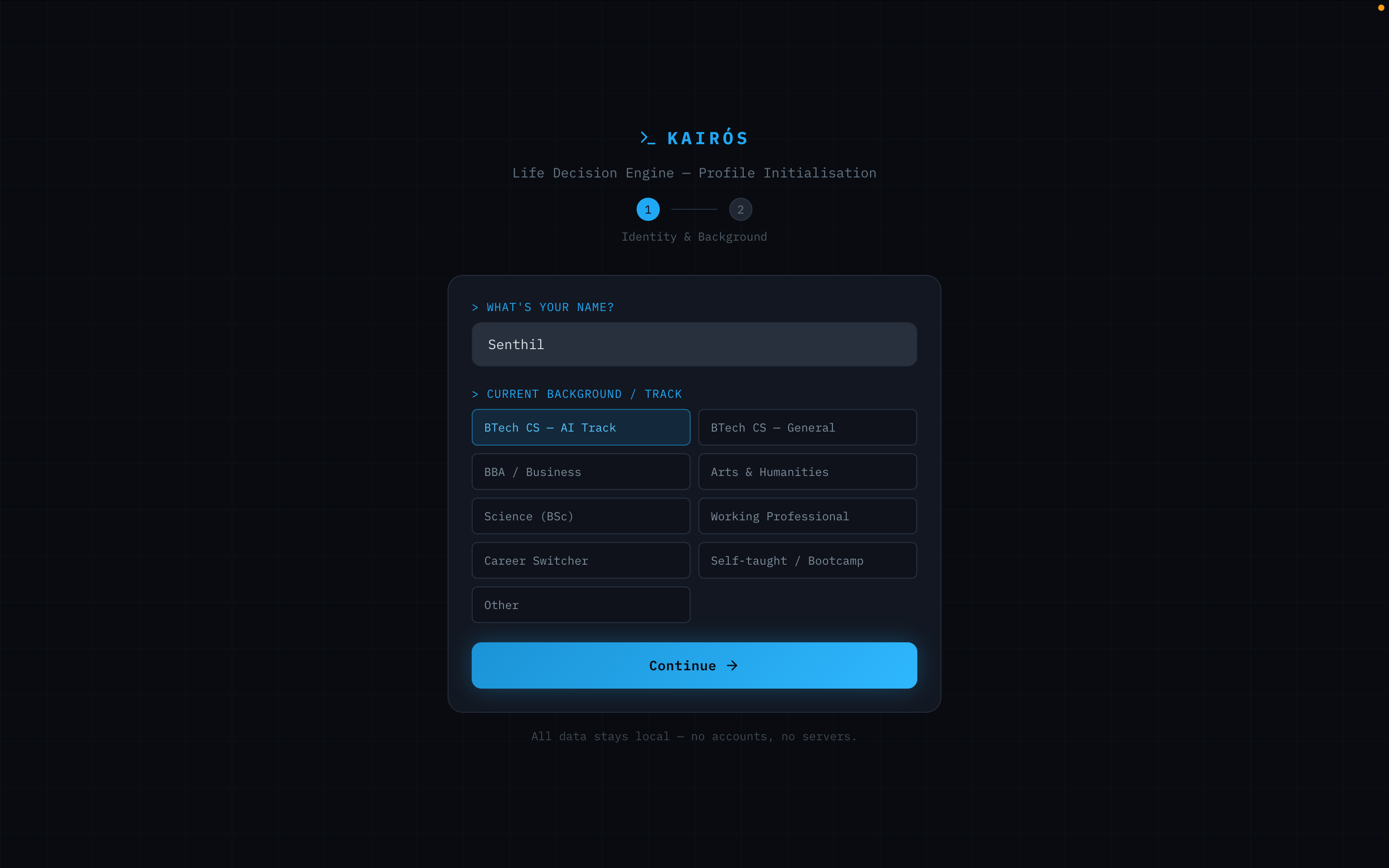
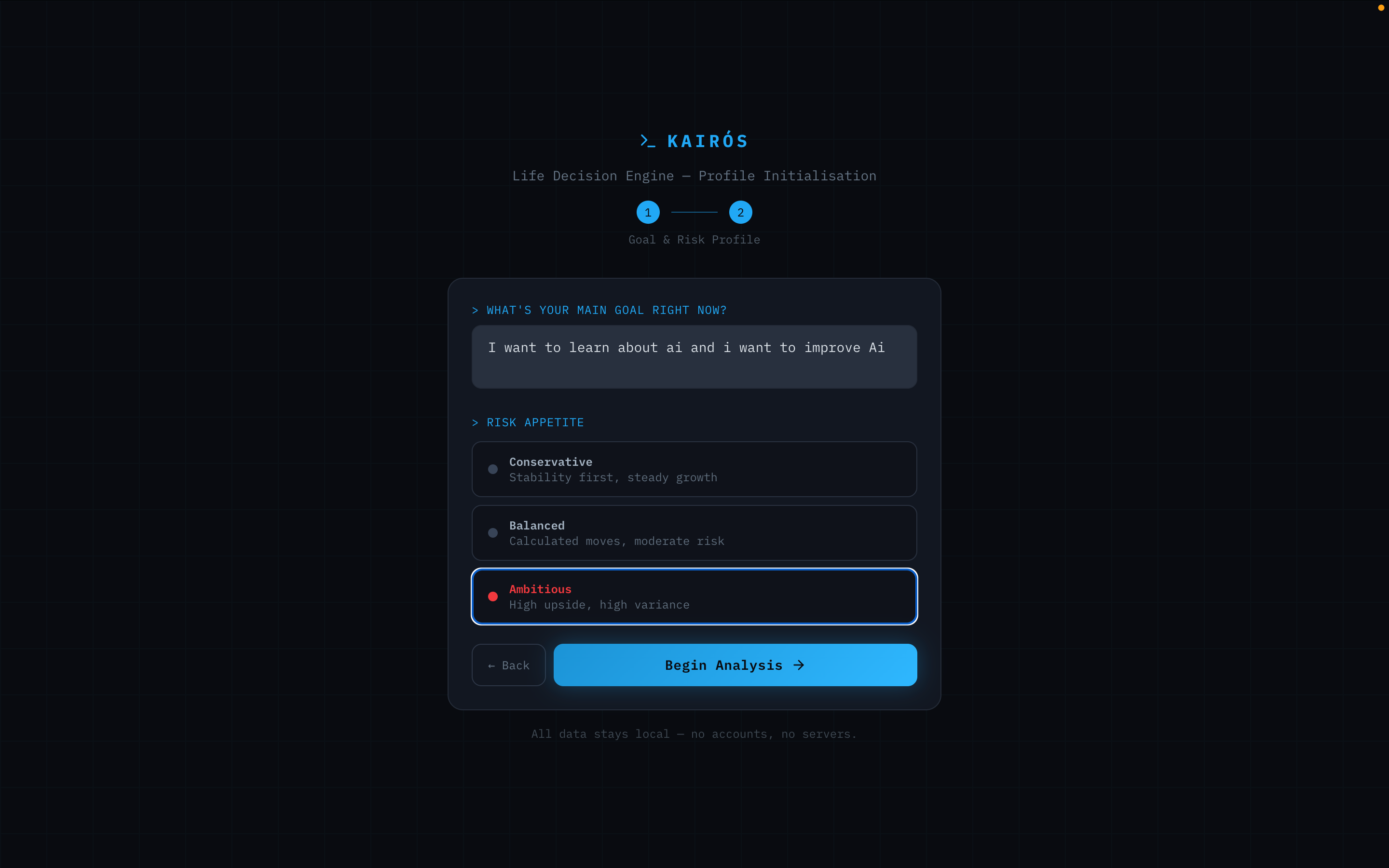
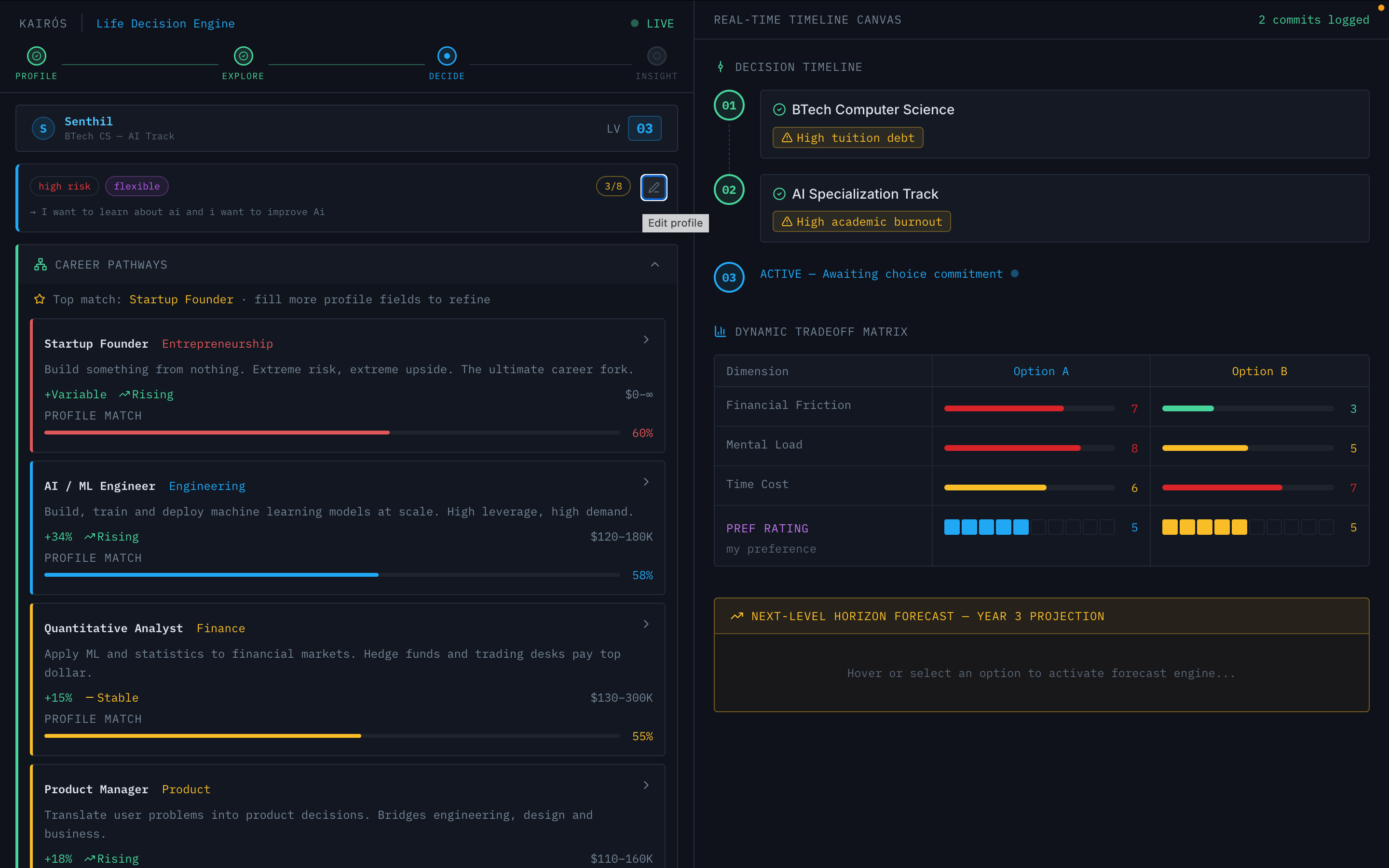
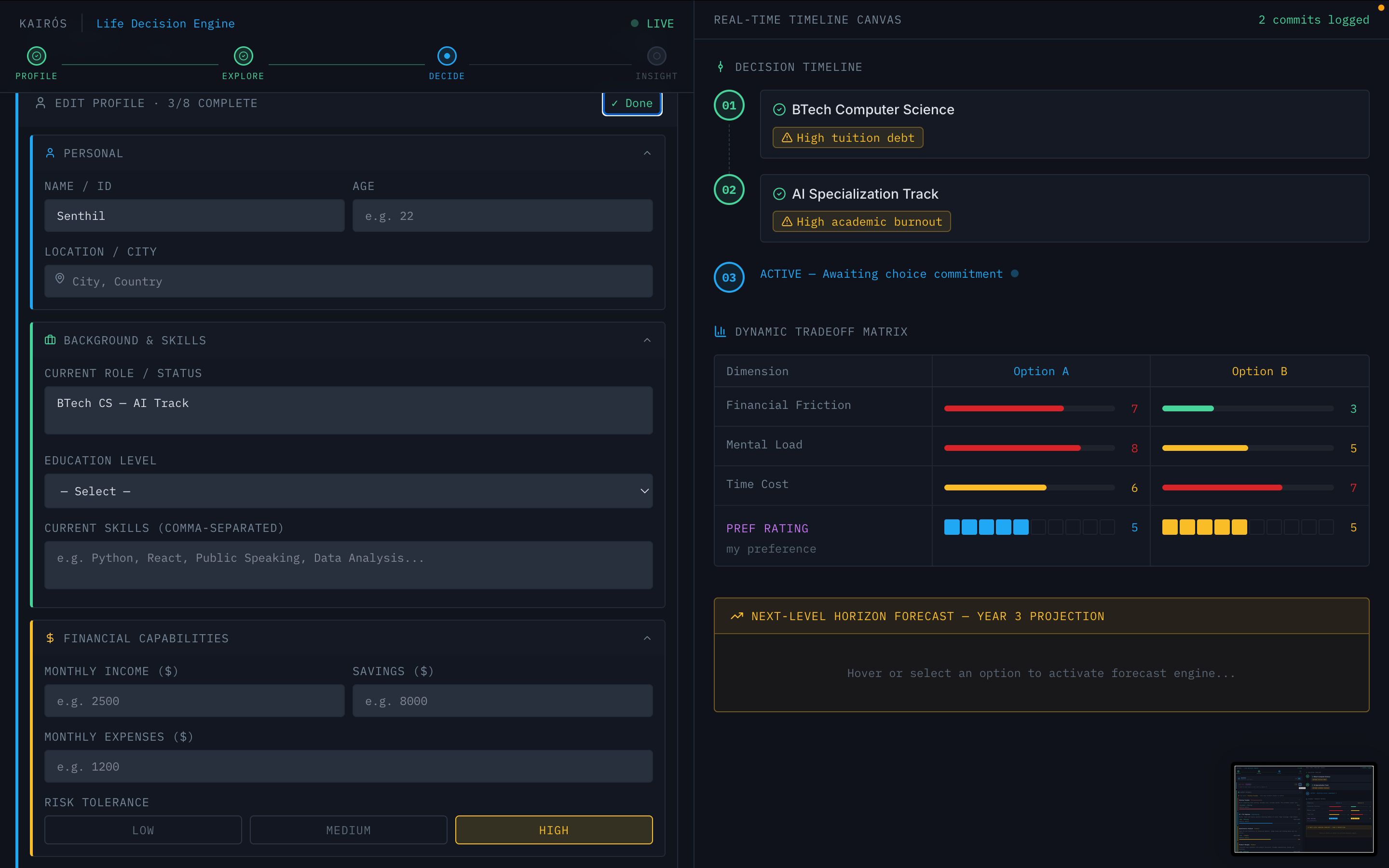
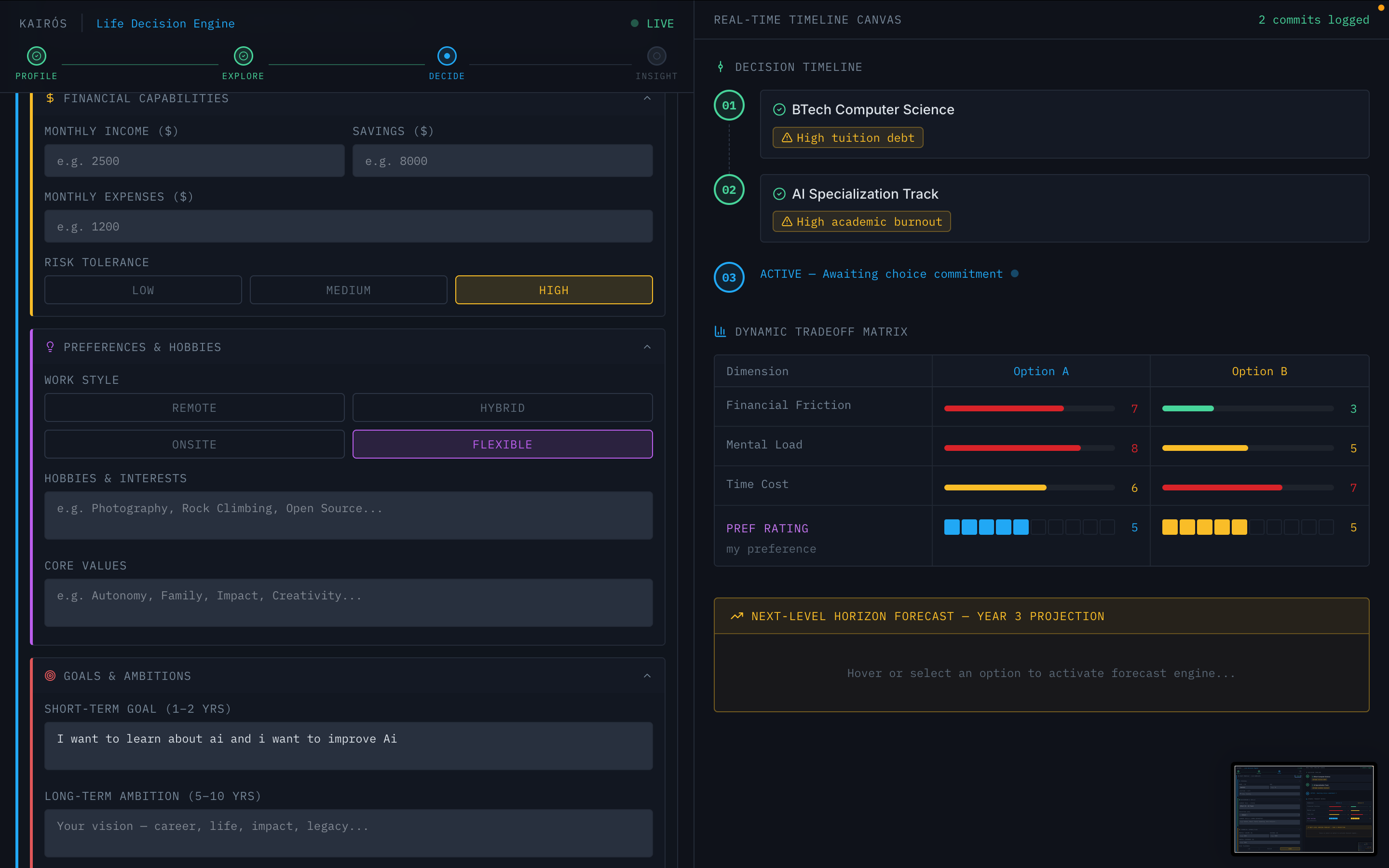
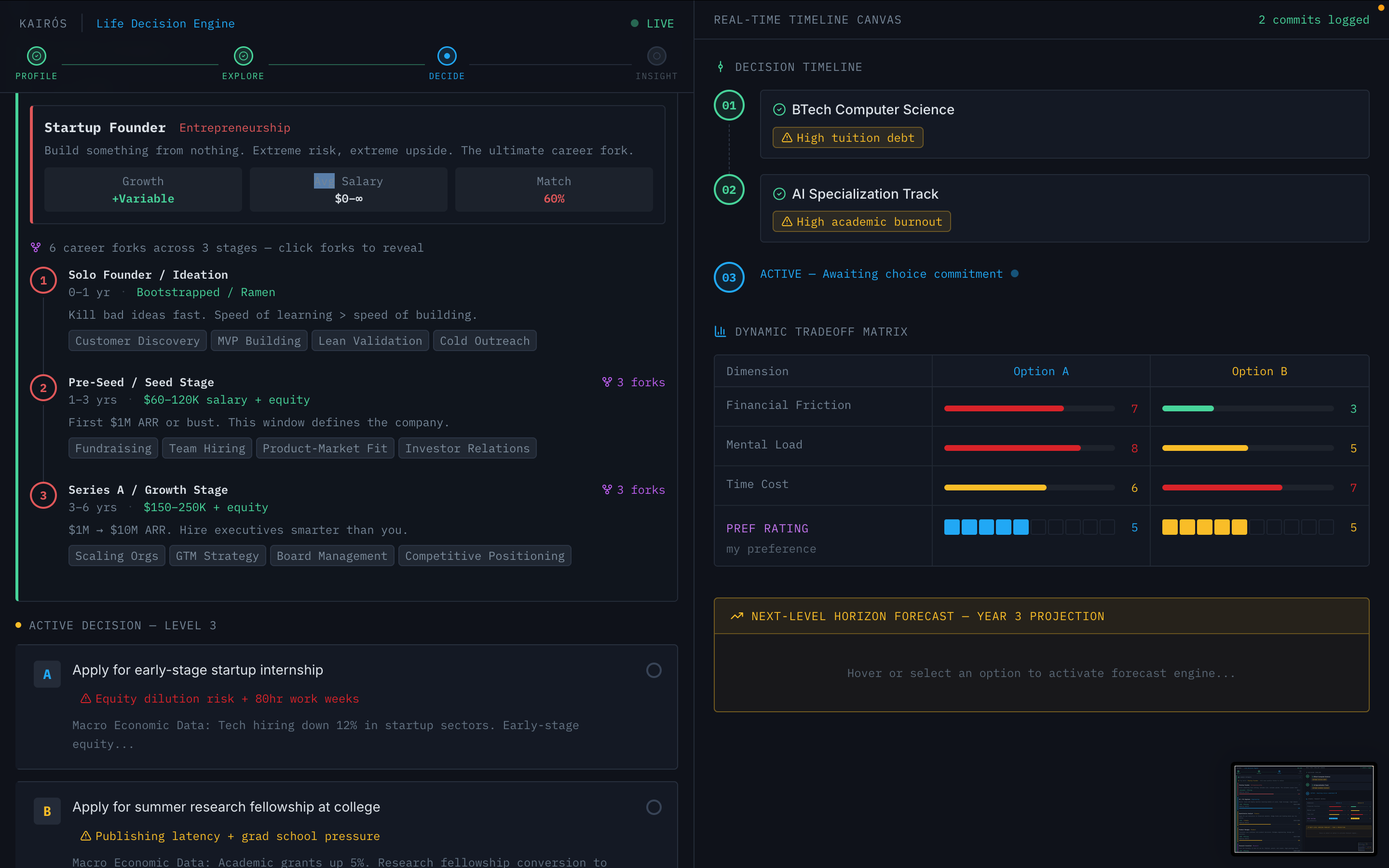
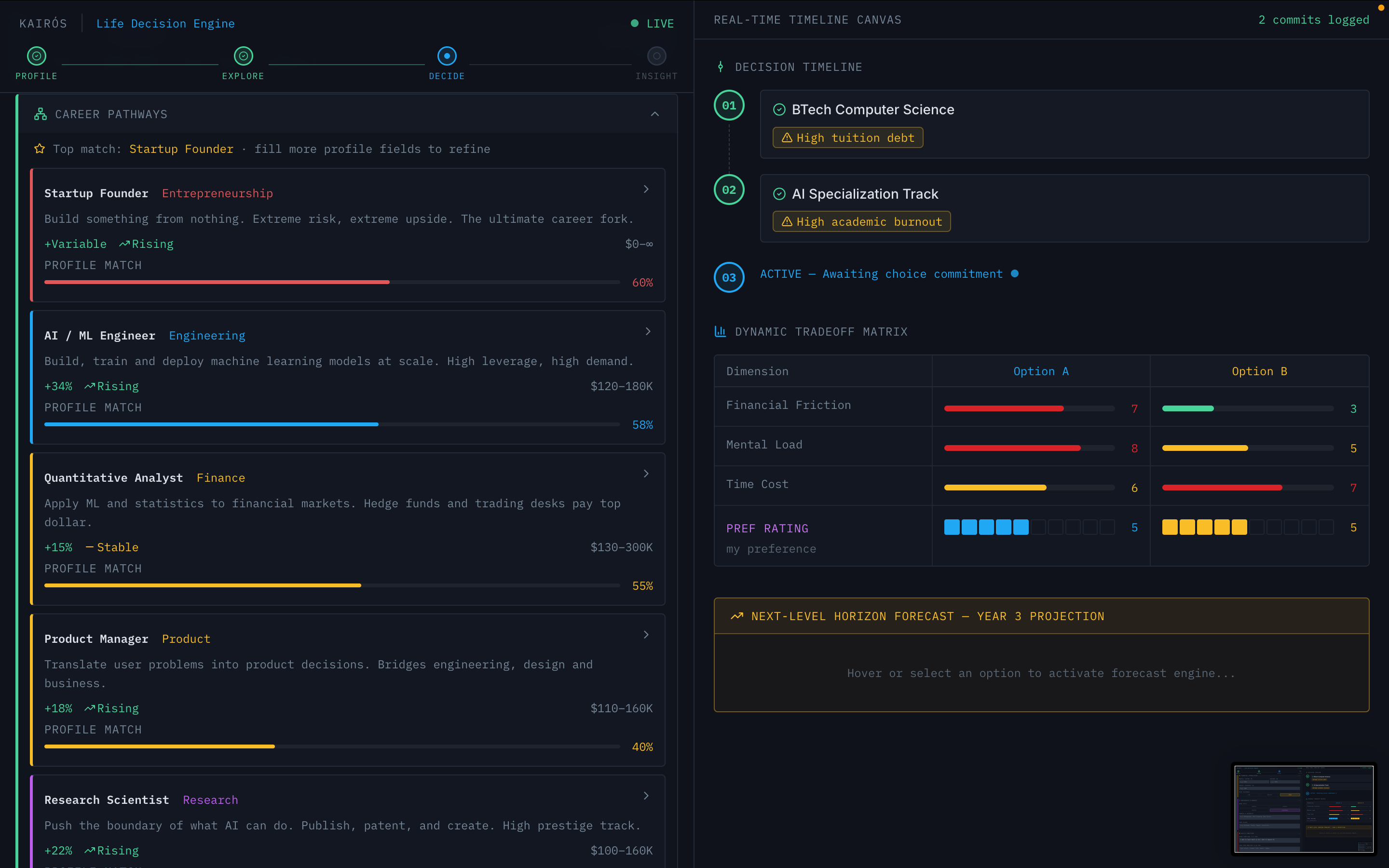
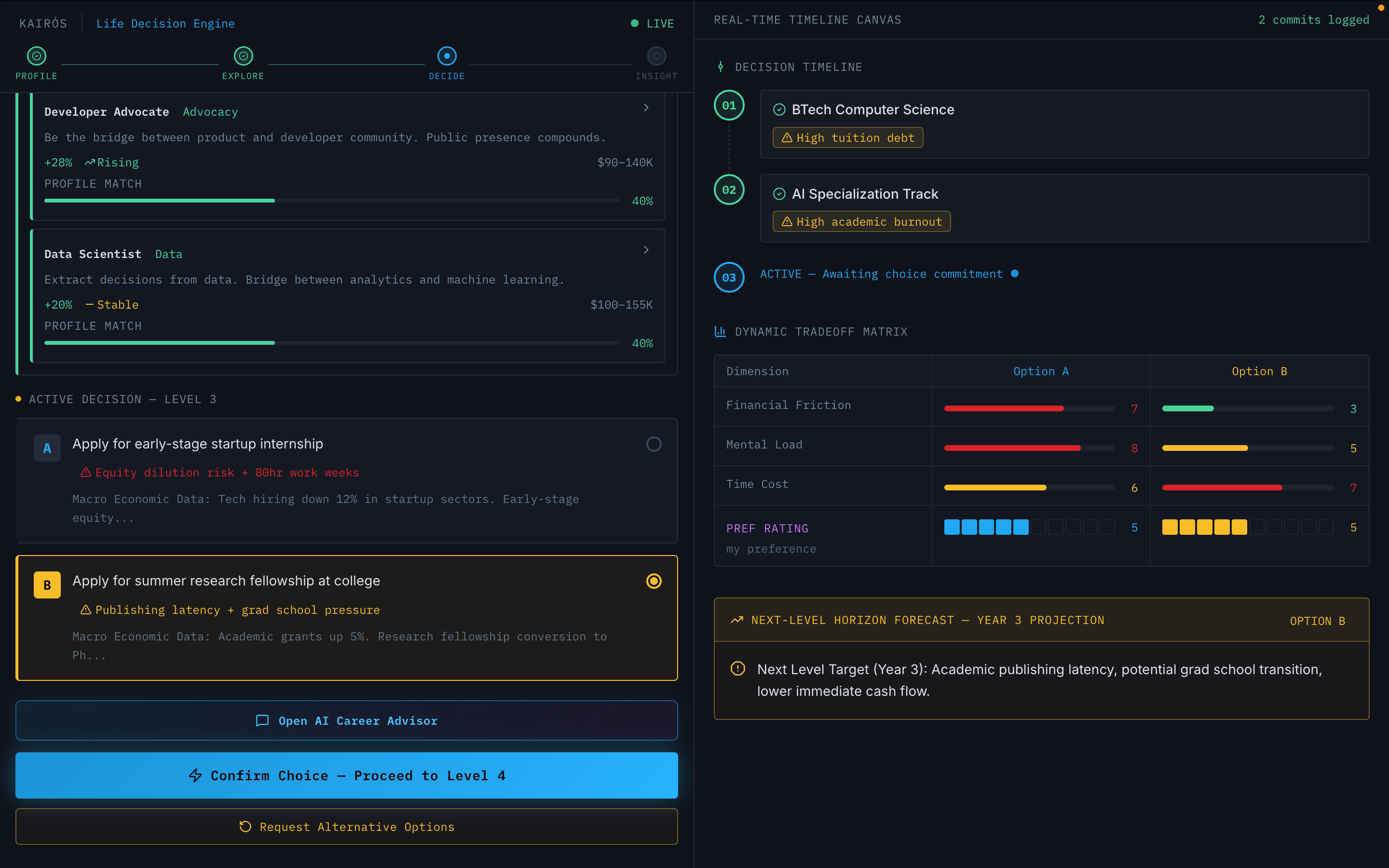
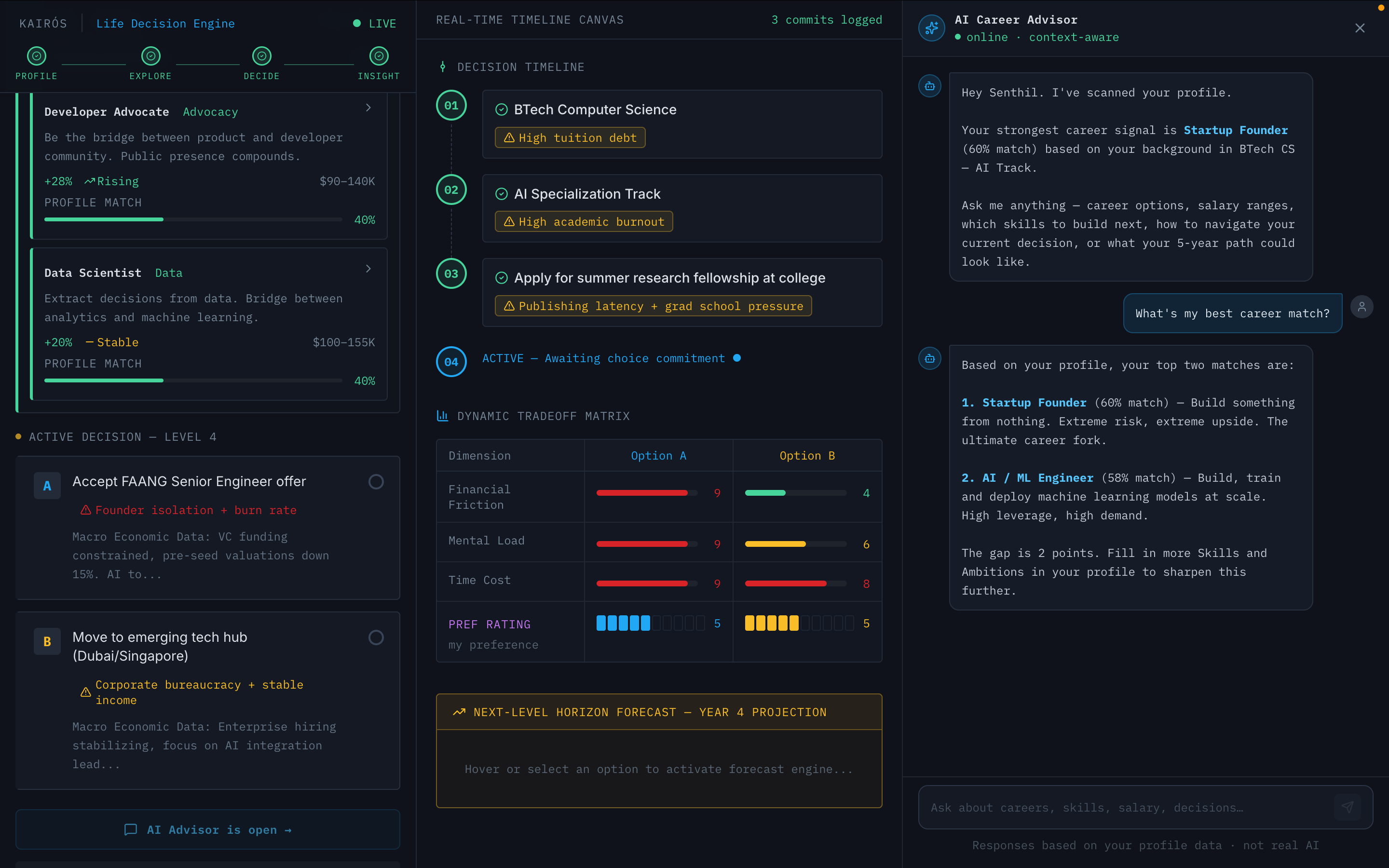
Kairós is a real-time sequential life decision simulator. It drops traditional chatbot interfaces in favor of a stateful, two-column executive dashboard.
- The Left Pane (Command Steering): Users input unstructured life objectives (e.g., "Grad school vs. tech startup internship")[cite: 1]. The system generates two distinct, parallel structural alternatives outlining specific friction indices and inherent tradeoffs.
- The Right Pane (Real-Time Timeline Canvas): As users commit to paths, the system builds a chronological vertical node tree mapping out their trajectory across 1-year, 3-year, and 5-year horizons.
How we built it
We architected Kairós as a real-time, non-blocking cloud application:
- Frontend: Built with Python and Streamlit, utilizing custom HTML/CSS injections to create the bento-grid "Anti-AI Wrap" UI.
- State Management: Firebase Firestore acts as our strict state machine, maintaining the user's historical decision ledger in real-time.
- Context & Grounding (RAG): We query a vector database containing public labor market metrics, cost-of-living data, and education ROI frameworks to ground the AI's reasoning in reality[cite: 1].
- Reasoning Engine: We utilize the Google Antigravity SDK to run asynchronous inference loops. Instead of conversational filler, the AI calculates a multi-horizon friction index.
To evaluate systemic risk across multi-year paths, we conceptually modeled the decision friction $F$ over time horizon $T$ using a time-decaying uncertainty function: $$F(P) = \sum_{t=1}^{T} \left( \alpha C_t + \beta U_t \right) e^{\lambda t}$$ Where $C_t$ represents the quantifiable structural cost (debt, latency), $U_t$ represents qualitative uncertainty, and $e^{\lambda t}$ mathematically scales the volatility as the projection moves further into the future (Years 3 and 5).
Challenges we ran into
Bridging a synchronous frontend UI (Streamlit) with an asynchronous AI inference loop (Google Antigravity) created significant thread-blocking issues. We had to carefully wrap our execution pipelines using Python's asyncio to prevent the UI from freezing during RAG queries.
Additionally, taming the LLM to output strictly formatted JSON payloads instead of conversational text was difficult. We had to implement rigorous system instructions and constraints to ensure the dynamic bento-cards populated cleanly without breaking the application logic.
Accomplishments that we're proud of
We are incredibly proud of our Responsible AI Guardrails[cite: 1]. A major risk in life simulators is over-reliance—where a user views a 5-year projection as a definitive, deterministic outcome[cite: 1]. We mitigated this by implementing "Dynamic Uncertainty Framing." Downstream predictive nodes on the timeline canvas are rendered with progressively lower opacity and blurred CSS filters. This visually proves to the user that future horizons are inherently uncertain and highly volatile.
Furthermore, we successfully built a strict Human-in-the-Loop system. The AI never auto-selects a path; it only exposes the friction. The user must manually click a physical "Commit Path" button to assume accountability and move the state forward[cite: 1].
What we learned
We learned that the true value of AI in high-stakes environments is not prediction, but structure. By forcing the AI to play devil's advocate and surface hidden considerations, we found that users actually build more confidence in their final choices[cite: 1]. AI is vastly more effective when positioned as an objective thought partner rather than an omniscient oracle.
What's next for Kairós
We plan to expand the underlying vector database to include more granular, localized macroeconomic data and integrate public research on behavioral science and regret minimization[cite: 1]. Ultimately, we want to scale Kairós into a fully deployable platform for university career centers globally.


Log in or sign up for Devpost to join the conversation.