-
-
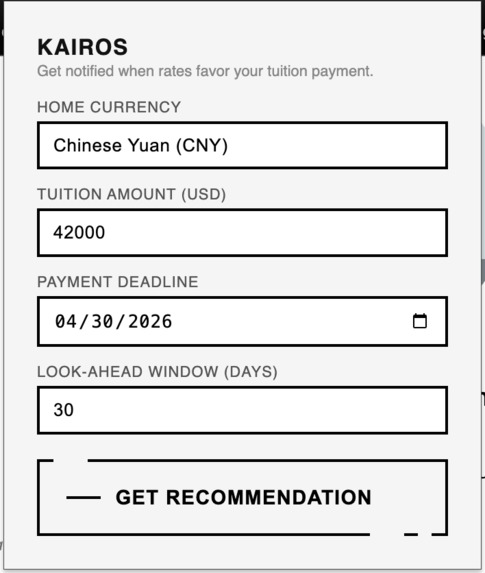
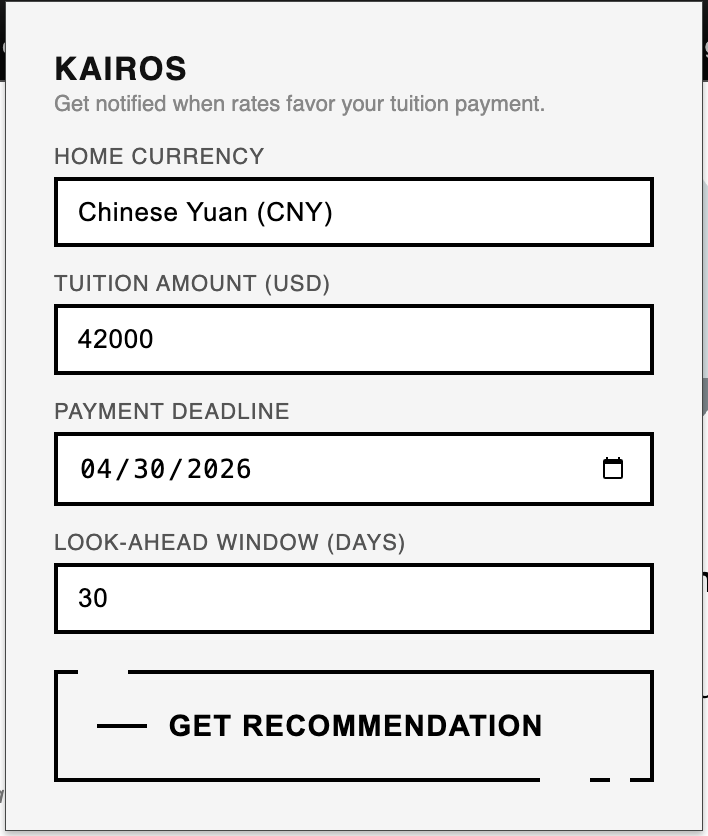
The interface of the extension
-

How the extension looks in Chrome
-
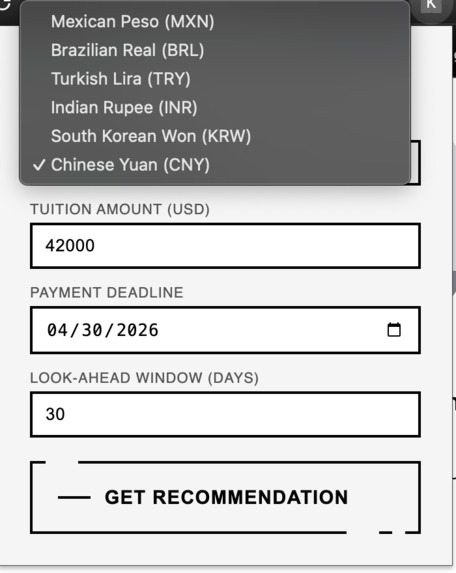
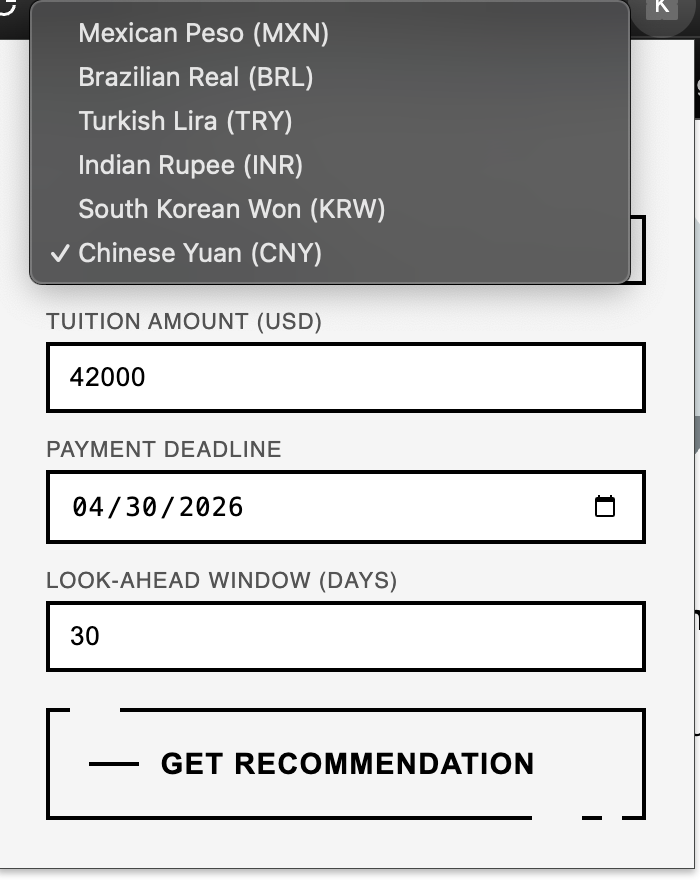
Currency options
-
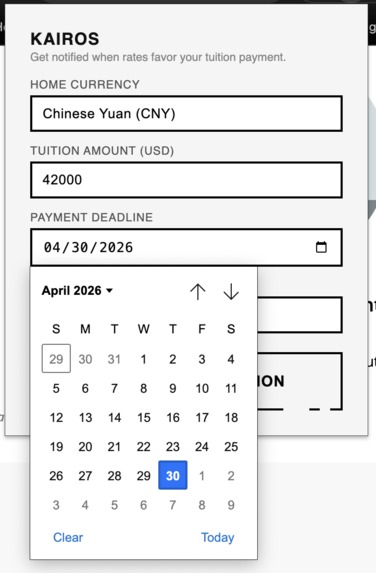
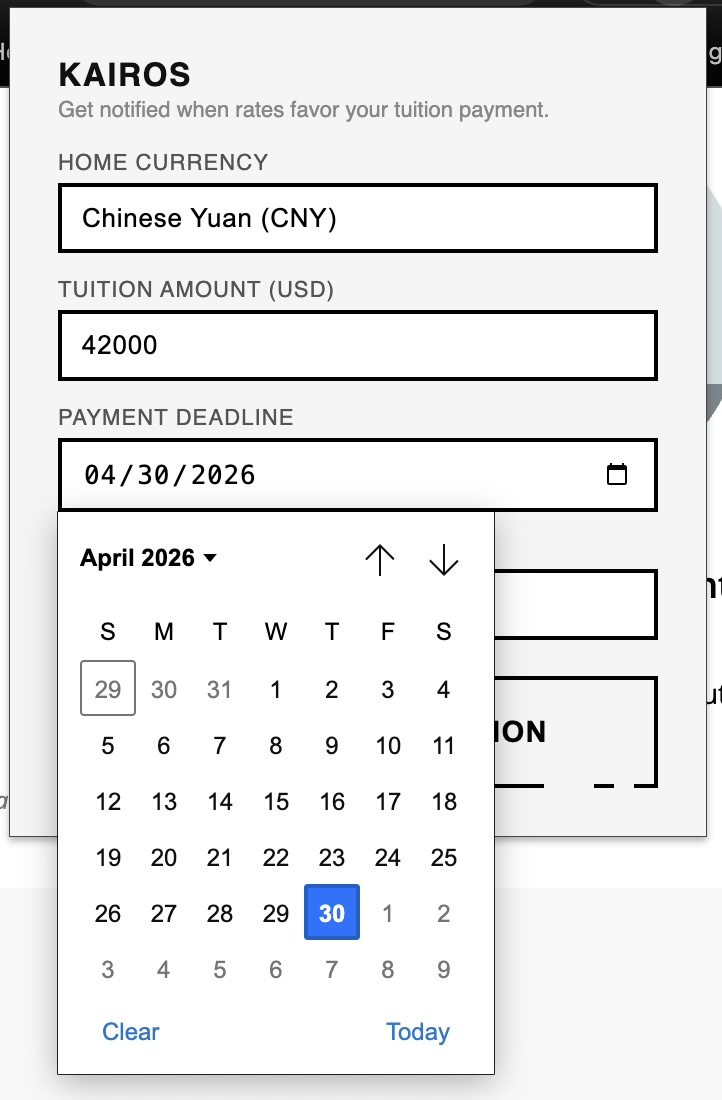
Drop-down menu for date picking
-
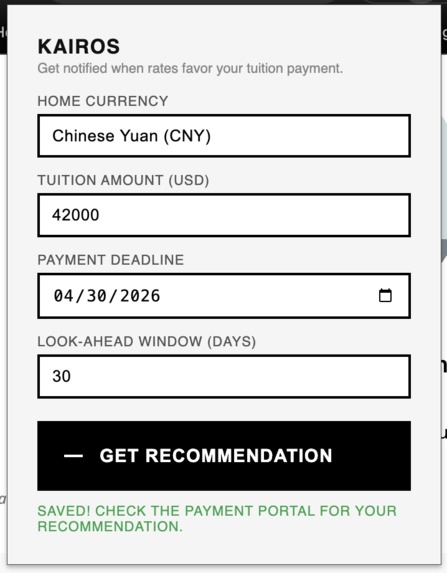
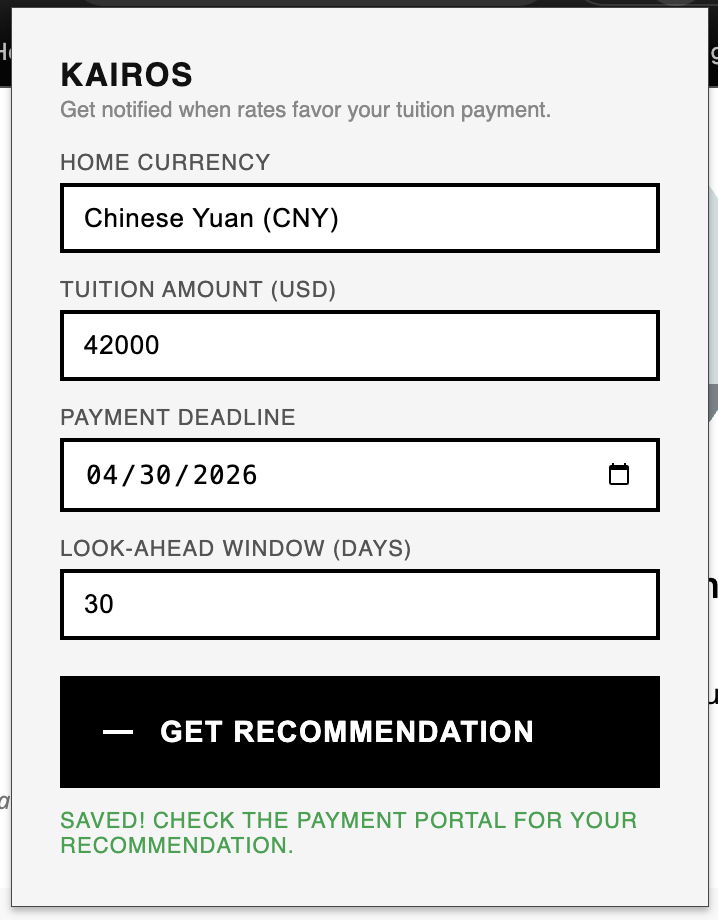
Recommendation button pressed
-

Pop-up banner on a payment site


Inspiration
One of our teammates is an international student who constantly checks exchange rates to decide when to pay tuition, knowing even small fluctuations can mean losing or saving over a thousand dollars. She realised there’s no simple tool that streamlines this process, despite exchange rates changing multiple times a day and timing being critical for students on tight budgets.
What it does
Simple workflow
- User enters tuition amount and currency
- Kairos tracks and predicts exchange rate trends
- User gets notified at the best day to pay
How we built it
We built Kairos as a Chrome extension with a Python backend, keeping the stack simple enough to ship in a hackathon but real enough to actually work. The backend is a FastAPI server running a Prophet time-series model. When a user submits their settings, the extension calls our /best-day endpoint, which pulls historical exchange rate data from Frankfurter.app, a free, no-key-required API with clean daily rates going back years. We feed that history into Prophet, which handles seasonality and trend detection automatically, then forecast 30–60 days ahead and find the date with the most favorable predicted rate before the user's deadline. The savings estimate compares the cost of converting the tuition amount at today's rate vs the predicted optimal rate, expressed in USD so it's immediately meaningful regardless of currency. On the extension side, we used Chrome's Manifest, a service worker in background.js handles the API call and stores the recommendation locally, content.js puts a banner directly onto payment portal sites, and popup.html gives the user a clean settings interface. The trickiest part was getting the savings math right. Exchange rate direction is counterintuitive, whether a higher or lower rate is "better" depends entirely on which direction the student is converting, and we went through a few iterations before the numbers made sense end-to-end.
Challenges we ran into
We initially built Kairos as a separate web app, but realized switching between platforms wasn’t ideal for users, so we pivoted to a browser extension that integrates more naturally into the tuition payment flow. When we found that most university portals don’t support irregular scheduled payments, we adapted by focusing on smart reminders instead, keeping users in control while still guiding them to the optimal time. We also noticed that payment information is often spread across multiple pages and can’t be auto-filled reliably, so we designed the experience to be simple and flexible, allowing users to easily act on our recommendations.
Accomplishments that we're proud of
- Good division of labour that makes the best use of everyone's strengths and skillsets
- Ability to scope our project appropriately to suit our skillsets and the time frame
- Efficiency and great time management
What we learned
- How to scope a project realistically within a short timeframe, focusing on core functionality first instead of overbuilding
- How to design and build a Chrome extension that integrates directly into existing user workflows
- How to apply predictive modeling to exchange rate data to generate meaningful, real-world insights
What's next for Kairos
- Automatically pull key data from payment portals so users don’t have to enter everything manually
- Move from manual refresh to real-time updates, with results generated instantly after submission
- Expand beyond tuition to other major payments like rent and flights
- Explore deeper integrations that can eventually handle payments directly, not just recommend when to pay
Built With
- fastapi
- frankfurter.app
- html
- javascript
- pandas
- prophet
- python

Log in or sign up for Devpost to join the conversation.