-
-
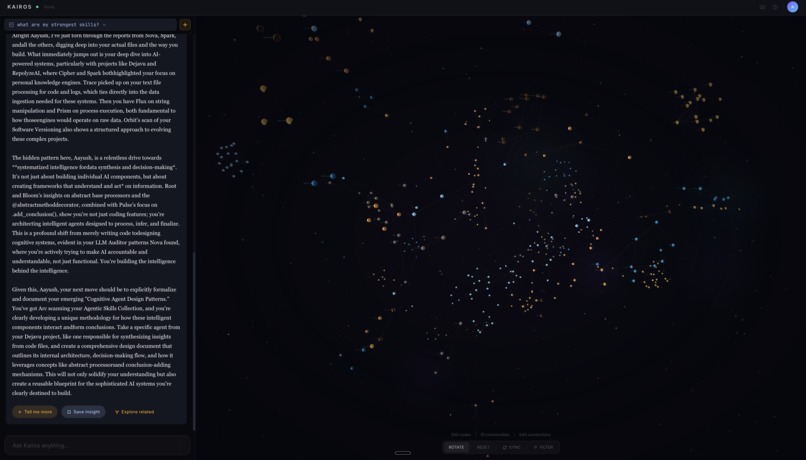
Demo
Inspiration
Every semester, 20 million college students generate thousands of files: lecture notes, code repos, research papers, project reports. But when they need help, they open ChatGPT and start from zero. Re-upload the same files. Re-explain their context. Get generic answers that could've been given to anyone.
We asked: what if your AI actually knew you?
What it does
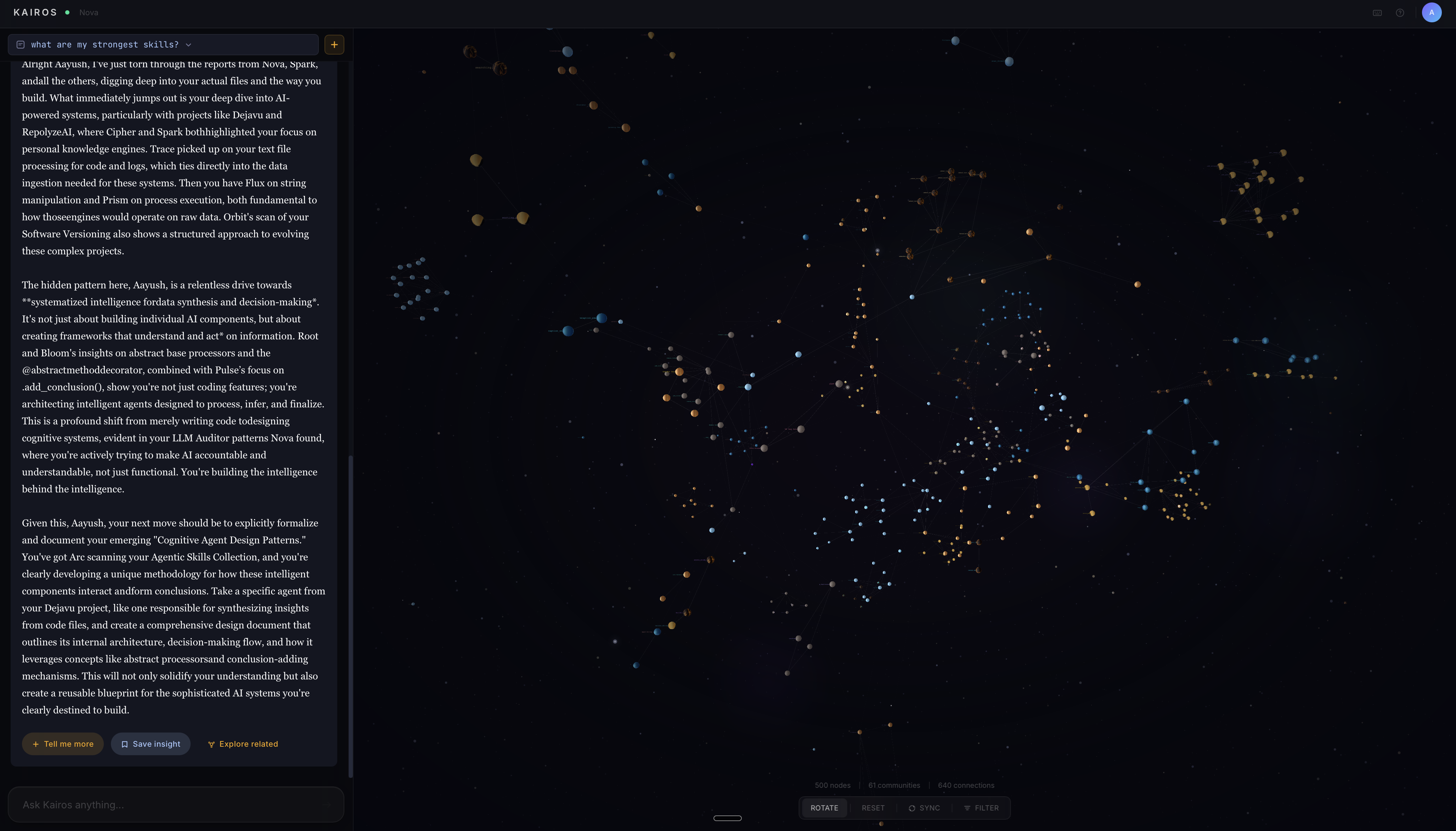
Kairos is a persistent knowledge operating system for students. It connects to your local files via a CLI, extracts concepts using AST parsing and Gemini, builds a 3D knowledge graph, and deploys AI agents that reason from multiple perspectives grounded in your actual work.
- CLI Bridge:
pip install kairos && kairos connect ~/my-classessyncs your files automatically - Knowledge Graph Pipeline: tree-sitter for code structure + Gemini for semantic meaning, with Leiden community detection
- 3D Galaxy Visualization: Your knowledge as an interactive universe. Planets are clusters, stars are concepts
- Multi-Agent Reasoning: 3+ AI agents (Mentor, Critic, Explorer) analyze questions from different angles, grounded in your files
- Persistent Memory: 4-layer memory stack that gets smarter the longer you use it
- Multimodal Search: Images and text in the same embedding space via Gemini Embedding 2
How we built it
Backend: FastAPI + PostgreSQL + pgvector. Graph pipeline uses tree-sitter (Python/JS/TS/Java), Gemini 2.5 Flash, NetworkX, and Leiden clustering. Hybrid search with Reciprocal Rank Fusion.
Frontend: Next.js 14 + react-force-graph-3d (Three.js). Custom planet textures, bloom effects, glassmorphism UI. Real-time WebSocket streaming.
CLI: Python Click with WebSocket sync. SHA-256 deduplication, 64KB chunked streaming.
AI: Gemini 2.5 Flash for multi-agent reasoning. Gemini Embedding 2 Preview for multimodal embeddings (768-dim).
Challenges we ran into
- School WiFi blocking PostgreSQL ports to Supabase. Built local PostgreSQL fallback.
- asyncpg returns JSONB as strings, not dicts. Hours of debugging.
- Rendering 1000+ 3D nodes without lag. Optimized geometry, tuned d3-force physics.
- Duplicate WebSocket connections from React StrictMode. Fixed with ref-based management.
Accomplishments we're proud of
- Full end-to-end pipeline: install CLI, connect folder, graph builds, galaxy renders, agents reason from your code
- 1000+ nodes indexed from real student files
- The 3D galaxy creates a genuine "aha" moment
- Multi-perspective AI grounded in actual work, not generic responses
What we learned
- pgvector + hybrid search (RRF) is powerful for knowledge retrieval
- Gemini's multimodal embeddings open up cross-modal search
- D3-force-3d physics tuning is an art
- Building real-time systems with WebSockets requires careful state management
What's next
- GitHub OAuth for one-click repo connection
- Collaborative galaxies between classmates
- University partnerships for advisor analytics
- Mobile app with 2D fallback
Built With
- 2
- 2.5
- algorithm
- css
- docker
- embedding
- flash
- gemini
- leiden
- networkx
- pgvector
- postgresql
- preview
- python
- react-force-graph-3d
- supabase
- tailwind
- three.js
- tree-sitter
- typescript
- websockets


Log in or sign up for Devpost to join the conversation.