-
-

Kairon Logo
-
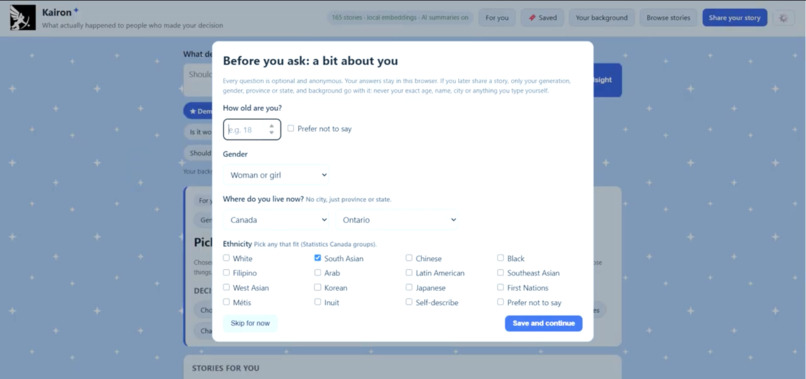
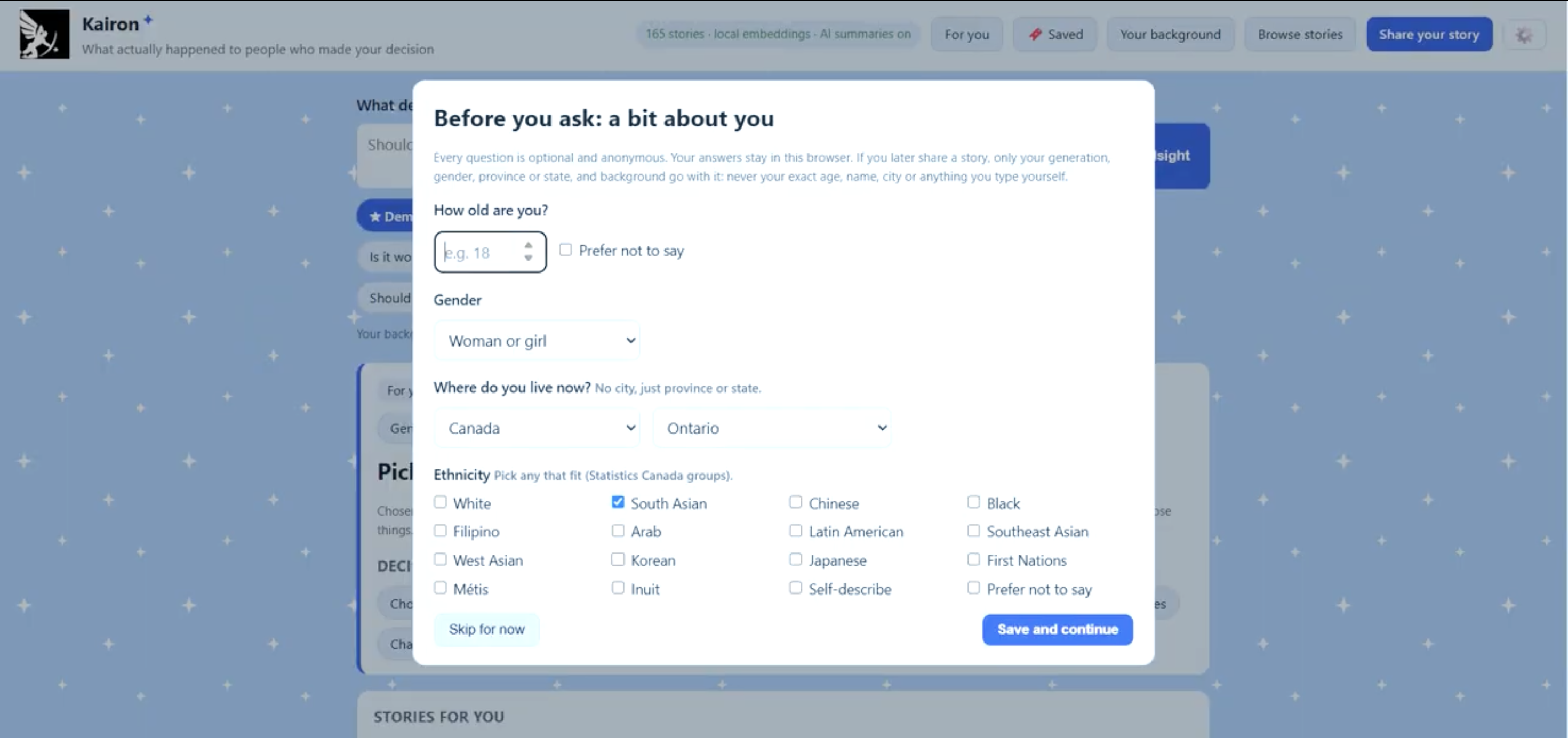
Profile Quiz
-
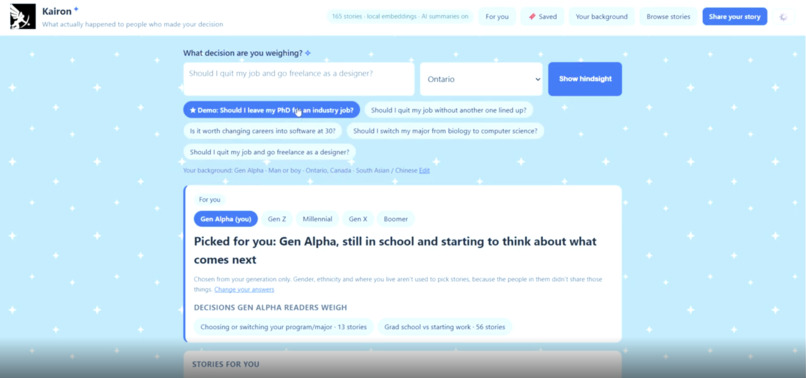
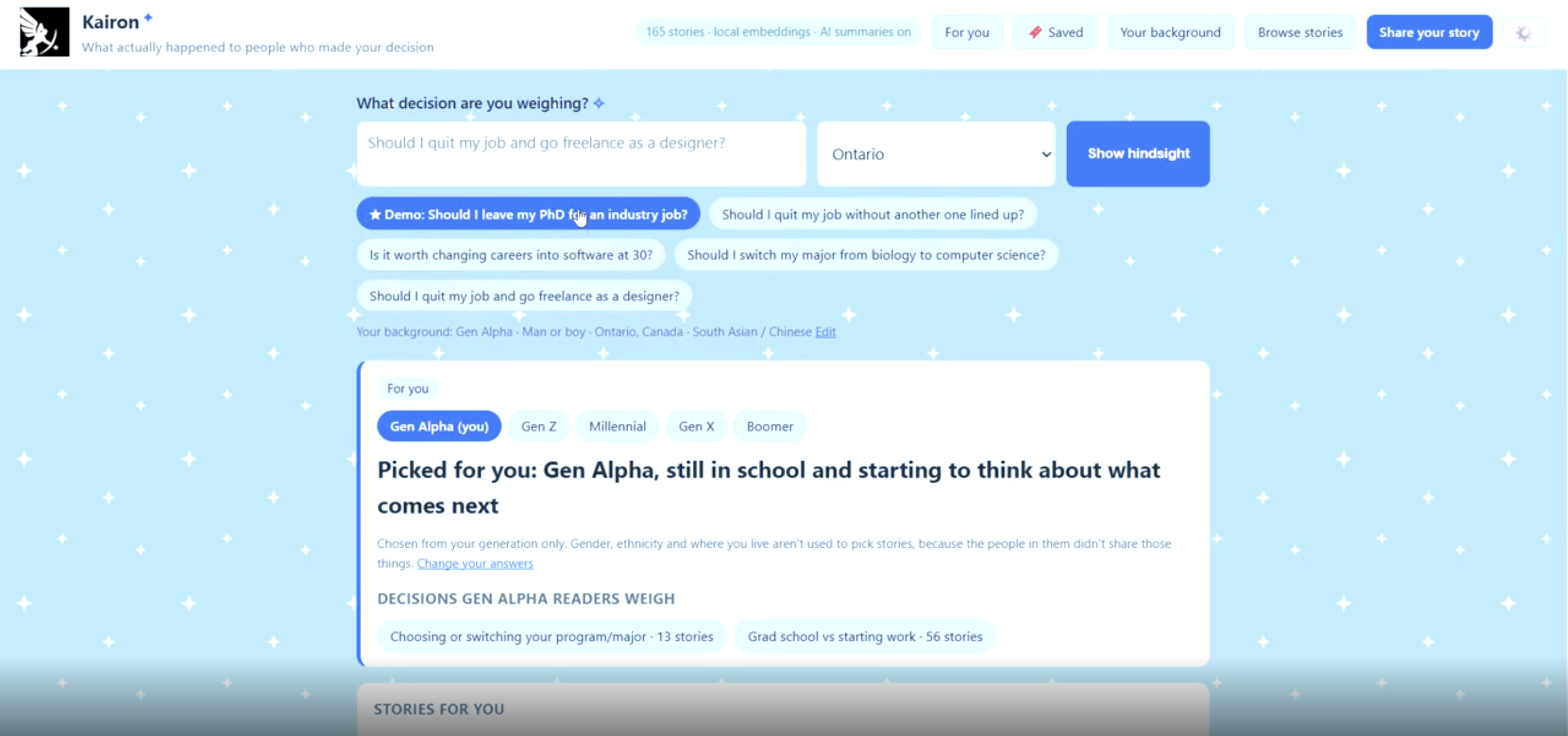
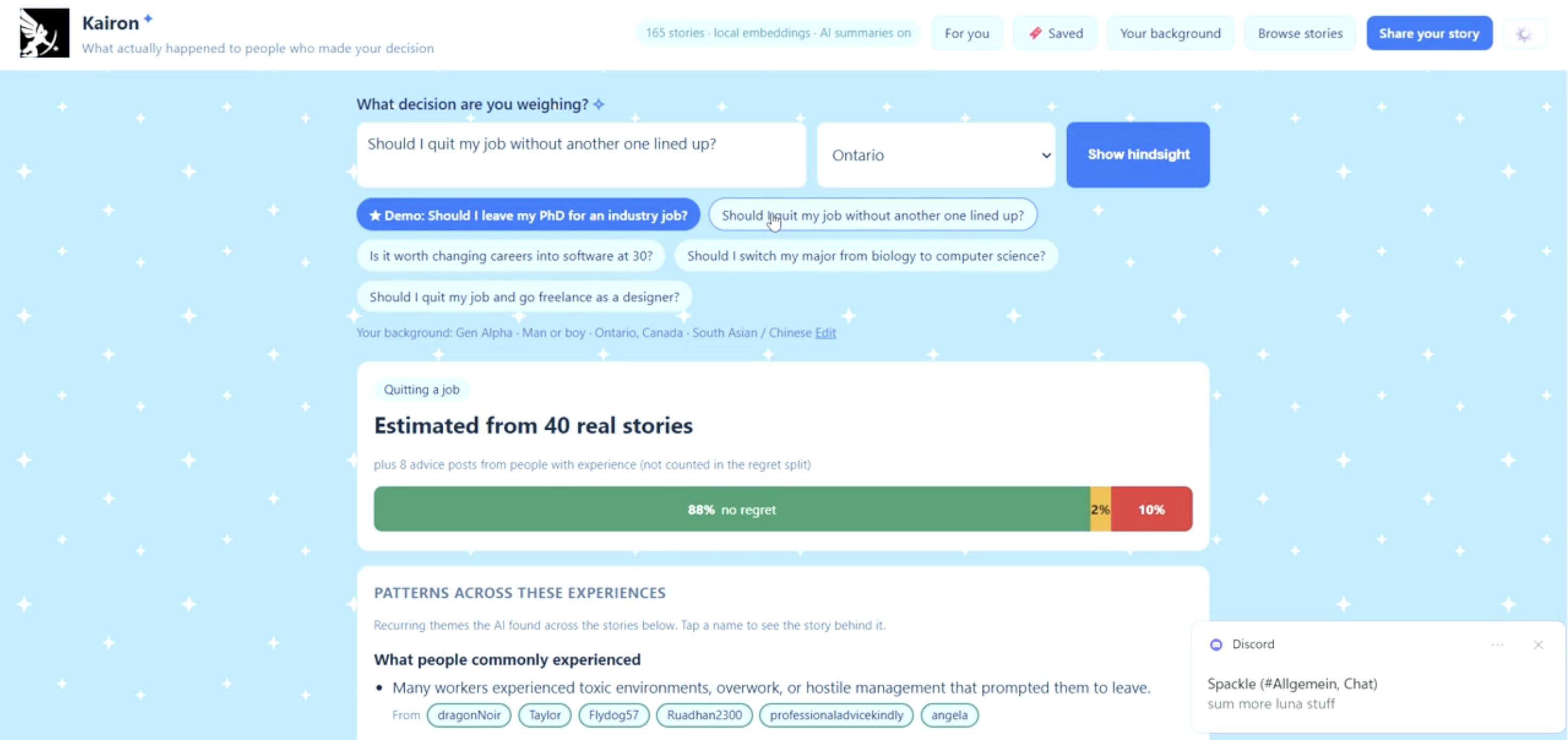
Ask Page
-
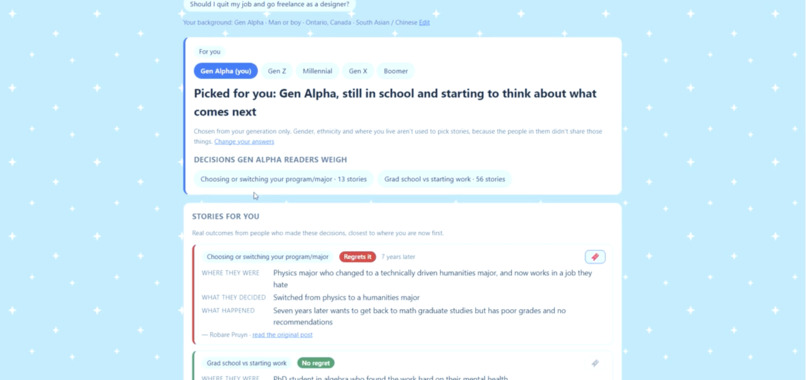
Response Page
-
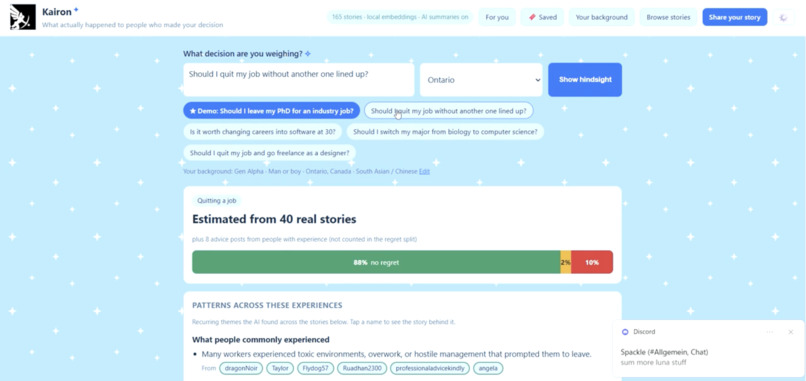
Regret Percentage Page
-
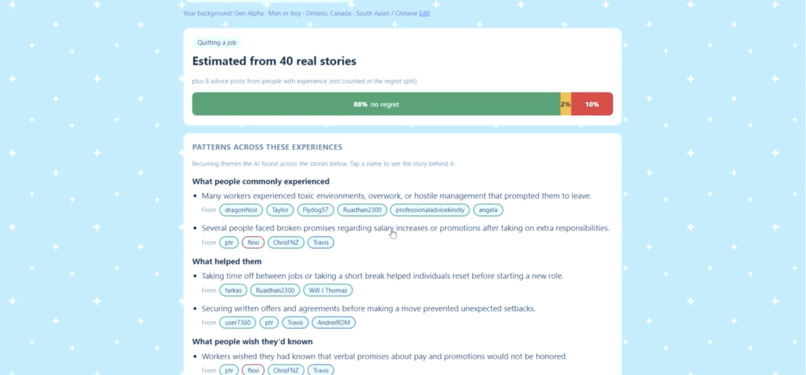
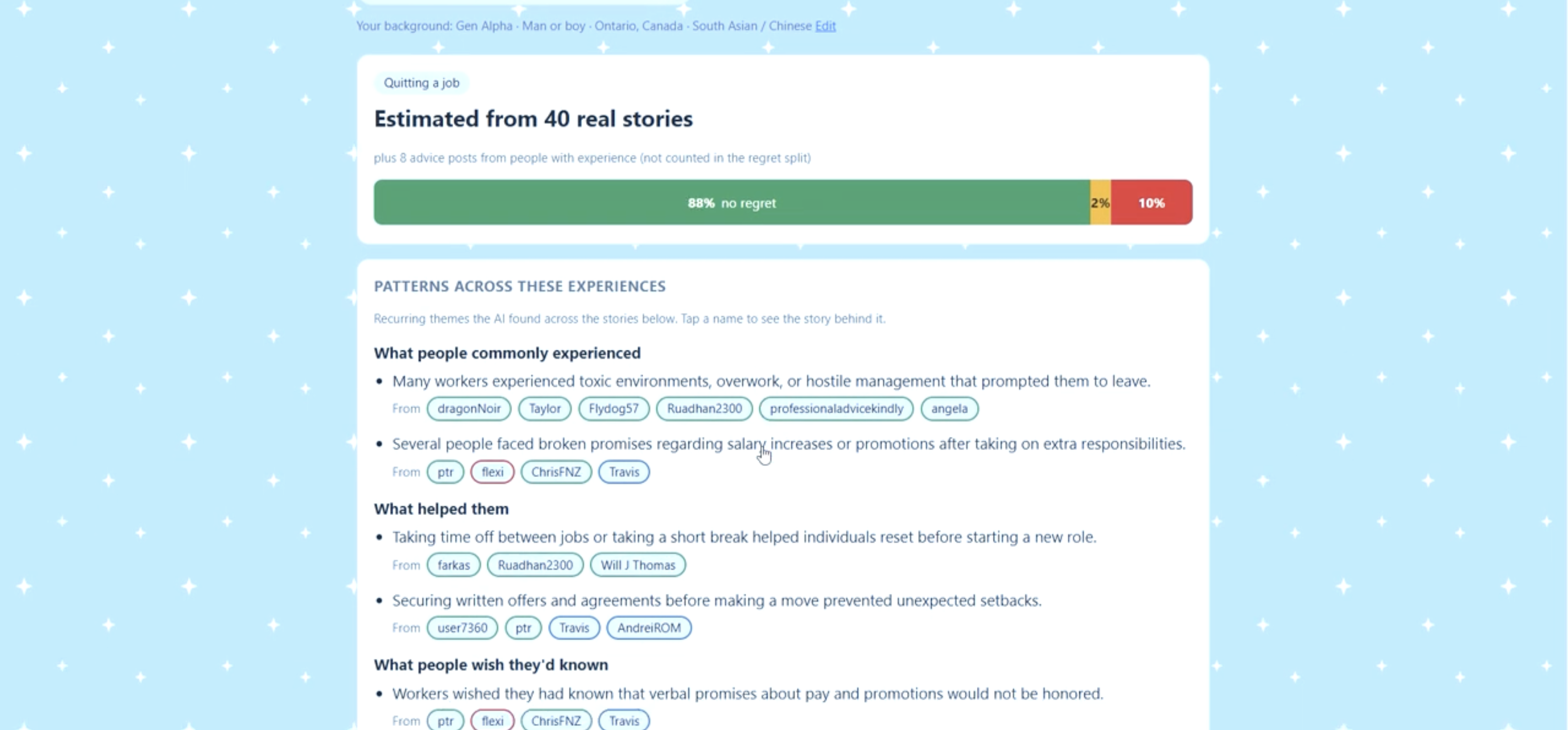
Patterns Across these Experiences page
-
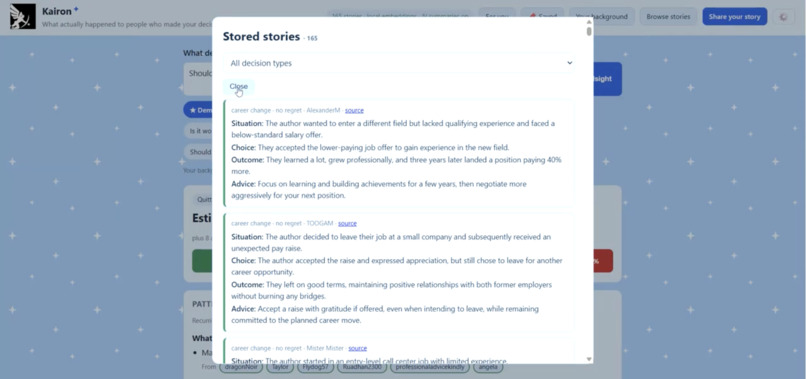
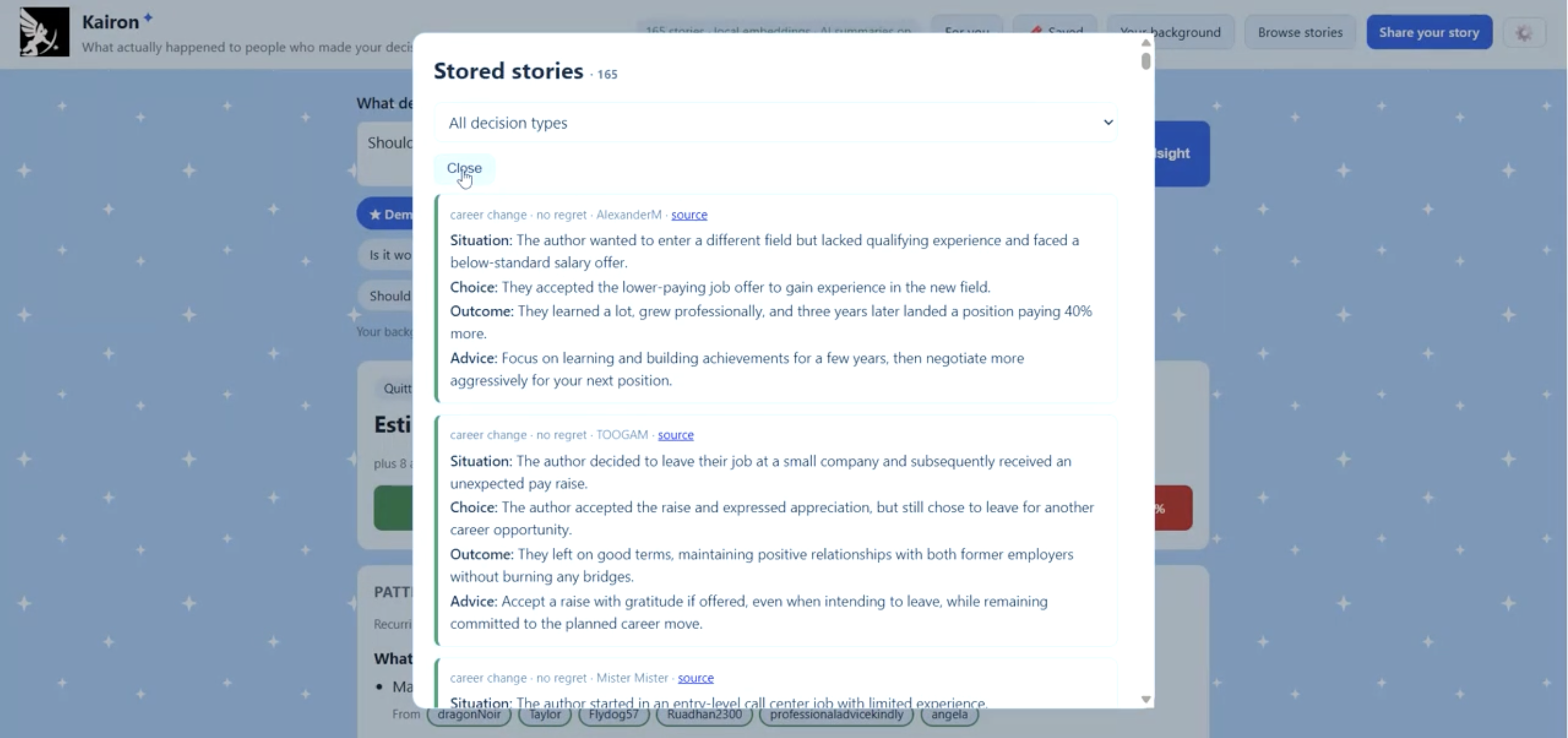
Stored stories page
-
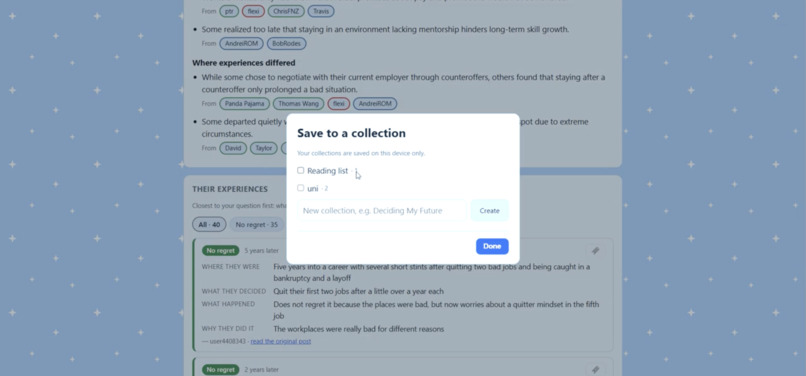
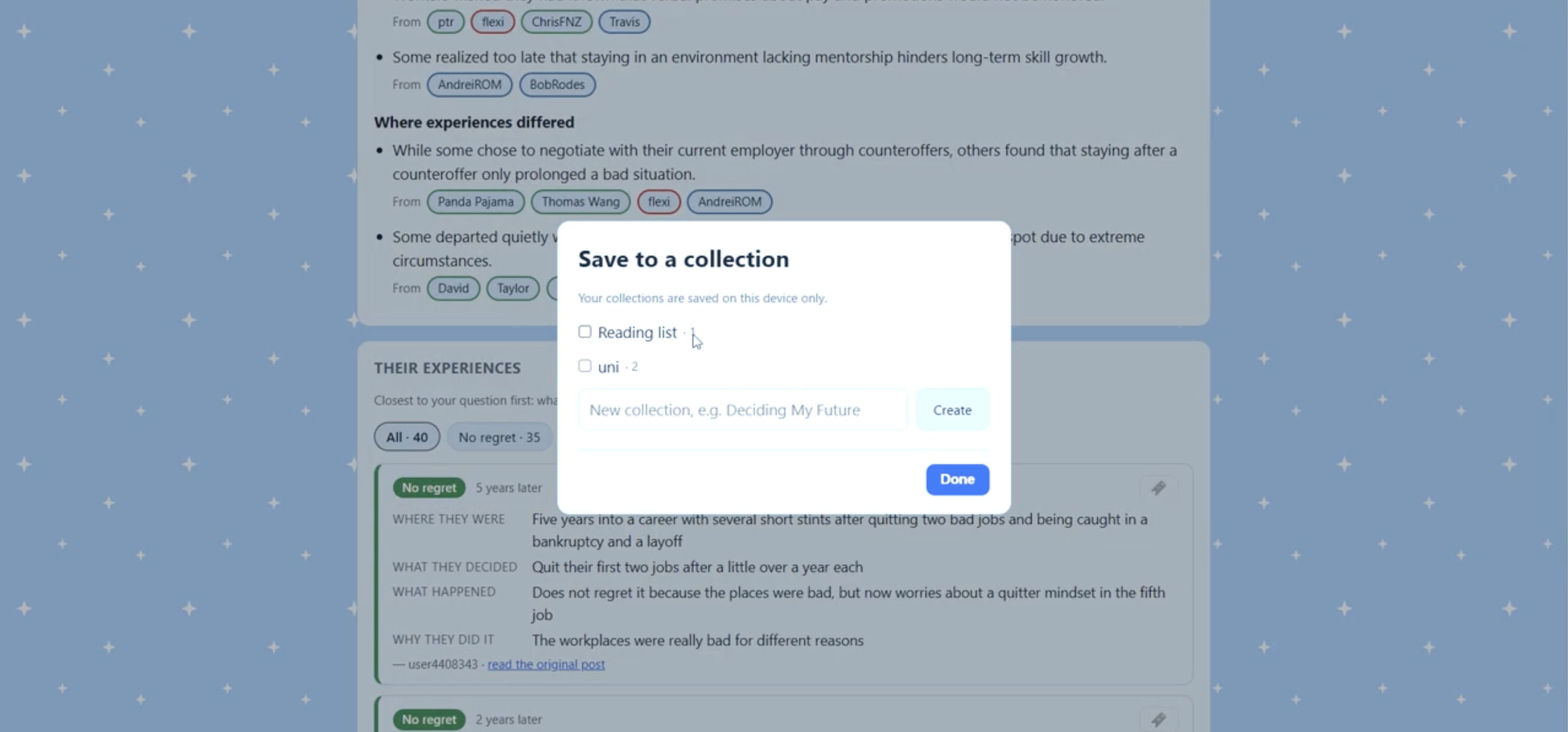
Adding Bookmark Page
-
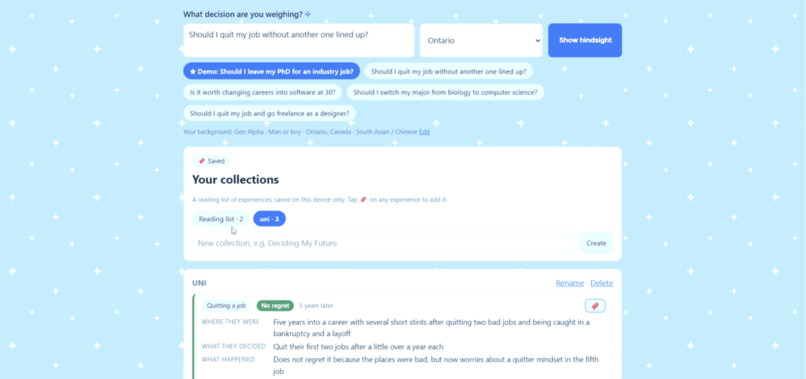
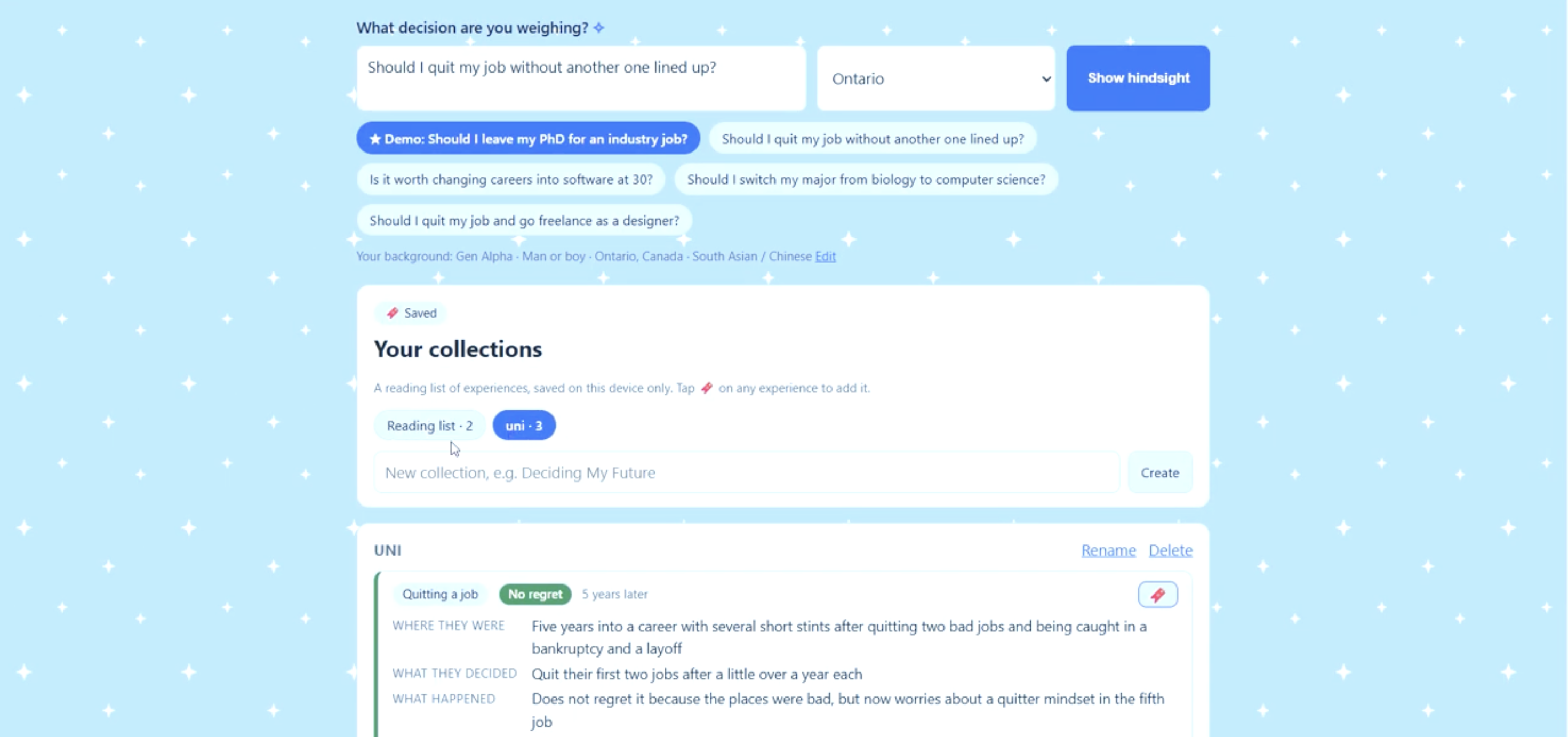
Collection Page
-
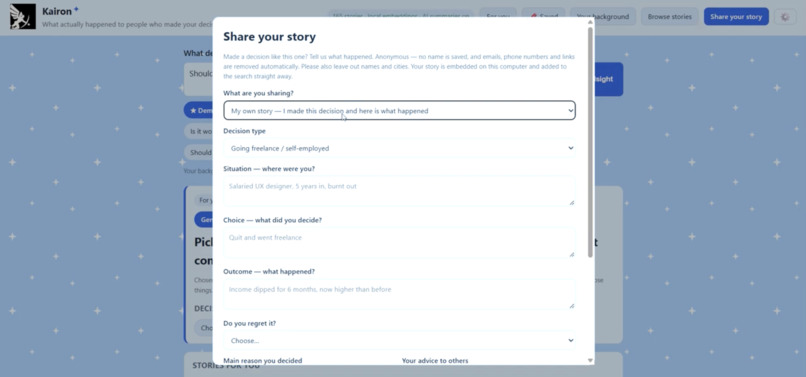
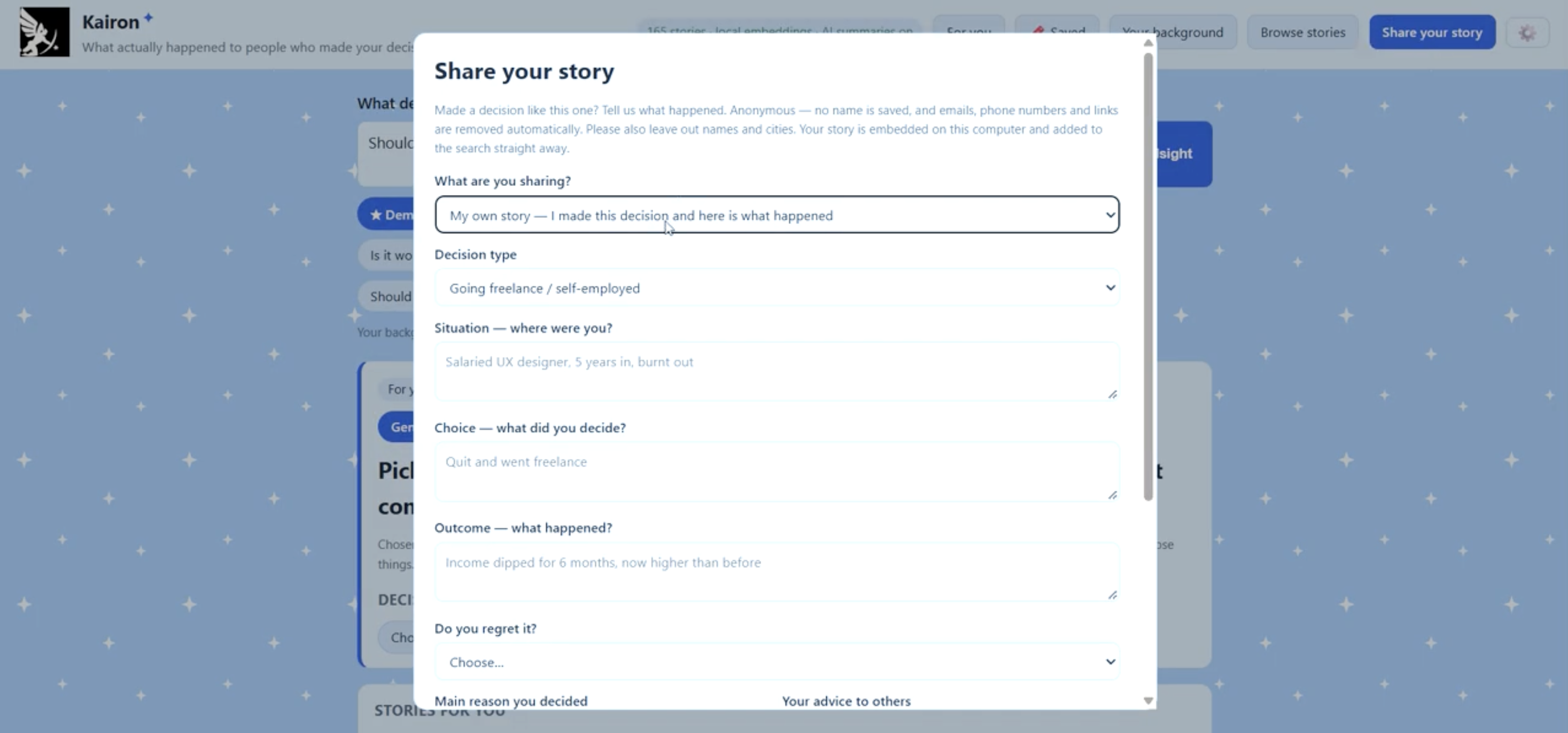
First Sharing Story Page
-
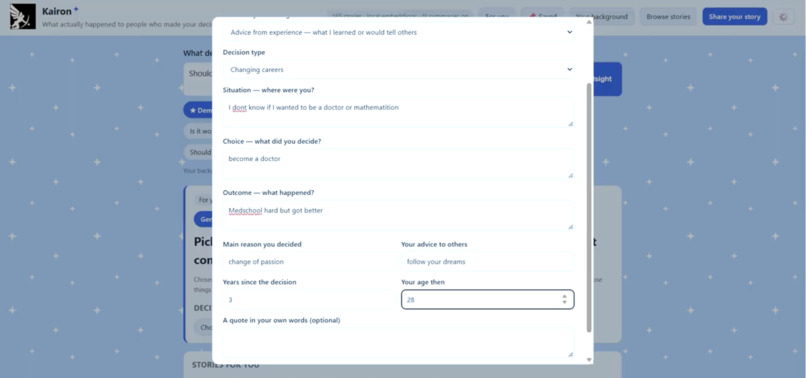
Filled Out Sharing Story Page

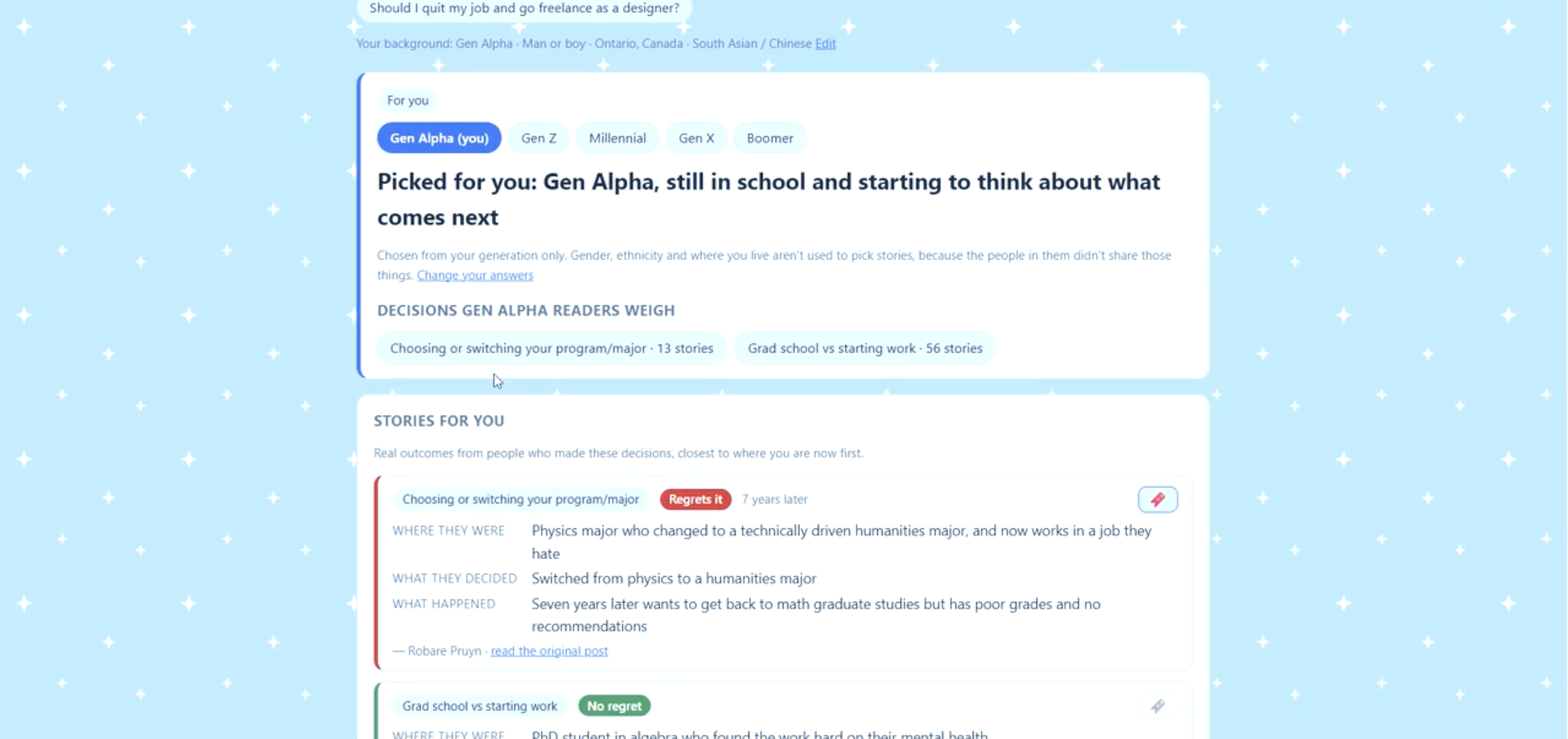
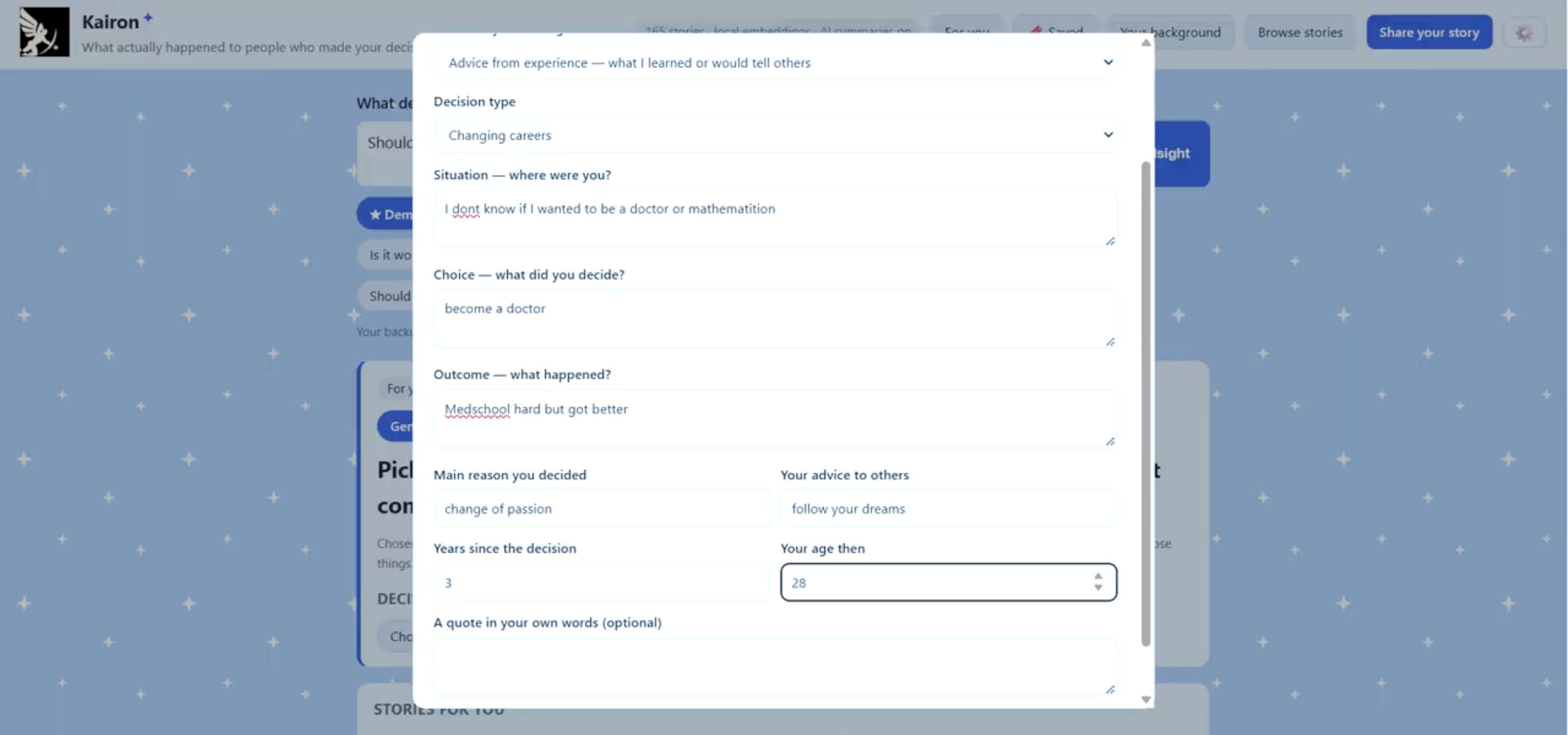
Inspiration
- Everyone faces big decisions for the first time at some point: quitting a sport at 16, switching careers at 30, moving cities at 45, etc. The people who know how those choices turn out are a few years ahead, but nobody really asks them about it. This guidance information is spread throughout the web on various different platforms making good advice almost impossible to find. Our personal experiences include asking our friends for advice on certain decisions, and them giving us little to no help, because they haven't experienced similar things to what we have. But we note that there are many people in the world that could help us! Real human words and experiences is what we're looking for, not just a chatbot.
What it does
- Kairon is named for the Greek kairos, "the right moment." You type a big decision in plain words, and Kairon finds real stories from people who made that same choice. It returns a Hindsight Report: how many people lived it, how it turned out, why, and the advice they'd give. Because a gap year at 18 isn't a gap year at 30, the report also shows how outcomes differ by age group when there's enough real data.
What problem it solves.
- Many of us face important decisions without someone there to guide us. This problem can occur in daily life when questions such as "should I quit abc" or "is xyz a good idea in my 30s?". The people who know how these choices turn out are a few years ahead of us, but we rarely have access to them. Friends often can't help because they haven't been through it, and the advice that does exist is scattered across forums, blogs, and comment threads, which makes it almost impossible to find. Reddit gives you opinions from anyone, and you have to wait for replies and sift through them yourself. Chatbots give generic pros-and-cons lists with no real outcomes behind them.
Kairon solves this by bringing real experiences into one place. You describe your decision, and Kairon finds real stories from people who made that same choice, then shows how many lived it, how it turned out, why, and the advice they'd give. It also shows how outcomes differ by age
Features and how to use the project.
- Ask in plain words. Type a decision the way you'd text it, like "Should I quit hockey to focus on school?" or "Should I switch careers at 30?"
- Hindsight Report: Kairon finds real stories from people who made that same choice and shows how many lived it, how it turned out, the main reasons, and the advice they'd give. Every quote links back to its source.
- Age-group view. A gap year at 18 isn't a gap year at 30, so the report shows how outcomes differ by age group when there's enough real data (at least 5 matching answers).
- Kairon also asks what you chose and how it went, and your story helps the next person.
How we built it
- We built Kairon on real data rather than AI-generated advice. Using the Stack Exchange API, we pulled 706 public posts from the Workplace and Academia sites, searching for phrases like “looking back” and “I regret”. Large language models on Groq’s free tier (gpt-oss-120b and qwen3.8-27b) then read each post and kept only those where someone described a decision they personally made and what happened afterward, about 17% of them. Each one became a structured story: situation, choice, outcome, regret (yes, mixed or no), reason, advice, and a quote that our code checks appears word for word in the original post. Together with stories from an earlier prototype, that gave us 165 real stories, each linked to its source under Stack Exchange’s CC BY-SA license. We never used AI to write stories. Each story is then converted into an embedding by all-MiniLM-L6-v2, running locally through transformers.js, so finding similar stories needs no API key and keeps data on the machine.
The app is a Node.js and Express server with a plain HTML, CSS and JavaScript front end, designed phone-first with a bottom tab bar and installable as a web app. When someone asks a question, Kairon first runs a safety check, then sorts the question into a decision type and ranks only stories of that type by similarity. The regret split is counted in code, never by AI, and percentages are hidden when fewer than five stories match. Google Gemini (gemini-3.5-flash-lite) writes the summary and the recurring patterns in a single call, under strict guardrails: it may only cite stories from the results, each pattern needs at least two sources, and any pattern containing a number is discarded. Quiz answers and saved collections stay in the user’s browser, and the server only ever sees their generation. We backed this with 46 automated tests covering safety cases, classifier accuracy and the AI guardrails, and we built the project with heavy help from AI coding assistants (Claude Code and GitHub Copilot), working through GitHub branches and pull requests.
Challenges we ran into
- Mainly, it was just developing an idea that took too long. This lead to a huge time crunch, where good time-management skills came in handy. Also, one of the biggest challenges we encountered was collecting reliable and relevant experiences from different sources. Otherwise, in code, there was not many bugs/errors, as it all worked out quite smoothly.
Accomplishments that we're proud of
- We got a curated source that was verified and we're using a RAG agent which is really cheap as well. We're happy that we fully achieved our goal with this demo! We are proud that each question leads to deeper branches with REAL sources that
What we learned
- Through building Kairon, we learned how to turn an idea into a functional application by connecting a frontend and backend. We gained experience working with data collection, filtering information, and organizing real-life experiences into a format that users can easily understand. We also learned how important it is to prioritize user safety, privacy, and the reliability of information, especially when building an app that people use to make important life decisions.
Another major thing we learned was that AI isn't always the best solution on its own. By combining technology with real people's experiences, we can create something that provides more relatable and practical perspectives.
What's next for Kairon
- We want to link to real try-it-first opportunities, like volunteering and job shadowing, and add crisis-language detection that points people to support such as Kids Help Phone and 9-8-8. Our goal is to make real, lived experience easy to find, so no one has to make a big decision alone.
Built With
- all-minilm-l6-v2
- claude
- claude-code
- css
- express.js
- fastapi
- fastembed
- gemini
- git
- github-copilot
- gpt-oss
- groq
- html
- hugging-face
- javascript
- onnx-runtime
- python
- qwen
- rag
- sentence-transformers
- stack-exchange-api
- statistics-canada
- transformers.js
- uvicorn
- vector-embedding

Log in or sign up for Devpost to join the conversation.