-
-
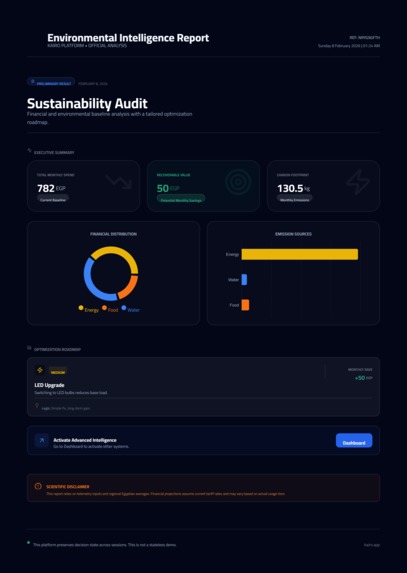
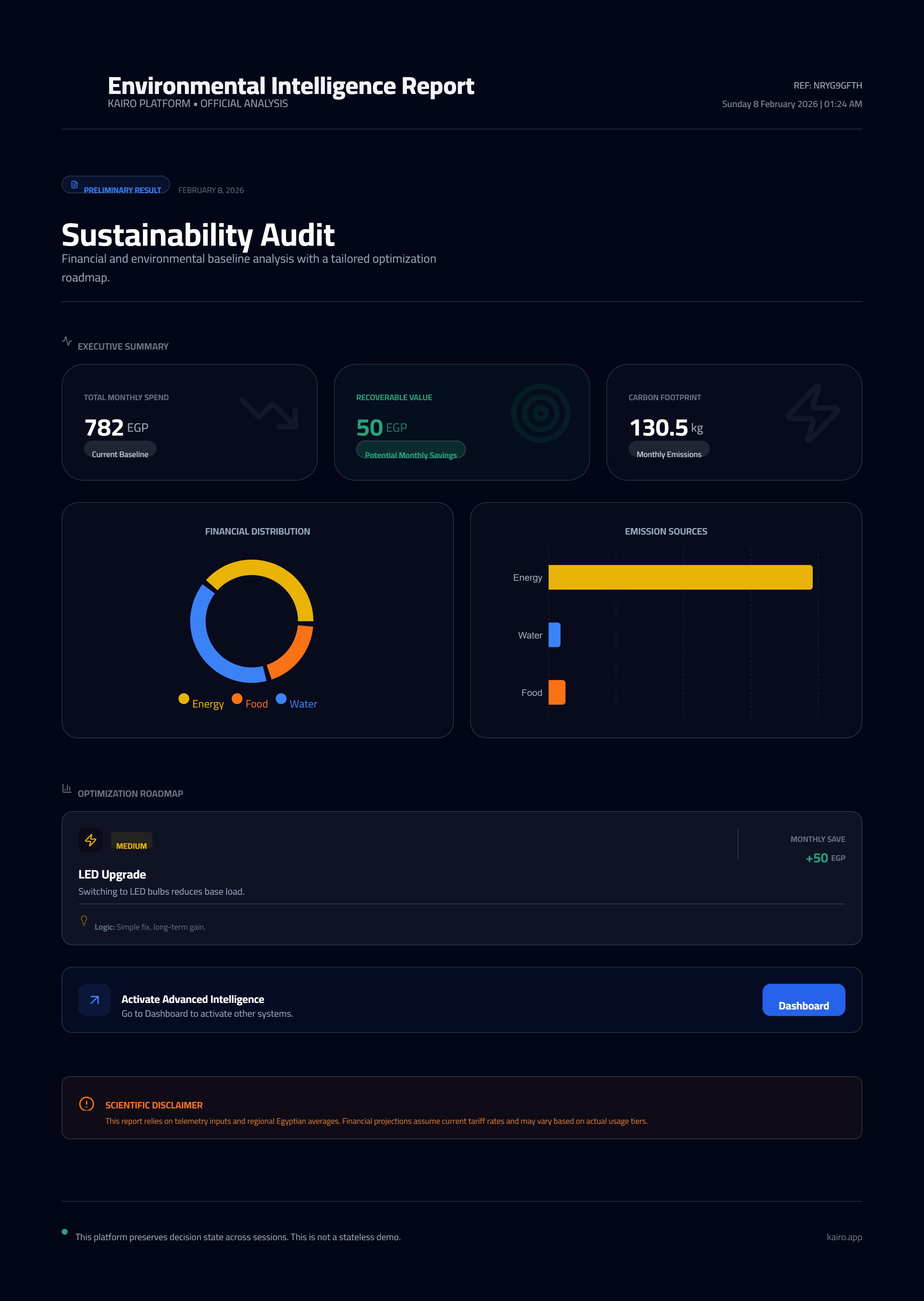
Sustainability Audit
-
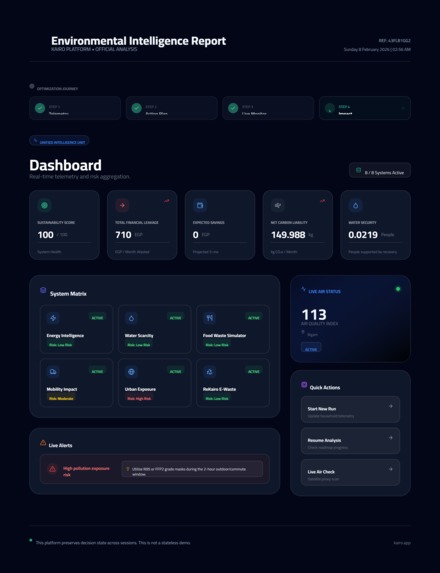
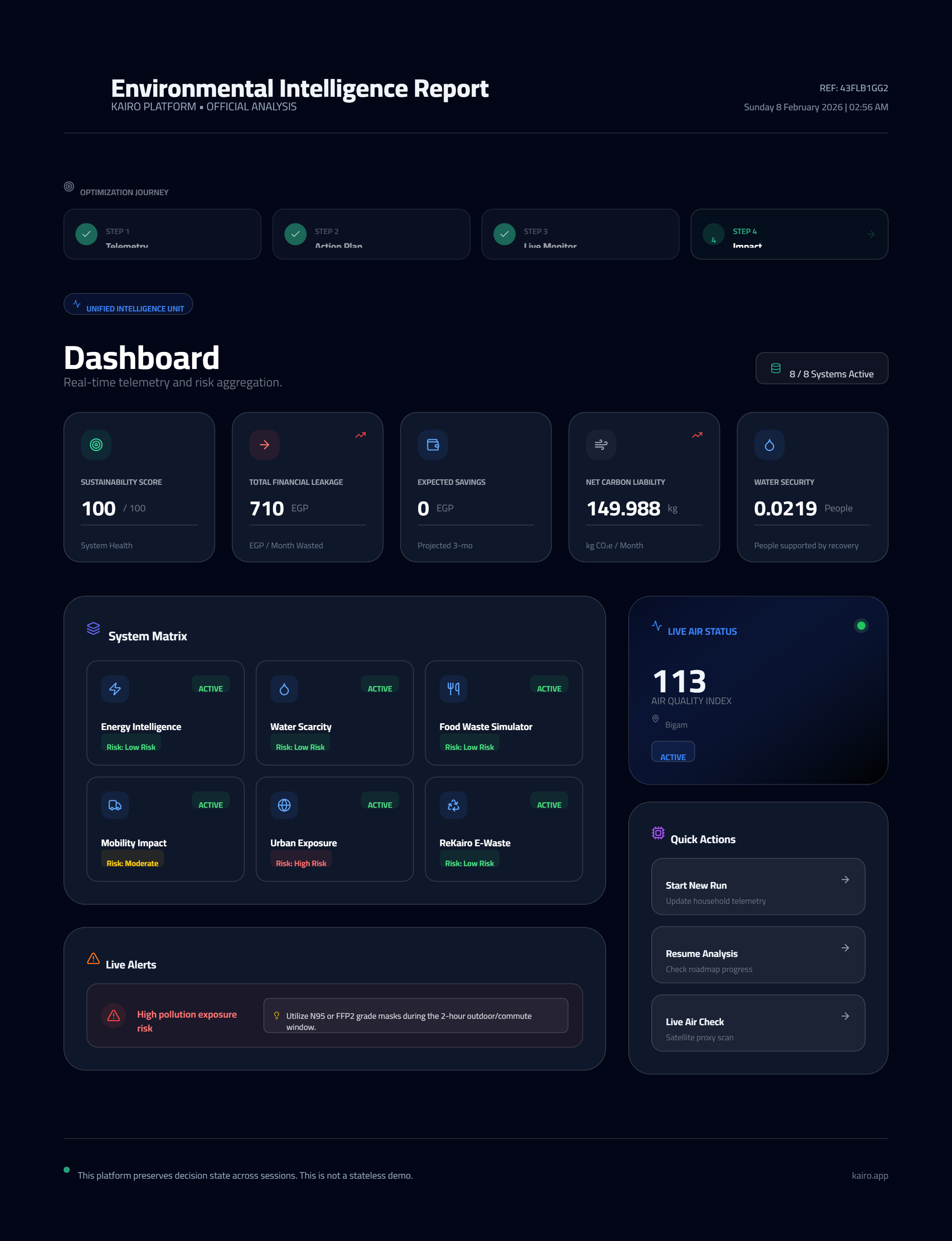
Dashboard
-
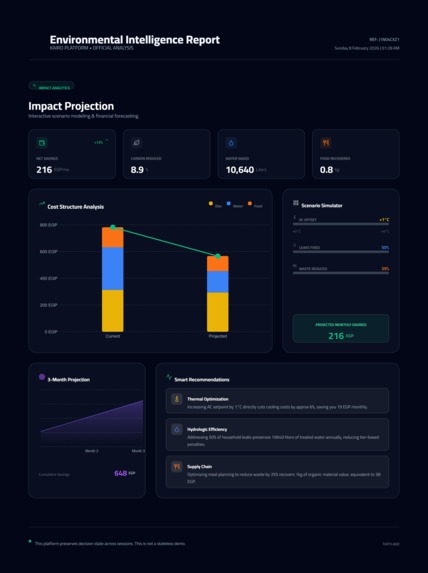
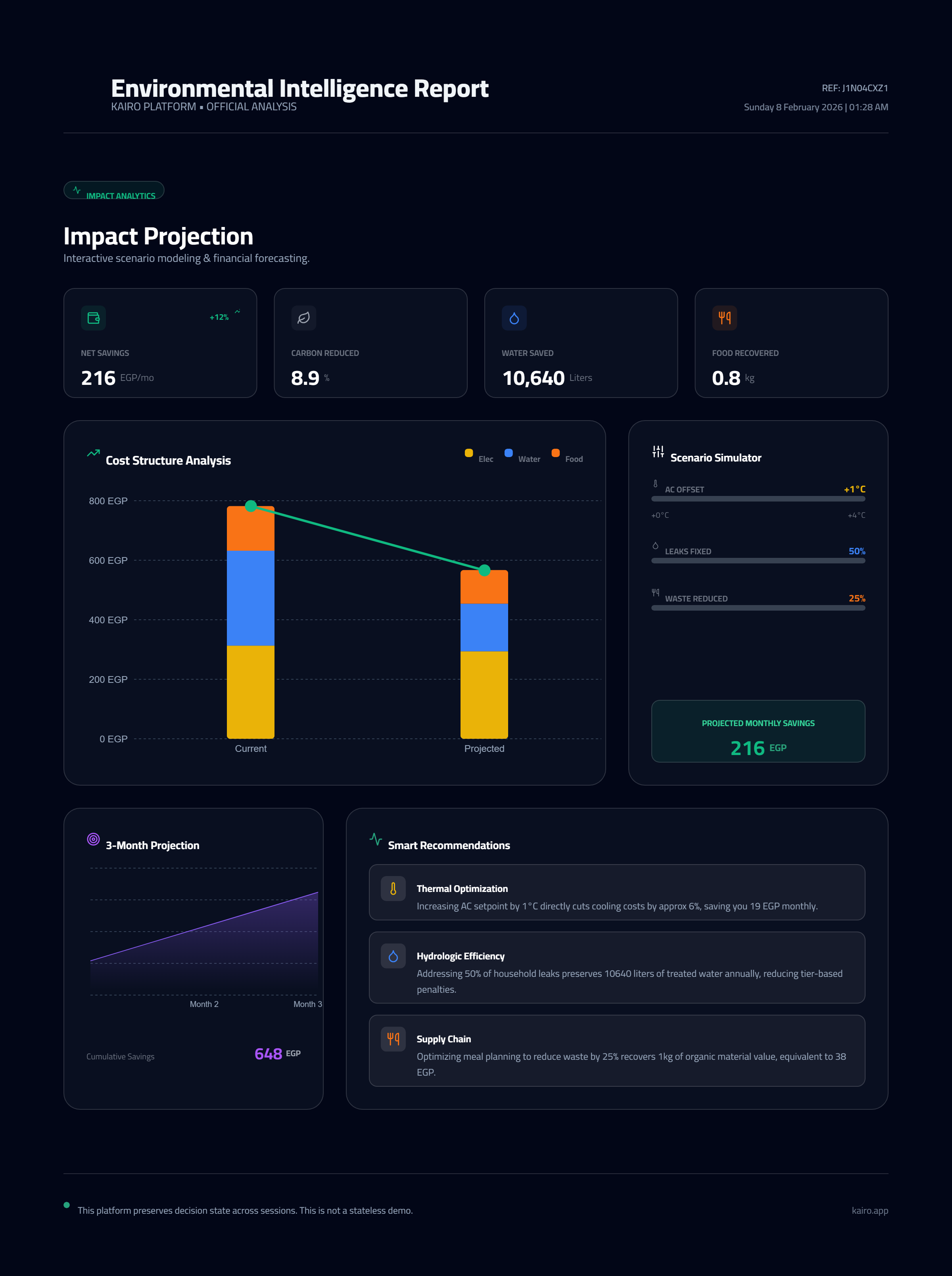
Impact Projection
-
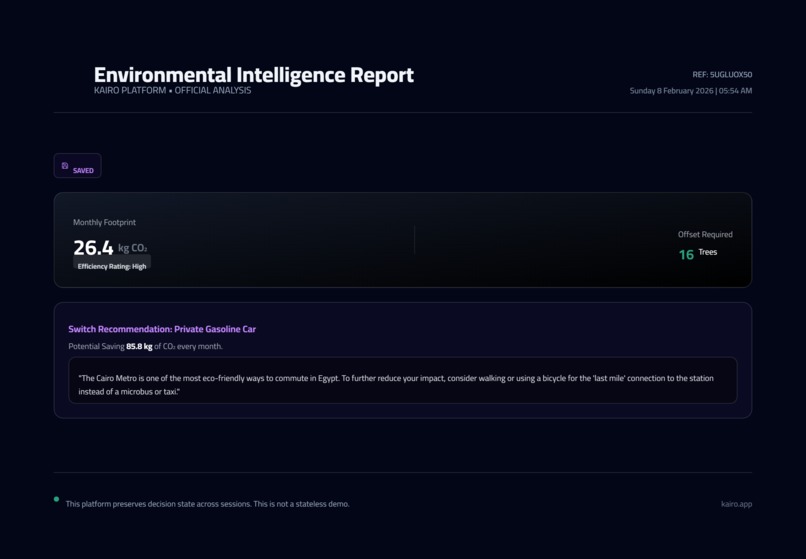
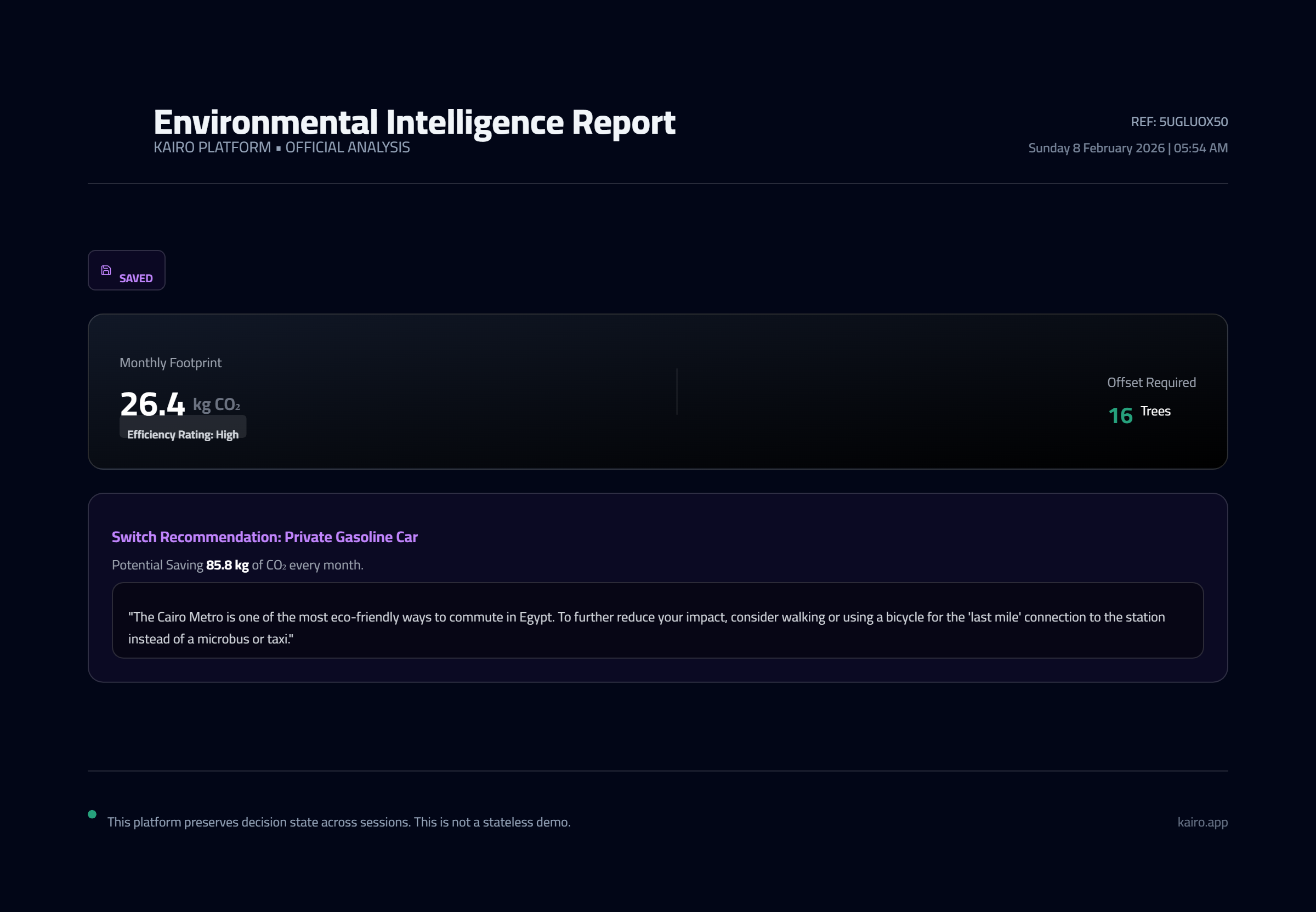
Mobility Impact
-
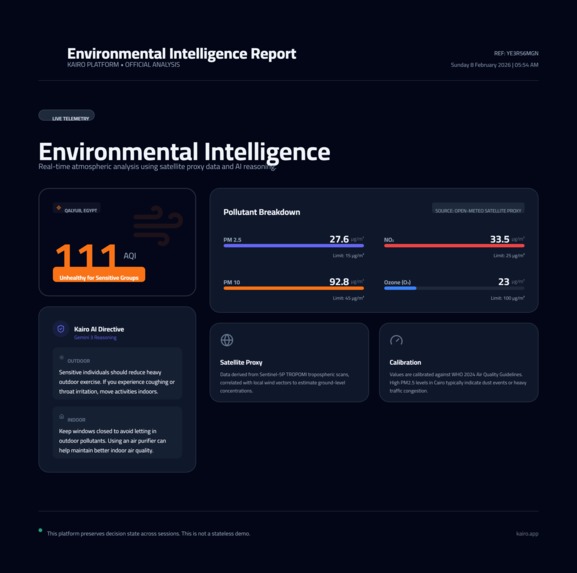
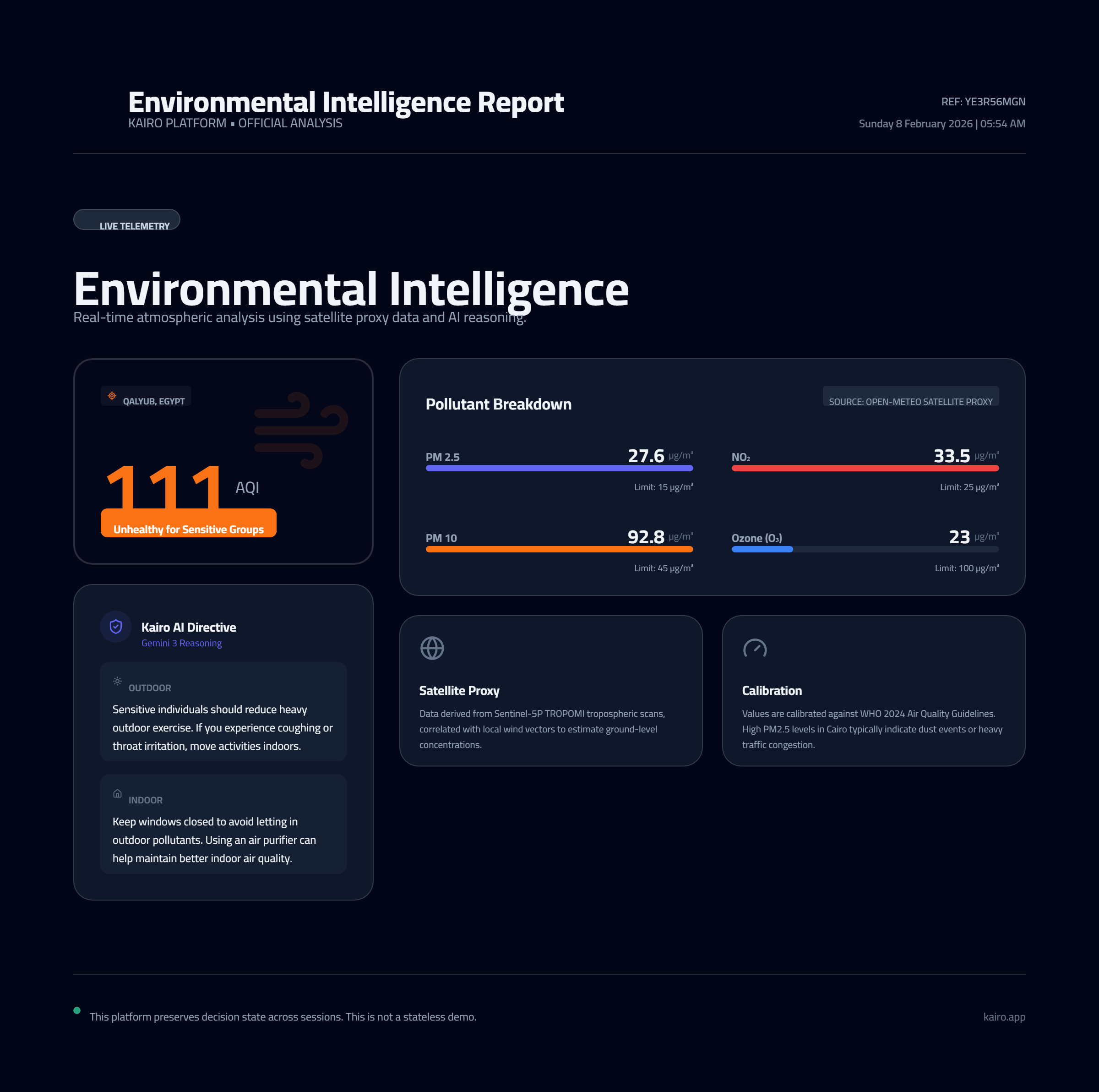
Environmental Intelligence
-
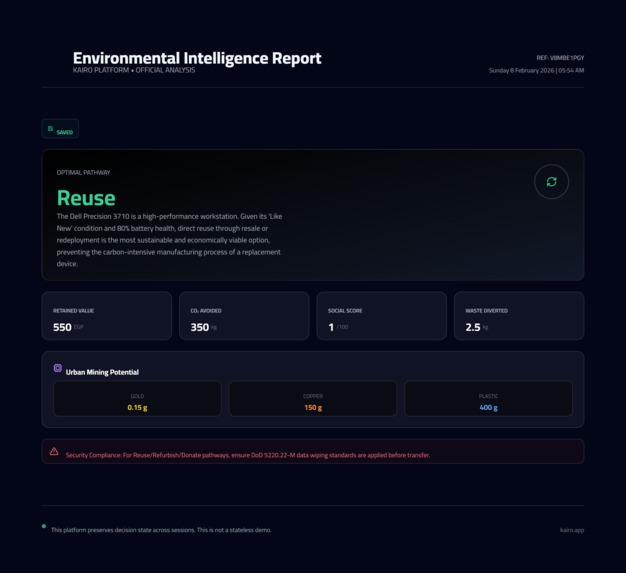
Circular Economy Engine
-
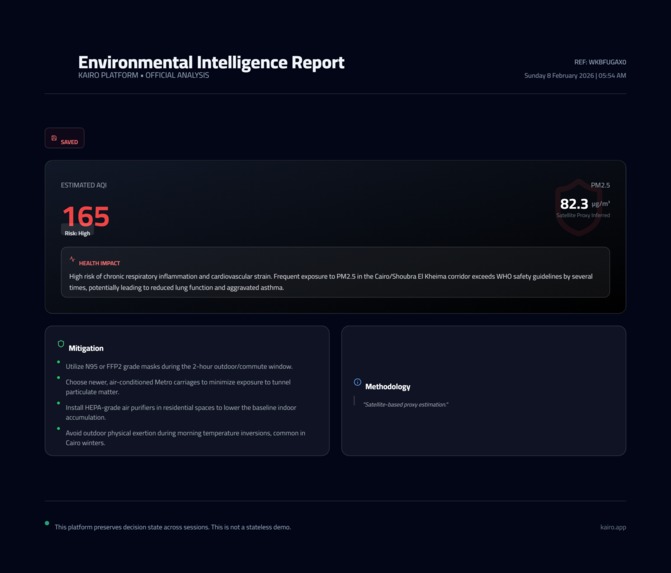
Urban Exposure
-
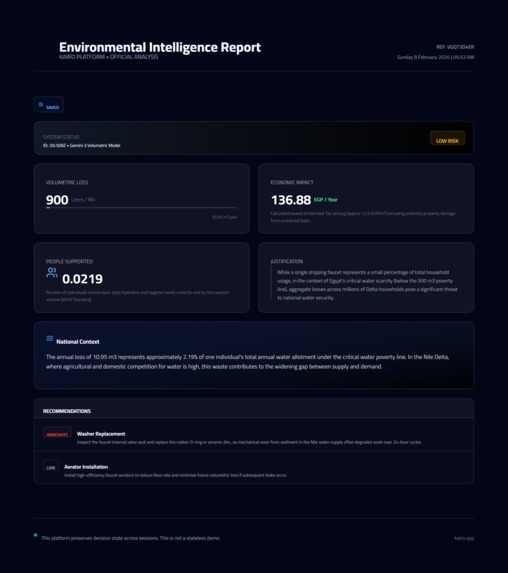
Water Scarcity Reasoning
-
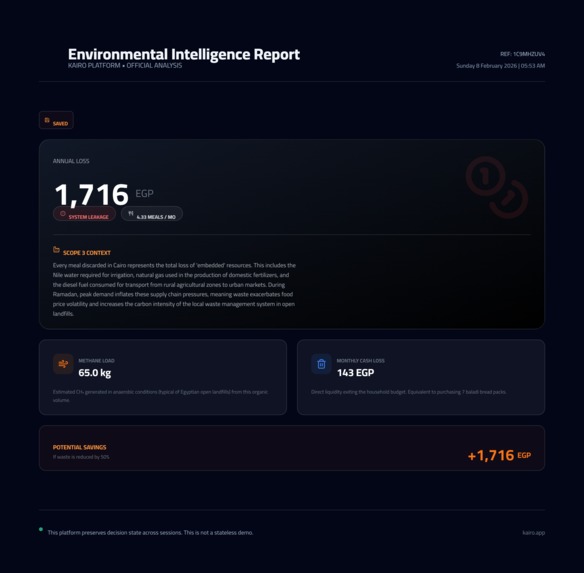
Food Waste Simulator
-
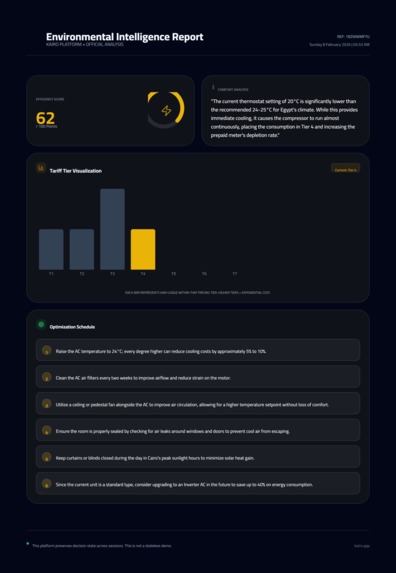
Grid Load Analysis
-
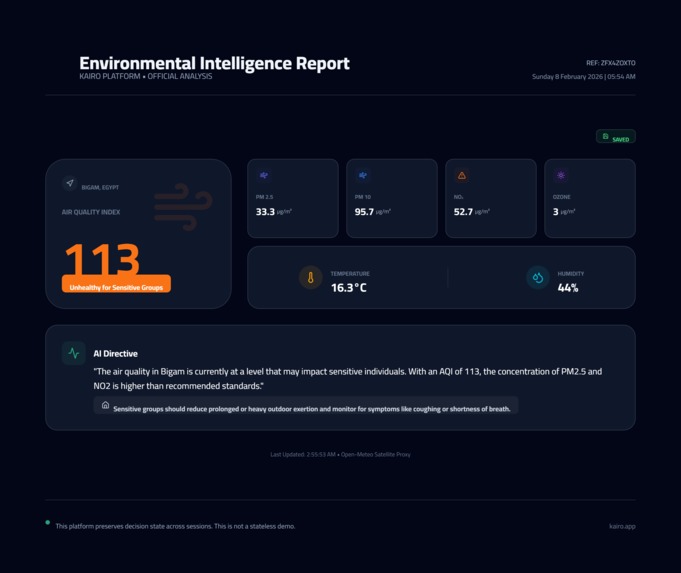
Live Atmosphere
Inspiration
Kairo started with a simple observation.
In the MENA region, sustainability tools often fail not because people lack awareness, but because they speak the wrong language.
Most climate applications report abstract metrics like tons of CO₂.
But families think in bills, money, and survival.
In economies facing inflation, water scarcity, and rising energy tariffs, sustainability is not a moral choice. It is a financial necessity.
We realized that carbon calculators are fundamentally broken for the developing world.
So we built a system that translates environmental physics into financial economics.
If people clearly see how much money they lose from waste, behavior changes naturally.
That idea became Kairo.
What it does
Kairo is an Environmental Intelligence Orchestrator.
It acts like a digital consultant for households.
The platform ingests real household telemetry and uses Google Gemini 3 to reason about inefficiencies and generate actionable recommendations.
Instead of abstract emissions, Kairo shows practical outcomes:
- money lost
- money saved
- water preserved
- energy reduced
- health exposure lowered
Core modules include:
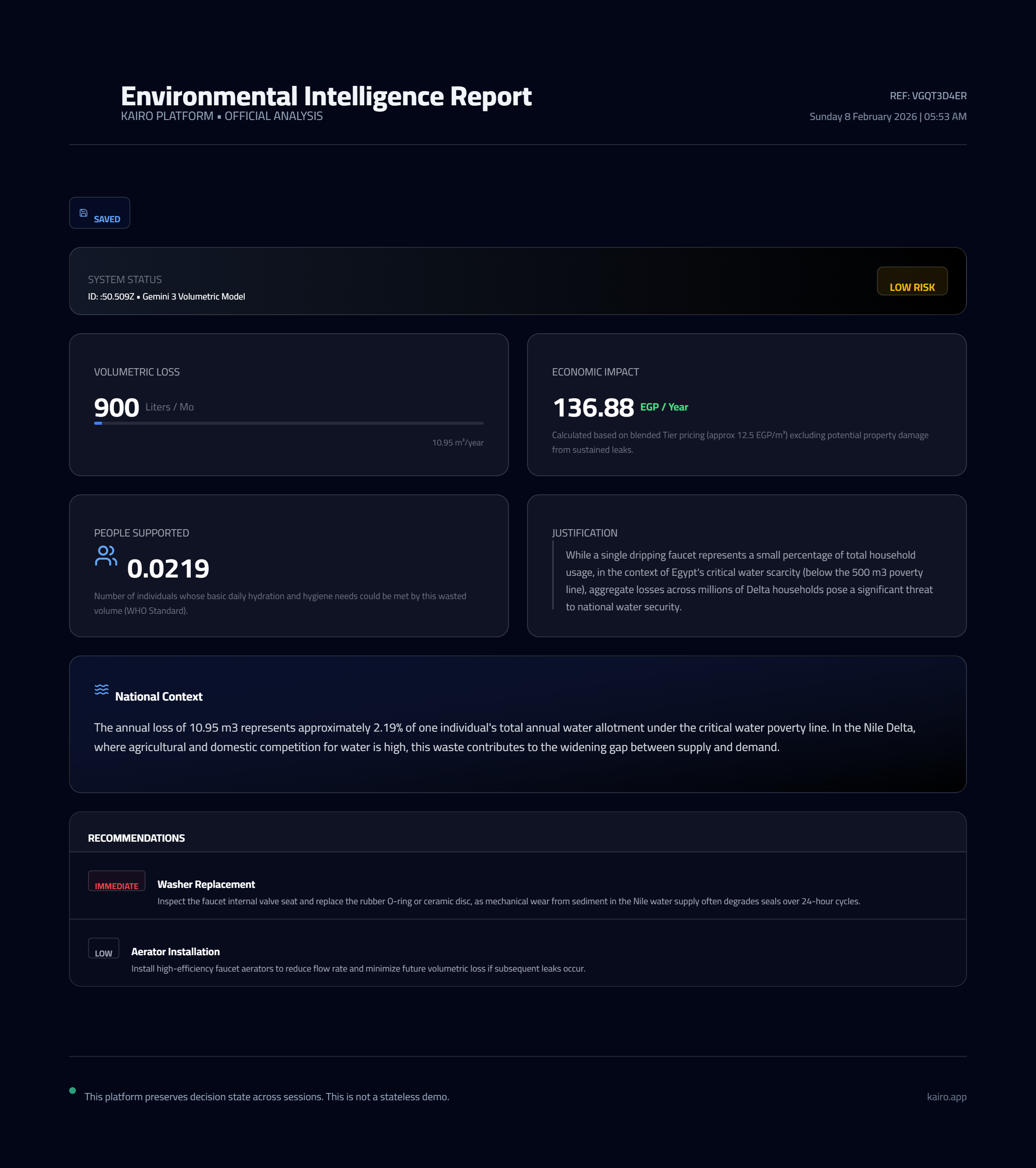
- Water Scarcity analysis
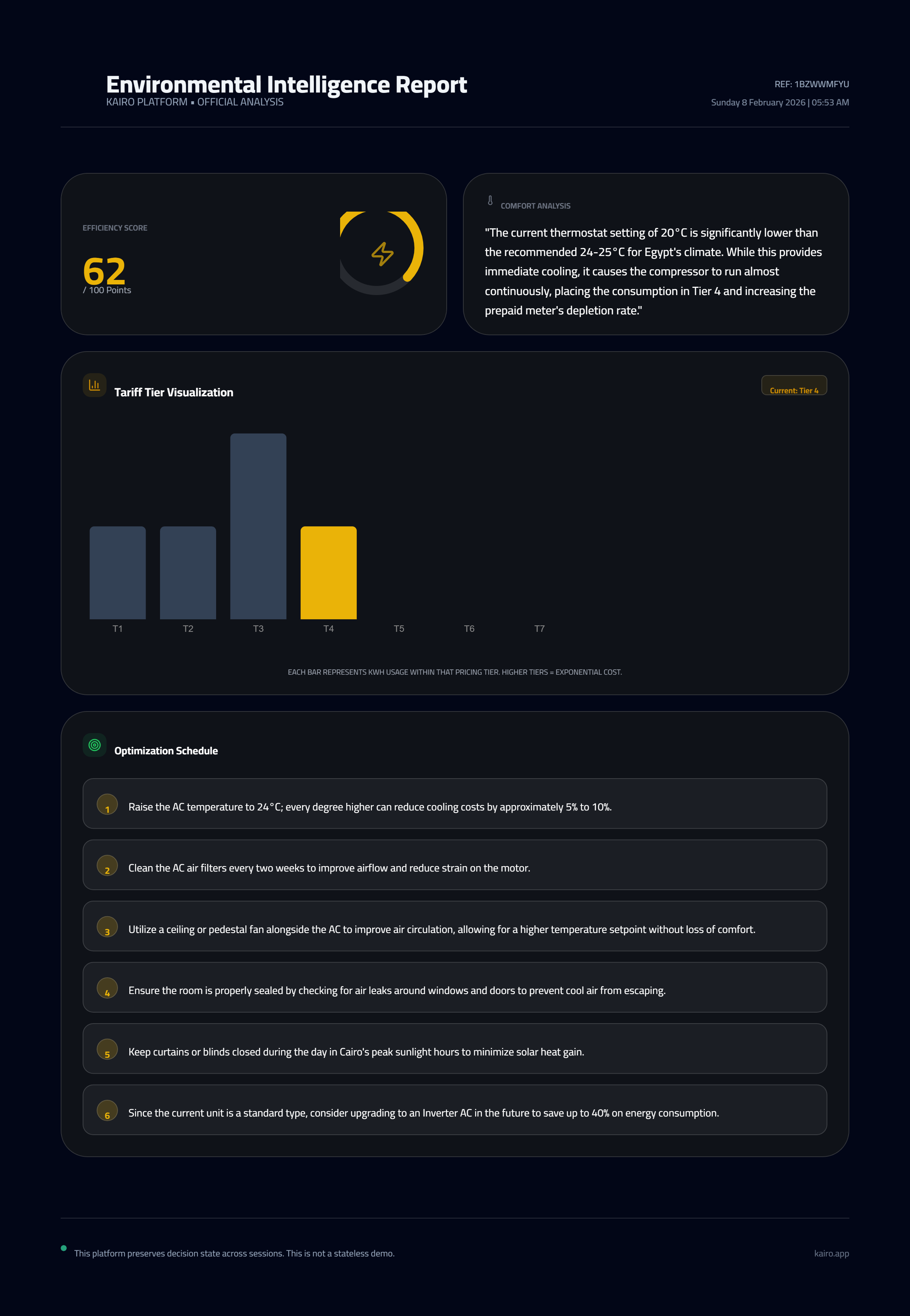
- Energy Intelligence and tariff optimization
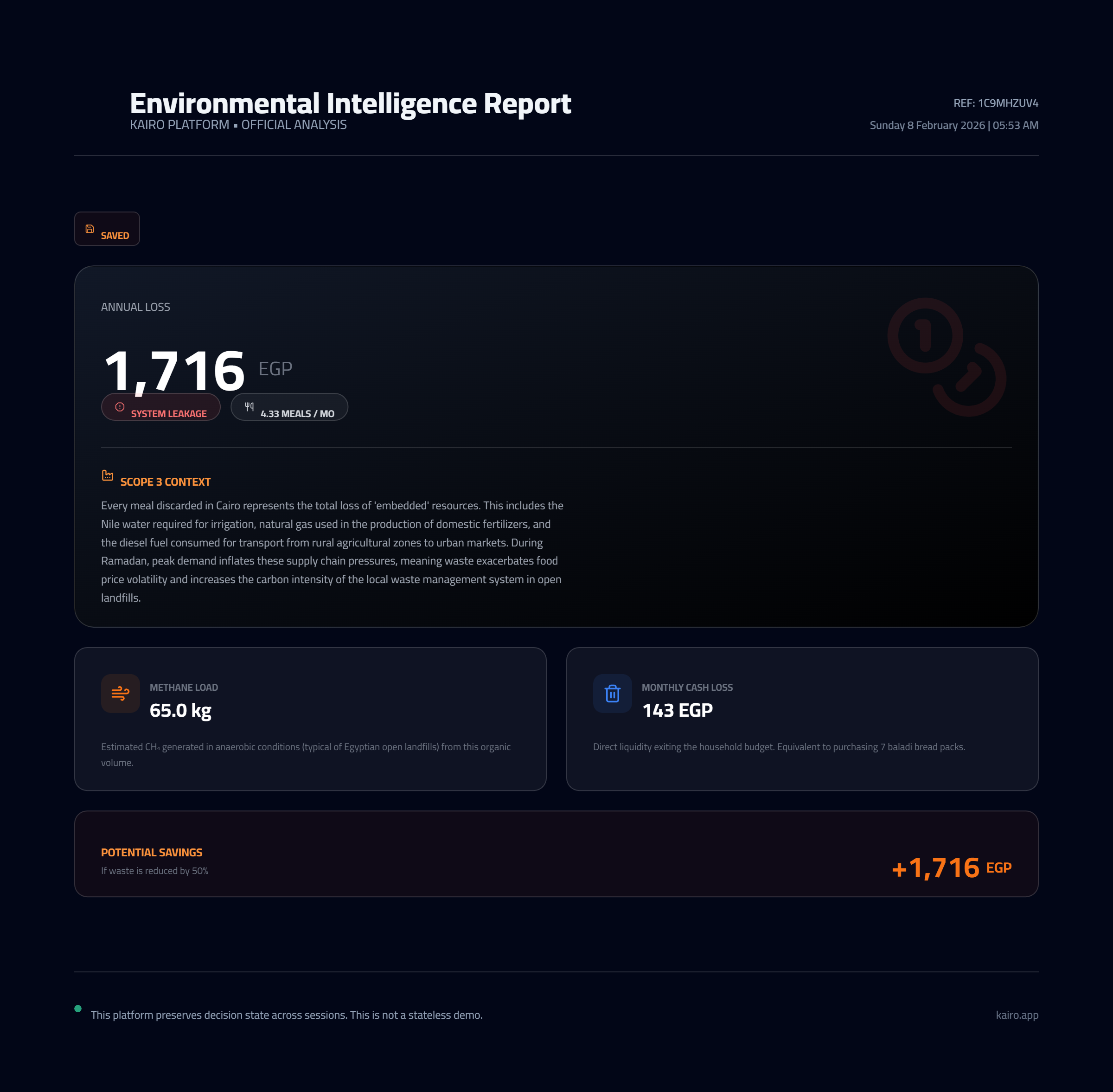
- Food Waste simulation
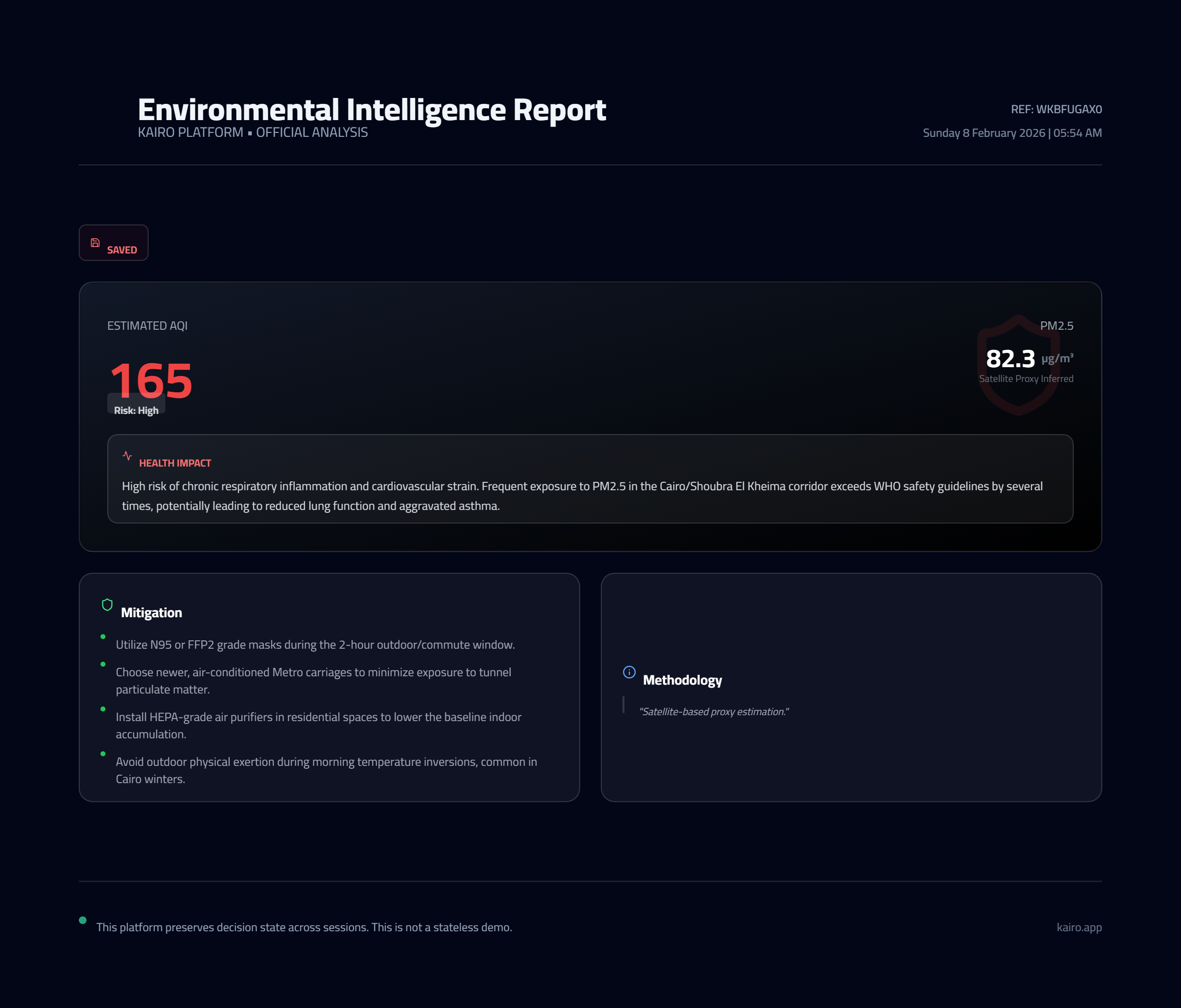
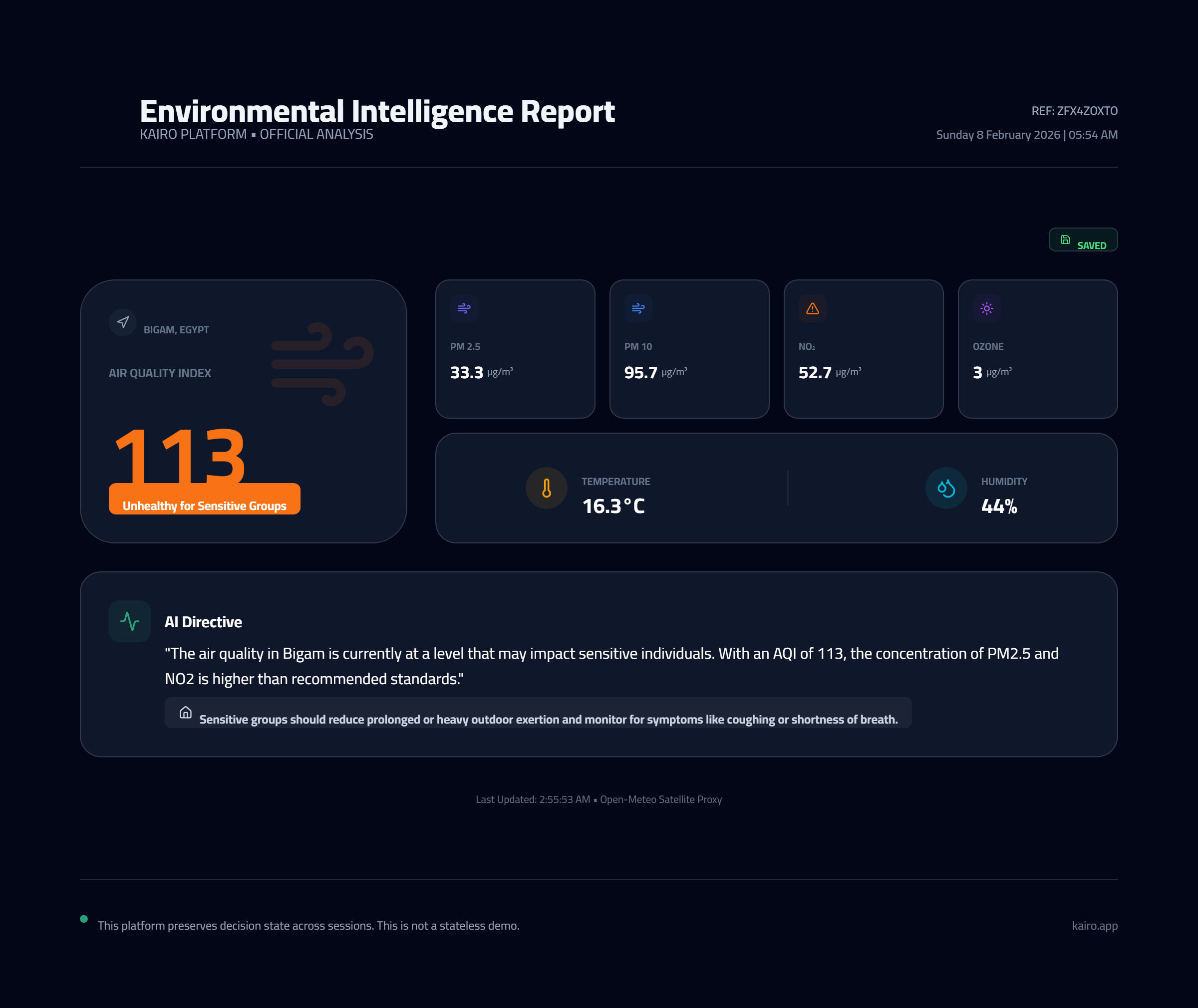
- Urban air exposure estimation
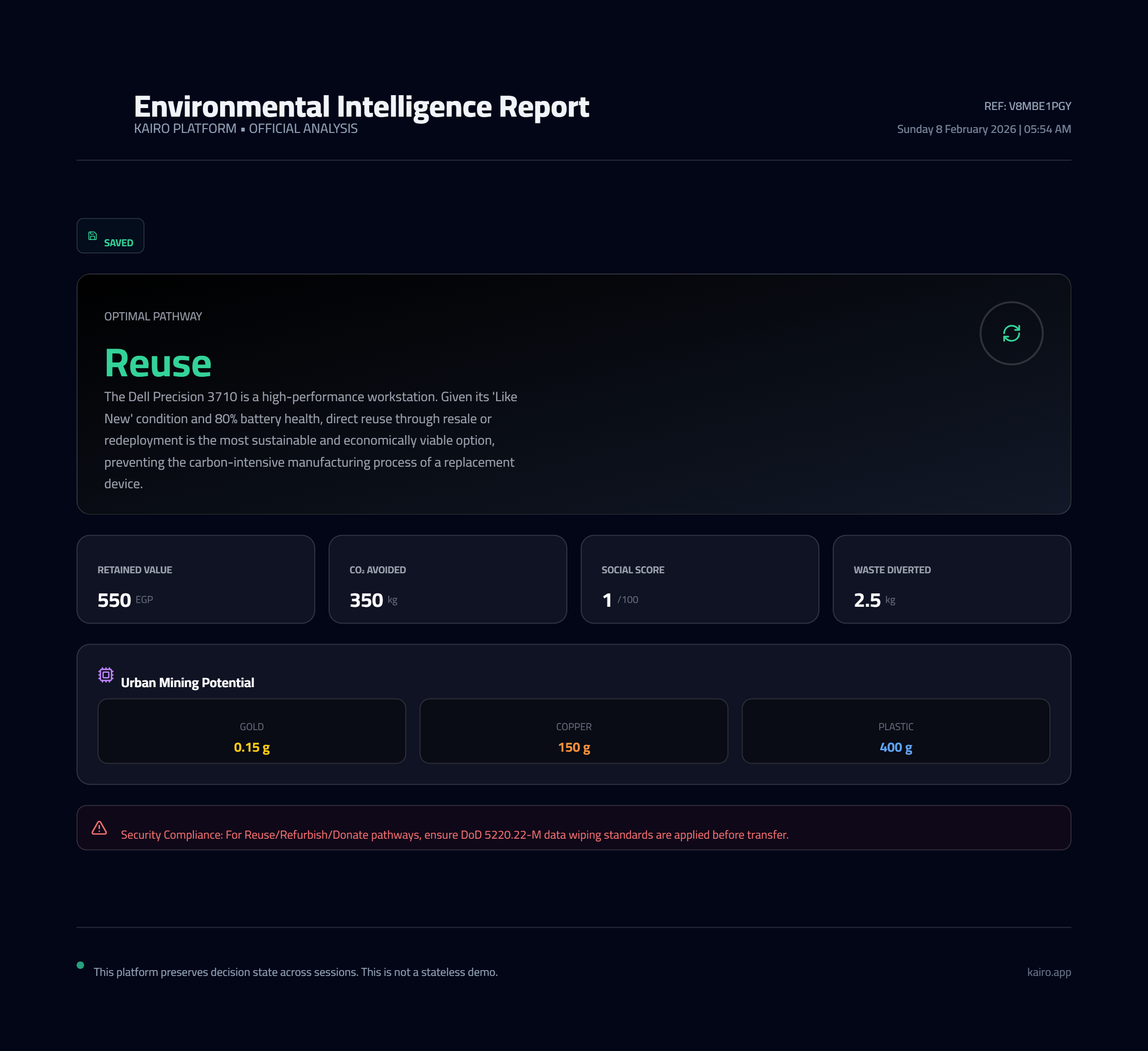
- Circular economy and e-waste valuation
Kairo turns invisible behavior into measurable financial and environmental impact.
How we built it
Kairo is built as a React + TypeScript single-page application with a modular agent architecture.
We designed a central orchestration layer that routes tasks to specialized AI agents.
Gemini Integration
Gemini 3 is the primary and exclusive intelligence engine of the system.
We use:
- Gemini 3 Flash for structured reasoning
- thinkingConfig for multi-step trade-off analysis
- multimodal inputs for image + text understanding
- structured JSON outputs for dashboards and charts
Gemini 3 is responsible for:
- extracting consumption data from uploaded bill images
- interpreting telemetry and behavioral inputs
- reasoning over tariff tiers and emission factors
- calculating financial loss and savings
- generating personalized recommendations
- producing deterministic structured outputs for charts
All analysis, guidance, and projections are generated through Gemini 3 orchestration.
Architecture
- Agent-based orchestration
- Central Gemini service layer
- LocalStorage persistence
- Session snapshots
- Offline deterministic fallbacks
- Recharts for visualization
This keeps the system fast, resilient, and usable even under limited connectivity.
Challenges we ran into
API quota limits
We frequently hit 429 rate-limit errors during development.
We solved this using:
- aggressive caching
- global singleton guards
- circuit breaker patterns
- local session snapshots
This reduced unnecessary Gemini calls and ensured system stability.
Prompt engineering
We needed strict JSON outputs for charts while still generating human-readable advice.
We solved this using:
- schema-constrained prompts
- structured outputs
- dual reasoning + explanation layers
Localization
Supporting English and Arabic (RTL) required dynamic layout flipping and careful UI logic.
Accomplishments that we're proud of
Kairo is not a mockup. It is a fully working, end-to-end system.
We successfully:
- built a production-ready React + TypeScript application
- integrated Gemini 3 as a reasoning engine, not just a chatbot
- enabled bill ingestion and structured analysis
- designed a modular agent-based orchestration architecture
- modeled Egyptian tariff structures for realistic savings
- engineered quota-safe caching and circuit breakers
- delivered bilingual English/Arabic UI with full RTL support
- generated actionable financial insights instead of abstract carbon metrics
Most importantly:
We proved that sustainability adoption increases when impact is translated into money.
What we learned
Accuracy matters more than speed in decision systems.
Users prefer slightly slower responses if the advice clearly saves money.
We also learned that combining:
Deterministic math models
-
Gemini 3 reasoning
creates higher trust than AI alone.
Framing sustainability financially drives real behavioral change.
What's next for Kairo
Our immediate goal is to move from prototype to real-world deployment.
We plan to launch a pilot in Egypt.
Next steps:
- integrate directly with smart meters
- expand Gemini-powered forecasting and simulations
- predict monthly bills and savings
- improve offline-first reliability
- deepen Arabic localization
- launch Kairo Business for SMEs and ESG reporting
Long term, we aim to become the intelligence layer for resource management across high-constraint economies worldwide.
Our vision:
Every household should have an AI system that thinks about efficiency before waste happens.
Built With
Languages
TypeScript, JavaScript, HTML5, CSS3
Frontend
React 19, Tailwind CSS, Framer Motion, Recharts, React Router
AI & Cloud
Google Gemini API, Gemini 3 Flash, Google AI Studio
Tools
Vite, Lucide React, html2canvas
Architecture
Client-side SPA, Agent-based orchestration, LocalStorage persistence, Offline fallback system
Built With
- agent-based-orchestration
- ailwind-css
- client-side-spa
- css3
- framer-motion
- gemini-2.5-flash-image
- gemini-3-flash
- google-ai-studio
- google-gemini-api
- html2canvas
- html5
- javascript
- lucide-react
- ocalstorage-persistence
- offline-fallback-system
- react-19
- react-router
- recharts
- typescript
- vite


Log in or sign up for Devpost to join the conversation.