-
-
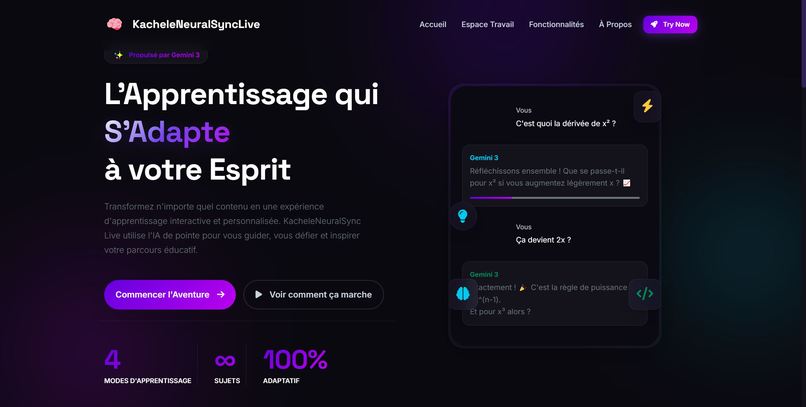
Home page
🧠 The Story of KacheleNeuralSync Live 🌟 Inspiration Our inspiration came from a simple but frustrating observation: Education is often a "one-size-fits-all" experience. Whether in a classroom or on a MOOC, students are usually forced to follow the same pace, regardless of their background or learning speed.
We wanted to create a platform where technology doesn't just deliver content, but actually understands it and adapts to the learner. We dreamed of a world where every student has access to a personal, elite tutor—one that doesn't just give answers, but guides you through the process of discovery. The launch of Gemini 3 provided the perfect "brain" to turn this vision into reality.
🛠️ How we built it KacheleNeuralSync Live was built as a full-stack Django application designed for high performance and scalability.
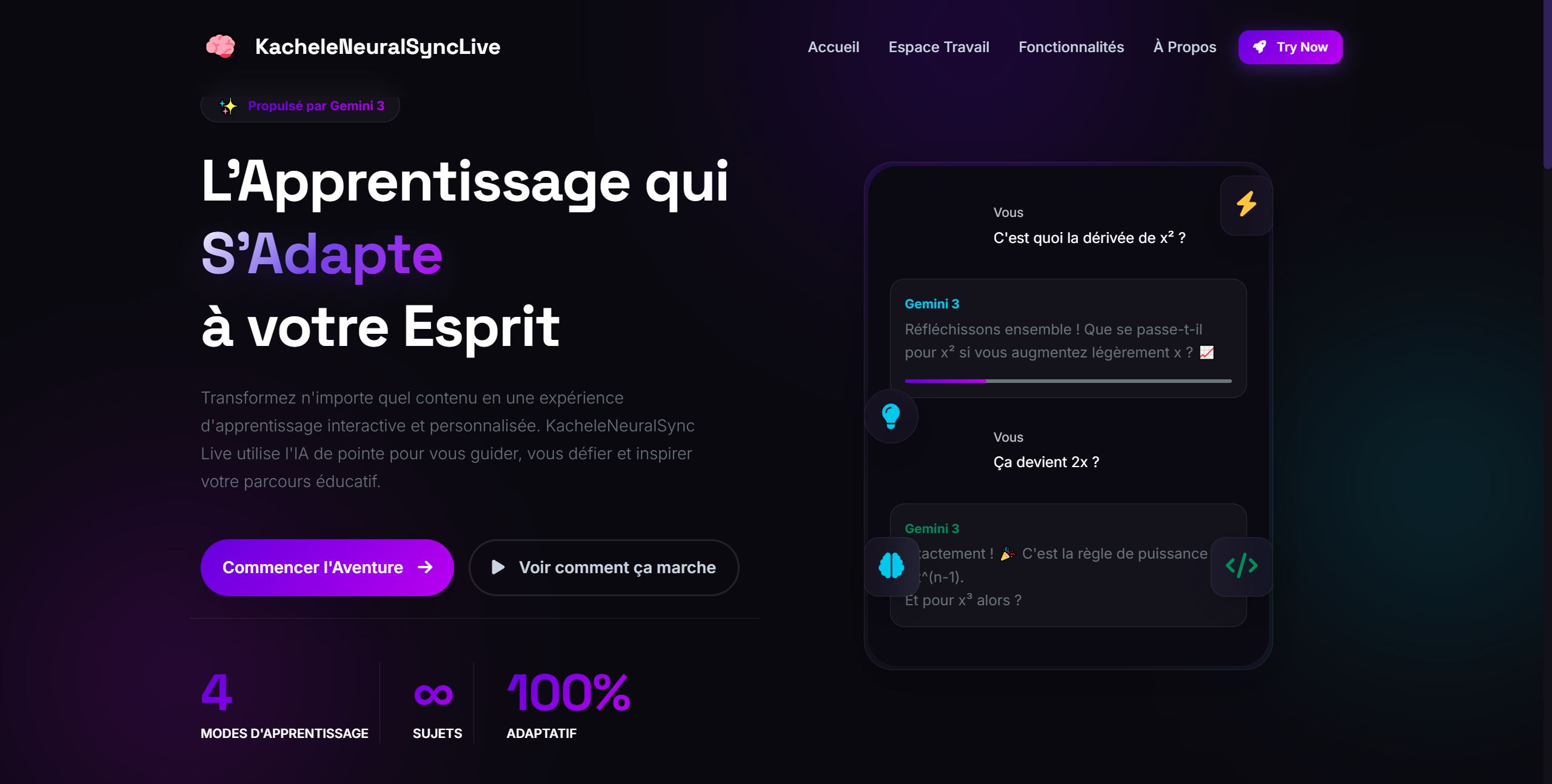
The Brain: We integrated the latest Google GenAI SDK to leverage Gemini 3's multimodal capabilities. This allows the system to "watch" videos, "read" complex PDFs, and "see" handwritten math problems. The Core: The backend uses Django 5.2, managing complex learning sessions, file processing, and structured data extraction. The Experience: We built a custom frontend using CSS variables and glassmorphism to create a "Neural" aesthetic. We used LaTeX to ensure mathematical clarity for scientific modules. The Logic: We implemented a Socratic Prompting Engine that instructs the AI to hide final solutions and instead offer hints based on the student's progress. For example, when solving a derivative like: $$ \frac{d}{dx}(x^2 + 3x + 5) $$ Gemini 3 doesn't just output $2x + 3$. It asks: "What is the derivative of the first term $x^2$ using the power rule $nx^{n-1}$?"
🚧 Challenges we faced The journey wasn't without its hurdles:
Multimodal Synchronization: Processing large video files and ensuring the AI generated timestamps ($MM:SS$) aligned perfectly with the visual content required extensive prompt tuning. The "Answer" Temptation: Large Language Models naturally want to be helpful and provide direct answers. Forcing the model to stick to the Socratic method—guiding without revealing—required sophisticated system instructions. Data Structuring: Extracting valid, complex JSON from long PDF analyses to build interactive Concept Maps was a challenge, which we solved by using Gemini 3's high-precision response MIME types. 📚 What we learned Building this project was a massive learning curve. We mastered the transition to the new Gemini 3 SDK, learned the nuances of asynchronous video processing, and deepened our understanding of pedagogical AI.
Most importantly, we learned that the future of EdTech isn't just about "Artificial Intelligence," but about "Augmented Intelligence"—using AI to empower human curiosity rather than replace it.


Log in or sign up for Devpost to join the conversation.